$100M Leads: Key Insights & Takeaways from Alex Hormozi
Master Alex Hormozi's complete playbook for generating unlimited leads using eight proven advertising methods that built multiple $100M+ companies.
by The Loxie Learning Team
What separates businesses that struggle to find customers from those that can't handle all the demand? Alex Hormozi argues it comes down to a systematic approach to lead generation that most entrepreneurs never learn. In $100M Leads, he reveals the exact methods that built multiple nine-figure companies—and none of them rely on luck, viral moments, or massive advertising budgets.
This guide breaks down Hormozi's complete framework for attracting strangers and converting them into eager buyers. You'll learn the Core Four lead sources, how to layer them for exponential growth, and why most businesses plateau at predictable revenue milestones. Whether you're just starting out or hitting a ceiling you can't break through, these principles provide a roadmap for predictable, scalable growth.
 Start practicing $100M Leads free for 7 days ▸
What is the lead generation equation and why does it matter?
Lead generation follows a simple mathematical formula: More Stuff × Better Stuff = More Leads. In this equation, "stuff" refers to any form of value you give away free—content, samples, tools, webinars, or experiences—that demonstrates your expertise before you ever ask for money. This framework transforms lead generation from a mysterious art into a predictable science.
The power of this equation lies in its two variables. You can increase lead flow by creating more free value (more stuff) or by improving the quality and relevance of what you offer (better stuff). Most businesses focus obsessively on one variable while ignoring the other. They either churn out mediocre content hoping volume will save them, or they perfect a single lead magnet while neglecting distribution. Hormozi's insight is that systematic improvement on both fronts compounds into results that feel almost unfair.
This mathematical approach removes the randomness that plagues most marketing efforts. Instead of wondering why some months are feast and others famine, you can trace results directly to your inputs. More value delivered to more people, consistently, equals more leads—period. The businesses that internalize this stop relying on hope and start engineering predictable growth.
What are the Core Four lead sources in $100M Leads?
The Core Four lead sources are Warm Outreach, Content, Cold Outreach, and Paid Ads. These represent the fundamental ways any business can attract potential customers. But Hormozi's framework goes deeper: each of these four methods splits into two levels of leverage—doing it yourself versus getting others to do it for you.
Warm Outreach
Warm outreach means reaching out to people who already know you—friends, family, former colleagues, past customers. This is where every business should start because these contacts already trust you. The leverage version involves referrals: getting your warm contacts to introduce you to their networks, effectively borrowing their trust.
Content
Content means creating valuable material—videos, articles, podcasts, social posts—that attracts strangers to you. You do this yourself initially (1-to-many), then leverage it through affiliates and partners who share your content with their audiences, multiplying your reach without multiplying your effort.
Cold Outreach
Cold outreach is contacting strangers directly through email, phone, direct messages, or other channels. You start doing this personally (1-to-1), then scale by hiring salespeople or agencies to conduct outreach on your behalf, turning your time into a system.
Paid Ads
Paid advertising means buying attention through platforms like Facebook, Google, YouTube, or any media channel. Initially you manage campaigns yourself, then leverage by hiring agencies or building internal teams that optimize and scale your ad spend.
Together, these create eight distinct advertising methods that can be systematically implemented and scaled. The path from startup to scale requires mastering them in sequence, starting with what you control directly before leveraging other people's efforts.
Practice these frameworks in Loxie ▸
Why do businesses plateau at predictable revenue milestones?
Every business hits lead plateaus at specific revenue points—typically around $100k, $1M, $10M, and $100M—because each level requires adding new lead generation methods rather than just doing more of what got you there. This explains why working harder on a single channel eventually stops producing results.
Consider a business that reached $100k through warm outreach alone. They've likely exhausted their personal network and its immediate referrals. Trying to squeeze more from this channel produces diminishing returns. The breakthrough comes from layering on a second method—perhaps content or cold outreach—which opens entirely new pools of potential customers.
The same pattern repeats at each milestone. A business at $1M from warm outreach and content hits a ceiling that can only be broken by adding cold outreach or paid ads. At $10M, the constraint shifts from methods to leverage: you need others generating leads on your behalf through affiliates, employees, or agencies. Understanding these predictable transitions lets you anticipate plateaus before they become crises and prepare the next growth lever in advance.
What is the difference between engaged leads and raw contacts?
Most businesses fail at lead generation because they confuse engaged leads with raw contacts. An engaged lead is someone who knows you, likes you, and trusts you—they've consumed your content, benefited from your free offerings, and developed a relationship with your brand. A raw contact is just a name on a list with no relationship established.
This distinction fundamentally changes how you approach lead generation. When businesses buy email lists or scrape LinkedIn for contacts, they're acquiring raw contacts with zero trust built. Trying to sell to these people immediately triggers resistance because they have no reason to believe you can help them. The conversion rates are abysmal, and the effort feels like pushing a boulder uphill.
Engaged leads, by contrast, have already experienced your value. They've watched your videos, used your free tools, or received help from your content. The selling conversation becomes welcomed rather than resisted because you've already proven yourself. The practical implication: stop measuring success by how many contacts you collect and start measuring by how many people you've genuinely helped before asking for anything in return.
Knowing these frameworks isn't the same as using them
Hormozi's Core Four and engaged lead concepts are powerful—but only if you remember them when you're actually planning your marketing. Loxie helps you internalize these frameworks through daily practice so they become automatic thinking tools, not just concepts you read once.
Try Loxie free for 7 days ▸What does "give first, ask second" mean in lead generation?
Give first, ask second is the cardinal rule of modern lead generation. It means providing genuine value before any sales attempt, completely reversing the traditional sequence of pitching first and proving value later. This approach leverages the psychology of reciprocity: when you help someone without asking for anything, they feel naturally inclined to return the favor.
The practical application looks like this: instead of cold calling someone and immediately pitching your service, you first share a useful article, offer a free consultation, or send a tool that solves one of their problems. Only after they've experienced real value do you introduce the possibility of working together. The ask feels like a natural next step rather than an intrusion.
This principle works because it builds what Hormozi calls "trust capital." Each time you deliver value without asking, you deposit into an emotional bank account. When you eventually make an offer, you're withdrawing from an account with a positive balance. Businesses that pitch immediately are asking for a withdrawal before making any deposits—and people instinctively protect themselves from those who take without giving.
How does the Problem-Agitate-Solution-Offer sequence work?
The Problem-Agitate-Solution-Offer (PASO) sequence creates inevitability in buying decisions by guiding prospects through a psychological journey that mirrors natural decision-making. Each step builds on the previous one, making your offer feel like the obvious conclusion rather than a sales pitch.
Problem: First, identify a specific, painful problem your prospect faces. This isn't a vague challenge but a concrete situation causing real frustration. The more precisely you can articulate their problem, the more they feel understood.
Agitate: Next, amplify the consequences of leaving this problem unsolved. What happens if they don't address it? What opportunities are they missing? What costs are they incurring—financial, emotional, or otherwise? This step isn't about manipulation; it's about helping prospects fully recognize what's at stake.
Solution: Present your unique mechanism for solving the problem. This is where you introduce your specific method, system, or approach—not just what you do, but how you do it differently than everyone else. Your unique mechanism becomes your competitive moat.
Offer: Finally, make an offer they'd feel stupid saying no to. Stack so much value that the price feels insignificant compared to what they receive. Include bonuses, guarantees, and urgency factors that make action the obvious choice.
This sequence works because each step creates emotional momentum toward the next. By the time you present your offer, prospects have relived their pain, understood the stakes, and seen a clear path forward. The decision to buy becomes logical rather than pressured.
Start retaining what you learn ▸
What makes an effective lead magnet?
Lead magnets work best when they solve one specific problem completely rather than addressing multiple problems partially. Depth beats breadth because specificity creates urgency and demonstrates expertise. A prospect with a pressing problem wants an immediate solution, not a general guide covering many topics they'll never read.
The ideal lead magnet follows the "one page, one problem, one promise, one pathway" formula. It can be consumed in under five minutes but provides immediate implementation value. Think checklists, calculators, templates, or single-focus guides that deliver a quick win. The prospect should be able to use it and see results within minutes of downloading.
Naming matters enormously. Name your lead magnet as a solution to a problem, not as a format. "5-Minute Mortgage Calculator" dramatically outperforms "Free Spreadsheet" because prospects buy outcomes, not delivery mechanisms. The name should immediately communicate what problem gets solved and hint at how quickly they'll see results.
This specificity serves a strategic purpose beyond conversion rates. When someone downloads a highly targeted lead magnet, you learn exactly what problem they care about. This information makes your follow-up infinitely more relevant than if they'd downloaded a generic guide that could apply to anyone.
How do you get your first 100 customers through warm outreach?
Your first 100 customers come from your existing network through the ACA method: Acknowledge the relationship, Compliment genuinely, then Ask for specific help. This framework turns the awkwardness of reaching out to contacts into an authentic conversation that makes people want to help rather than feeling manipulated.
Acknowledge: Start by recognizing your existing relationship. "Hey Sarah, we haven't talked since the Johnson project two years ago..." This shows you're reaching out as a person, not running a mass campaign.
Compliment: Offer genuine praise about something specific. "I've been following your work on sustainable packaging—the partnership you announced last month was brilliant." This can't be generic flattery; it must demonstrate you actually pay attention to them.
Ask: Make a specific request, but not a sales pitch. "I've started a consulting practice helping manufacturers reduce waste. I'm not sure if that's relevant to you, but I'm wondering if you know anyone who might be struggling with packaging costs?" The ask is for a referral or introduction, not for them to buy.
This approach works because it respects the relationship while being transparent about your goals. People want to help others they know, but they resist feeling used. The ACA method lets them be generous on their terms, often leading to introductions you never would have gotten through a direct sales pitch.
What is the Triple Specificity Rule for cold outreach?
Cold outreach converts when you research one specific pain point for one specific person and offer one specific solution—this is the Triple Specificity Rule. Generic templates get ignored because they feel like spam. Precision messages achieve ten times higher response rates because they demonstrate investment in understanding the recipient's unique situation.
The research phase is where most people cut corners. Before reaching out, you should know the person's name, their company's recent challenges or wins, and a specific problem they likely face based on their role and industry. This isn't stalking; it's the minimum respect required to deserve someone's attention.
The message itself should immediately prove you've done your homework. Instead of "I help companies grow," try "I noticed your engineering team grew 40% last quarter—I've helped three similar companies prevent the communication breakdowns that typically follow rapid scaling." The specificity demonstrates you're not just blasting templates to thousands of people.
This approach requires more effort per message, but the math works out. Sending 20 highly researched messages that get five responses beats sending 200 generic templates that get two. The quality of conversations is also dramatically better because you've established credibility before the first reply.
How does the Give-Give-Give-Ask rhythm work for content?
Content converts strangers into leads through the Give-Give-Give-Ask rhythm: provide value three times before any pitch. This ratio builds enough trust equity to earn permission to sell, transforming your content from interruption to invitation. Audiences learn to expect value from you, which makes occasional asks welcomed rather than resented.
The "gives" can take many forms: educational posts, entertaining stories, free tools, case studies, or behind-the-scenes insights. What matters is that each piece delivers genuine value with no strings attached. The audience shouldn't feel like every interaction is leading to a sales pitch.
When you do ask, the request benefits from the trust you've built. An audience that's received consistent value thinks, "This person has helped me so many times—if they're recommending something, it's probably worth checking out." Compare this to accounts that pitch constantly: even good offers get ignored because the audience has learned to distrust everything from that source.
The ratio isn't rigid—some creators successfully use 4:1 or 5:1—but the principle is consistent. Value must dramatically outweigh asks. When you feel like you're giving too much away free for 7 days, you're probably approaching the right balance.
What is the 3:1:1 Rule for paid advertising?
The 3:1:1 Rule states that for every $3 spent on ad traffic, you should invest $1 in creative testing and $1 in landing page optimization. Most businesses fail at paid advertising because they spend everything on traffic to broken funnels, wondering why their ads "don't work" when the real problem is everything that happens after the click.
Creative testing means constantly experimenting with different hooks, images, videos, and ad copy. The hook—the first thing someone sees—determines roughly 80% of an ad's performance. The same offer with different creative can produce wildly different results. Your job is to find the versions that resonate, then scale those while continuing to test new variations.
Landing page optimization means improving what happens after someone clicks. This includes headline testing, form simplification, social proof placement, page speed, and mobile experience. A 2x improvement in landing page conversion effectively cuts your customer acquisition cost in half—often easier and cheaper than finding new audiences or creating new ads.
This allocation ensures sustainable profitability. When you pour money into traffic without improving your conversion assets, you're essentially buying more expensive failures. The 3:1:1 framework forces continuous improvement of the entire system, not just the front end.
How do you design referral programs that actually work?
Customers refer when you make them heroes, not when you pay them. The most effective referral programs are designed so that introducing you elevates the referrer's status rather than making them look like commission-seekers. People will enthusiastically recommend something that makes them look smart or generous, but they'll hesitate if it makes them look like they're trying to profit from friends.
Status-based referral design means giving customers something to share that reflects well on them. Instead of "refer a friend and get $50," try "give your friend $100 off their first month." The first frame positions them as someone extracting value; the second frames them as someone giving a gift. Same economics, completely different psychology.
Timing matters too. The optimal moment to ask for referrals is immediately after delivering exceptional value—when gratitude is at its peak. Right after someone achieves a result with your help, ask: "Who else do you know who needs this same result?" This captures the emotional high before it fades into normalized expectations.
The best referral programs remove friction entirely. Provide shareable links, done-for-you messages, and social proof assets. Most customers want to refer but don't know how. When you make sharing effortless, dormant promotional energy gets released across your entire customer base.
What is the Two-Step Close and why does it multiply close rates?
The Two-Step Close separates information gathering from decision making: the first call is to understand needs, the second call is to present a solution. This deliberate pause multiplies close rates by eliminating pressure and building anticipation. Prospects given time to process information will often self-sell between conversations.
On the first call, your only goal is discovery. Ask questions, understand their situation, learn their constraints and desires. Don't pitch, don't propose solutions, don't even hint at pricing. When the call ends, the prospect should feel heard and understood, not sold to.
Between calls, something powerful happens. Prospects reflect on the conversation, realize how clearly you understood their problem, and begin imagining what a solution might look like. They often do your selling for you, convincing themselves that they need help before you've even proposed anything.
The second call becomes a presentation of a solution specifically designed for what you learned in the first call. The proposal feels personalized because it is. Objections are reduced because you've already addressed their specific concerns in your recommendation. The decision feels collaborative rather than adversarial.
Practice these sales frameworks ▸
How does the Value Ladder create 10x customer spending?
The Value Ladder Ascension model shows how customers spend ten times more at each level when you solve increasingly important problems. A typical progression might flow from a $7 ebook to a $70 course to a $700 coaching program to a $7,000 mastermind. Each level qualifies and prepares customers for the next investment.
The key insight is that different problems warrant different prices. Solving "how do I understand this topic" might be worth $7. Solving "how do I implement this system" might be worth $70. Solving "how do I get personalized guidance" might be worth $700. Solving "how do I get access to the network and opportunities" might be worth $7,000.
Each step serves a dual purpose: delivering value and identifying who's ready for more. Not everyone who buys your ebook will want coaching, but those who do have demonstrated commitment and verified they're a good fit. The ladder naturally filters for customers who can benefit most from higher-touch, higher-investment solutions.
Most businesses leave enormous money on the table by offering only one level. They might have a $100 service and wonder why growth stalls. The opportunity isn't just more customers at $100—it's the subset of existing customers who would gladly pay $1,000 or $10,000 for a bigger problem solved.
Why does retention math beat acquisition math?
Keeping a customer 10% longer increases lifetime value more than reducing acquisition cost by 50%, yet most businesses obsess over new leads while ignoring churn. This mathematical reality should fundamentally change how you allocate resources between getting new customers and keeping existing ones.
The math works because of compounding. If a customer stays 10% longer, they not only generate 10% more direct revenue but also 10% more referrals, 10% more upsell opportunities, and 10% more word-of-mouth. These effects multiply in ways that simple acquisition cost reduction cannot match.
Yet the industry fixates on acquisition. Marketing budgets, conference talks, and business courses overwhelmingly focus on getting new customers. Meanwhile, existing customers quietly churn, often for reasons that would be cheap and easy to fix. The business works harder and harder to fill a leaky bucket instead of patching the holes.
Practical retention improvement starts with understanding why customers leave. Exit surveys, churn interviews, and usage data reveal patterns that point to fixable problems. Often, small investments in onboarding, support, or communication dramatically reduce churn. These investments pay returns forever, unlike acquisition spending that must be repeated continuously.
What is the Share Trigger Formula for engineering virality?
Engineer virality with the Share Trigger Formula: create moments worth sharing by combining unexpected value with easy sharing mechanisms at emotional peak moments. This systematic approach removes randomness from word-of-mouth, designing specific triggers that reliably generate organic sharing behavior.
Unexpected value means exceeding expectations in surprising ways. When customers receive something they didn't anticipate—an unannounced bonus, exceptional service recovery, or results beyond what was promised—they experience a jolt of positive emotion that demands expression. This is the "you won't believe what happened" moment that people naturally want to share.
Easy sharing mechanisms mean removing all friction from the sharing act. Provide ready-made messages, shareable images, and one-click options. People's motivation to share has a short half-life; if sharing requires effort, the moment passes and they move on without telling anyone.
Emotional peak timing means identifying when customers feel maximum positive emotion and making sharing easy at that exact moment. Right after achieving a goal, receiving unexpected value, or experiencing exceptional service—that's when the share trigger should appear. The moment fades quickly; capture it or lose it.
The real challenge with $100M Leads
Hormozi's frameworks are comprehensive and actionable. The Core Four lead sources, the give-first principle, the Two-Step Close, the Value Ladder—these concepts can genuinely transform how you generate leads and grow your business. But here's what happens after you finish the book: within weeks, you'll struggle to recall most of these frameworks when you actually need them.
This isn't a criticism of your memory or commitment. It's how human brains work. Research shows we forget approximately 70% of new information within 24 hours unless we actively reinforce it. A month later, most of what remains is vague familiarity—you know you read something about lead magnets, but the specific principles have dissolved.
How many business books have you read that felt transformative in the moment but changed nothing about your actual work? The problem isn't that the ideas weren't good. The problem is that insight without retention is entertainment, not education. You can't apply frameworks you can't remember.
How Loxie helps you actually remember what you learn
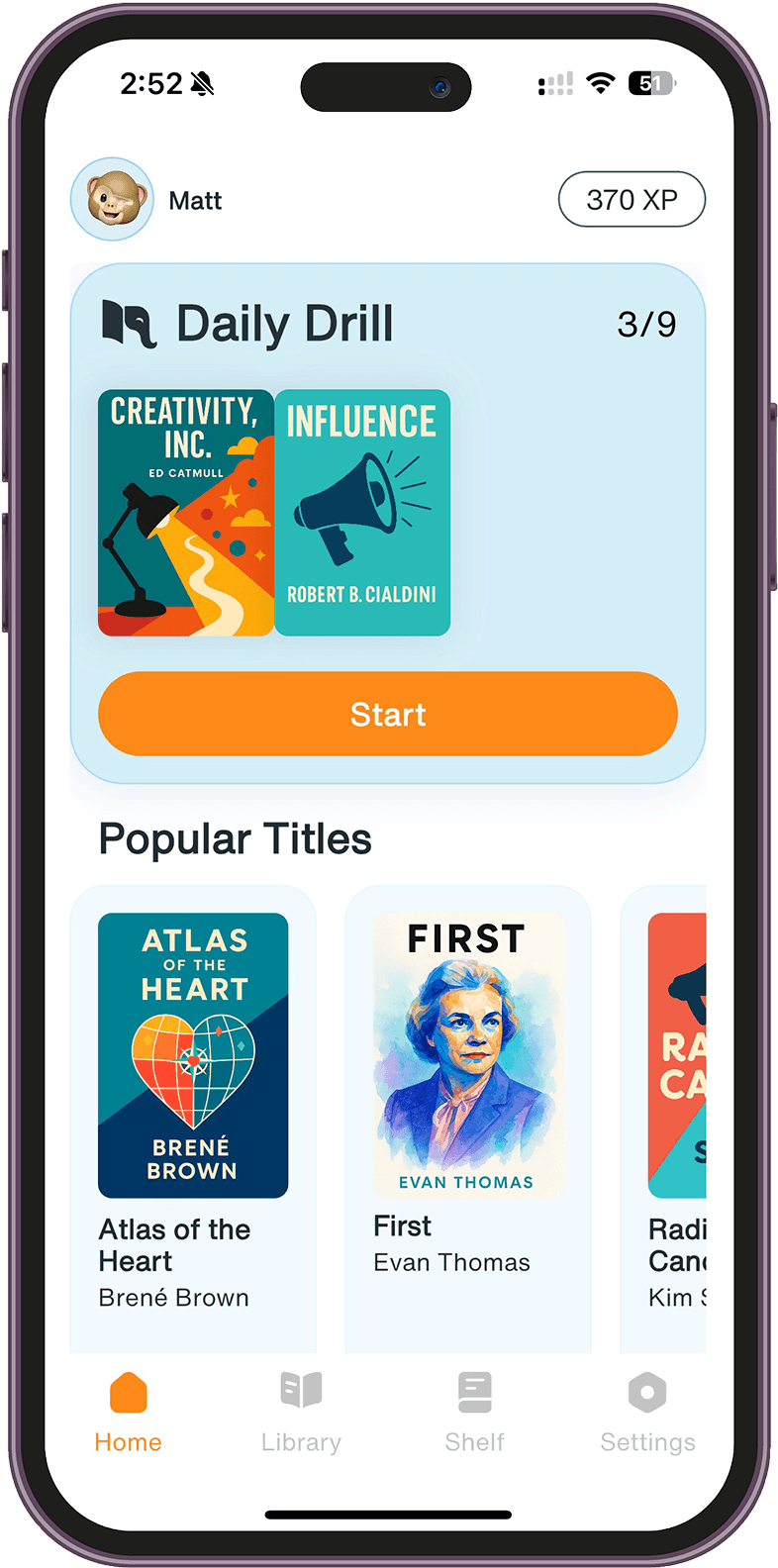
Loxie uses spaced repetition and active recall—two of the most scientifically validated learning techniques—to help you retain what you learn from books like $100M Leads. Instead of reading once and forgetting, you practice for just 2 minutes a day with questions that resurface key concepts right before you'd naturally forget them.
Spaced repetition works by timing your practice sessions strategically. When you first learn the Core Four lead sources, Loxie might quiz you the next day. If you remember correctly, the next review might be three days later, then a week, then a month. The intervals expand as your memory strengthens, making retention effortless over time.
Active recall—actually retrieving information rather than passively reviewing it—forces your brain to strengthen the neural pathways for that knowledge. Reading your highlights doesn't build memory; being asked "What are the four components of the PASO sequence?" and reconstructing the answer from memory does.
$100M Leads is in Loxie's full topic library, free to browse and read — the retention drills that make it stick are part of Pro, with a 7-day free trial. You can start reinforcing these frameworks today, ensuring that Hormozi's lead generation principles become permanent thinking tools rather than temporary inspiration.
Frequently Asked Questions
What is the main idea of $100M Leads?
The core idea is that lead generation follows a predictable mathematical equation: More Stuff × Better Stuff = More Leads. Success comes from systematically creating and distributing valuable free offerings across eight distinct advertising methods (the Core Four lead sources at two leverage levels each), rather than relying on luck or sales tactics.
What are the Core Four lead sources in $100M Leads?
The Core Four are Warm Outreach (contacting people who already know you), Content (creating valuable material that attracts strangers), Cold Outreach (contacting strangers directly), and Paid Ads (buying attention through advertising platforms). Each can be done personally or leveraged through others.
What does "give first, ask second" mean?
It means providing genuine value before any sales attempt, reversing the traditional pitch-first approach. By helping people without expecting anything in return, you build trust capital that makes eventual sales conversations welcomed rather than resisted because prospects have already experienced your value.
What is the Two-Step Close?
The Two-Step Close separates information gathering from decision making: the first call focuses solely on understanding needs, the second call presents a tailored solution. This pause eliminates pressure, builds anticipation, and allows prospects time to self-sell between conversations, dramatically increasing close rates.
Why do businesses plateau at specific revenue levels?
Businesses hit predictable plateaus at $100k, $1M, $10M, and $100M because each level requires adding new lead generation methods rather than scaling what already works. Breaking through requires layering additional lead sources, not just intensifying effort on existing channels.
How can Loxie help me remember what I learned from $100M Leads?
Loxie uses spaced repetition and active recall to help you retain key concepts from $100M Leads. Instead of reading the book once and forgetting most of it, you practice for 2 minutes a day with questions that resurface Hormozi's frameworks right before you'd naturally forget them. $100M Leads is in Loxie's full topic library, free to browse and read — the retention drills that make it stick are part of Pro, with a 7-day free trial.
We're an Amazon Associate. If you buy a book through our links, we earn a small commission at no extra cost to you.
Stop forgetting what you learn.
Start learning for good with your 7-day FREE trial.