$100M Offers: Key Insights & Takeaways from Alex Hormozi
Master Alex Hormozi's systematic framework for creating irresistible offers that command premium prices and practically sell themselves.
by The Loxie Learning Team
Check out the podcast style deep dive!
What if your product or service could be so valuable that price becomes irrelevant? That's the central premise of $100M Offers by Alex Hormozi. Drawing from his experience building multiple eight-figure companies, Hormozi reveals that the difference between struggling entrepreneurs and wildly successful ones isn't working harder or having a better product—it's knowing how to engineer offers that customers feel compelled to accept.
This guide breaks down Hormozi's complete framework for creating what he calls "Grand Slam Offers." You'll learn the four pillars that make any offer irresistible, the mathematical formula for maximizing perceived value, and the specific techniques for stacking value so high that your price feels like a steal. Whether you're launching a new business or trying to scale an existing one, these principles will transform how you think about selling.
 Start practicing $100M Offers free for 7 days ▸
What is a Grand Slam Offer and why does it matter?
A Grand Slam Offer is an offer so valuable that customers focus entirely on what they'll gain rather than what they'll spend. This transforms selling from an act of convincing into simply presenting an opportunity. When your offer is constructed correctly, the value-to-price ratio becomes so obviously favorable that saying "no" feels irrational.
The key insight here is that most businesses fail not because their products are bad, but because their offers are weak. Hormozi argues that the same product can generate 100 times different results based solely on how it's packaged, presented, and positioned. This means you can dramatically increase revenue by improving your offer structure without changing your core product or service at all. Understanding this principle intellectually is one thing—but applying it consistently when you're building offers requires having these frameworks deeply internalized, which is exactly what Loxie's spaced repetition helps you accomplish.
What are the four pillars of a Grand Slam Offer?
A Grand Slam Offer combines four essential elements that work together synergistically: an irresistible value proposition, a starving crowd (desperate market), premium pricing that reinforces value, and an unbeatable guarantee that reverses all risk.
Here's how these pillars reinforce each other: The desperate market makes your value proposition more compelling because pain creates urgency. Premium pricing actually increases perceived value rather than decreasing it—cheap prices signal cheap products. And the guarantee removes the final barrier to purchase by eliminating the customer's risk entirely. When all four pillars are in place, you've created an offer architecture that virtually eliminates buyer resistance.
Why market selection matters more than offer quality
The right market beats the best offer. Hormozi emphasizes that selling to a "starving crowd"—people with massive pain, purchasing power, easy targeting, and growth potential—makes even mediocre offers successful. Market selection determines approximately 80% of your success because desperate buyers with money and accessibility will overlook offer imperfections, while perfect offers fail in markets that lack urgency, funds, or reachability.
This is why entrepreneurs often struggle despite having excellent products. They've chosen markets where customers aren't desperate enough, don't have sufficient budget, or are too difficult to reach. Understanding these market selection criteria is foundational—but it's also the kind of strategic thinking that fades from memory unless you actively review it.
Practice these concepts in Loxie ▸
How do you escape commoditization and price competition?
Commoditization happens when you sell the same thing the same way as everyone else. The escape route involves changing one of three variables: what you sell, who you sell to, or how you sell it. This three-path framework provides clear strategic options for differentiation—you can productize your service differently, target a unique niche, or create a distinctive delivery mechanism.
Hormozi emphasizes that differentiation isn't about being slightly better—it's about being so different that comparison becomes impossible. When you create a category of one, competitors are forced to compete for second place in a category you've defined. This moves you beyond feature comparisons to creating entirely new buying criteria, making your offer the only logical choice rather than the best among many options.
What is the Value Equation and how do you use it?
The Value Equation is a mathematical framework for maximizing any offer's perceived value. The formula is: (Dream Outcome × Perceived Likelihood of Achievement) ÷ (Time Delay × Effort Required). This equation reveals four distinct levers you can pull to increase value perception.
To maximize value, you want to increase the numerator and decrease the denominator. That means making the outcome more desirable, boosting the customer's belief that they'll achieve it, decreasing the time to results, and minimizing the effort required from them. Each lever has a multiplicative effect on total value perception—which is why small improvements across all four can dramatically transform an offer's appeal.
Why speed of delivery matters exponentially
Time delay kills value exponentially because the human brain heavily discounts future rewards. Cutting delivery time from 30 days to 3 days can 10x perceived value even if the end result remains identical. This explains why "done-for-you" services command premium prices—they eliminate the time delay entirely.
Why perceived likelihood trumps actual success rates
Perceived likelihood of success matters more than actual success rates when it comes to purchase decisions. Testimonials, guarantees, and social proof can make a 50% success rate feel like 95% certainty. This insight emphasizes that trust-building elements and risk reversal are often more valuable investments than marginal improvements in actual outcomes.
How does problem stacking reveal hidden value?
Problem stacking is a technique where you list every micro-problem your customer faces, then position your offer as the complete solution to all of them—not just the obvious ones. This comprehensive problem-mapping approach uncovers value opportunities competitors miss, allowing you to address frustrations customers didn't even realize were solvable.
The practical exercise Hormozi recommends is the problem-solution matrix: list 20 or more problems your customer faces, create two to three solutions for each, then cherry-pick the highest-impact, lowest-cost combinations for your offer. This systematic approach ensures comprehensive value coverage while maintaining profitability. You can include many high-perceived-value solutions that cost little to deliver alongside your core offering.
Reframing features as problems prevented
Transform features into problem-solutions by asking "What does this prevent?" rather than "What does this provide?" People pay more to avoid pain than to gain pleasure. This reframing technique leverages loss aversion psychology, making your offer feel essential rather than optional by highlighting the problems it prevents.
These frameworks are powerful—but only if you remember them when it matters.
The Value Equation and problem stacking techniques are easy to understand but hard to recall under pressure. Loxie uses spaced repetition to keep these concepts fresh so you can apply them when building your next offer.
Try Loxie free for 7 days ▸Why should you charge premium prices instead of competing on cost?
Charge based on value delivered, not time invested. A five-minute solution to a million-dollar problem is worth far more than a month-long solution to a hundred-dollar problem. This shift from cost-plus to value-based pricing aligns compensation with client results, enabling exponential income growth as expertise increases while time investment decreases.
Competing on price is a race to the bottom where even the winner loses. Price competition erodes margins and attracts price-sensitive customers who lack loyalty. Competing on value, by contrast, is a race to the top where everyone who participates can win. Premium pricing creates a virtuous cycle: higher prices attract better customers who get better results, generating better testimonials that justify even higher prices.
Using price anchoring strategically
Price anchoring makes any number relative. Present a $10,000 option first to make your $2,000 offer feel like a steal, even if $2,000 was your target price all along. The brain uses the first number as a reference point, making subsequent prices feel like discounts regardless of absolute value. This psychological principle enables premium pricing without resistance.
How do you present your value stack effectively?
The value stack presentation technique involves showing each component's individual price, then revealing the bundled price. This makes the discount feel massive even at premium rates. Prospects see they're getting $50,000 worth of value for $5,000, and the purchase starts to feel like preventing a loss rather than spending money.
This presentation method leverages anchoring and loss aversion simultaneously. The key is that the individual component prices must be credible—they should reflect what each piece would genuinely cost if purchased separately or the value it delivers. When done right, your full offer feels like an extraordinary bargain even at prices your competitors would never dare to charge.
How does scarcity create value and urgency?
Scarcity creates value through three distinct mechanisms: limited supply ("only 10 spots available"), limited time ("enrollment ends Friday"), and limited bonuses ("first 20 buyers get the extra module"). Each type triggers different psychological urgency—supply scarcity activates competitive instincts, time scarcity triggers procrastination anxiety, and bonus scarcity triggers loss aversion.
The critical principle is that honest scarcity outperforms fake scarcity over time. Real constraints like cohort sizes, personal capacity, or seasonal availability build trust while maintaining urgency. Customers can verify the legitimate reasons for limitations, leading to repeat buyers who trust your integrity. Rolling cohorts—"next group starts Monday"—create perpetual urgency that feels natural because the constraint is real and recurring.
Start retaining what you learn ▸
How should bonuses be designed to maximize conversions?
Bonuses should solve specific objections rather than just add more stuff. If prospects think your program is too hard, add done-for-you templates. If they doubt they'll succeed, add coaching calls. Each bonus addresses a hidden "no," turning potential objections into reasons to buy. This strategic bonus design preemptively addresses concerns through targeted value additions rather than sales arguments.
The goal is to make bonuses more valuable than the core offer itself. When the extras alone justify the price, the main product feels free, eliminating price resistance entirely. This shifts the purchase decision from "is the main product worth it?" to "how can I not take advantage of all these bonuses?"
High-value, low-cost bonus additions
High-value, low-cost additions like templates, recordings, and checklists can 10x perceived value while adding zero fulfillment cost. Digital assets are pure margin value-stackers—they solve real problems without increasing delivery complexity. Solutions don't need to be complex to be valuable; often a checklist or simple system solves an expensive problem better than elaborate interventions.
Leveraging partner bonuses
Partner bonuses cost nothing but add massive value. Negotiate with complementary businesses to include their products as bonuses in exchange for exposure to your buyers. This creates win-win-win scenarios: you add value without cost, partners gain qualified customers, and buyers receive comprehensive solutions.
What makes an effective guarantee?
Conditional guarantees outperform unconditional ones. "Follow the system and get results or your money back" qualifies buyers and reduces refunds while still reversing risk. This guarantee structure attracts serious buyers while repelling those looking free for 7 days rides—the conditions ensure engagement while the guarantee still removes purchase risk for committed customers.
Stack guarantees for overwhelming confidence. Combining money-back, results-based, and timeline guarantees eliminates every possible fear, making "no" seem irrational. Multiple guarantee layers address different risk concerns simultaneously, creating such comprehensive protection that prospects feel foolish not buying.
When anti-guarantees work better
In some cases, anti-guarantees create exclusivity. "We don't offer refunds because we only work with committed clients" can increase conversions by signaling premium value and attracting serious buyers. This contrarian approach leverages the psychology of commitment and exclusivity, where the absence of a safety net attracts higher-quality customers who value skin in the game.
How do you test and validate your Grand Slam Offer?
Test your Grand Slam Offer with "beta pricing"—charge 50-80% of your target price to early adopters, gather feedback, then raise prices with each iteration until you encounter resistance. This incremental testing approach validates market demand while building social proof, allowing you to find optimal pricing through real market feedback rather than guesswork.
The first $100k proves the model. Focus on nailing one offer for one market before expanding, as premature scaling kills more businesses than staying small too long. Most businesses fail from trying to serve everyone before they've mastered serving someone. Perfect your value delivery and economics before complexity creeps in.
How should you name your offer for maximum impact?
Name your offer like a blockbuster movie—it should convey transformation, create intrigue, and be impossible to forget. A magnetic name becomes a marketing asset that sells itself through word-of-mouth. Memorable names get shared more often and stick in prospects' minds longer than generic descriptors.
Hormozi provides the M.A.G.I.C. naming formula: Make a promise, Announce the avatar, Give them a timeline, Indicate the container, Create curiosity. This systematic approach ensures your offer name communicates value, identifies the buyer, sets expectations, and creates desire in just a few words.
Learn the M.A.G.I.C. formula with Loxie ▸
The real challenge with $100M Offers
Here's the uncomfortable truth about business books like this one: the frameworks are genuinely powerful, but knowing about the Value Equation isn't the same as applying it when you're building your next offer. Research on the forgetting curve shows we lose approximately 70% of new information within 24 hours without active reinforcement. A week later, only fragments remain.
How many business books have you read that felt transformative in the moment but you can't recall the key frameworks from today? The Grand Slam Offer pillars, the four levers of the Value Equation, the M.A.G.I.C. naming formula—these are the kinds of specific, actionable concepts that slip away precisely because they're detailed enough to be useful. You end up with a vague sense that the book was helpful without the ability to implement what you learned.
How Loxie helps you actually remember what you learn
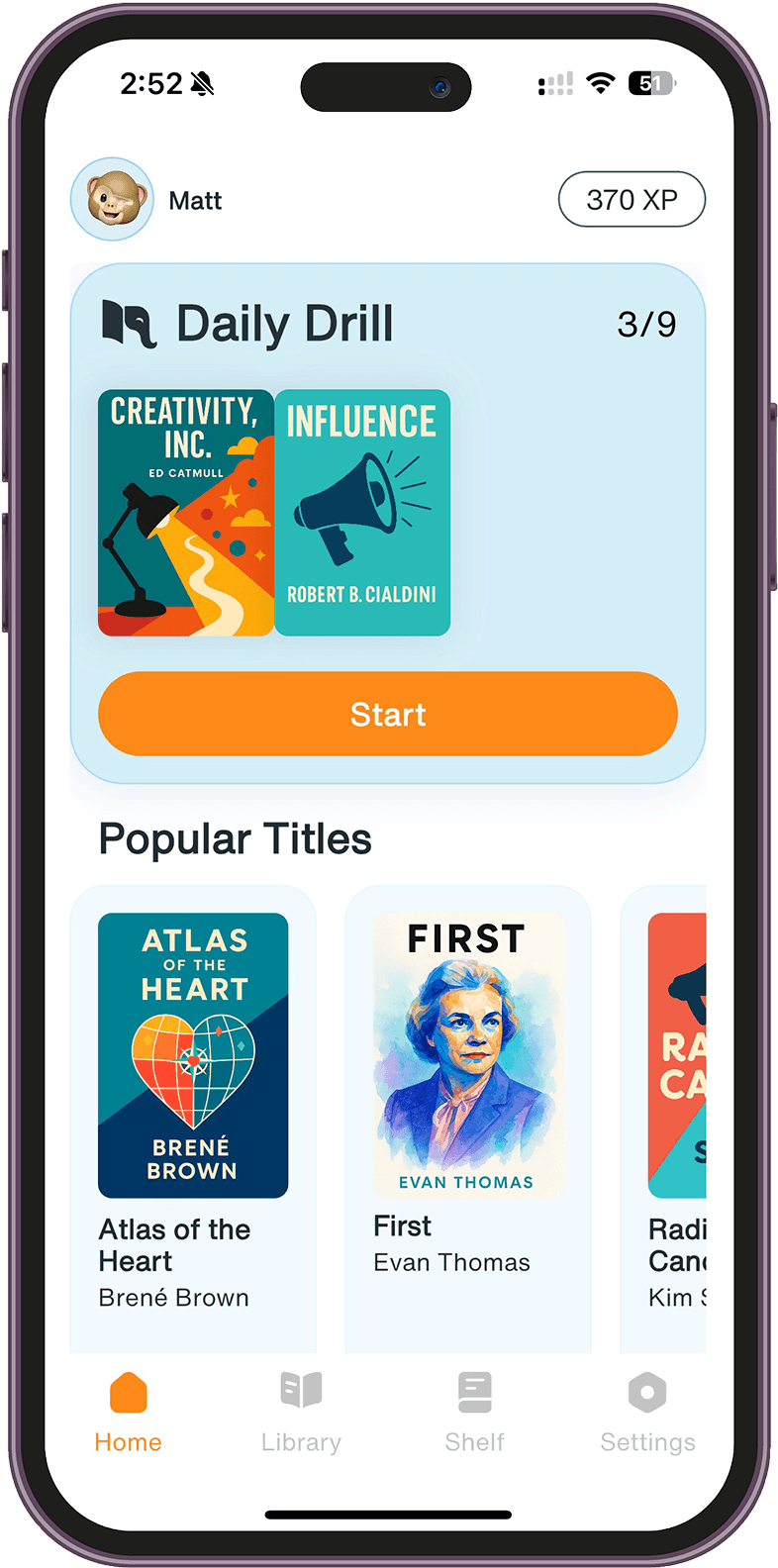
Loxie solves the retention problem using two techniques backed by cognitive science: spaced repetition and active recall. Instead of reading $100M Offers once and hoping the concepts stick, you practice with questions that resurface the key ideas right before you'd naturally forget them. Two minutes a day keeps these frameworks accessible when you need them most—when you're actually building your next offer.
$100M Offers is in Loxie's full topic library, free to browse and read — the retention drills that make it stick are part of Pro, with a 7-day free trial, so you can start reinforcing these concepts immediately. Whether it's the Value Equation formula, the four pillars of a Grand Slam Offer, or the specific techniques for designing bonuses that address objections, you'll retain what you've learned and be able to apply it months from now.
Frequently Asked Questions
What is the main idea of $100M Offers?
The core argument is that business success depends more on how you package and present your product than on the product itself. By creating a "Grand Slam Offer" that stacks massive value through strategic design—combining an irresistible value proposition, the right market, premium pricing, and risk reversal—you can make price irrelevant and transform selling into simply presenting an opportunity.
What is the Value Equation in $100M Offers?
The Value Equation is (Dream Outcome × Perceived Likelihood of Achievement) ÷ (Time Delay × Effort Required). It provides four levers for maximizing perceived value: make the outcome more desirable, increase belief in success, reduce time to results, and minimize customer effort. Each lever multiplies the others' effects.
What are the four pillars of a Grand Slam Offer?
A Grand Slam Offer combines four elements: an irresistible value proposition, a starving crowd (desperate market with pain, purchasing power, and accessibility), premium pricing that reinforces value perception, and an unbeatable guarantee that reverses all customer risk.
What is the M.A.G.I.C. naming formula?
M.A.G.I.C. stands for: Make a promise, Announce the avatar (target customer), Give them a timeline, Indicate the container (format of delivery), and Create curiosity. This formula ensures your offer name communicates value and identifies the buyer in just a few words.
Why does Alex Hormozi recommend premium pricing?
Premium pricing creates a virtuous cycle: higher prices attract better customers who are more committed, leading to better results and testimonials that justify even higher prices. Competing on price erodes margins and attracts disloyal customers, while competing on value builds sustainable businesses.
How can Loxie help me remember what I learned from $100M Offers?
Loxie uses spaced repetition and active recall to help you retain key concepts from $100M Offers. Instead of reading the book once and forgetting most of it, you practice for 2 minutes a day with questions that resurface the Value Equation, Grand Slam Offer pillars, and other frameworks right before you'd naturally forget them. $100M Offers is in Loxie's full topic library, free to browse and read — the retention drills that make it stick are part of Pro, with a 7-day free trial.
We're an Amazon Associate. If you buy a book through our links, we earn a small commission at no extra cost to you.
Stop forgetting what you learn.
Start learning for good with your 7-day FREE trial.