Atomic Habits by James Clear: Key Concepts and How to Apply Them
The complete guide to building good habits and breaking bad ones
by The Loxie Learning Team
You've probably heard that habits shape your life. But James Clear's Atomic Habits goes further, arguing that the smallest changes, executed consistently, can lead to remarkable transformations. The math is startling: getting just 1% better each day means you'll be 37 times better after one year.
This guide breaks down Clear's complete framework for building habits that stick and dismantling the ones holding you back. Whether you've read the book and want a refresher, or you're discovering these ideas for the first time, you'll walk away understanding not just what to do, but why it works.
 Start practicing Atomic Habits free for 7 days ▸
What makes Atomic Habits different from other habit books?
Most habit advice focuses on goals: lose 20 pounds, write a book, save money. Clear flips this entirely. Goals, he argues, are useful for setting direction, but systems are what actually produce results. Winners and losers often have the same goals. The difference is whether they build systems that make success inevitable.
This systems-first thinking runs through every page of Atomic Habits. Clear isn't interested in motivation or willpower. He's interested in designing your environment, your identity, and your daily routines so that good behaviors become automatic and bad ones become difficult.
The title itself reveals his philosophy: "atomic" refers both to tiny size (small habits) and to immense power (like atomic energy). Small habits are the compound interest of self-improvement.
Why do most people fail at changing their habits?
Clear identifies a critical mistake: we try to change our behaviors without changing our underlying beliefs about who we are.
There are three layers to behavior change. The outermost layer is outcomes, which is what you get. The middle layer is processes, which is what you do. The deepest layer is identity, which is what you believe about yourself.
Most people work from the outside in. They set an outcome goal ("I want to lose weight"), then try to force a process ("I'll go to the gym"). But they never address identity, so the change doesn't last. As soon as life gets hard, they revert to who they've always been.
Clear argues we should work from the inside out. Start by deciding who you want to become. Want to lose weight? Don't focus on the outcome. Focus on becoming "someone who doesn't miss workouts." Every action then becomes a vote for that identity. Each vote is small, but they accumulate into evidence that reshapes what you believe about yourself.
This identity-based approach to habits is one of Clear's most important contributions, and also one of the easiest concepts to forget when you're back in the chaos of daily life. This is why two people can perform the same behavior with completely different results. One person avoids a cigarette by saying "No thanks, I'm trying to quit." Another says "No thanks, I'm not a smoker." Same action, but the second person has internalized a new identity.
What is the habit loop and why does it matter?
Every habit, good or bad, follows the same neurological pattern. Clear breaks it into four stages:
Cue: The trigger that initiates the behavior. This could be a time of day, an emotional state, a location, or the presence of certain people.
Craving: The motivational force. You don't crave the habit itself. You crave the change in state it delivers. You don't want to scroll social media; you want the relief from boredom.
Response: The actual behavior. This can be a thought or an action, depending on how much friction is involved.
Reward: The payoff that satisfies the craving and teaches your brain which behaviors are worth repeating.
Understanding this loop is essential because it reveals the levers you can pull. Want to build a habit? Manipulate all four stages in your favor. Want to break one? Disrupt the loop at any point.
Start retaining what you learn ▸
What are the Four Laws of Behavior Change?
Clear translates the habit loop into four practical laws, each one targeting a different stage. This framework is the heart of Atomic Habits, and it's one of the most-practiced topics among Loxie users for good reason: it's practical, memorable, and applicable to almost any behavior you want to change.
1. Make it obvious (Cue)
You can't build a habit you don't notice. Clear recommends "implementation intentions," which means specifying exactly when and where you'll perform a behavior. "I will meditate for one minute at 7am in my kitchen" outperforms "I'll try to meditate more" every time.
Even more powerful is habit stacking. Link a new habit to an existing one. "After I pour my morning coffee, I will write in my journal for two minutes." The existing habit becomes the cue for the new one.
Your environment matters enormously here. People with high self-control aren't exercising more willpower. They're structuring their lives to avoid temptation in the first place. If you want to read more, put a book on your pillow. If you want to eat healthier, put fruit on the counter and hide the cookies.
2. Make it attractive (Craving)
We're drawn to behaviors that feel appealing. Clear introduces "temptation bundling," which means pairing an action you need to do with one you want to do. Only listen to your favorite podcast while exercising. Only watch that TV show while folding laundry.
Your social environment shapes what feels attractive, too. We naturally imitate three groups: the close (family and friends), the many (our tribe), and the powerful (those with status). Surround yourself with people who embody the habits you want, and those behaviors start feeling normal rather than effortful.
3. Make it easy (Response)
Here's a counterintuitive insight: habits form based on frequency, not time. Doing something 100 times matters more than doing it over 100 days sporadically. Repetition is what builds the neural pathways.
This is why Clear advocates the "Two-Minute Rule." Scale any habit down to something that takes two minutes or less. "Read 30 pages" becomes "read one page." "Run three miles" becomes "put on my running shoes." The goal isn't the two-minute version. It's establishing the identity of someone who shows up consistently.
Friction is the enemy of good habits and the ally of bad ones. Want to practice guitar? Leave it out on a stand. Want to stop checking your phone? Put it in another room.
4. Make it satisfying (Reward)
We repeat behaviors that feel good immediately. The problem is that most good habits have delayed rewards (fitness, saving money, learning), while most bad habits feel good right now.
Clear's solution is to add immediate satisfaction to beneficial behaviors. Use a habit tracker. The simple act of marking an X on a calendar triggers a small dopamine hit. Move a paperclip from one jar to another after each sales call. Make progress visible and tangible.
For breaking bad habits, create immediate costs. A habit contract with a friend (and a real penalty) makes the consequences of slipping feel present rather than abstract.
These four laws are easy to understand but hard to remember when you need them.
Loxie's Atomic Habits practice sessions help you internalize the framework so it's available when you're actually trying to change a behavior.
Try Loxie free for 7 days ▸
How does environment design beat willpower?
One of Clear's most practical insights is that willpower is overrated. People who appear to have tremendous self-control have actually designed their environments to minimize temptation.
Think about it: we check our phones 150 times a day without effort, but struggle to meditate for five minutes. The phone is right there, always visible, zero friction. Meditation requires finding time, finding space, sitting still when your mind wants stimulation.
The solution isn't more discipline. It's smarter design. Make good habits the path of least resistance. Make bad habits inconvenient. This works for one-time choices too: buy smaller plates, delete social media apps from your phone, set up automatic savings transfers.
Practice these concepts in Loxie ▸
What happens when habits get boring?
Clear addresses something most habit books ignore: the danger of boredom. The greatest threat to long-term success isn't failure. It's losing interest once a habit becomes automatic.
He references the "Goldilocks Zone," which means working on challenges that are right at the edge of your current ability. Too easy and you disengage. Too hard and you get discouraged. The sweet spot maintains focus and flow.
But even in the Goldilocks Zone, boredom eventually arrives. Clear argues that professionals stick with their habits even when they're not exciting; amateurs let motivation dictate their behavior. At some point, everyone faces the same challenge: can you keep showing up when the work is no longer novel?
How do you apply these ideas immediately?
If you want to put Atomic Habits into practice today, here are three starting points:
Start with identity. Write down the type of person you want to become, not the outcomes you want. "I'm someone who writes every day" rather than "I want to write a book."
Design one environment change. Pick your most important habit and reduce friction dramatically. Want to exercise in the morning? Sleep in your workout clothes.
Use the Two-Minute Rule. Take your desired habit and shrink it until it's almost impossible to fail. The goal is to establish consistency first.
The real challenge with Atomic Habits
Here's an uncomfortable truth: you've just absorbed a powerful framework for behavior change. Clear's ideas are backed by research, illustrated with compelling examples, and packaged in a memorable system. But knowledge isn't the bottleneck. Retention is.
Studies on the "forgetting curve" show that we lose roughly 70% of new information within 24 hours, and up to 90% within a week. That's not a character flaw. It's how human memory works. Without active reinforcement, even the best ideas fade.
Think about it: How many books have you read that felt life-changing in the moment, but now you'd struggle to recall three key points from?
How Loxie helps you actually remember what you learn
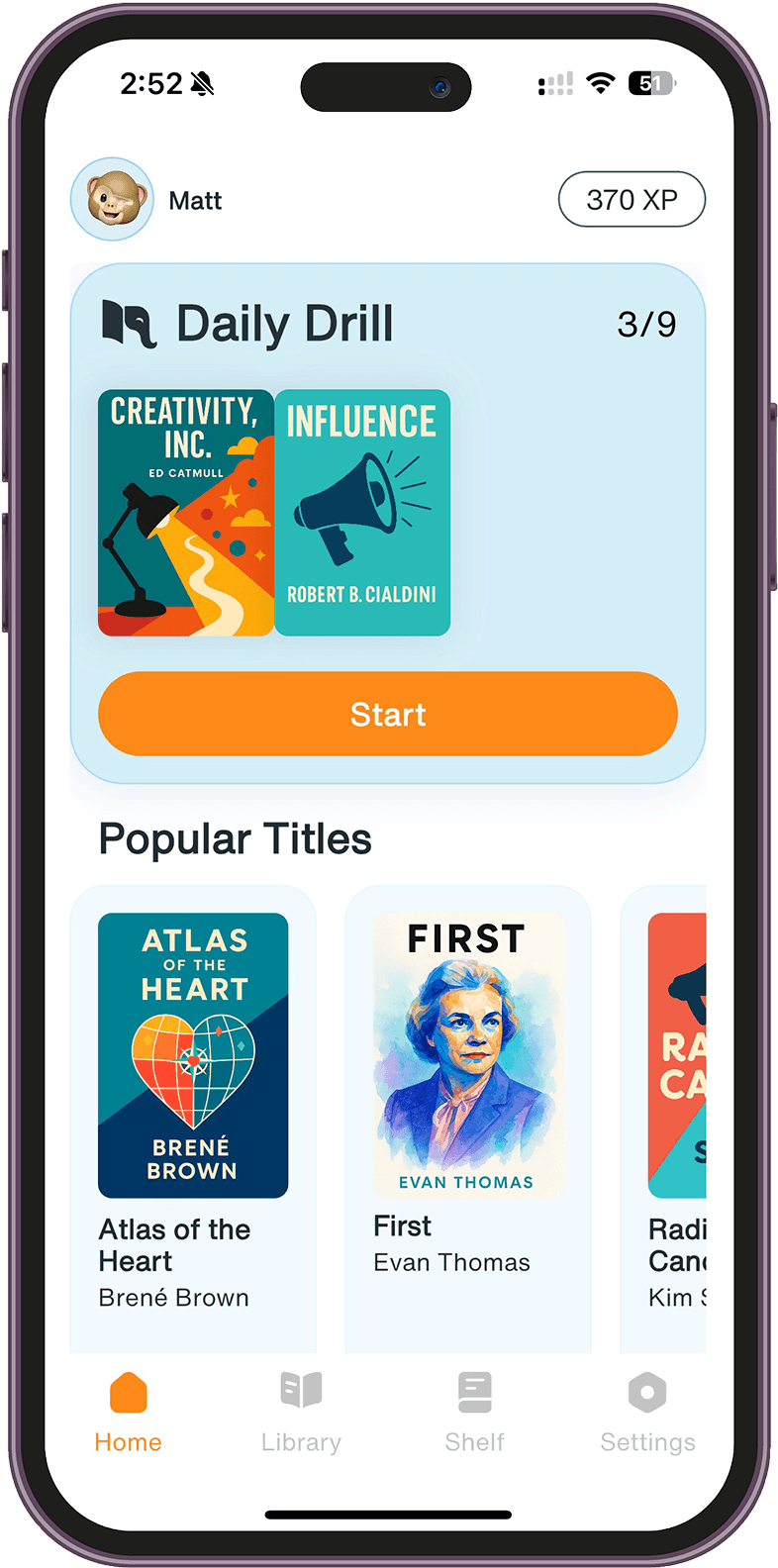
Loxie exists to close this gap. Instead of hoping you'll remember Clear's Four Laws or the Two-Minute Rule, Loxie uses spaced repetition and active recall to move ideas from short-term exposure to long-term memory.
Here's how it works: You practice for about 2 minutes a day. Loxie handles the spacing and question timing automatically, surfacing concepts right before you'd naturally forget them. Each session reinforces what you've learned and deepens your understanding.
The free version gives you access to the full topic library, including Atomic Habits, with a daily 5-question practice session. Loxie Pro unlocks unlimited daily practice and deeper reasoning questions.
Frequently Asked Questions
What is the main idea of Atomic Habits?
The core idea is that small, incremental improvements compound over time into remarkable results. Rather than focusing on goals, Clear argues you should build systems and focus on becoming the type of person who naturally does the behaviors you want.
What are the 4 laws of Atomic Habits?
The Four Laws of Behavior Change are: (1) Make it obvious, (2) Make it attractive, (3) Make it easy, and (4) Make it satisfying. Each law targets a different stage of the habit loop and gives you a lever to build good habits or break bad ones.
What is the Two-Minute Rule?
The Two-Minute Rule says to scale down any new habit to take two minutes or less. "Read 30 pages" becomes "read one page." The goal is to establish the identity of someone who shows up consistently before optimizing for performance.
What is the habit loop?
The habit loop is the neurological pattern underlying all habits. It has four stages: cue (trigger), craving (motivation), response (action), and reward (satisfaction). Understanding this loop lets you manipulate each stage to build or break habits.
How long does it take to build a habit?
Clear argues that habits form based on frequency, not time. The popular "21 days" or "66 days" figures are misleading. What matters is how many repetitions you perform, not how many days pass. The more you repeat a behavior, the more automatic it becomes.
How can Loxie help me remember what I learned from Atomic Habits?
Loxie uses spaced repetition and active recall to help you retain the key concepts from Atomic Habits. Instead of reading the book once and forgetting most of it, you practice for 2 minutes a day with questions that resurface ideas right before you'd naturally forget them. Loxie includes Atomic Habits in its full topic library, so you can start reinforcing these concepts immediately.
We're an Amazon Associate. If you buy a book through our links, we earn a small commission at no extra cost to you.
Stop forgetting what you learn.
Start learning for good with your 7-day FREE trial.