Blood in the Garden: Key Insights & Takeaways
Discover how Pat Riley's 1990s Knicks became basketball's most feared team and what their near-dynasty reveals about building championship culture.
by The Loxie Learning Team
The 1990s New York Knicks were basketball's ultimate contradiction: a team beloved by their city and despised by everyone else, feared by opponents yet perpetually falling short of ultimate glory. Chris Herring's Blood in the Garden tells the complete story of how Pat Riley transformed a mediocre franchise into the NBA's most intimidating force—and why championships remained agonizingly out of reach.
This guide breaks down the essential lessons from Herring's account. You'll understand how elite coaches build championship cultures, why great rivalries forge team identity, and what causes championship windows to open and close. Whether you're a basketball fan, a student of organizational leadership, or someone fascinated by what separates near-greatness from actual titles, these insights reveal timeless truths about competition at the highest level.
 Start practicing Blood in the Garden free for 7 days ▸
How did Pat Riley transform the Knicks into championship contenders?
Pat Riley immediately reshaped the Knicks' culture by establishing non-negotiable standards for effort, preparation, and physicality that separated championship contenders from mediocre teams. When Riley arrived in New York, he inherited talented players but a losing mentality. His solution was simple but brutal: outwork and out-tough every opponent.
Riley's transformation centered on extreme practice culture featuring marathon sessions, physical combat drills, and relentless conditioning. Players described practices as harder than games. This approach built the mental toughness that defined the 90s Knicks, creating a team that opponents dreaded facing because they knew every possession would be a battle. The Knicks didn't just play defense—they made offense feel like punishment.
However, Riley's methods came with costs. The physical toll shortened careers and created lasting damage to players like Patrick Ewing and Charles Oakley. Understanding this tradeoff—immediate competitive advantage versus long-term player health—remains relevant for anyone building high-performance teams today. Loxie helps you retain these leadership lessons so you can apply them thoughtfully in your own context.
What made the Knicks' defensive system revolutionary?
The Knicks' suffocating defensive system under Pat Riley revolutionized NBA strategy by proving that physical, grinding defense could neutralize superior offensive talent. Their approach was simple in concept but devastating in execution: make every shot, every dribble, every pass as difficult as possible through relentless pressure and physicality.
This system exploited the era's lenient officiating standards. Hand-checking, hard fouls, and bruising defense through enforcers like Anthony Mason and Charles Oakley made the Knicks nearly unbearable to play against. They turned games into wars of attrition where the more talented team often lost simply because they couldn't withstand the punishment.
The Knicks' style was so effective that it forced the league to adapt its rules. The NBA's eventual implementation of hand-checking restrictions and defensive three-second violations specifically targeted and dismantled the defensive system that had defined the Knicks' success. This demonstrates how distinctive team eras leave permanent marks on basketball by forcing rule changes that reshape the sport's evolution.
Practice these concepts in Loxie ▸
Why did Patrick Ewing face such unique pressure as the Knicks' star?
Patrick Ewing faced unique pressure as the Knicks' franchise cornerstone because New York's basketball culture demands not just excellence but dominance. The city that never sleeps doesn't accept moral victories or second-place finishes. For Ewing, a Hall of Fame career that would have made him a legend anywhere else felt perpetually incomplete without a championship.
The complex relationship between Ewing and Knicks fans—who simultaneously revered and criticized him—reflected the impossible gap between championship expectations and the reality of competing in the Jordan era. Fans loved Ewing's work ethic and competitive fire while constantly questioning whether he could deliver when it mattered most. This love-hate dynamic persisted throughout his career.
Ewing's role extended beyond his own performance. As the foundational player, he created an organizational blueprint by embodying work ethic, competitiveness, and character that became the standard for every subsequent roster addition. When the Knicks evaluated potential acquisitions, they measured players against what Ewing represented. This is how franchise players shape organizations—not just through their own contributions, but by establishing the culture that others must match.
How did the Knicks-Bulls rivalry define both franchises?
Great rivalries forge team identity through repeated high-stakes battles that reveal character, expose weaknesses, and force organizations to evolve or be left behind. The epic Knicks-Bulls playoff battles of the 1990s—featuring seven playoff series and numerous legendary moments—defined both franchises' identities and created a rivalry that transcended wins and losses to become part of basketball mythology.
The early playoff battles with Jordan's Bulls in the early 1990s established the Knicks as legitimate contenders by proving they could physically and mentally compete with the NBA's best, even if they couldn't yet beat them. Each series taught the Knicks what championship basketball required. The Bulls, meanwhile, learned that their path to titles would always run through brutal battles with New York.
Physical confrontations and on-court brawls escalated rivalry intensity by creating lasting animosity, memorable moments, and a cycle of retaliation that defined both teams for years. Players on both sides genuinely disliked each other, which made every game feel like more than a game. This authenticity is what separates legendary rivalries from manufactured storylines.
Remembering the details that matter
The Knicks-Bulls rivalry contains dozens of crucial moments, strategic adjustments, and lessons about competition. Loxie helps you retain these specifics through spaced repetition, so you can reference them in conversations and apply the leadership principles to your own challenges.
Try Loxie free for 7 days ▸What role did Madison Square Garden play in the Knicks' success?
Madison Square Garden became a competitive advantage when passionate New York fans embraced the Knicks' blue-collar identity, creating an intimidating atmosphere that rattled opponents and energized the home team. The Garden wasn't just where the Knicks played—it was a weapon they wielded against every visitor.
The combination of celebrity courtside culture and passionate blue-collar fans created Madison Square Garden's unique mystique. Movie stars sat next to construction workers, all unified by their devotion to a team that played with the same gritty intensity they brought to their daily lives. This made Knicks games the epicenter of New York's sports and entertainment worlds.
Teams become cultural phenomena by embodying their city's identity, and the 90s Knicks' toughness mirrored New York's personality perfectly. The city saw itself in Oakley's ferocity, Ewing's relentlessness, and the team's collective refusal to back down from anyone. This created an unbreakable bond between team and city that transcended individual games or seasons.
Why do championship windows open and close?
Championship windows require perfect alignment of superstar talent, elite coaching, organizational commitment, and timing—because even one missing element can doom a deserving team to fall short. The Knicks had most of these elements for much of the 1990s, but never achieved the perfect alignment that produces titles.
The 1994 NBA Finals run succeeded partly by capitalizing on Michael Jordan's baseball sabbatical, demonstrating how championship opportunities often require both organizational readiness and fortunate timing when dominant competitors temporarily exit the stage. The Knicks were prepared when their window opened, but Houston proved slightly better when it mattered most.
Championship windows close inevitably through the convergence of aging stars losing athleticism, key injuries derailing continuity, and league rule changes that neutralize a team's competitive advantages. The Knicks experienced all three: Ewing's body broke down, the roster aged together, and the NBA changed rules specifically to combat their style. Understanding this inevitability helps organizations maximize their windows while they're open.
How did Pat Riley's departure affect the Knicks?
Elite coaches leaving successful franchises creates organizational instability that can unravel championship cultures. Pat Riley's shocking exit to Miami fractured the Knicks' carefully built foundation and created one of basketball's most bitter coaching rivalries when he became their direct competitor.
Former allies becoming rivals creates the most intense competitive relationships because shared history, intimate knowledge, and feelings of betrayal fuel conflicts that transcend normal competition. Riley knew every Knicks player's weakness, every organizational tendency, every strategic preference. This intelligence made the Heat-Knicks rivalry of the late 1990s especially vicious.
However, continuity of defensive systems and organizational identity can survive coaching changes when the culture has been deeply embedded in the team's DNA. Jeff Van Gundy proved this by maintaining the Knicks' intimidating style after Riley's departure. Van Gundy's success demonstrated that Riley had built something sustainable—a culture strong enough to outlast its creator.
What made the 1999 Knicks' Finals run so remarkable?
The 1999 Knicks' run to the Finals as an eighth seed proved that playoff seeding becomes irrelevant when teams embrace defensive intensity and seize momentum at the right moments. Lower-seeded teams can make improbable Finals runs when veteran leadership, defensive identity, and playoff experience combine with nothing-to-lose mentality.
Allan Houston's series-winning shot against Miami became the signature play of this improbable run, demonstrating how clutch performers create franchise-defining moments that resonate for decades. Role players like John Starks and Houston became franchise legends through signature moments that captured the team's identity and gave fans emotional touchstones beyond wins and losses.
The 1999 run also validated the organizational culture that survived Riley's departure. The Knicks proved that championship mindset must be instilled before championship talent arrives, because winning cultures attract and develop players capable of competing at the highest level. Jeff Van Gundy's team played with the same identity Riley had built years earlier.
How should teams approach roster construction and character fit?
Roster construction should prioritize character fit over pure talent because players who embody team identity create sustainable success while mismatched stars destroy chemistry. The Knicks' best teams featured players who genuinely embraced the physical, defensive identity—not mercenaries looking for easier paths to success.
Physical enforcers like Charles Oakley and Anthony Mason set organizational tone by protecting stars, intimidating opponents, and demonstrating that toughness would be the team's calling card. These players weren't the most talented on the roster, but they were essential to the culture that made everything else work.
However, win-now mentality can override character concerns when aging cores and closing championship windows create pressure to take risks on talented but troubled players. The Knicks faced this tension repeatedly, sometimes making controversial acquisitions that reflected organizational desperation more than principled roster building. Loxie helps you retain these organizational lessons so you can recognize similar dynamics in business, sports, or any competitive environment.
Start retaining what you learn ▸
What consequences come with embracing villain status?
Embracing villain status creates competitive disadvantages through hostile officiating and media coverage, but simultaneously forges unbreakable bonds with fans who see their own struggles reflected in the team's us-against-the-world mentality. The Knicks chose to be villains and accepted everything that came with it.
Poor relationships with media and officials created cumulative disadvantages through negative coverage shaping public perception and borderline calls consistently going against the team in crucial moments. The controversial officiating in the 1994 Eastern Conference Semifinals—particularly the phantom foul call on Scottie Pippen in Game 5's final seconds—altered championship history and remained a source of grievance for Knicks fans.
Yet the villain identity also created something precious: authenticity. Knicks fans knew their team would fight for every possession, refuse to be intimidated, and never apologize for who they were. In a city that prizes toughness and authenticity, this approach built a loyalty that survived disappointing endings and decades of subsequent mediocrity.
The real challenge with Blood in the Garden
Chris Herring's book contains dozens of characters, strategic concepts, organizational lessons, and historical details that illuminate how championship cultures are built and why they fall short. The problem is that most of what you learn will fade within weeks of finishing the book.
Research on memory shows we forget up to 70% of new information within 24 hours. How many sports books have you read that felt revelatory in the moment but you can barely recall three key points from now? The insights about Riley's coaching methods, the Knicks-Bulls rivalry dynamics, and championship window management are genuinely valuable—but only if you can remember them when they're relevant.
How Loxie helps you actually remember what you learn
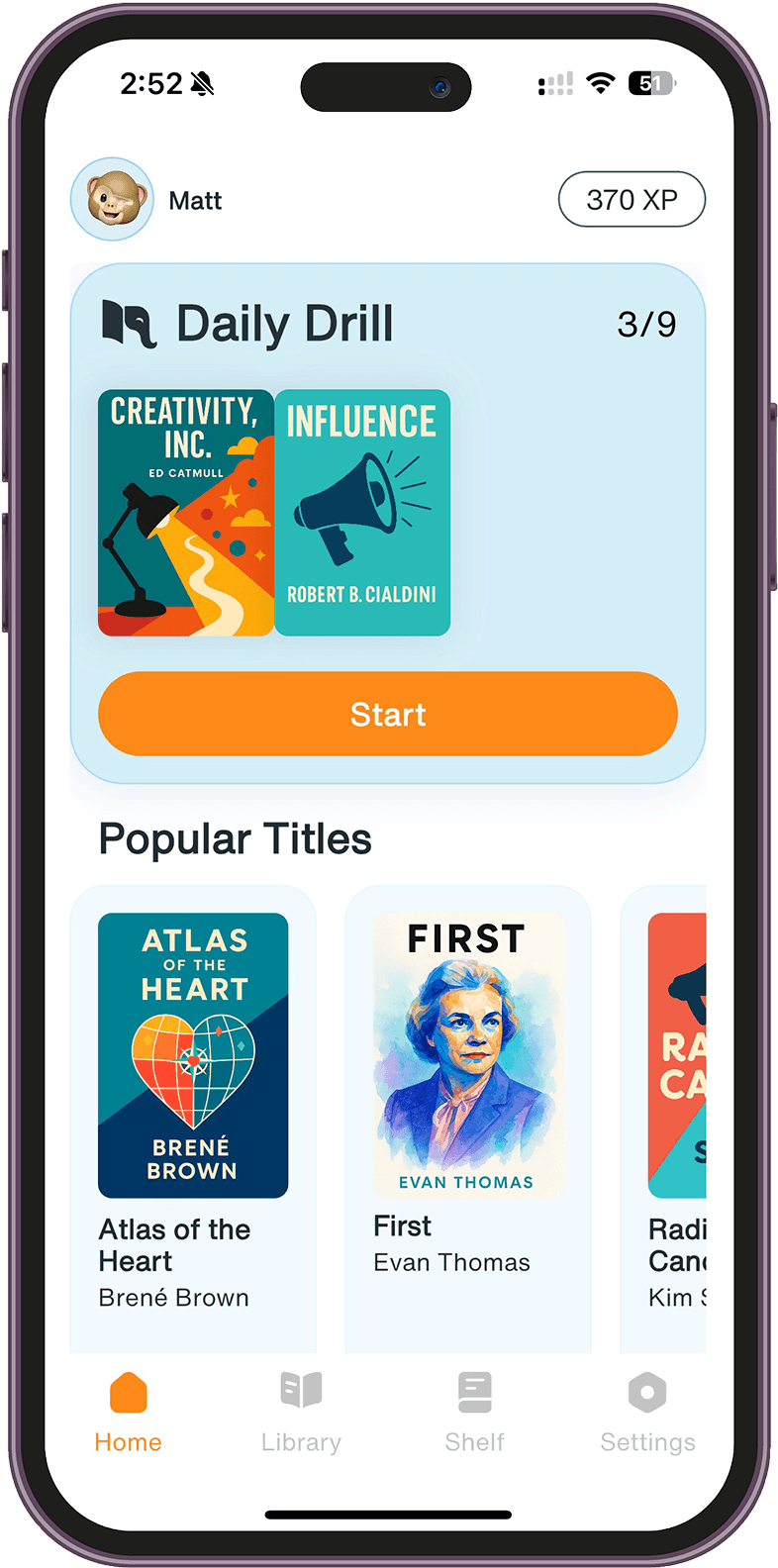
Loxie uses spaced repetition and active recall—the two most scientifically validated learning techniques—to help you retain the key concepts from Blood in the Garden. Instead of reading once and hoping something sticks, you practice for 2 minutes a day with questions that resurface ideas right before you'd naturally forget them.
Loxie includes Blood in the Garden in its full topic library, so you can immediately start reinforcing concepts like championship window dynamics, culture-building through defensive identity, and how great rivalries forge team character. Each practice session strengthens your memory, turning insights that would have faded into knowledge you can actually use.
Frequently Asked Questions
What is the main idea of Blood in the Garden?
Blood in the Garden chronicles how Pat Riley transformed the 1990s New York Knicks into basketball's most feared and controversial team through brutal defensive systems, relentless physicality, and a culture that mirrored New York City's toughness. The book explores why this exceptional team came tantalizingly close to championships without ever winning one.
What are the key takeaways from Blood in the Garden?
The book reveals that championship cultures require elite coaching, foundational players who set standards, roster construction prioritizing character fit, and fortunate timing. It also shows how great rivalries forge team identity, why championship windows inevitably close, and how distinctive team eras permanently reshape their sports.
Why didn't the 90s Knicks win a championship?
The Knicks fell short due to several factors: Michael Jordan's Bulls were historically great, the 1994 Finals featured heartbreaking individual failures like John Starks' Game 7 shooting, and the team's physical style led to rule changes that eventually neutralized their advantages. Aging stars and injuries closed their window before they could break through.
What made Pat Riley's coaching approach so effective?
Riley established non-negotiable standards for effort, preparation, and physicality through extreme practice culture. His marathon sessions and physical combat drills built mental toughness that made opponents dread facing the Knicks. However, this approach also shortened careers through accumulated physical damage.
How did the Knicks' style change NBA basketball?
The Knicks' suffocating defensive system was so effective that the NBA implemented rule changes—including hand-checking restrictions and defensive three-second violations—specifically to combat their style. This directly influenced the transition to modern basketball's emphasis on spacing, pace, and perimeter play.
How can Loxie help me remember what I learned from Blood in the Garden?
Loxie uses spaced repetition and active recall to help you retain the key concepts from Blood in the Garden. Instead of reading the book once and forgetting most of it, you practice for 2 minutes a day with questions that resurface ideas right before you'd naturally forget them. Loxie includes Blood in the Garden in its full topic library.
We're an Amazon Associate. If you buy a book through our links, we earn a small commission at no extra cost to you.
Stop forgetting what you learn.
Start learning for good with your 7-day FREE trial.