Can't Hurt Me: Key Insights & Takeaways from David Goggins
Master David Goggins' mental toughness framework and learn how to unlock the 60% of potential your mind is hiding from you.
by The Loxie Learning Team
What if the moment you feel completely exhausted, you've only accessed 40% of what you're actually capable of? David Goggins' Can't Hurt Me isn't just a memoir—it's a manual for breaking through the mental barriers that keep most people operating at a fraction of their potential. Through his transformation from an overweight, depressed young man into a Navy SEAL, ultramarathon runner, and world-record holder, Goggins reveals that the mind quits long before the body needs to.
This guide breaks down Goggins' complete mental toughness framework. You'll learn the 40% Rule, how to callus your mind against suffering, and practical techniques like the Accountability Mirror and Cookie Jar that turn your worst experiences into your greatest competitive advantages. Whether you've read the book or are encountering these ideas for the first time, you'll walk away understanding how to systematically expand what you believe is possible.
 Start practicing Can't Hurt Me free for 7 days ▸
What is the 40% Rule and how does it work?
The 40% Rule states that when your mind signals you're completely done, you've actually only used about 40% of your true capacity—meaning 60% more potential remains untapped. This isn't motivational rhetoric but a biological reality: your brain contains a protective "governor" that sends exhaustion signals long before actual physical failure to preserve energy reserves for emergencies.
Goggins discovered this principle through extreme physical trials, from Navy SEAL Hell Week to 100-mile ultramarathons. When instructors, pain, and every logical argument told him to quit, he found that pushing past those signals revealed capabilities his mind had been hiding from him. The gap between perceived limits and actual limits is enormous—and it can only be bridged by proving to your mind, through repeated experience, that you'll continue regardless of its protests.
Understanding this principle intellectually is one thing. Actually applying it when you're suffering is another entirely. The 40% Rule only becomes useful when you can recall it in the moment of maximum pain—which is why Loxie helps you internalize concepts like this through spaced repetition, so they're accessible when you need them most.
What is mental callusing and how do you develop it?
Mental callusing works exactly like physical callusing: just as repeated friction on your hands builds protective tissue that makes future friction painless, repeated exposure to psychological discomfort builds mental armor that makes previously unbearable situations manageable. The process is simple in concept and brutal in execution—you deliberately seek out controlled suffering until it no longer controls you.
This isn't about one dramatic test of willpower. Mental calluses form through consistent, daily exposure to things that make you uncomfortable. Cold showers when you'd rather be warm. Running in the rain when you could stay dry. Waking at 4 AM when your bed is calling you back. Each small act of voluntary hardship deposits another layer of psychological protection.
Why daily discomfort builds involuntary suffering capacity
The key insight is that controlled suffering in small doses creates capacity for uncontrolled suffering in larger doses. Like a vaccination that uses tiny amounts of disease to build immunity, deliberate daily discomfort creates psychological antibodies against future hardship. When crisis arrives—and it always does—your mind recognizes the sensation of suffering as familiar rather than threatening.
Most people avoid discomfort whenever possible, which trains their mental governor to activate at lower and lower thresholds. Every time you negotiate with pain and choose comfort, you teach your mind that suffering is dangerous. Goggins inverts this pattern: by choosing discomfort daily, he taught his mind that suffering is survivable, even useful.
Practice these concepts in Loxie ▸
How can trauma become a competitive advantage?
Your worst experiences and deepest pain can be alchemized into your greatest source of power when you learn to use trauma as fuel rather than letting it become your excuse. Goggins transformed childhood abuse, poverty, and racism from limiting factors into driving forces, demonstrating that the same experiences that break most people can become the foundation for extraordinary achievement.
The mechanism is a fundamental choice about meaning. Trauma doesn't have inherent meaning—it's raw data that your mind interprets. Most people interpret their pain as evidence of victimhood, proof that life is unfair and success is therefore impossible or undeserved. Goggins made a different interpretation: his suffering became evidence of what he could survive, proof that if he could endure that, he could endure anything.
This reframe isn't denial or toxic positivity. Goggins acknowledges the horror of his childhood in unflinching detail. The alchemy happens when you accept what happened without accepting that it defines what's possible. Your trauma becomes leverage precisely because you didn't choose it—overcoming unchosen suffering is more impressive than succeeding from privilege.
What is the Accountability Mirror technique?
The Accountability Mirror forces you to confront your raw truth without filters by writing your failures, lies, and excuses on sticky notes around your bathroom mirror until you can't escape the gap between who you've become and who you could be. Every morning, you face not just your reflection but a documented inventory of everything you've been avoiding.
This practice strips away the comfortable narratives we construct to protect our egos. Most self-improvement fails because people never achieve genuine honesty about their starting point. They tell themselves they're "not that out of shape" or "pretty disciplined most of the time." The Accountability Mirror demolishes these protective fictions by externalizing them where you can't unsee them.
How to implement the Accountability Mirror
Start by writing specific, measurable truths on sticky notes: the weight you've gained, the promises you've broken, the goals you've abandoned, the lies you tell yourself. Place them where you'll see them during your daily routine. The discomfort of seeing these truths becomes the fuel for changing them—you're not trying to feel good, you're trying to change.
As you address each failure, remove its note and replace it with what you're doing about it. The mirror becomes a dynamic document of transformation rather than a static accusation. But the process only works if you're ruthlessly honest—the moment you soften a truth to make it more comfortable, the technique loses its power.
Knowing the Accountability Mirror exists won't change your life.
Remembering to use it when you're stuck will. Loxie reinforces techniques like this through spaced repetition so they're available when you need them—not just after you've finished reading.
Try Loxie free for 7 days ▸Why does taking extreme ownership matter?
Taking ownership means accepting that everything in your life—including circumstances you didn't create—becomes your responsibility to fix, because waiting for fairness or justice guarantees you'll die waiting. This isn't about blame or fault; it's about recognizing that expecting others to solve your problems means surrendering your power to change.
Goggins didn't choose his abusive father, his family's poverty, or the racism he faced. But he realized that cataloging these injustices, no matter how real they were, only made him a more articulate victim. The circumstances were unfair. And nobody was coming to fix them. These two facts coexist: you can acknowledge injustice while refusing to let it determine your trajectory.
This level of ownership feels unfair because it is unfair. You're accepting responsibility for problems you didn't cause. But the alternative—waiting for the world to become fair—has a 100% failure rate. The only path to freedom runs through total accountability, even for situations that aren't your fault.
What's the difference between motivation and obsession?
Motivation is a temporary emotional state that fluctuates based on circumstances. Obsession is an identity-level commitment that makes success non-negotiable regardless of how you feel. Goggins' distinction between these two explains why most transformation attempts fail: they're built on motivation, which evaporates when comfort becomes available again.
When Goggins needed to lose 106 pounds in three months to qualify for SEAL training, motivation wasn't enough. He had to become pathologically fixated to the point where nothing else existed except the goal. Sleep, social life, variety, balance—all of it was sacrificed to a single consuming purpose. This isn't sustainable or healthy as a permanent lifestyle, but impossible transformations require temporary insanity.
When obsession becomes necessary
Motivation says "I really want this." Obsession says "I cannot exist without this." The difference shows up when conditions turn hostile. Motivated people quit when progress stalls, when pain increases, when easier options appear. Obsessed people continue because stopping isn't a recognized option—their identity depends on completion.
Most people never access obsession because they never commit completely enough for it to activate. They keep backup plans, maintain balance, preserve options. Goggins argues that these safety nets prevent the full psychological commitment that unlocks impossible performance. You can only become obsessed when failure would cost you something you can't live without.
What does "taking souls" mean?
"Taking souls" means turning every doubter, competitor, and obstacle into fuel by making their disbelief in you the source of your power. Instead of being demoralized by people trying to break you, you flip the dynamic: their attempts to destroy you become ammunition that makes you stronger.
During Hell Week, when Navy SEAL instructors tried to crush candidates psychologically, most people internalized the abuse and weakened. Goggins inverted the relationship: he drew energy from their attacks. Every insult, every impossible demand, every attempt to make him quit became proof that they feared what he might become. He was quite literally feeding off their negative energy.
This technique transforms psychological warfare from a weapon used against you into fuel you control. When someone underestimates you, dismisses you, or actively works against you, they're handing you free motivation. The person trying to take your soul ends up giving you theirs.
What is the Cookie Jar method and how do you use it?
The Cookie Jar is a mental storage technique where you catalog your past victories as ammunition for future suffering. When you're in the middle of breaking down, you reach into this mental jar of memories—specific moments when you overcame odds—and use them as proof that your current situation is survivable.
The technique works because your mind argues in evidence, not abstractions. When suffering tells you "you can't continue," generic self-belief has no counter-argument. But specific memories do: "I survived Hell Week. I finished that race on broken feet. I lost 106 pounds." Each past victory is evidence that contradicts your mind's claim of impossibility.
Building your own Cookie Jar
Start by documenting every significant obstacle you've overcome—not just physical challenges, but emotional, professional, and personal ones. Write them down in detail: what seemed impossible, how you felt, and how you pushed through anyway. The more specific the memory, the more powerful it becomes as ammunition.
During moments of suffering, deliberately recall these memories. Not vaguely, but in precise detail. Remember exactly how bad that previous situation felt, and how you emerged on the other side. Your mind can't argue with your own history. If you did it before, you can do it again.
Why does visualization work for extreme performance?
Visualization for extreme performance isn't positive thinking—it's mental rehearsal of specific suffering, practicing exact moments of pain until your mind accepts them as survivable. When those moments arrive in reality, they feel like expected checkpoints rather than surprising emergencies, removing fear's power.
Goggins visualized precise moments of agony during ultramarathons: what his broken feet would feel like at mile 70, the kidney pain at hour 15, the hallucinations from sleep deprivation. By the time these sensations actually arrived, his mind recognized them from practice. There was no panic because there was no surprise.
This approach inverts the typical visualization advice that focuses on seeing yourself succeed. Goggins argues that visualizing success creates false comfort that evaporates at the first sign of struggle. Instead, visualize struggle itself—map the territory of suffering so thoroughly that when you enter it, you're navigating familiar ground.
Start retaining what you learn ▸
What does it mean to become "uncommon amongst uncommon"?
Becoming "uncommon amongst uncommon" means outworking the hardest workers. When you're already in the top 1%, the only way forward is to make elite performers look average by raising your standard beyond what even exceptional people consider possible. Your competition isn't average people—it's yesterday's version of yourself.
This concept prevents the plateau that kills most high achievers. Once you become better than average, the temptation is to coast on that achievement. You've "made it." But Goggins rejects any endpoint: there is no arrival, only continuous becoming. The moment you're satisfied with being uncommon, you've started declining.
The practical application is constant escalation. Whatever your current standard, find people exceeding it and make their performance your baseline. If you're doing what elite performers do, you're only keeping pace. To separate, you must do what even elite performers consider excessive.
Why does talent lose to obsession?
Talent is beaten by obsession every time because natural ability creates complacency while struggle creates hunger. Goggins failed the pull-up world record twice before succeeding on his third attempt with 4,030 pull-ups in 17 hours—proving that repetition and willingness to fail publicly defeats genetic advantages.
People with natural gifts often never develop the work ethic required for elite performance because they can coast on talent through early stages. When they finally hit the ceiling of natural ability, they lack the psychological muscles to push through. Meanwhile, those who struggled from the start built those muscles out of necessity.
Volume beats genetics
The math is straightforward: if you practice more than everyone else, you'll eventually surpass them regardless of starting position. Goggins wasn't naturally suited to distance running, pull-up competitions, or Navy SEAL training. He compensated with pure volume—more hours, more repetitions, more suffering than anyone who relied on natural ability.
This is good news for anyone without obvious talent: your limitation is actually an advantage because it forces you to build capabilities that talented people never develop. The question isn't whether you have natural ability. The question is whether you're willing to out-work people who do.
How does the After Action Report turn failure into education?
The After Action Report (AAR) transforms suffering into education by dissecting every failure for lessons. After each defeat or challenge, you write a detailed analysis of what broke you and why—converting pain into applicable knowledge that makes the next attempt more likely to succeed.
This military practice applied to personal development ensures that hardship pays dividends by extracting maximum learning from minimum experience. Without deliberate analysis, you might repeat the same mistakes indefinitely. With an AAR, each failure becomes an investment in future success.
Conducting your own AAR
After any significant failure or challenge, document: What happened exactly? Where did you break? What was the first sign of failure? What would you do differently? What worked that you should repeat? Be brutally specific—vague answers produce vague improvements.
The AAR reframes failure from something to avoid into reconnaissance. Each defeat maps your vulnerabilities with precision that success could never reveal. Goggins' multiple failures at world records weren't setbacks—they were intelligence-gathering missions that informed his eventual success.
Why does internal motivation outlast external validation?
Internal motivation sustains when external validation disappears. Goggins ran ultramarathons alone in the dark because depending on cheers, recognition, or witnesses makes you a slave to other people's attention. When the audience leaves—and it always does eventually—externally-fueled performers collapse.
True endurance athletes learn to generate their own fuel through internal dialogue and personal standards. Their power source travels with them rather than depending on environmental conditions. A crowd might add 5% to your performance, but if you need that crowd to perform at all, you're fragile.
The practical application is training in isolation, without accountability partners, social media documentation, or anyone watching. If you only perform when observed, you haven't internalized the behavior—you've outsourced your motivation to an external system that you can't control.
Practice these concepts in Loxie ▸
The real challenge with Can't Hurt Me
Here's the uncomfortable truth: reading Can't Hurt Me feels like transformation. You finish the book fired up, convinced you'll never quit again, ready to push past your 40% barrier. But within weeks, that fire fades. The concepts that felt so clear become fuzzy. When you actually face suffering, you can't remember the specific techniques that would help.
This isn't a failure of willpower—it's the forgetting curve at work. Research shows we forget 70% of what we learn within 24 hours, and 90% within a week. So all those powerful ideas—the Cookie Jar, the Accountability Mirror, the 40% Rule—gradually fade until you're left with a vague sense that you once read something inspiring.
How many books have changed your life for a month before fading into a title you vaguely remember? The gap between reading Goggins' principles and living them is the gap between information and retention.
How Loxie helps you actually remember what you learn
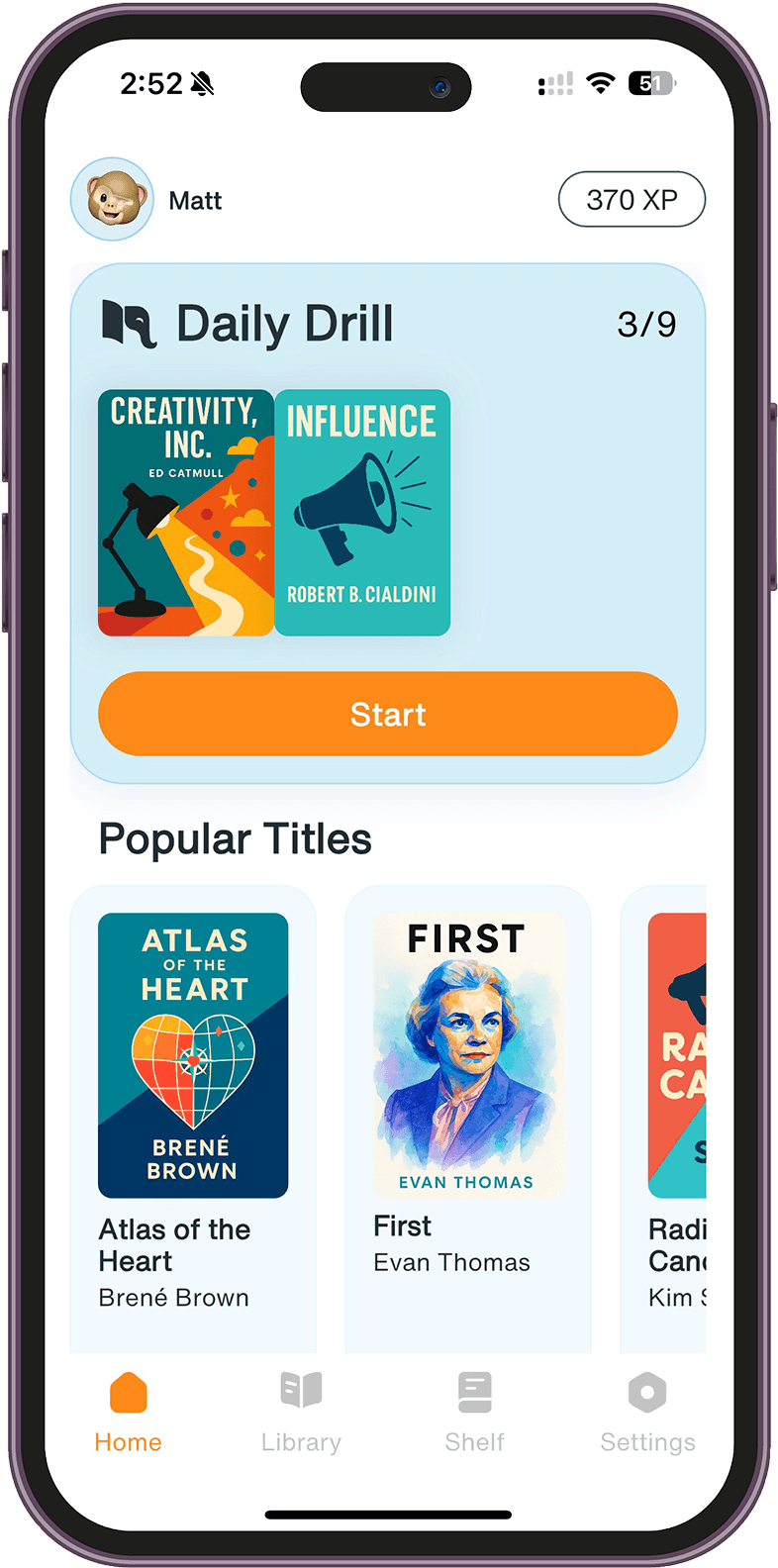
Loxie uses spaced repetition and active recall—the same techniques that help medical students remember thousands of facts—to keep the insights from Can't Hurt Me available when you need them. Instead of reading once and hoping for the best, you practice for 2 minutes a day with questions that resurface ideas right before you'd naturally forget them.
The 40% Rule is useless if you can't recall it when you're exhausted. The Cookie Jar only works if you actually remember to use it mid-suffering. Mental callusing requires consistent practice, not occasional inspiration. Loxie ensures these concepts stay sharp and accessible, so when you face your next challenge, Goggins' techniques are ready to deploy.
Loxie includes Can't Hurt Me in its full topic library, so you can start reinforcing these concepts immediately—no subscription required to access the core content.
Frequently Asked Questions
What is the main idea of Can't Hurt Me?
The central idea is that humans operate at only 40% of their true capacity when they feel exhausted—meaning most limits are mental, not physical. Through techniques like mental callusing, the Accountability Mirror, and the Cookie Jar, Goggins shows how to systematically expand your psychological capacity for suffering and achievement.
What is the 40% Rule from Can't Hurt Me?
The 40% Rule states that when your mind signals you're completely done, you've actually only used about 40% of your true capacity. The remaining 60% is locked behind a biological "governor" that protects you from discomfort—but can be overridden through mental training and repeated proof that you'll push past it.
What is mental callusing?
Mental callusing is the process of building psychological resilience through repeated exposure to controlled discomfort. Like physical calluses that form from friction, mental calluses develop when you deliberately seek out daily hardship—cold showers, early runs, uncomfortable situations—until previously unbearable experiences become manageable.
What is the Cookie Jar method?
The Cookie Jar is a mental technique where you store memories of past victories to use as fuel during future suffering. When you're breaking down, you recall specific moments when you overcame impossible odds, using your own history as evidence that contradicts your mind's claims that you can't continue.
What's the difference between motivation and obsession according to Goggins?
Motivation is a temporary emotional state that disappears when conditions get hard. Obsession is an identity-level commitment that makes success non-negotiable regardless of feelings. Goggins argues that impossible transformations require obsession—a pathological fixation where failure isn't a recognized option.
How can Loxie help me remember what I learned from Can't Hurt Me?
Loxie uses spaced repetition and active recall to keep Goggins' techniques accessible when you actually need them. Instead of reading once and forgetting 90% within a week, you practice for 2 minutes daily with questions that resurface ideas right before you'd naturally forget them. Loxie includes Can't Hurt Me in its full topic library.
We're an Amazon Associate. If you buy a book through our links, we earn a small commission at no extra cost to you.
Stop forgetting what you learn.
Start learning for good with your 7-day FREE trial.