Co-Active Coaching: Key Insights & Takeaways
Master the transformative coaching methodology that treats people as naturally creative, resourceful, and whole.
by The Loxie Learning Team
What if the most powerful thing a coach could do is stop trying to fix people? Co-Active Coaching by Henry Kimsey-House, Karen Kimsey-House, Phillip Sandahl, and Laura Whitworth presents a methodology that fundamentally shifts the coaching relationship from expert-client to collaborative partnership. The approach rests on a radical premise: people are already naturally creative, resourceful, and whole—they don't need answers delivered to them; they need someone who can help them access the wisdom they already possess.
This guide breaks down the complete Co-Active framework, from the three levels of listening to the art of powerful questions, from designing coaching alliances to integrating intuition into conversations. Whether you're a professional coach looking to deepen your practice, a leader who wants to develop others more effectively, or someone curious about what transformative coaching actually looks like, you'll understand both the philosophy and the practical skills that make Co-Active coaching so effective.
 Start practicing Co-Active Coaching free for 7 days ▸
What does it mean to see clients as naturally creative, resourceful, and whole?
Seeing clients as naturally creative, resourceful, and whole means believing they already possess the answers to their own challenges—the coach's role becomes creating conditions for those answers to emerge rather than providing solutions. This isn't just a nice sentiment; it's a fundamental shift that transforms how coaches approach every conversation, question, and challenge that surfaces.
When a coach operates from this belief, they stop diagnosing problems and prescribing fixes. Instead, they become curious about what the client already knows, what resources they've overlooked, and what possibilities exist that haven't been explored yet. The power dynamic shifts entirely: clients aren't dependent on the coach's expertise but are supported in accessing their own wisdom through powerful questions and deep listening.
This perspective also changes how coaches interpret struggle and resistance. Rather than seeing confusion as evidence that the client needs more guidance, they see it as part of the creative process—a temporary state that often precedes breakthrough insights. The coach's confidence in the client's inherent capability creates space for clients to trust themselves, experiment with new approaches, and take ownership of their growth in ways that external advice never could.
How does Co-Active coaching balance being and doing?
The Co-Active model explicitly addresses both "being" (exploring values, purpose, and fulfillment) and "doing" (taking action and achieving goals), recognizing that sustainable transformation requires attention to both dimensions simultaneously. This dual focus prevents the common trap of achieving external goals that leave people feeling empty, or endlessly exploring inner states without translating insights into concrete changes.
Being work explores questions like: What truly matters to you? What kind of person do you want to become? What values must be honored for choices to feel right? This inner exploration ensures that goals and actions align with authentic identity rather than external expectations or inherited scripts about success.
Doing work focuses on concrete commitments, accountability structures, and measurable progress. It asks: What specific action will you take? By when? How will you handle obstacles? This action orientation ensures that insights don't remain abstract but get tested and refined through real-world experience.
Master coaches learn to dance between these modes based on what clients need in each moment. Sometimes someone needs a push toward action after too much contemplation; other times they need permission to slow down and examine whether their goals actually reflect what they want. The integration of being and doing creates lasting change because external achievements rest on a foundation of internal alignment.
Practice these coaching concepts in Loxie ▸
What is the designed alliance and why is it essential?
The designed alliance is an explicit negotiation between coach and client about how they will work together—including communication styles, accountability structures, and permission to challenge—creating a custom framework tailored to each unique relationship. Rather than applying a standard approach to every client, this collaborative design process dramatically increases the likelihood of breakthrough results.
The conversation covers practical matters: How often will we meet? How do you want to be held accountable? What should I do if you seem to be avoiding something? It also addresses deeper questions: What kind of support helps you grow? How do you typically respond to challenge? When are you most likely to shut down or disengage?
This explicit agreement creates psychological safety because both parties understand the rules of engagement. Clients know what to expect and feel empowered because they've shaped the relationship. Coaches gain permission to challenge and push in ways that might otherwise feel intrusive. When difficulties arise, the designed alliance provides a reference point for navigating tension and recalibrating the partnership.
What are the three levels of listening in Co-Active coaching?
The three levels of listening—internal, focused, and global—allow coaches to access different types of information and respond from increasingly sophisticated awareness, each level building on the previous one to create comprehensive understanding of what's happening in the coaching conversation.
Level I: Internal Listening
Internal listening is awareness of your own thoughts, reactions, and internal dialogue. At this level, attention is primarily on what the conversation means to you, how it relates to your experience, and what you're thinking about saying next. While everyone starts here, coaches learn to notice when they're stuck in internal listening and consciously shift to deeper levels.
Level II: Focused Listening
Focused listening directs complete attention onto the client—not just their words but their tone, pace, emotional undertones, and what they're not saying. At this level, coaches temporarily set aside their own reactions to be fully present with another person. This is where most effective coaching happens, as the coach becomes a clear mirror reflecting back what the client is communicating.
Level III: Global Listening
Global listening expands awareness to sense the energetic field between coach and client, picking up on metaphors, images, body sensations, and environmental cues that reveal deeper truths than words alone can convey. At this level, coaches notice what's happening in the space between people—shifts in energy, unspoken tensions, emerging possibilities. This expanded awareness often surfaces insights that surprise both coach and client.
Mastering these listening levels transforms coaching conversations. Coaches can notice not just what clients say but how they say it, what topics create energy versus deflation, and what patterns emerge across conversations. These observations become powerful data for facilitating transformation that goes beyond surface-level problem-solving.
Deep listening is a skill that requires practice to develop
Understanding the three levels intellectually is just the beginning—actually shifting between them in real conversations takes repeated practice. Loxie helps you internalize these distinctions so you can access them when you need them most.
Start retaining what you learn ▸How does intuition work in coaching conversations?
Intuition in coaching operates as a direct knowing that bypasses analytical thinking—coaches learn to trust gut feelings, sudden images, body sensations, or phrases that pop into mind as valid data that often reveals what logic cannot access. This isn't mystical; it's the brain processing patterns below conscious awareness and surfacing insights through non-verbal channels.
Developing intuitive capacity requires first noticing these subtle signals—the tightening in your chest when something feels off, the image that appears when a client mentions a relationship, the word that keeps echoing in your mind. Many people dismiss these signals as distractions, but trained coaches learn to treat them as potentially valuable information worth exploring.
Sharing intuitions effectively requires specific language that frames insights as offerings rather than truths. Phrases like "I have a hunch..." or "Something tells me..." or "I'm noticing a feeling that..." allow coaches to introduce potentially transformative perspectives while preserving the client's autonomy to accept or reject them. The intuition is offered without attachment—if it doesn't land, the coach lets it go without insisting on its validity.
When intuition is accurate, it often cuts through layers of intellectual discussion to reach core issues immediately. A coach might say, "I have this image of you carrying a heavy backpack everywhere you go—does that resonate?" and unlock a conversation about burdens the client hadn't consciously named but instantly recognizes.
What makes a coaching question powerful?
Powerful questions emerge from genuine curiosity rather than leading the client toward predetermined answers—they open new territory for exploration rather than confirming what's already known or subtly imposing the coach's agenda. The distinction between curious and leading questions fundamentally shapes the quality of coaching conversations.
Leading questions already contain an answer: "Don't you think you should talk to your boss about this?" or "Wouldn't it help to exercise more?" These questions disguise advice as inquiry, closing down exploration while pretending to open it up. Clients often feel manipulated without knowing why, and their ownership of resulting decisions diminishes.
Curious questions genuinely don't know where they'll lead: "What do you really want here?" or "What would be different if you had that?" or "What's the fear underneath this?" These questions invite clients into unknown territory where discovery becomes possible. The coach is as curious about the answer as the client.
Often the most powerful questions are the simplest. "What do you want?" cuts through complex narratives to reveal core desires. "What's important about that?" uncovers underlying values. "And what else?" keeps exploration going when the first response is only surface-level. These simple questions bypass intellectual defenses and create direct access to what matters most.
Why is self-management essential for coaches?
Self-management requires coaches to notice their own triggers, judgments, and advice-giving impulses, then consciously choose to return focus to the client's agenda rather than their own. This metacognitive awareness prevents coaches from unconsciously projecting their values, solving problems the client hasn't asked them to solve, or using sessions to work through their own unresolved issues.
Every coach has triggers—topics that provoke strong reactions, personality types that feel challenging, situations that remind them of their own struggles. Without self-awareness, these triggers hijack attention and distort perception. A coach who struggled with a controlling parent might over-react to any sign of authority in client relationships. A coach who values directness might judge clients who process slowly as resistant.
Interestingly, strong emotional reactions in coaches often contain valuable information about what might be happening for the client. When examined with curiosity rather than suppressed, a coach's frustration or judgment can signal important dynamics that, when skillfully explored, unlock deeper understanding. The key is noticing the reaction, not acting from it automatically.
Self-management also involves monitoring the impulse to give advice. When coaches know the "right" answer, resisting the urge to share it directly requires discipline. Asking questions that help clients discover insights themselves takes longer but creates more lasting change because clients own what they've discovered rather than merely accepting what they've been told.
How does fulfillment coaching help clients find what truly matters?
Fulfillment coaching helps clients distinguish between achievements that look good externally and choices that create genuine satisfaction by aligning actions with core values. Many people pursue goals that meet others' expectations—prestigious careers, conventional markers of success—but feel empty or disconnected from their authentic selves even when they achieve them.
Values clarification exercises reveal the non-negotiable principles that, when honored in daily choices, create a sense of integrity and deep satisfaction regardless of external outcomes. Values might include creativity, connection, adventure, security, contribution, or excellence—but the specific constellation differs for each person, and discovering what truly matters requires careful exploration.
Once values are identified, they become a reliable internal compass for decision-making. Clients can evaluate options not just by practical criteria but by asking: "Does this honor my values?" A promotion that conflicts with family time values creates chronic tension; turning it down might seem irrational but actually serves deeper fulfillment.
This focus on values-based decision making helps clients escape the trap of pursuing goals that were never really theirs. The question shifts from "What should I want?" to "What do I actually want?" and from "How do I succeed?" to "What would success mean for someone with my values?"
What does life balance actually mean in Co-Active coaching?
Life balance in the Co-Active model isn't about equal time allocation across life areas but about conscious choice—acknowledging trade-offs and ensuring that current imbalances serve larger purposes rather than happening by default. This reframing liberates clients from the impossible pursuit of perfect balance.
The Wheel of Life assessment visually maps satisfaction across different life areas—career, relationships, health, finances, personal growth, fun, physical environment, and others. Rather than judging imbalances, this tool makes patterns immediately visible and invites reflection: "Is this the balance I'm choosing, or the one I've drifted into?"
Sometimes imbalance is exactly right. Building a business might require temporarily deprioritizing other areas. Caring for a new child naturally shifts focus. The question isn't whether life is balanced but whether the current allocation reflects conscious choice aligned with current priorities and values.
Coaching helps clients distinguish between sustainable temporary imbalances and chronic patterns that drain energy and create resentment. A conscious choice to work intensively for six months feels different than an unconscious habit of always putting work first. The first serves larger purposes; the second often perpetuates dissatisfaction.
How does process coaching work with what's happening in the moment?
Process coaching uses whatever is happening in the moment—resistance, excitement, confusion, frustration—as the perfect gateway to explore patterns that show up everywhere in the client's life. Rather than trying to resolve these states, coaches get curious about them, transforming every coaching moment into a learning laboratory.
When a client resists a question, that resistance becomes the focus: "I notice you're pushing back against this. What's happening for you right now?" When they light up about a possibility, that energy gets explored: "There's real excitement in your voice. What does this connect to?" The content becomes secondary to the process of how the client is engaging.
The coaching relationship itself becomes a microcosm where clients' life patterns inevitably emerge. How they handle conflict, receive support, avoid vulnerability, or take risks in coaching mirrors how they operate everywhere. A client who deflects compliments in session probably does the same at work and home.
This recognition of parallel processes allows coaches to help clients see and shift patterns in the safety of the coaching relationship before applying changes in higher-stakes situations. Experimenting with new responses to challenge in a session prepares clients to respond differently when similar dynamics arise elsewhere.
What does integration look like for master coaches?
Integration means fluidly dancing between different coaching approaches—sometimes challenging, sometimes supporting, sometimes exploring being, sometimes pushing for doing—based on what serves the client in each moment rather than following a rigid methodology. Master coaches develop the ability to sense which tool or approach is needed and shift seamlessly between modes.
This fluidity requires holding multiple perspectives simultaneously. The coach sees the client's current reality, their potential, and the gap between them. They track the conversation's content while monitoring the process. They stay connected to their own intuitions while remaining focused on the client. This multi-dimensional awareness creates a creative tension that naturally pulls toward growth.
Integration also means bringing your whole self to coaching. Coaches don't become neutral facilitators who disappear behind techniques. They bring their personality, life experience, humor, and unique gifts to each conversation. Authenticity creates connection that no methodology can produce.
The Perspectives Exercise demonstrates this integrative approach by having clients physically move to different positions in the room to embody different viewpoints. Rather than just talking about another person's perspective, clients literally stand where that person would stand and speak from that position. This somatic approach bypasses intellectual analysis, using physical movement to unlock insights that thinking alone couldn't access.
How does powerful acknowledgment differ from ordinary praise?
Powerful acknowledgment goes beyond praise to reflect back the client's core qualities and courage—naming the being behind the doing in ways that help clients see their own greatness. While praise focuses on accomplishments or outcomes, acknowledgment recognizes who the person is and what it took for them to show up as they did.
Praise sounds like: "Great job finishing that project!" Acknowledgment sounds like: "I see the courage it took to set that boundary with your team, especially given how much you value harmony." The first comments on what happened; the second reflects back the person's character and the internal challenge they navigated.
This deep recognition helps clients internalize their strengths and build self-trust that doesn't depend on external validation or specific outcomes. When a coach consistently names qualities the client might not see in themselves—resilience, creativity, integrity, vulnerability—clients begin to incorporate these self-perceptions. They stop needing others to validate their worth.
Acknowledgment is particularly powerful after difficult moments. When clients fail, struggle, or face disappointment, acknowledgment of what they brought to the situation—their willingness to try, their honesty about what went wrong, their persistence—creates foundation for growth rather than shame.
How do you develop your unique coaching style?
Developing your unique coaching style means integrating Co-Active principles with your natural gifts, life experiences, and personality rather than mimicking someone else's approach. The goal isn't to become a generic Co-Active coach but to become the distinctive coach that only you can be.
This authentic development process requires self-knowledge: What are your natural strengths? What life experiences have given you unique insight into particular challenges? What communication styles feel most authentic to you? What populations or issues draw you? The answers shape a practice that can't be replicated.
Coaches who try to adopt someone else's style often feel inauthentic and struggle to connect. Clients sense the gap between who the coach is pretending to be and who they actually are. But when coaches bring their full selves—their humor, their intensity, their gentleness, their directness—they create distinctive value that attracts clients who specifically need what they uniquely offer.
Sustainable practice also requires coaches to apply Co-Active principles to themselves—treating their own development as ongoing, honoring both being and doing in their professional growth. Coaches who stop growing become stale. The recursive application of coaching principles prevents burnout and ensures coaches continue developing alongside their clients.
The real challenge with Co-Active Coaching
Here's what most people discover after reading Co-Active Coaching: understanding the concepts intellectually is completely different from embodying them in actual conversations. You can explain the three levels of listening perfectly but still catch yourself stuck in Level I when a real client sits across from you. You know that powerful questions come from curiosity, but in the moment, leading questions slip out automatically.
This gap between knowing and doing isn't a failure of willpower—it's how memory and skill development actually work. Research on the forgetting curve shows that within 24 hours of reading new material, we lose up to 70% of it. A week later, the sophisticated distinctions between acknowledgment and praise, between curious and leading questions, blur together. The framework that seemed so clear becomes vague precisely when you need it most.
How Loxie helps you actually remember what you learn
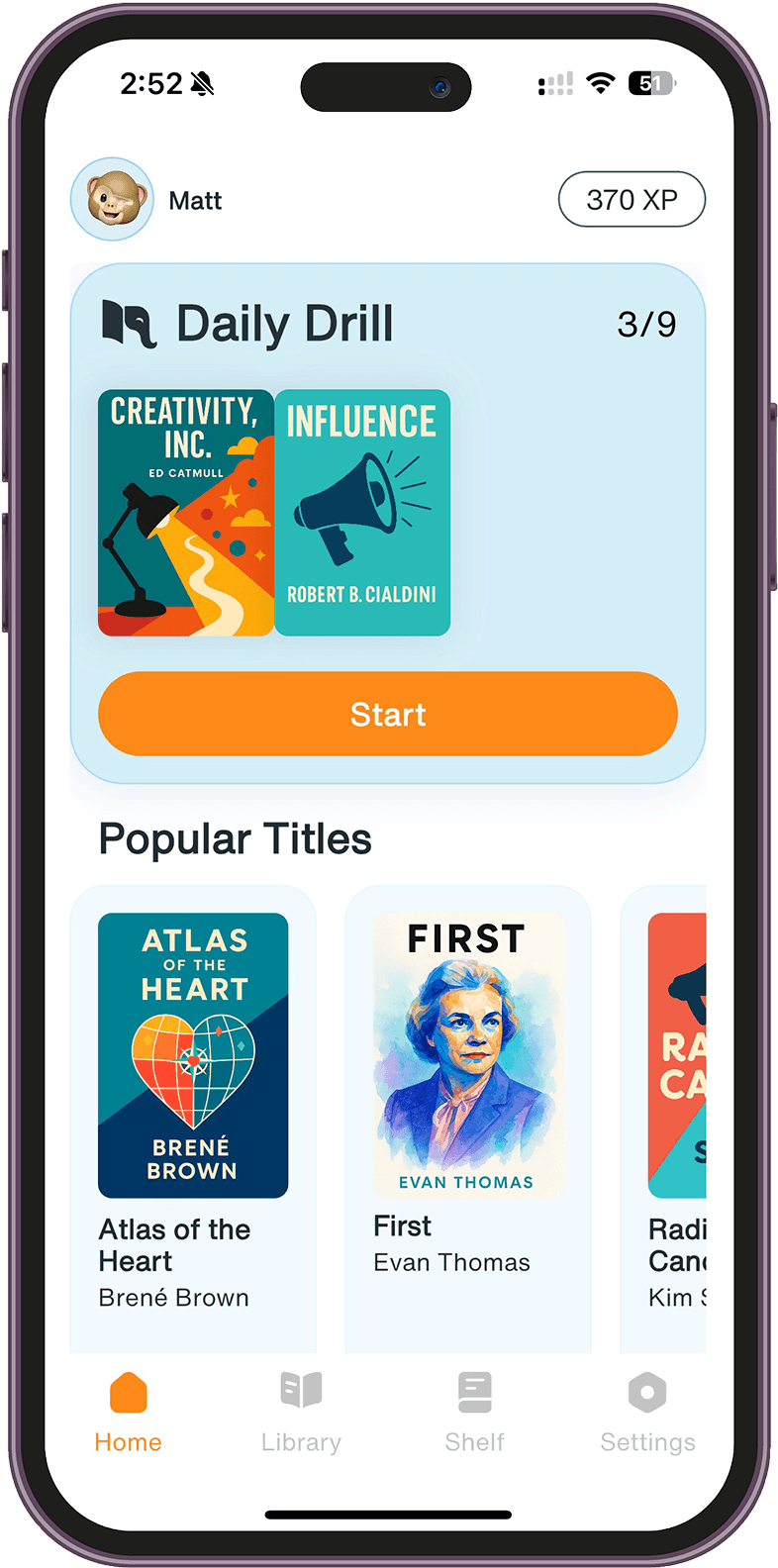
Loxie uses spaced repetition and active recall—two techniques from cognitive science—to help you move concepts from short-term understanding to long-term capability. Instead of reading Co-Active Coaching once and watching the insights fade, you practice retrieving key concepts through targeted questions that resurface right before you'd naturally forget them.
The practice takes just 2 minutes a day. Questions might ask you to distinguish between the three listening levels, explain why the designed alliance matters, or recall what makes acknowledgment different from praise. Each time you successfully retrieve a concept, the interval before you see it again extends. Concepts you struggle with appear more frequently until they stick.
Loxie includes Co-Active Coaching in its full topic library, so you can start reinforcing these concepts immediately. Because reading about coaching isn't the same as becoming a better coach—but remembering the framework when you need it is the first step toward actually using it.
Frequently Asked Questions
What is the main idea of Co-Active Coaching?
The core idea is that people are naturally creative, resourceful, and whole—they don't need coaches to provide answers but to create conditions where their own wisdom can emerge. This shifts coaching from expert advice-giving to collaborative partnership through powerful questions, deep listening, and genuine curiosity.
What are the three levels of listening in Co-Active coaching?
Level I (Internal) focuses on your own thoughts and reactions. Level II (Focused) directs complete attention onto the client—their words, tone, and what's unsaid. Level III (Global) senses the energetic field between coach and client, picking up on metaphors, images, and patterns that reveal deeper truths.
What is the designed alliance in coaching?
The designed alliance is an explicit agreement between coach and client about how they'll work together—covering communication styles, accountability preferences, and permission to challenge. This collaborative design creates psychological safety and ensures both parties understand expectations.
What does 'being' versus 'doing' mean in Co-Active coaching?
Being explores values, purpose, and fulfillment—who you want to become. Doing focuses on actions, goals, and measurable progress. The Co-Active model integrates both, recognizing that lasting change requires external achievements built on internal alignment.
How can Loxie help me remember what I learned from Co-Active Coaching?
Loxie uses spaced repetition and active recall to help you retain the key concepts from Co-Active Coaching. Instead of reading the book once and forgetting most of it, you practice for 2 minutes a day with questions that resurface ideas right before you'd naturally forget them. Loxie includes Co-Active Coaching in its full topic library.
We're an Amazon Associate. If you buy a book through our links, we earn a small commission at no extra cost to you.
Stop forgetting what you learn.
Start learning for good with your 7-day FREE trial.