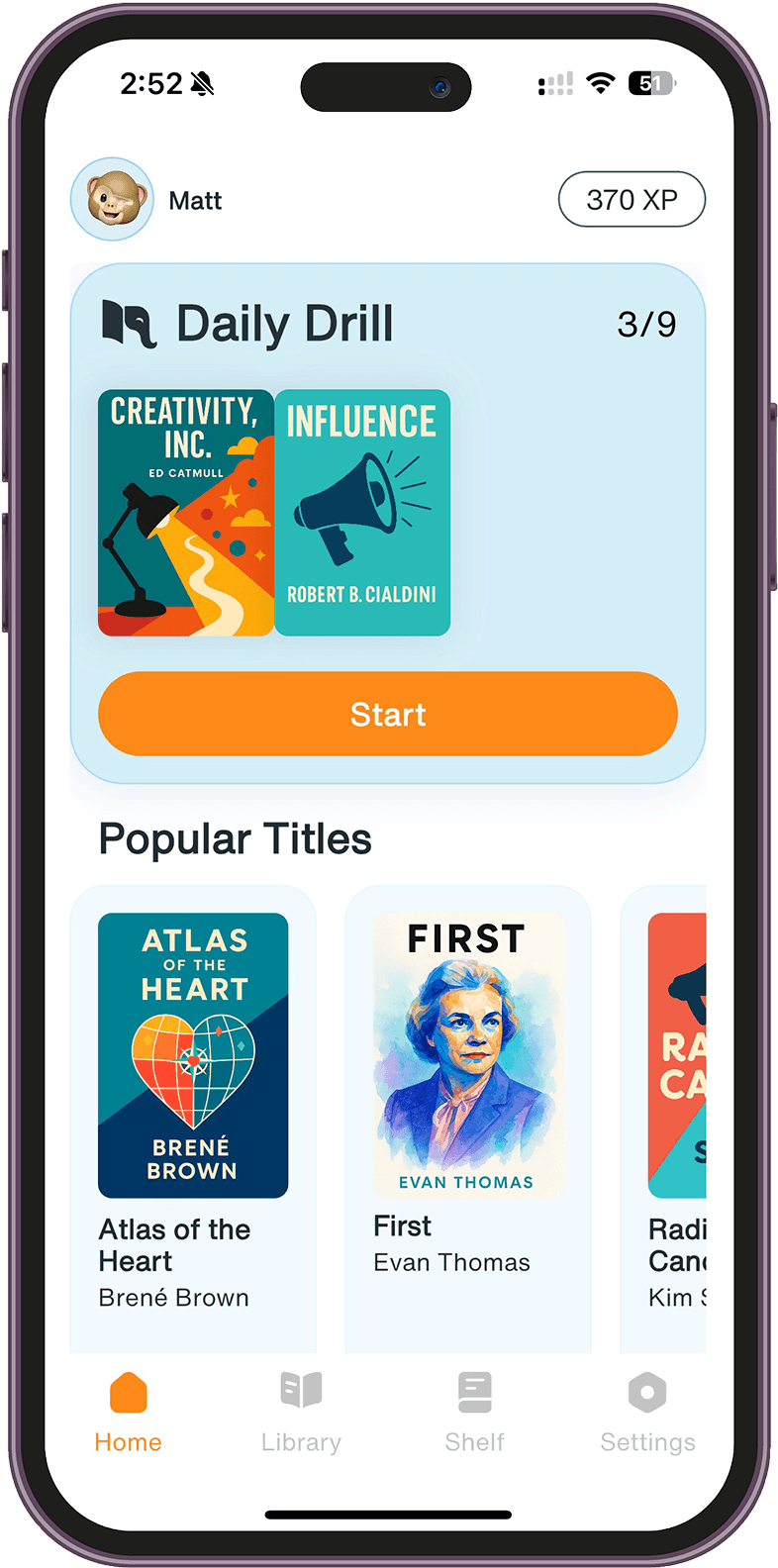
Creativity, Inc.: Key Insights & Takeaways from Ed Catmull
Master the management principles that built Pixar's legendary creative culture and learn how to foster innovation in any organization.
by The Loxie Learning Team
How did a small graphics company become the studio behind Toy Story, Finding Nemo, and Up? In Creativity, Inc., Pixar co-founder Ed Catmull pulls back the curtain on the management principles that transformed Pixar into one of the most consistently innovative companies in entertainment history. The lessons go far beyond animation—they reveal how any organization can build a culture where creativity flourishes.
This guide breaks down Catmull's complete framework for fostering innovation, embracing failure productively, and creating environments where people do their best work. Whether you lead a creative team, manage knowledge workers, or simply want to understand what makes organizations truly innovative, these principles will reshape how you think about culture, feedback, and the messy reality of bringing new ideas to life.
 Start practicing Creativity, Inc. free for 7 days ▸
Why is candor so essential to creative organizations?
Candor—the ability to speak honestly without fear of repercussion—is the foundation of Pixar's creative success. When team members can openly challenge ideas, point out problems early, and share critical feedback, organizations avoid the slow decay that comes from people staying silent to protect relationships or their careers. Without candor, small problems fester into crises, mediocre ideas go unchallenged, and the best thinking in the room stays trapped inside people's heads.
Building candor requires more than just telling people to be honest. It demands systematic processes that make honest feedback expected and safe. At Pixar, this manifests in structures like the Braintrust—regular meetings where critique is the norm, where clear rules separate ideas from ego, and where cultural reinforcement consistently rewards honest feedback over politeness. The key insight is that candor doesn't happen naturally; you must engineer environments where it becomes the default behavior.
Candor enables creative risk-taking because it creates psychological safety. When people know they can voice concerns without punishment, they become willing to propose bold ideas that conventional thinking would reject. They challenge assumptions openly. They push boundaries without fear of judgment. This combination of honest feedback and creative courage is what allows organizations to produce breakthrough work rather than safe, predictable output.
What is the Braintrust and how does it work?
The Braintrust is Pixar's peer-to-peer feedback system where directors present work-in-progress to fellow filmmakers who offer candid notes without any authority to mandate changes. This distinction is crucial: the Braintrust has no power. Directors receive feedback but retain complete creative control over their films. This structure enables honest critique without damaging relationships or creating resentment.
The format works because it removes hierarchy from creative feedback. When power dynamics are eliminated, peers speak more honestly. Creators listen more openly when advice comes without commands attached. Solutions emerge from collective wisdom rather than top-down directives. The Braintrust sessions create a space where the work itself becomes the focus, and everyone's job is simply to help make the film better.
Removing hierarchy from feedback improves work quality for another reason: it taps into diverse perspectives. Different filmmakers bring different mental models, experiences, and sensibilities. When a director struggling with a story problem presents to the Braintrust, they gain access to multiple ways of seeing their challenge. This diversity of viewpoint often reveals solutions that no single person—regardless of their seniority or talent—could have discovered alone.
Practice these leadership concepts in Loxie ▸
How does fear kill creativity and what can leaders do about it?
Fear kills creativity by causing people to play it safe, hide problems until they become crises, and choose predictable solutions over innovative ones. When employees fear punishment for mistakes, they avoid the risks necessary for breakthrough innovation. They cover up early warning signs instead of surfacing them. They propose ideas they know will be approved rather than ideas that might actually work. Over time, fear creates organizations that are technically functional but creatively dead.
The antidote is embracing failure as inevitable and instructive. At Pixar, this means reframing organizational attitudes toward mistakes. Post-mortems examine what went wrong without assigning blame. Failure stories are shared as teaching tools rather than cautionary tales about careers derailed. People are evaluated on their response to setbacks rather than just their successes. This cultural shift enables teams to take the risks necessary for creative breakthroughs.
Leaders must model this relationship with failure themselves. When directors admit uncertainty in meetings, when executives share their own mistakes openly, when promotions go to people who helped others succeed through difficult challenges—these actions signal that failure is safe. The goal isn't to eliminate failure but to fail faster, learn more, and channel those lessons into better work. Understanding this intellectually is one thing; actually embodying it as a leader requires constant practice and reinforcement.
Why do diverse perspectives drive creative breakthroughs?
Diverse perspectives drive creative problem-solving breakthroughs by combining different mental models to reveal solutions that homogeneous groups would miss. When people with varied backgrounds, expertise, and thinking styles tackle a problem together, they challenge assumptions that others take for granted. This creates productive friction that forces deeper thinking and prevents teams from converging too quickly on obvious answers.
At Pixar, this principle shapes how teams are assembled. Visionary directors are paired with pragmatic producers. Technical innovators work alongside artistic storytellers. This deliberate tension between different perspectives—rather than smooth agreement—drives excellence. The friction isn't comfortable, but it produces work that neither group could achieve alone.
Cross-departmental collaboration amplifies this effect. Research trips expose teams to unfamiliar problem-solving approaches. Engineers attend story meetings; artists learn about rendering pipelines. These collisions between different domains spark unexpected connections. The animator who understands physics constraints thinks about movement differently than one who doesn't. The technical director who grasps emotional storytelling makes different choices about which problems to solve.
Understanding creative culture is just the beginning
The challenge isn't learning these principles—it's remembering them when you're in the meeting, facing the difficult conversation, or making the hiring decision. Loxie uses spaced repetition to help you internalize concepts like the Braintrust and psychological safety so they're available when you need them most.
Start retaining what you learn ▸How do mental models and blind spots derail creative organizations?
Mental models and blind spots systematically derail creative organizations by causing leaders to misread situations based on past successes. When something has worked before, it becomes the lens through which leaders interpret new challenges—even when the new situation is fundamentally different. Teams repeat familiar solutions instead of exploring alternatives. Entire companies miss emerging threats because those threats conflict with established beliefs about how the world works.
The danger increases with success. Every hit reinforces existing mental models. Leaders who have been proven right develop confidence that can blind them to contrary evidence. Organizations that have found winning formulas become allergic to questioning those formulas. This success-induced complacency breeds risk aversion precisely when adaptation is most needed.
Uncovering hidden problems requires specific tools and systematic approaches. Regular postmortems must examine successes as rigorously as failures—because successful projects often contain seeds of future problems that get overlooked in celebration. Anonymous feedback channels bypass hierarchy to surface concerns that people won't voice publicly. Deliberate devil's advocate sessions challenge consensus thinking before it calcifies into groupthink.
What hidden forces create invisible barriers to creativity?
Hidden organizational forces create invisible barriers to creativity through mechanisms that operate below conscious awareness. Unspoken hierarchies silence junior voices—the newest team members often have the freshest perspectives but feel least empowered to share them. Success-induced complacency breeds risk aversion as organizations unconsciously protect what made them successful rather than questioning it. Cultural assumptions go unquestioned because they're embedded in daily operations, invisible like water to fish.
These forces are particularly dangerous because they're difficult to see. A leader who genuinely values diverse input may still create dynamics where certain people don't feel safe speaking. A culture that celebrates risk-taking in its messaging may still punish failures in its promotion decisions. The gap between stated values and actual behavior often goes unnoticed by those inside the organization.
Surfacing these hidden forces requires deliberate intervention. Company-wide problem-solving events like Pixar's Notes Day tap collective intelligence by temporarily suspending hierarchy, creating cross-functional teams, and empowering every employee—from janitors to directors—to identify and solve organizational challenges. These structured disruptions to normal operations reveal problems that everyday work obscures.
Learn Creativity, Inc. for good ▸
How can organizations embrace ambiguity while maintaining momentum?
Creative organizations thrive by embracing ambiguity while maintaining forward momentum through iterative development that allows direction changes. Rather than requiring certainty before beginning work, they build processes that treat uncertainty as creative space. Decision-making frameworks work with incomplete information. Cultures celebrate learning from uncertainty rather than punishing imperfect predictions.
This requires reframing how organizations think about planning. Plans become flexible guides rather than rigid contracts. Progress is measured through learning milestones instead of fixed deliverables. Teams see uncertainty as creative fuel rather than risk to be eliminated. The goal isn't to remove ambiguity—which is impossible in creative work—but to build comfort with operating effectively within it.
Flexibility and adaptability turn unexpected changes into creative opportunities rather than obstacles. When disruptions are treated as creative inputs, teams discover possibilities they would never have found through linear planning. Maintaining loose planning frameworks accommodates new discoveries without derailing projects. This mindset shift—from seeing change as enemy to seeing change as ally—separates organizations that innovate from those that merely execute.
How do you balance production demands with innovation needs?
Creative organizations must balance production demands with innovation needs by protecting experimental time within schedules, not just hoping innovation happens in the margins. This means assigning resources to exploratory projects without immediate payoff. It means resisting the efficiency mindset that kills creative discovery by demanding every hour justify itself in terms of current deliverables.
Protecting new ideas requires strategic buffering from business pressures. Creating designated development zones sets clear boundaries between exploration and production phases. Leaders must shield creative teams from premature commercial demands—the questions about market size and revenue projections that kill fragile ideas before they've had time to develop into something substantial.
Excellence and experimentation coexist through systematic creative practices. Protected research time allows exploration without production pressure. Rapid prototyping enables quick testing of ideas before major resource commitment. Post-mortems celebrate learning from failure alongside commercial hits. Metrics balance quality with innovation rather than optimizing purely for efficiency. These structures create space for the kind of play and experimentation that eventually produces breakthrough work.
What makes creative leadership different from other kinds of leadership?
Creative leadership emerges from mastering both the technical craft of your field and the human dynamics of collaboration, trust-building, and psychological safety. Leaders who understand only the work but not the people struggle to create environments where creativity flourishes. Leaders who understand people but lack deep craft knowledge can't evaluate work quality or guide technical decisions. The rare leaders who combine both capabilities can bridge what's technically possible with what's emotionally powerful.
This dual mastery develops over time through deliberate cultivation. Early fascination with a craft—whether sparked by a Disney film or a technical challenge—forms the emotional foundation that sustains leaders through decades-long journeys to breakthrough innovation. That passion must be matched by growing skill in the human dimensions: reading team dynamics, building trust through consistent behavior, creating safety for honest feedback.
Creative leadership principles like candor, trust, and empowerment transfer across different organizational contexts because they address universal human needs. Psychological safety matters whether you're making films or developing software. Meaningful contribution drives engagement regardless of industry. Collaborative problem-solving produces better outcomes in any domain where problems are complex enough that no individual has all the answers.
How do you build exceptional creative teams?
Building exceptional creative teams requires deliberately assembling complementary skills rather than hiring people who think alike. Pairing visionary directors with pragmatic producers creates dynamic tension that drives excellence. Technical innovators working alongside artistic storytellers produce work that neither group could achieve independently. The goal is productive friction, not comfortable agreement.
Team composition matters more than individual talent. A group of brilliant people who all think the same way will produce less innovative work than a diverse team with more modest individual credentials. This is counterintuitive—organizations naturally want to hire the "best" people by conventional measures—but breakthrough creative work emerges from collision and synthesis, not from amplified individual excellence.
Effective meetings and communication amplify creative collaboration through structured formats. Dailies provide regular work-in-progress reviews that catch problems early. Braintrust sessions create space for candid feedback. Clear decision-making protocols balance input with action—ensuring that collaboration doesn't become paralysis. These structures seem mundane but they determine whether diverse talent actually produces diverse thinking or simply creates coordination overhead.
How do you revitalize a struggling creative organization?
Revitalizing struggling creative organizations requires systematic cultural transformation rather than quick fixes. The process begins with establishing trust—people must believe that new leadership genuinely wants different outcomes and will behave differently than previous leaders. This takes time and consistent action. Trust cannot be declared; it must be earned through repeated demonstration.
Removing fear of failure comes next. When organizations have punished mistakes, people have learned to hide problems and avoid risks. Changing this pattern requires visible examples of failure being treated as learning. Leaders must share their own mistakes openly. Post-mortems must focus on understanding rather than blame. These behaviors must persist long enough to overcome the learned caution that struggling organizations have ingrained.
Empowering individuals at all levels and creating forums for honest feedback—like the Braintrust—enables the ideas and concerns that have been suppressed to finally surface. Often, the people closest to the work have long known what's wrong and what might fix it. They've just learned that voicing those insights isn't safe. Cultural transformation creates conditions where that knowledge can finally flow and inform organizational decisions.
What are the three essential elements of sustainable creative culture?
Building sustainable creative cultures requires balancing three essential elements: candor that enables honest feedback without crushing spirits, experimentation that treats failure as valuable learning, and excellence that maintains high standards without stifling innovation. Getting any one element right while neglecting the others produces dysfunction. Candor without psychological safety becomes brutality. Experimentation without standards becomes chaos. Excellence without permission to fail becomes paralysis.
The balance is dynamic, not static. Different projects, different phases, and different team compositions require different emphasis. Early creative development needs more experimentation and tolerance for ambiguity. Final production phases need more focus on excellence and execution. Leaders must read these shifting needs and adjust their approach accordingly—which requires deep understanding of both the work and the people doing it.
Creative culture thrives through daily practices that reinforce all three elements simultaneously. Directors admitting uncertainty in meetings models candor. Braintrust sessions giving feedback without authority demonstrates respect for creative ownership. Promotions based on helping others succeed rewards collaboration. Celebrating instructive failures alongside commercial hits signals that learning matters as much as outcomes. These small, repeated behaviors accumulate into culture over time.
How does Notes Day keep Pixar's culture fresh?
Notes Day keeps culture fresh by shutting down production annually so all employees—from janitors to directors—can propose and vote on process improvements. This structured disruption ensures that practices evolve through frontline insights rather than executive mandates. The people doing the work often see inefficiencies and opportunities that leadership misses. Notes Day creates a channel for that knowledge to surface and drive change.
The temporary suspension of hierarchy matters. When everyone's voice carries equal weight, ideas compete on merit rather than status. Junior employees who would never speak up in normal meetings contribute freely. Cross-functional teams form around problems that span departments. The organization briefly becomes a meritocracy of ideas rather than a hierarchy of roles.
Notes Day also demonstrates organizational commitment to continuous improvement. The willingness to stop production—to sacrifice the efficient use of expensive resources—signals that culture matters enough to invest in directly. This symbolic gesture reinforces the values that Notes Day is designed to protect and strengthen.
What role does randomness play in creative work?
Randomness becomes a creative force when properly harnessed through structured experimentation, deliberate exposure to diverse inputs, and systems that capture and evaluate accidental discoveries before they disappear. The best creative work often emerges from unexpected collisions—an overheard conversation, a technical accident, a wrong turn that reveals something better than the original destination.
Organizations can't manufacture serendipity, but they can create conditions where it's more likely to occur and more likely to be captured when it does. Cross-departmental collaboration exposes people to unfamiliar problem-solving approaches. Research trips immerse teams in environments outside their normal experience. Loose creative mandates leave room for discoveries that tight briefs would prevent.
The challenge is balancing openness to randomness with the focus needed to ship work. Too much structure kills serendipity. Too little structure produces chaos without capture—interesting accidents happen but nobody notices or acts on them. The creative organizations that sustain innovation over time develop intuition for this balance, knowing when to explore and when to exploit, when to follow the plan and when to abandon it for something better.
The real challenge with Creativity, Inc.
Reading Creativity, Inc. feels transformative. The Braintrust concept clicks immediately. The relationship between fear and creativity makes intuitive sense. The importance of candor, psychological safety, and embracing failure—these ideas resonate deeply. You finish the book convinced you'll lead differently, create more courageously, build better teams.
Then you return to work. A colleague presents a mediocre idea and you stay silent to preserve the relationship. A project fails and you focus on assigning responsibility rather than extracting learning. An executive asks for your opinion and you soften your critique to avoid conflict. The principles that felt so clear while reading become fuzzy in application. How many books have felt life-changing but changed nothing about how you actually behave?
This is the forgetting curve at work. Research shows we forget 70% of new information within 24 hours without reinforcement. The concepts from Creativity, Inc. aren't just ideas to know—they're principles to internalize deeply enough that they shape behavior in real moments. That requires a different kind of learning than reading alone can provide.
How Loxie helps you actually remember what you learn
Loxie uses spaced repetition and active recall to help you internalize concepts from Creativity, Inc. so they're available when you need them. Instead of reading the book once and watching the insights fade, you practice for just 2 minutes a day with questions designed to resurface ideas right before you'd naturally forget them.
This isn't passive review—it's active retrieval practice. When you recall the Braintrust's key design principle or articulate why fear kills creativity, you strengthen neural pathways in ways that reading never can. Over time, these concepts become genuinely accessible: available in the meeting, during the difficult conversation, when making the decision that matters.
Creativity, Inc. is available in Loxie's free topic library, so you can start reinforcing Ed Catmull's insights immediately. The principles that can transform how you lead and create are too valuable to forget. Make them permanent.
Frequently Asked Questions
What is the main idea of Creativity, Inc.?
The central argument is that creative organizations succeed by building cultures of candor, embracing failure as learning, and systematically removing the barriers—especially fear—that prevent people from doing their best work. Pixar's sustained success came not from hiring geniuses but from creating an environment where creativity could flourish.
What is the Braintrust in Creativity, Inc.?
The Braintrust is Pixar's peer-to-peer feedback system where directors present work-in-progress to fellow filmmakers who offer candid notes without any authority to mandate changes. This structure enables honest critique because removing power dynamics allows people to speak freely and creators to listen openly.
What are the key takeaways from Creativity, Inc.?
Key takeaways include: candor requires systematic processes to overcome natural reluctance; fear kills creativity by making people play it safe; diverse perspectives drive breakthroughs; mental models and blind spots systematically derail organizations; and balancing production demands with innovation needs requires protecting experimental time deliberately.
How does Ed Catmull define creative leadership?
Catmull argues that creative leadership emerges from mastering both the technical craft of your field and the human dynamics of collaboration, trust-building, and psychological safety. Leaders must create environments where people feel safe taking risks and speaking honestly while maintaining high standards for the work itself.
What is Notes Day at Pixar?
Notes Day is an annual event where Pixar shuts down production so all employees—from janitors to directors—can propose and vote on process improvements. This practice ensures that culture evolves through frontline insights rather than executive mandates, and demonstrates commitment to continuous improvement.
How can Loxie help me remember what I learned from Creativity, Inc.?
Loxie uses spaced repetition and active recall to help you retain the key concepts from Creativity, Inc. Instead of reading the book once and forgetting most of it, you practice for 2 minutes a day with questions that resurface ideas right before you'd naturally forget them. Loxie includes Creativity, Inc. in its full topic library.
We're an Amazon Associate. If you buy a book through our links, we earn a small commission at no extra cost to you.
Stop forgetting what you learn.
Start learning for good with your 7-day FREE trial.