Dare to Lead: Key Insights & Takeaways from Brené Brown
Master Brené Brown's research-backed framework for leading with vulnerability, building trust, and creating cultures where people do their best work.
by The Loxie Learning Team
What if the quality most leaders try to hide is actually the source of their greatest strength? Brené Brown's Dare to Lead presents two decades of research proving that vulnerability—the willingness to show up when you can't control the outcome—isn't weakness but the birthplace of innovation, trust, and meaningful change. This challenges everything traditional leadership training taught us about projecting certainty and invincibility.
This guide breaks down Brown's complete framework for courageous leadership. You'll learn why vulnerability is the most accurate measure of courage, how to build trust through specific observable behaviors, and how to stay open during difficult conversations when every instinct tells you to shut down. Whether you're leading a team of two or two thousand, these research-backed strategies will transform how you show up.
 Start practicing Dare to Lead free for 7 days ▸
Why is vulnerability the foundation of courageous leadership?
Vulnerability is the foundation of courageous leadership because you literally cannot be brave without uncertainty, risk, and emotional exposure. Brown's research reveals that every positive emotion and behavior change—from creativity and innovation to trust and belonging—emerges from vulnerability. The willingness to show up when you can't control the outcome distinguishes leaders who drive real change from those who merely manage the status quo.
This finding revolutionizes how we think about leadership development. For decades, leaders were trained to project certainty, hide doubts, and armor up against any sign of weakness. But Brown's data shows this approach backfires. When leaders refuse to be vulnerable, they create cultures where employees won't take risks, admit mistakes, or bring forward creative ideas that might fail. The very armor leaders use to protect themselves ends up killing the innovation they need.
Understanding this changes what leadership training should actually focus on. Rather than teaching leaders to appear invulnerable, effective development builds their capacity to stay open during uncertainty, model healthy risk-taking, and create psychological safety for others to do the same. Loxie helps leaders internalize this fundamental reframe through spaced repetition, so the insight stays accessible in high-pressure moments when the instinct to armor up is strongest.
What does 'vulnerability is not weakness' actually mean?
The statement that vulnerability is not weakness means that the courage to be imperfect, uncertain, and emotionally exposed is actually the most accurate measure of bravery. Brown's research proves this is not just motivational rhetoric but measurable reality: you cannot experience courage without first experiencing vulnerability. Every brave act—asking for help, admitting you don't know, trying something that might fail—requires tolerating vulnerability first.
The myth that vulnerability equals weakness keeps leaders trapped in exhausting armor. They spend enormous energy maintaining a facade of certainty while privately feeling like frauds. This creates a vulnerability-courage paradox: we perceive vulnerability as courage when we see it in others but as weakness in ourselves. Leaders admire team members who admit mistakes and ask for help, then refuse to model those same behaviors.
Recognizing this paradox is liberating. The qualities you most admire in other leaders—their authenticity, their willingness to say "I was wrong," their openness to feedback—all require the vulnerability you've been trained to avoid. Modeling vulnerability isn't self-indulgent; it's necessary for creating environments where others feel safe to take the creative risks that drive breakthrough performance.
Practice these leadership concepts in Loxie ▸
What is the difference between healthy vulnerability and oversharing?
Healthy vulnerability is sharing feelings and experiences appropriately with people who have earned the right to hear them, while oversharing is dumping emotions without boundaries in ways that burden others or create chaos. This distinction is critical because many leaders avoid vulnerability entirely after witnessing someone use it inappropriately, concluding that any emotional openness is dangerous.
The difference comes down to discernment rather than disclosure. Before being vulnerable, daring leaders consider: Has this person earned my trust? Is the timing and setting appropriate? Am I sharing to connect and build relationship, or to process my own emotions at someone else's expense? Will sharing this serve the team and the work, or just make me feel better in the moment?
This framework prevents two common mistakes. The first is confusing vulnerability with emotional incontinence—sharing everything with everyone regardless of context or relationship. The second is using vulnerability as a manipulation tactic, sharing weakness strategically to appear relatable while still maintaining control. Genuine vulnerability requires both courage and wisdom, which is why it's a skill that develops over time with practice.
What does 'clear is kind, unclear is unkind' mean for leaders?
Clear is kind means that having direct, honest conversations about expectations and performance—even when uncomfortable—is more compassionate than avoiding difficult feedback that leaves people confused and unable to improve. Unclear is unkind because vague communication sets people up for failure while the leader tells themselves they're "being nice."
This principle dismantles a common leadership trap: believing that withholding hard truths protects people. In reality, when leaders avoid difficult conversations, they're not protecting their team—they're protecting themselves from discomfort. Meanwhile, the employee continues behaviors that will eventually get them fired, or spends years in a role that's wrong for them, or never gets the specific feedback that would unlock their potential.
What clear conversations require
Being clear means stating expectations explicitly, giving feedback that's specific enough to act on, and addressing problems when they're small rather than waiting for annual reviews. It means saying "I need you to complete reports by end of day Tuesday" rather than "try to be better about deadlines." It means having the conversation now, not hoping the problem resolves itself.
This doesn't mean being harsh or abandoning empathy. Clear and kind aren't opposites—they work together. You can deliver difficult feedback with compassion for how hard it is to hear while still being direct about what needs to change. The kindness is in the clarity itself: giving people real information they can use to succeed.
Knowing "clear is kind" isn't the same as doing it
Most leaders intellectually agree with this principle but still avoid hard conversations in the moment. Loxie helps you internalize these concepts through active recall so they're available when you're facing a difficult conversation, not just when you're reading about leadership.
Try Loxie free for 7 days ▸What does it mean to 'rumble with vulnerability'?
Rumbling with vulnerability means staying in tough conversations when every instinct tells you to shut down, deflect, blame, or armor up. It's the practice of leaning into discomfort rather than around it, understanding that the courage to stay curious and open during difficult moments is where real change and deeper trust actually happen.
The word "rumble" is intentional. These conversations are messy. They don't follow scripts. They require tolerating the uncertainty of not knowing how things will resolve while staying engaged anyway. A rumble is a commitment to stay curious, to keep asking questions, to resist the defensive shortcuts that would let you escape the discomfort but would also prevent breakthrough.
What rumbling looks like in practice
When receiving difficult feedback, rumbling means asking "Tell me more" instead of defending or explaining. When facing conflict, it means getting genuinely curious about the other person's perspective rather than preparing your counterargument. When you don't know the answer, it means saying "I don't know" and sitting with that uncertainty rather than pretending certainty you don't have.
The natural human response to vulnerability is to protect yourself—to shut down the conversation, deflect blame, or exit as quickly as possible. Rumbling requires overriding that instinct and staying present. This doesn't mean being passive or accepting poor treatment. It means having the discipline to remain open and curious for long enough that something new can emerge.
How does curiosity function as a vulnerability superpower?
Curiosity functions as a vulnerability superpower because staying curious for just 5-10 seconds longer than comfortable when receiving feedback or facing conflict transforms defensive reactions into learning opportunities. That brief pause—staying curious instead of immediately reacting—is the gap where leadership growth actually happens.
This works because defensiveness is fast and automatic while curiosity is slower and deliberate. When someone criticizes your work, your brain immediately starts generating rebuttals, explanations, and counterattacks. Curiosity interrupts this process. Instead of responding to the threat, you respond to the information: "What specifically could I have done differently? What am I missing here?"
The 5-10 second timeframe is important. Brown isn't asking leaders to become endlessly patient or to never feel defensive. She's pointing to a narrow window—those first few seconds after you feel threatened—where the choice between curiosity and defense gets made. Practicing that pause, even briefly, changes the trajectory of the entire conversation. Loxie's spaced repetition approach helps leaders build this habit by reinforcing the concept until curiosity becomes the automatic response rather than defensiveness.
Start retaining what you learn ▸
Why is perfectionism actually destructive rather than helpful?
Perfectionism is destructive because it's not actually about striving for excellence—it's a twenty-ton shield of armor that says "if I do everything perfectly, I can avoid criticism, blame, and shame." Rather than driving high performance, perfectionism actually creates the very disconnection, disengagement, and risk aversion it attempts to prevent.
This reframe is essential because perfectionism often masquerades as a virtue. High-achievers proudly claim perfectionist tendencies as evidence of their commitment to quality. But Brown's research reveals perfectionism as a self-protection strategy rooted in fear, not a standard rooted in excellence. The perfectionist isn't trying to be great—they're trying to avoid being seen as flawed.
How perfectionism kills innovation
When perfectionist leaders model "mistakes are unacceptable," they create cultures where no one takes creative risks. Innovation requires experimentation, and experimentation requires accepting that most attempts won't work. A team led by a perfectionist learns quickly that the safest career move is to propose nothing new, try nothing unproven, and never put forward ideas that might fail.
Healthy striving, by contrast, focuses on improvement rather than avoidance. It asks "how can I get better?" rather than "how can I avoid criticism?" Leaders who model healthy striving celebrate learning from failure, share their own mistakes openly, and create environments where the risk of trying something new is lower than the risk of stagnation.
How do shame's 'two tapes' undermine organizational performance?
Shame drives two destructive mental tapes—"never good enough" and "who do you think you are?"—that create cultures where people either burn out trying to prove themselves or play small to avoid being exposed as frauds. Understanding these universal shame messages helps leaders identify when shame is driving team behavior and intervene with empathy rather than more pressure.
The "never good enough" tape drives overwork, perfectionism, and constant comparison. People caught in this loop can never rest because there's always more to prove. The "who do you think you are?" tape drives imposter syndrome and playing small. People caught here avoid visibility, decline opportunities, and never fully show their capabilities for fear of being "found out."
Both tapes produce the same result: disengaged employees who either exhaust themselves or underperform. Leaders who recognize shame's signature can respond differently. Instead of more pressure (which intensifies the "never good enough" tape) or exposure (which triggers the "who do you think you are?" tape), they can offer empathy and normalize struggle. This breaks the shame cycle and returns people to productive engagement.
What is genuine empathy and why do leaders get it wrong?
Genuine empathy is connecting with the emotion underneath someone's experience rather than trying to fix, minimize, or silver-line their struggle. Leaders get it wrong when they respond to "I'm scared" with solutions, reassurance like "You'll be fine," or worse, by immediately shifting focus to how the problem affects them.
The most common empathy failure is the urge to fix. When someone shares a struggle, many leaders immediately shift into problem-solving mode. But often people don't need solutions—they need to feel understood first. Jumping to solutions can actually communicate "your feelings are inconvenient and I'd like you to stop having them now."
What empathy sounds like
Empathic responses often start with "Me too," "Tell me more," or simply acknowledging the emotion: "That sounds really hard." They communicate "you're not alone in this feeling" rather than "here's how to not feel that way." Sometimes the most powerful response is just presence—staying with someone in their difficulty rather than rushing them through it.
This doesn't mean leaders should never offer solutions. But sequencing matters. Connection comes first. Once someone feels understood, they're much more receptive to problem-solving. A leader who first acknowledges "This situation sounds incredibly frustrating—I'd be upset too" and then asks "Would it help to think through some options?" will get far better results than one who skips straight to the advice.
How do you actually live your values under pressure?
Living your values requires identifying your two core values, translating them into specific observable behaviors, and then practicing them especially when it's hard, expensive, or unpopular. This transforms values from wall posters and mission statements into daily leadership decisions that maintain integrity when the pressure is highest.
Why only two values? Because when everything is a priority, nothing is. Leaders who claim ten core values effectively have none—they lack the clarity to make hard tradeoffs when values conflict. Narrowing to two forces prioritization and creates decision-making clarity. When you know your top two values, you know what to sacrifice when you can't have everything.
Turning values into behaviors
Values require behavioral markers to become real. The abstract value "integrity" becomes actionable when you specify: "I choose honesty over harmony," "I admit mistakes quickly rather than defending," or "I do what's right over what's easy or popular." These behavioral definitions let you check yourself—did I actually practice integrity today, or just claim to value it?
The real test comes under pressure. Claiming courage is easy when there's nothing at stake. The question is whether you choose courage when it might cost you the promotion, when being honest will make the meeting uncomfortable, when doing the right thing is unpopular with people whose approval you want. Values practiced only when convenient aren't values at all.
What is the BRAVING inventory and how does it build trust?
The BRAVING inventory is a framework that breaks trust into seven specific, observable behaviors: Boundaries, Reliability, Accountability, Vault (confidentiality), Integrity, Non-judgment, and Generosity. This transforms vague "trust issues" into specific, diagnosable, and fixable problems—allowing leaders to identify exactly which element is broken and take targeted action.
Trust is usually discussed as a feeling or a general sense about a person. The problem is you can't fix a feeling. BRAVING makes trust behavioral. When trust breaks down, you can now ask: "Which specific element is the issue? Did they violate a boundary? Were they unreliable? Did they share something they shouldn't have?" Each answer points to a different intervention.
The seven elements of BRAVING
Boundaries means respecting others' limits and being clear about your own. Reliability means doing what you say you'll do, consistently. Accountability means owning your mistakes, apologizing, and making amends. Vault means keeping confidential information confidential—including information about others. Integrity means choosing courage over comfort, what's right over what's fun or easy. Non-judgment means allowing people to struggle and ask for help without being judged. Generosity means extending the most generous interpretation of others' intentions while still holding them accountable.
The Generosity element deserves special attention. It's not naive optimism or excusing bad behavior. It's assuming good intent while still addressing problematic actions: "I want to assume you had good reasons for missing that deadline. Can you help me understand what happened?" This creates space for explanation without abandoning accountability.
How does 'the story I'm telling myself' help leaders stay grounded?
The phrase "the story I'm telling myself" creates psychological distance between leaders and the narratives their threatened brains automatically generate. When facing uncertainty or perceived threat, our minds instantly create explanations that are often incomplete, distorted, or completely wrong. This tool helps leaders recognize when fear is driving interpretation rather than facts.
Here's why this matters: when something bad happens—you're left off an email, your idea gets rejected, someone gives you critical feedback—your brain immediately writes a story explaining why. These first-draft stories tend to be worst-case scenarios that protect you from further surprise. "I was left off the email because they don't respect me" or "My idea was rejected because they're threatened by me."
Using the phrase in practice
Naming "the story I'm telling myself" interrupts the automatic process. Instead of acting on your worst-case interpretation, you acknowledge it as a story—a hypothesis to test rather than a fact to react to. "The story I'm telling myself is that you don't trust my judgment. Can you help me understand what's actually going on?"
This phrase works in two directions. Used internally, it creates space between stimulus and response, allowing you to question your assumptions before acting. Used in conversation, it invites clarification without accusation. "The story I'm telling myself is X" is much less defensive than "You obviously think X." It opens dialogue rather than escalating conflict.
The real challenge with Dare to Lead
Brown's research is compelling, and her frameworks are practical. But here's what most readers discover: understanding these concepts intellectually doesn't automatically change behavior. You can agree that clear is kind, that vulnerability is courage, that curiosity beats defensiveness—and still revert to old patterns when you're actually in a difficult conversation with stakes on the line.
This is the forgetting curve at work. Within a week of finishing the book, most of what you highlighted and underlined starts fading. Within a month, you might remember the general themes but not the specific frameworks. That powerful insight about the BRAVING inventory? You'll remember trust is important but forget which seven elements make it up.
The irony is painful: Dare to Lead teaches skills for showing up during difficulty, but the difficulty of retention means most readers never fully internalize those skills. How many leadership books have you read that felt transformative but didn't actually transform your leadership? How many frameworks did you highlight that you can't recall today?
How Loxie helps you actually remember what you learn
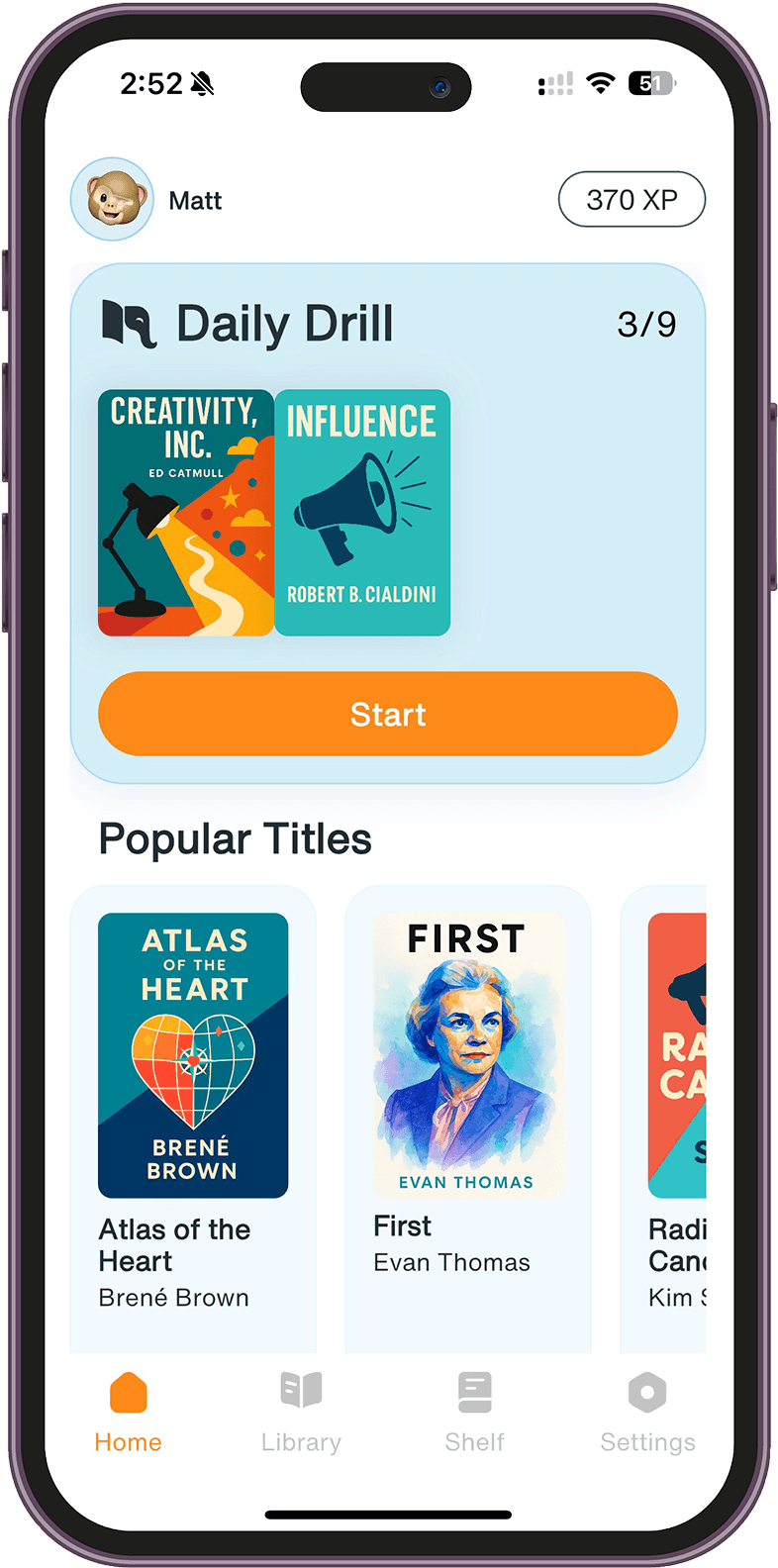
Loxie uses spaced repetition and active recall to help you move these concepts from understanding to availability. Instead of reading once and hoping the ideas stick, you practice for just 2 minutes a day with questions that resurface ideas right before you'd naturally forget them.
When you're in a difficult conversation and feel the urge to armor up, you won't have time to look up what "rumbling with vulnerability" means. Either the concept is available in your mind at that moment, or it's not. Loxie's approach ensures these frameworks are there when you need them—not just when you're reviewing notes.
Loxie includes full access to Dare to Lead and hundreds of other books, so you can start reinforcing these leadership concepts immediately. No credit card required, no trial limitations. If Brown's research resonates with you, make sure it stays with you.
Frequently Asked Questions
What is the main idea of Dare to Lead?
The central idea is that vulnerability—the willingness to show up when you can't control the outcome—is not weakness but the foundation of courageous leadership. Brown's research proves you cannot have courage, innovation, or trust without first being willing to be vulnerable. This transforms leadership development from projecting certainty to building the capacity for openness and authenticity.
What are the key takeaways from Dare to Lead?
Key takeaways include: vulnerability is courage (not weakness), clear is kind (honest feedback is more compassionate than avoidance), the BRAVING inventory breaks trust into seven fixable behaviors, perfectionism kills innovation by making mistakes unacceptable, and living values means practicing them when it's hard, expensive, or unpopular—not just when convenient.
What does 'clear is kind' mean?
Clear is kind means that direct, honest communication—even when uncomfortable—is more compassionate than avoiding difficult conversations that leave people confused. When leaders withhold hard truths to "be nice," they're actually protecting themselves from discomfort while setting others up for failure. True kindness is giving people the clear information they need to succeed.
What is the BRAVING trust framework?
BRAVING is an acronym for seven behaviors that build trust: Boundaries (respecting limits), Reliability (doing what you say), Accountability (owning mistakes), Vault (keeping confidences), Integrity (choosing what's right over what's easy), Non-judgment (letting people struggle without judgment), and Generosity (assuming good intent while maintaining accountability).
What does Brené Brown mean by 'rumbling with vulnerability'?
Rumbling with vulnerability means staying engaged in tough conversations when every instinct tells you to shut down, deflect, or armor up. It's the practice of leaning into discomfort rather than avoiding it, staying curious for longer than is comfortable, because breakthrough understanding and deeper trust happen in that difficult space—not in the shortcuts that let you escape.
How can Loxie help me remember what I learned from Dare to Lead?
Loxie uses spaced repetition and active recall to help you retain the key concepts from Dare to Lead. Instead of reading the book once and forgetting most of it, you practice for 2 minutes a day with questions that resurface ideas right before you'd naturally forget them. Loxie includes Dare to Lead in its full topic library, so you can start reinforcing these leadership concepts immediately.
We're an Amazon Associate. If you buy a book through our links, we earn a small commission at no extra cost to you.
Stop forgetting what you learn.
Start learning for good with your 7-day FREE trial.