Deep Work & Focus: Key Concepts & What You Need to Know
Master the rare ability to concentrate without distraction—the skill that separates high performers from the perpetually busy.
by The Loxie Learning Team
In an economy that increasingly rewards thinking over doing, the ability to focus deeply for extended periods isn't just a nice-to-have—it's a career-defining skill. Yet most knowledge workers spend their days drowning in emails, bouncing between meetings, and never finding time for the cognitively demanding work that actually creates value. The problem isn't laziness; it's that no one taught us how to protect and cultivate our attention.
This guide breaks down the essential concepts of deep work and focus. You'll learn the critical distinction between deep and shallow work, understand why a single email check costs you 23 minutes of productivity, discover the flow state triggers that transform effortful grinding into absorbed engagement, and master practical strategies for protecting your most valuable cognitive resource: sustained attention.
 Start practicing Deep Work concepts ▸
What is deep work and why does it matter?
Deep work involves cognitively demanding activities that push your mental capabilities to their limit while creating new value, improving skills, or producing work that's hard to replicate. Writing complex code, developing strategic plans, learning difficult concepts, solving novel problems—these activities require sustained, distraction-free focus to access your full cognitive capacity.
The key distinction is that deep work stretches your abilities and produces unique value. Reading and understanding a complex research paper is deep work; skimming news articles is not. Creating a novel solution to a technical problem is deep work; attending routine status meetings is not. This distinction matters because deep work is what creates career capital and competitive advantage in knowledge work.
Deep work requires uninterrupted focus because complex cognitive tasks depend on loading relevant information into working memory and maintaining intricate mental models. Think of it like building a house of cards in your mind—each layer depends on the previous ones staying perfectly in place. A single interruption forces you to rebuild these models from scratch, which is why fragmented time produces dramatically inferior results compared to continuous blocks. Two hours of uninterrupted work produces more than four hours of frequently interrupted time because the cognitive architecture required for complex thinking cannot survive disruption.
What is shallow work and why is it dangerous?
Shallow work consists of logistical tasks like email, scheduling, data entry, and routine meetings that can be performed while distracted and don't create significant new value. These tasks feel productive because they generate visible activity and cleared inboxes, but they don't move important projects forward or develop valuable skills.
The danger of shallow work is that it provides immediate satisfaction—inbox zero, responded messages, completed administrative tasks—while consuming time that could be spent on value creation. Many knowledge workers spend entire days on shallow work while believing they're being productive, not recognizing that being busy and creating value are entirely different things.
Research consistently shows that most knowledge workers spend 60% of their time on shallow tasks like email, meetings, and administrative work while believing they're doing important work. The problem isn't laziness but confusion about what creates value. Clearing your inbox feels productive but doesn't create anything new. Attending meetings feels important but often doesn't require your unique expertise. Until you consciously distinguish deep from shallow work, shallow tasks will continue expanding to fill all available time.
The deep work advantage
The ability to distinguish deep work (creating, analyzing, strategizing) from shallow work (responding, coordinating, administrating) and ruthlessly protect deep work time determines professional value creation. Those who can maintain 3-4 hours of daily deep work dramatically outperform those who only manage scattered minutes between interruptions.
Research on elite performers shows they average 3-4 hours of deliberate practice daily, which aligns with deep work capacity. This isn't about working more hours but about protecting a critical mass of focused time. A programmer who codes for 3 uninterrupted hours will outproduce someone who codes for 6 hours with constant Slack interruptions. The difference compounds over time into dramatically different career trajectories. Understanding this distinction intellectually is one thing—but applying it consistently requires internalizing these concepts so deeply they become automatic. Loxie helps you move from knowing about deep work to actually implementing it by reinforcing these principles through spaced repetition.
Practice deep vs. shallow work concepts ▸
How do you design an environment for deep work?
Environmental design for deep work requires removing visual triggers like phones, browser tabs, and clutter because seeing these distractions activates neural pathways that demand willpower to resist. Each resistance depletes cognitive resources you need for the actual work, making focus progressively harder throughout the session.
Your brain automatically processes everything in your visual field, even when you're not consciously attending to it. A visible phone triggers thoughts about messages waiting. An open browser suggests quick checks. Each suppression of these impulses uses the same mental energy needed for complex thinking. This is why working in a visually clean environment isn't about aesthetics but about preserving cognitive resources.
The phone-in-another-room effect
Studies demonstrate that physical distance from distractions improves cognitive performance even when devices are silenced. Test scores improve by 10-15% when phones are in another room versus face-down on the desk, proving that proximity alone creates cognitive drain. Your brain maintains a background process monitoring nearby devices even when you're not consciously thinking about them. Physical separation is more powerful than any app or setting.
Creating dedicated deep work spaces
Dedicated deep work spaces create psychological associations where entering the space automatically triggers focus mode. Using a specific desk, room, or even chair exclusively for concentrated work trains your brain to shift into deep work without conscious effort, like how your bedroom triggers sleepiness. Professional writers often have a separate writing space they never use for anything else. The association becomes so strong that simply sitting in the chair initiates the mental shift to concentration, eliminating the usual warm-up period.
What triggers flow state and how do you reach it consistently?
Clear goals with defined outcomes enable flow state by eliminating decision fatigue. Knowing exactly what 'done' looks like—complete first draft, solve these three problems, finish code module—allows your brain to dedicate all cognitive resources to execution rather than constantly questioning what you should be doing.
Vague goals like 'work on project' force your brain to repeatedly decide what to do next, breaking concentration. But specific goals like 'write introduction section of 500 words' create a clear target that pulls you forward. Olympic athletes visualize exact performances before competing for this reason—the clearer the target, the easier it is to enter flow state pursuing it.
The 4% challenge-skill sweet spot
Challenge-skill balance for flow requires tasks roughly 4% beyond current ability. Too easy creates boredom that invites distraction. Too hard triggers anxiety that breaks concentration. But slight stretch engages your full attention while remaining achievable, creating the absorbed focus that defines flow state.
This 4% sweet spot comes from research on peak performance. It's why video games are so engaging—they constantly adjust difficulty to stay just beyond your current skill. In work, you can create this by breaking complex projects into subtasks at the right difficulty, or by adding constraints to easy tasks (like time limits) to increase challenge. The key is finding tasks that make you reach without making you struggle.
Knowing about flow triggers isn't the same as using them
You've just learned that clear goals, immediate feedback, and challenge-skill balance trigger flow state. But will you remember to apply these principles tomorrow? Loxie helps you internalize these concepts through daily practice so they become second nature.
Make flow triggers automatic ▸What is the true cost of context switching?
Context switching imposes a 23-minute recovery cost because your brain must rebuild the entire mental model of the original task. A 30-second email check actually costs 23.5 minutes of deep work capacity, meaning four brief checks per hour completely eliminate your ability to do cognitively demanding work.
This 23-minute figure comes from UC Irvine research tracking knowledge workers. The cost isn't just the interruption time but the cognitive effort required to reload context, remember where you were, and rebuild focus. It's like restarting your computer—quick to shut down, slow to return to full capacity. This explains why people feel exhausted after days full of 'quick checks' despite not accomplishing anything substantial.
Attention residue and working memory
The true cost of interruptions compounds because each switch leaves attention residue from the previous task. If you check email while writing a report, part of your mind continues processing the email even after returning to writing, reducing your cognitive capacity by up to 40% until the residue clears.
Your brain doesn't have a clean 'switch' between tasks. It's more like having multiple browser tabs open—even when you're focused on one, the others consume memory. This residue effect is why you might read the same paragraph three times after an interruption without comprehending it. Your conscious mind is reading, but unconscious processes are still handling the previous task.
The Zeigarnik effect and open loops
Attention residue occurs when part of your cognitive capacity remains stuck on unfinished tasks. Incomplete work creates open loops that your brain continuously processes in the background, consuming mental bandwidth even when you're trying to focus on something else, like running an app that won't close.
The Zeigarnik effect explains why unfinished tasks dominate mental space. Russian psychologist Bluma Zeigarnik discovered that waiters could remember complex orders perfectly until they were delivered, then immediately forgot them. Your brain treats unfinished tasks as problems requiring active monitoring. This is why writing down tasks in a trusted system provides relief—your brain stops maintaining the open loop once it trusts the external system will handle it.
Learn to eliminate attention residue ▸
How do you manage communication without destroying focus?
Task batching consolidates similar shallow activities into dedicated blocks—processing all emails at 11am and 4pm, scheduling meetings only on Tuesdays/Thursdays, or handling all administrative tasks in one Friday afternoon session. This approach reduces context switching costs while protecting remaining time for uninterrupted deep work.
Batching works because similar tasks use the same cognitive mode and mental models. Processing 20 emails in one sitting is far more efficient than handling them individually throughout the day. Your brain loads the 'email processing' context once instead of twenty times. This approach transforms shallow work from constant interruption into contained, efficient sessions.
Sender filters and friction
Sender filters reduce incoming communication by making senders do more work upfront. Requiring specific subject line formats like '[Action Required]' or '[FYI Only]', using intake forms instead of open-ended emails, or establishing office hours for questions shifts effort to senders and protects your attention from low-value interruptions.
Most people send emails without considering the receiver's time cost. Sender filters create friction that makes people pause and consider whether the communication is necessary. When sending an email requires filling out a form with specific fields, many realize they can solve the problem themselves. This isn't about being difficult but about protecting finite attention for high-value work.
How do you train your concentration like a muscle?
Productive meditation uses physically occupied but mentally free time like walking, driving, or showering to focus on a single professional problem. Repeatedly returning wandering attention to the problem trains concentration muscles exactly like traditional meditation, but produces work output while building focus capacity.
Your mind naturally wanders during physical activities. Productive meditation harnesses this by giving your mind a specific problem to wander toward. When you notice thoughts drifting to other topics, you gently return to the problem, building the same attention control as sitting meditation. Many breakthrough insights come during these sessions because the relaxed state allows novel connections.
Attention restoration and recovery
Attention restoration requires activities that use different cognitive systems than focused work. Nature walks engage spatial processing, simple physical tasks use motor control, daydreaming activates the default mode network. Without these restoration periods, concentration capacity permanently depletes like a muscle that never recovers between workouts.
The brain networks used for focused attention need genuine rest to restore. Switching to 'lighter' work doesn't provide this restoration because it uses the same executive attention networks. True restoration comes from activities that let the prefrontal cortex idle while other brain regions take over. This is why a walk in nature restores focus better than scrolling social media.
What are the different deep work philosophies?
Deep work rituals eliminate decision fatigue by standardizing every aspect of focus sessions—same start time, same location, same beverage, same music. These rituals convert the transition into deep work from an effortful decision requiring willpower into an automatic behavior triggered by environmental cues.
Every decision depletes the same willpower reserve you need for deep work. By ritualizing everything—where you sit, what you drink, how you begin—you preserve mental energy for the actual work. Writers who always start by sharpening pencils, programmers who always begin with specific music, researchers who always light a candle—these aren't quirks but cognitive optimization strategies.
The monastic philosophy
The monastic philosophy eliminates or radically minimizes all shallow obligations—no email, minimal meetings, no administrative tasks—maximizing deep work by removing competing commitments entirely. This approach is suitable only for people whose primary value creation comes from singular deep thinking like researchers, authors, or artists. Donald Knuth, the computer scientist, doesn't use email at all. His assistant prints important messages quarterly.
The rhythmic philosophy
The rhythmic philosophy embeds deep work into daily routine through consistent scheduling—every morning 5-8am before family wakes, first four hours of each workday before meetings, or every evening 8-11pm after kids sleep. This approach builds an automatic habit that makes deep work inevitable rather than negotiated. By linking deep work to daily rhythms, it becomes as automatic as brushing teeth. The consistency builds cumulative progress—3 hours daily equals 15 hours weekly, 780 hours yearly.
Choosing the right philosophy
Philosophy selection depends on three factors: role constraints (how much schedule control you have), value creation type (solo deep thinking vs collaborative iteration), and cognitive switching ability (how quickly you can enter deep focus). Matching philosophy to context determines success more than the philosophy itself.
A startup founder can't go monastic but might manage bimodal. A manager can't disappear for days but could do rhythmic mornings. A consultant with variable client demands might need journalistic. The best philosophy is the one you can actually execute given your real constraints. Choosing an incompatible philosophy guarantees failure regardless of motivation.
Find your deep work philosophy ▸
The real challenge with learning deep work concepts
You've just absorbed a comprehensive framework for protecting your attention and doing meaningful work. You understand the 23-minute switching cost, the 4% challenge-skill sweet spot for flow, the Zeigarnik effect, and the differences between monastic, rhythmic, and journalistic philosophies. But here's the uncomfortable truth: within a week, you'll have forgotten most of these specific insights.
Research on memory shows we lose 70% of new information within 24 hours and up to 90% within a week without reinforcement. The irony is painful—you're learning about focus and retention, yet the learning process itself is designed to fail. Reading about deep work once doesn't make you a deep worker any more than reading about exercise makes you fit.
How Loxie helps you actually remember what you learn
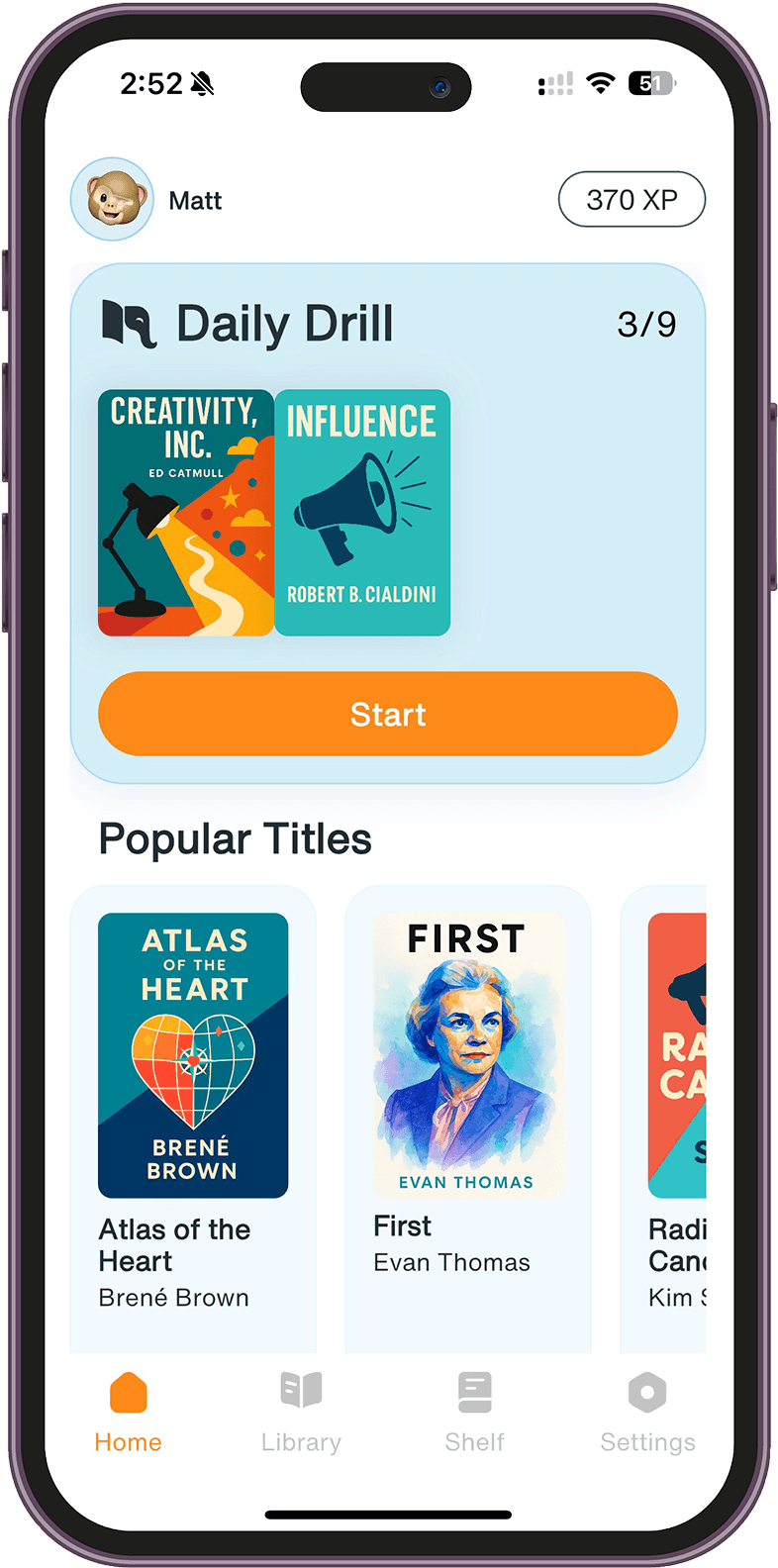
Loxie uses spaced repetition and active recall to transform these deep work concepts from interesting ideas into permanently accessible knowledge. Instead of reading once and forgetting, you practice for 2 minutes a day with questions that resurface the 23-minute switching cost, the flow state triggers, and the attention residue concept right before you'd naturally forget them.
Loxie includes deep work and focus concepts in its complete topic library. Each time you practice, you're not just reviewing—you're strengthening the neural pathways that make these ideas available when you're designing your workday, setting up your environment, or choosing between checking email and protecting your focus time.
Frequently Asked Questions
What is deep work?
Deep work involves cognitively demanding activities that push your mental capabilities to their limit while creating new value, improving skills, or producing work that's hard to replicate. Examples include writing complex code, developing strategic plans, or learning difficult concepts. Deep work requires sustained, distraction-free focus to access your full cognitive capacity.
What is the difference between deep work and shallow work?
Deep work creates significant new value and requires focused concentration—writing, analyzing, strategizing. Shallow work consists of logistical tasks like email, scheduling, and routine meetings that can be performed while distracted. The key test: could a bright recent graduate learn this task in 30 minutes? If yes, it's shallow work.
How long does it take to recover from an interruption?
Research shows it takes an average of 23 minutes to fully recover focus after an interruption. This means a 30-second email check actually costs 23.5 minutes of deep work capacity. Four brief checks per hour can completely eliminate your ability to do cognitively demanding work.
What triggers flow state?
Flow state requires three conditions: clear goals with defined outcomes, immediate feedback on progress, and challenge-skill balance where the task is roughly 4% beyond your current ability. Too easy creates boredom; too hard triggers anxiety. The sweet spot engages full attention while remaining achievable.
What is attention residue?
Attention residue occurs when part of your cognitive capacity remains stuck on previous tasks after switching. If you check email while writing a report, part of your mind continues processing the email even after returning to writing, reducing cognitive capacity by up to 40% until the residue clears.
How can Loxie help me learn deep work concepts?
Loxie uses spaced repetition and active recall to help you retain deep work concepts permanently. Instead of reading once and forgetting most of it, you practice for 2 minutes a day with questions that resurface ideas like the 23-minute switching cost and flow state triggers right before you'd naturally forget them. Loxie includes deep work in its complete topic library.
Stop forgetting what you learn.
Start learning for good with your 7-day FREE trial.