Difficult Conversations: Key Insights & Takeaways
Master the Harvard Negotiation Project's framework for transforming conflicts into productive dialogues that solve problems and strengthen relationships.
by The Loxie Learning Team
Why do some conversations feel impossible no matter how hard you try? Difficult Conversations by Douglas Stone, Bruce Patton, and Sheila Heen reveals that every challenging discussion actually contains three hidden conversations happening simultaneously—and most of us only address one while ignoring the others entirely. This explains why arguments escalate, why reasonable people talk past each other for years, and why the same conflicts keep resurfacing.
This guide breaks down the complete framework from the Harvard Negotiation Project for transforming conflicts into productive dialogues. Whether you're navigating tension with a colleague, having a hard talk with a family member, or addressing an issue with a friend, you'll learn not just what to say, but how to understand the deeper dynamics that make conversations difficult in the first place.
 Start practicing Difficult Conversations free for 7 days ▸
What are the three conversations hidden in every difficult discussion?
Every difficult conversation is actually three conversations happening simultaneously: the "What Happened?" conversation about facts and interpretations, the Feelings conversation about emotions, and the Identity conversation about what the situation says about who we are. This framework reveals why arguments escalate—we're not just debating facts but defending our emotions and self-image at the same time.
Consider a simple disagreement about a missed deadline. On the surface, you're discussing what happened and who's responsible. But underneath, one person might feel disrespected (Feelings conversation) while the other feels their competence is being questioned (Identity conversation). Neither party addresses these deeper layers directly, so the surface argument goes in circles while the real issues remain untouched.
Understanding these three layers allows you to address what's actually causing the conflict. When someone reacts disproportionately to a minor issue, it's often because their identity feels threatened or their emotions are running high—not because they're being irrational about the facts. Recognizing which conversation each person is having enables you to align the dialogue and address what really matters.
How do you transform a battle into a learning conversation?
The goal isn't to eliminate difficult conversations but to transform them from battles about who's right into learning conversations where both parties understand each other better and find solutions together. This shift from winning to learning changes the entire dynamic of any conflict.
When you approach a conversation trying to prove you're right, you're invested in defeating the other person's perspective. But when you approach it trying to learn—genuinely curious about why they see things differently—you become collaborators exploring a puzzle rather than adversaries fighting for victory. This doesn't mean abandoning your perspective; it means holding it alongside genuine curiosity about theirs.
The practical difference is profound. Instead of defending positions, people explore perspectives. Instead of preparing rebuttals while the other person talks, you actually listen. Instead of conversations ending with one winner and one loser (who will likely seek revenge later), they end with both parties feeling understood—even if they still disagree. This approach preserves relationships while actually solving problems more effectively than adversarial debates.
Practice these techniques in Loxie ▸
Why do we see the same situation so differently?
We each have different information (what we notice and remember), different interpretations (the meaning we make), and different values (what we think is important)—yet we argue as if there's one objective truth rather than multiple valid perspectives. This insight dismantles the assumption that disagreement means someone is wrong.
Two witnesses to the same meeting will literally see different things based on their position in the room, what they were focused on, and their past experiences with the people involved. One person might notice a colleague's dismissive tone while another, sitting elsewhere, noticed only the content of what was said. Their conflicting accounts of what happened can be equally true from their respective perspectives.
The curiosity shift that changes everything
The shift from "I'm right, you're wrong" to "I wonder what information you have that I don't" transforms adversaries into puzzle-solving partners. Instead of defending and attacking, both parties become investigators trying to understand why two reasonable people see things so differently.
This reframe changes the entire emotional tone of difficult conversations. When you genuinely wonder what the other person saw that you didn't, you often uncover surprising information that changes everything. Maybe they had context you lacked. Maybe you had context they lacked. Either way, the conversation becomes collaborative exploration rather than competitive debate.
What is the intent-impact gap and why does it matter?
We know our own intentions but only see others' impact on us, while they know their intentions but only see our impact on them—creating mirror-image misunderstandings where both parties feel like the victim. This asymmetry explains why both people in a conflict can genuinely feel wronged.
Here's how it works: You judge yourself by your good intentions ("I was just trying to help") while judging others by how their actions hurt you ("They made me look bad in that meeting"). Meanwhile, they do exactly the same in reverse—they know they meant well, but they only see how your reaction hurt them. Both people walk away feeling attacked by someone who claims to be innocent.
How to disentangle impact from intent
The solution is to separate what happened (impact) from why it happened (intent). Say "When you did X, I felt Y" instead of "You intended to hurt me." This allows you to share your experience without triggering defensiveness about motives you can't actually know.
This linguistic shift is powerful because your feelings are indisputable—no one can argue with how something affected you—while accusations about intentions invite arguments. Saying "When you interrupted me in the meeting, I felt dismissed" opens space for the other person to clarify their actual intentions ("I was excited about your idea and wanted to build on it") without first having to defend against false assumptions about wanting to hurt you.
Communication frameworks are easy to understand but hard to remember in the heat of conflict.
Loxie uses spaced repetition to help you internalize these techniques so they're available when you need them most—not just when you're calmly reading about them.
Try Loxie free for 7 days ▸What is the difference between blame and contribution?
Contribution explores how each person's actions led to the current situation, while blame judges who's wrong—shifting from blame to contribution transforms finger-pointing into collaborative problem-solving. This distinction changes everything about how conflicts get resolved.
Blame looks backward to punish: "This is your fault." Contribution looks forward to prevent: "How did we both end up here?" When both parties examine their contribution (even if unequal), they move from adversaries to collaborators working to improve the situation. This doesn't mean accepting responsibility for things that weren't your fault—it means understanding how the system of interactions between you created the problem.
Why focusing on your contribution gives you power
Even when the split is 95%-5%, focusing on your 5% contribution gives you power to change the dynamic, while waiting for the other person to fix their 95% leaves you helpless and resentful. This counterintuitive approach recognizes that you can only control your own behavior.
By changing even your small contribution, you alter the system dynamics and often inspire reciprocal changes. If you always respond to criticism with defensiveness, and you shift to responding with curiosity, the entire conversation pattern changes—even if the other person's criticism was mostly unfair. Focusing on others' faults maintains the status quo; changing your own behavior creates movement.
Why do unexpressed feelings sabotage conversations?
Unexpressed feelings don't go away—they leak out through tone, body language, and passive-aggressive behavior, contaminating the conversation in ways that are harder to address than explicit emotions. When we try to be "rational" by suppressing emotions, they emerge sideways as sarcasm, withdrawal, or subtle sabotage.
You've probably experienced this: someone claims they're "fine" while their tone says otherwise. Or you find yourself making cutting remarks about unrelated topics because you're angry about something you haven't addressed directly. These indirect expressions of emotion make conversations more confusing and harder to resolve than simply stating "I'm frustrated" would.
Acknowledging feelings directly paradoxically makes conversations less emotional and more productive. When you say "I'm frustrated because I feel like my efforts aren't being recognized," you've named the elephant in the room. Now it can be addressed. When you pretend the elephant isn't there, everyone has to navigate around it while pretending it doesn't exist—which is exhausting and ultimately futile.
Start retaining what you learn ▸
What is the identity conversation and why does it trigger such strong reactions?
Identity conversations are about whether we're competent, good, or worthy of love—and when these core self-perceptions feel threatened, we literally cannot hear feedback or engage productively until we regain our balance. This explains why minor criticisms can trigger major reactions.
If feedback threatens your sense of being a good parent, competent professional, or caring friend, your identity is at stake. A comment like "You forgot to pick up the kids" isn't just about logistics—it might feel like an accusation that you're a bad parent. When identity is threatened, the primitive brain takes over, making rational discussion impossible until the threat is neutralized.
Moving from all-or-nothing identity to complexity
We often have an all-or-nothing identity—seeing ourselves as either completely competent or totally incompetent. When feedback threatens this binary view, we panic rather than learning from legitimate criticism.
The solution is developing a complex identity: "I'm generally competent but still learning in some areas." This creates resilience that allows you to hear feedback without feeling destroyed. When your identity can hold multiple truths simultaneously—"I'm a caring person AND I sometimes hurt people unintentionally"—criticism becomes information rather than condemnation.
Grounding identity in what you can control
Ground your identity in things you can control (your effort, intentions, and capacity to learn) rather than things you can't (others' opinions, outcomes, or being perfect). When identity depends on always being right or liked by everyone, any criticism becomes devastating.
But when identity is based on trying your best and learning from mistakes, feedback becomes useful information rather than an attack on your worth. You can hear "that presentation didn't land well" without it meaning "you're incompetent." This shift enables growth instead of triggering defense.
How do you start a difficult conversation without triggering defensiveness?
Start difficult conversations from the "Third Story"—a neutral description of the situation that both parties can accept, like "We see this situation differently" rather than "You screwed up and need to apologize." This neutral opening prevents immediate defensiveness by not assigning blame or taking sides.
The Third Story describes the problem as a mediator would see it—acknowledging that there's a difference between views without judging who's right. It positions you as partners facing a shared problem rather than opponents, creating psychological safety that allows both people to share their perspectives openly.
Compare these openings: "You've been completely dismissive of my ideas" versus "I've noticed we seem to have different views about how decisions should be made on this project." The first guarantees a defensive reaction. The second invites collaboration because it doesn't attack anyone's identity or assign fault.
What does it mean to truly listen in a difficult conversation?
True listening requires managing your internal voice—the running commentary that prepares rebuttals, makes judgments, and plans responses—by explicitly shifting focus to understanding their story, feelings, and identity concerns. Most "listening" is actually waiting to talk while mentally preparing counterarguments.
Real listening means temporarily suspending your own agenda to fully grasp not just their words but their emotions and what this means for their self-image. This is harder than it sounds. When someone is saying something you disagree with, your brain automatically starts building your response. Genuine listening requires consciously interrupting this process.
Paraphrase for understanding, not agreement
Saying "Let me make sure I understand: you felt blindsided when..." shows you're listening without endorsing their view. This technique satisfies the speaker's need to be understood while preserving your ability to disagree.
When people feel truly heard, they become less repetitive and defensive. They stop escalating to make their point because they trust it's been received. This creates space for them to hear your perspective in return. The paradox is that truly listening to someone's position often makes them more willing to hear yours.
The power of "And Stance" over "But Stance"
Use "And Stance" instead of "But Stance"—saying "I see you worked hard on this AND I have concerns about the approach" validates both perspectives rather than negating theirs with "but."
The word "but" erases everything before it, triggering defensiveness. "I appreciate your effort, but..." communicates that the appreciation is meaningless preamble to the real message. "And" holds both truths simultaneously, acknowledging their reality while adding yours. This linguistic shift dramatically reduces resistance and creates space for both perspectives to coexist.
How do you share your perspective without attacking?
Share your story as your experience, not the truth—using phrases like "From my perspective" or "The story I'm telling myself" acknowledges subjectivity and invites dialogue rather than debate about who's right.
This framing prevents arguments about objective truth by acknowledging that you're sharing one perspective among many. It makes your view hearable because you're not attacking theirs. "The story I'm telling myself is that you didn't value my input" is much easier to respond to than "You don't value my input" because the first invites curiosity about different perspectives while the second triggers defense.
Reframing attacks into concerns
When someone says "You don't care about this project," hear it as "I'm worried my contributions aren't valued" and respond to the underlying fear. This translation skill recognizes that most attacks express unmet needs or fears.
By responding to the emotion behind the accusation rather than the accusation itself, you address what really matters and de-escalate rather than counterattack. Saying "It sounds like you're worried your work isn't being appreciated—can you tell me more about that?" addresses their real concern rather than defending against their inflammatory words.
When should you not have a difficult conversation?
Sometimes the most powerful choice is not having the conversation—when the relationship isn't worth the effort, when you can't change the outcome, or when your identity is too fragile to handle it constructively right now. This permission to walk away prevents wasting energy on unchangeable situations.
Three conversation purposes determine whether to engage: learning (understanding their perspective), expressing (sharing your experience), or problem-solving (finding solutions). If you can't identify at least one legitimate purpose, don't have the conversation. Entering a conversation to change someone's mind or prove you're right—purposes that rarely succeed—sets you up for frustration.
This is strategic rather than avoidant—choosing battles where conversation can actually make a difference. Sometimes the wise choice is waiting until you're less triggered, or accepting that some relationships or situations aren't worth the investment of a difficult conversation.
How do the skills work together as a complete system?
The complete framework works as a system: start from Third Story, listen for their three conversations, share your three conversations, and problem-solve from a learning stance—each element reinforces the others. This integrated approach creates a self-reinforcing cycle where each skill makes the others more effective.
The Third Story opening reduces defensiveness, which makes the other person more willing to share openly. Real listening builds trust, which makes them more receptive when you share your perspective. And when both parties feel heard, collaborative problem-solving becomes possible. Skip any step and the whole process suffers.
Practice on low-stakes conversations first
Practice on low-stakes conversations first—applying these skills when emotions are calm builds muscle memory for when conversations become truly difficult and your fight-or-flight response kicks in.
Like learning any skill under pressure, you need to practice when stakes are low. Starting with minor disagreements helps internalize the framework so it becomes automatic during high-stress conversations when your primitive brain wants to attack or flee. By the time you face a truly difficult conversation, the skills should be second nature rather than something you have to consciously remember.
The real challenge with Difficult Conversations
Here's the uncomfortable truth about communication frameworks: they're easy to understand and almost impossible to remember when you actually need them. In the heat of conflict, when someone says something that triggers you, your brain doesn't calmly recall the Third Story approach or the distinction between intent and impact. It goes into fight-or-flight mode.
How many times have you read advice about handling conflict, nodded along, and then completely forgotten it the next time someone pushed your buttons? The problem isn't that the advice is wrong—it's that knowledge stored passively in your brain isn't accessible under stress. You need these skills to be automatic, not something you have to consciously retrieve.
How Loxie helps you actually remember what you learn
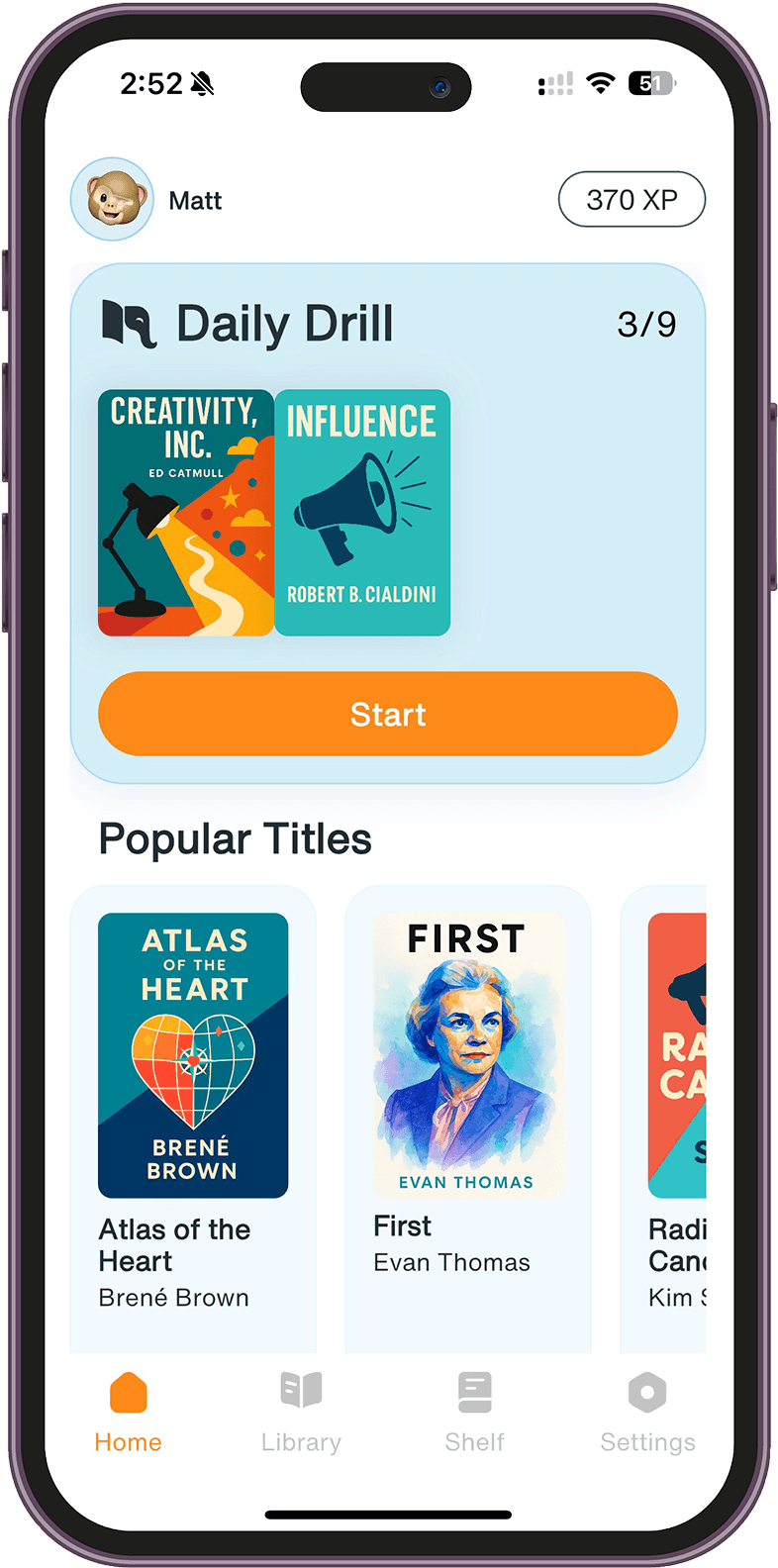
Loxie uses spaced repetition and active recall to help you retain the key concepts from Difficult Conversations. Instead of reading the book once and forgetting most of it within weeks, you practice for just 2 minutes a day with questions that resurface ideas right before you'd naturally forget them.
This isn't passive review—it's active engagement that strengthens neural pathways. When you repeatedly recall the difference between blame and contribution, or practice identifying the three conversations in a scenario, you build the automatic responses that stay with you under pressure. Loxie includes Difficult Conversations in its full topic library, so you can start reinforcing these concepts immediately.
Frequently Asked Questions
What is the main idea of Difficult Conversations?
The central insight is that every difficult conversation is actually three conversations happening simultaneously: the "What Happened?" conversation about facts, the Feelings conversation about emotions, and the Identity conversation about what the situation means for who we are. Understanding and addressing all three layers is essential for productive dialogue.
What are the three conversations in Difficult Conversations?
The three conversations are: (1) the "What Happened?" conversation about differing interpretations of facts and events, (2) the Feelings conversation about unexpressed emotions underlying the discussion, and (3) the Identity conversation about how the situation threatens each person's sense of competence, goodness, or worthiness.
What is the difference between blame and contribution?
Blame focuses on judging who is wrong and looks backward to assign fault, while contribution explores how each person's actions led to the current situation and looks forward to prevent future problems. Shifting from blame to contribution transforms adversarial finger-pointing into collaborative problem-solving.
What is the Third Story approach?
The Third Story is a neutral way to open a difficult conversation that both parties can accept, like "We seem to see this situation differently." It describes the problem as an impartial observer would, without assigning blame or taking sides, creating safety for both people to share their perspectives.
How do you separate intent from impact in a conversation?
Use the formula "When you did X, I felt Y" instead of "You intended to hurt me." This allows you to share how their actions affected you without making assumptions about their motives. It's indisputable (no one can argue with your feelings) and opens space for them to clarify their actual intentions.
How can Loxie help me remember what I learned from Difficult Conversations?
Loxie uses spaced repetition and active recall to help you retain the key concepts from Difficult Conversations. Instead of reading the book once and forgetting most of it, you practice for 2 minutes a day with questions that resurface ideas right before you'd naturally forget them. Loxie includes Difficult Conversations in its full topic library.
We're an Amazon Associate. If you buy a book through our links, we earn a small commission at no extra cost to you.
Stop forgetting what you learn.
Start learning for good with your 7-day FREE trial.