Do Hard Things: Key Insights & Takeaways from Steve Magness
Discover why real toughness comes from emotional intelligence and vulnerability—not just pushing through pain.
by The Loxie Learning Team
What if everything you believed about being tough was actually making you weaker? Steve Magness's Do Hard Things dismantles the cultural myths around mental strength, revealing that suppressing emotions and grinding through pain often backfires. Real resilience, he argues, comes from embracing vulnerability, developing emotional intelligence, and working with your psychology rather than against it.
This guide breaks down Magness's complete framework for building genuine mental toughness. Whether you're an athlete, professional, or anyone facing life's inevitable challenges, you'll learn why traditional "tough it out" approaches fail and what actually works according to cutting-edge psychology and neuroscience research.
 Start practicing Do Hard Things free for 7 days ▸
Why does traditional toughness often backfire?
Traditional cultural definitions of toughness—gritting through pain, suppressing emotions, and never showing weakness—actually undermine performance rather than enhance it. This approach increases stress hormones, impairs decision-making, and prevents the adaptive responses that genuine challenges require. The "tough it out" mentality treats our emotions as enemies to defeat rather than signals to understand.
When we suppress emotions during difficult moments, we trigger what psychologists call emotional rebound effects. The feelings we push down come back stronger, often at the worst possible times. We also lose critical self-awareness data that could help us make better decisions under pressure. The stoic facade might look impressive, but internally we're burning through mental resources at an unsustainable rate.
Magness presents research showing that false bravado creates fragile self-esteem that crumbles under real pressure. Without the foundation of genuine competence and emotional awareness, people become defensive, unable to learn from failure, and increasingly brittle in the face of setbacks. This is the opposite of what we actually need when things get hard.
What does real toughness actually look like?
True toughness comes from developing emotional intelligence and embracing vulnerability rather than suppressing feelings. This allows us to navigate challenges with wisdom and authenticity instead of burning out from constant suppression. Real resilience means understanding our emotions as useful information, not obstacles to overcome.
The emotionally intelligent approach works better because it engages our full cognitive capacity. When we acknowledge what we're feeling rather than fighting it, we activate the prefrontal cortex—the brain region responsible for complex decision-making and emotional regulation. Suppression, by contrast, keeps us stuck in primitive threat-detection mode where nuanced thinking becomes impossible.
This redefinition of toughness applies equally to work performance, relationship quality, and personal growth. In professional settings, psychological safety and adaptive challenge-response create thriving environments. In relationships, mutual vulnerability and emotional attunement deepen connections. Personal development accelerates when we practice self-compassion alongside wise persistence. All these outcomes flow from authentic rather than performative strength.
Practice real toughness principles in Loxie ▸
How does science-based resilience work with our psychology?
Science-based resilience leverages emotional awareness, stress reappraisal, and acceptance rather than fighting against our natural responses. This approach recognizes that sustainable mental strength requires understanding our biological stress responses and emotional systems to channel them productively rather than constantly battling them.
Understanding stress neuroscience transforms how we respond to challenges. Stress responses evolved to mobilize energy and sharpen focus during threats. When we view stress hormones as energy mobilization rather than threats to control, they can actually enhance performance. The racing heart and heightened alertness that feel like anxiety can become fuel for focused action once we reframe their meaning.
Working with biological reactions proves more effective than suppressing them because acknowledgment and acceptance activate higher-order brain functions. When we name what we're feeling and accept its presence, we create space between the emotion and our response. This gap allows wisdom to enter where reactivity previously dominated.
Why acceptance forms the foundation of resilience
Accepting difficult situations as they are forms the foundation for resilience by reducing psychological resistance. When we stop fighting reality, we conserve mental energy and create space for effective action. This isn't passive resignation—it's strategic acknowledgment that enables smart response.
Denial and minimization, by contrast, prevent effective problem-solving. They distort our perception of challenges, delay adaptive responses, and increase long-term stress. The person who accepts that a situation is hard can begin solving it immediately. The person denying the difficulty remains stuck, exhausting themselves on internal resistance rather than external progress.
Why is self-awareness so critical for pursuing difficult goals?
Self-awareness of our patterns and triggers—like tendencies to catastrophize, perfectionism, or avoidance—enables strategic responses that work with our psychology rather than fighting it. When we know our predictable reactions to stress, temptation, and setbacks, we can plan around them instead of being blindsided.
Personal tendency awareness prevents self-sabotage in goal pursuit by helping us anticipate our own obstacles. If you know you tend to give up when progress feels slow, you can build in milestone celebrations. If perfectionism paralyzes your starts, you can commit to imperfect first attempts. Self-knowledge transforms weaknesses into navigable terrain.
This principle extends to understanding our physical intelligence as well. Bodily awareness—recognizing tension patterns, energy levels, and physical cues—helps us distinguish between genuine physiological limits that protect us from harm and perceived barriers created by fear or discomfort that we can safely push through. The body provides real-time data that anxious thoughts often distort.
Self-awareness is powerful—but only if you remember to apply it.
Loxie helps you internalize these patterns and responses so they become automatic, not just intellectual knowledge you forget under pressure.
Build lasting self-awareness with Loxie ▸How do you create space between stimulus and response?
Creating space between stimulus and response through techniques like the 4-7-8 breath, naming emotions, or the 10-second pause enables thoughtful action by engaging the prefrontal cortex rather than defaulting to fight-or-flight reactions. This gap is where wisdom lives—the moment between what happens and how you respond.
Impulsive reactions under pressure often lead to poor outcomes because they bypass our executive function entirely. Our primitive threat-detection systems misinterpret modern stressors as survival threats, triggering responses calibrated for physical danger when we actually need calm analysis. The pause interrupts this ancient programming.
These pause techniques can be trained and strengthened like physical skills through deliberate practice. Start with low-stakes situations—a minor frustration, a small disappointment—and gradually apply the techniques to higher-pressure moments. With repetition, the pause becomes increasingly automatic, available even when stress is high and time feels short.
Why does cognitive flexibility matter for resilience?
Cognitive flexibility allows adaptation to changing circumstances by enabling us to shift perspectives, reframe challenges, and find creative solutions rather than rigidly adhering to predetermined approaches. The ability to think differently when circumstances demand it separates those who persist from those who break.
Having multiple pathways to success reduces brittleness in goal achievement. When we're locked into a single approach, any obstacle becomes a potential failure point. With alternative routes mapped, setbacks become detours rather than dead ends. Momentum survives because we always have another direction to try.
This flexibility extends to how we work with discomfort. Frameworks like the RPE scale (rating perceived exertion) and what Magness calls the "discomfort compass" help us assess whether challenges are building resilience or causing depletion. Not all hard things help us grow—cognitive flexibility includes knowing when to push and when to recover.
Learn flexible response strategies in Loxie ▸
What makes value-aligned challenges more sustainable?
Value-aligned challenges create sustainable motivation because pursuing goals that connect to our core beliefs and identity generates internal drive that persists through difficulties without depleting willpower. When the work matters to who we are, the effort feels purposeful rather than pointless.
Intrinsic motivation sustains effort better than external rewards because it taps into autonomous drive, personal meaning, and mastery desires that regenerate energy rather than deplete it. External rewards require constant replenishment; intrinsic motivation is self-renewing because it feeds on the activity itself.
Connecting with deeper purpose provides resilience during difficulties by creating a "why" that transcends immediate discomfort. When obstacles arise, purpose transforms them from meaningless suffering into meaningful steps toward valued outcomes. The hardship becomes part of the story rather than a reason to quit.
Why arbitrary hardships often lead to burnout
Arbitrary hardships often lead to burnout and poor outcomes because they lack intrinsic meaning. Without connection to values, difficulties require constant willpower expenditure and create resentment rather than growth. The difference between growth pain and harm pain often comes down to whether the struggle serves something we care about.
Growth pain feels sharp but purposeful with clear connection to progress. Harm pain feels dull, persistent, and disconnected from goals. Recognizing this distinction prevents both unnecessary suffering and missed opportunities for development. The point isn't to avoid all discomfort—it's to choose discomfort that actually builds something.
How does genuine confidence differ from false bravado?
Genuine confidence builds from accumulating evidence of actual capabilities through deliberate practice and small wins, creating a stable foundation that withstands setbacks better than affirmations or visualization alone. Real confidence knows its basis; false confidence hopes not to be tested.
This evidence-based approach works because confidence becomes grounded in reality rather than wishful thinking. When challenges arise, the person with genuine confidence can draw on specific memories of past successes. They know they've handled difficulty before because they have concrete proof. The person running on bravado has only stories they've told themselves.
Building this foundation requires working with our psychology by understanding our patterns, triggers, and tendencies. When we know ourselves accurately—both strengths and limitations—we channel natural responses toward productive outcomes rather than creating internal resistance. Self-knowledge and genuine confidence reinforce each other in an upward spiral.
Why is social support essential for genuine resilience?
Social support is essential for developing genuine resilience because shared vulnerability, mutual encouragement, and collective wisdom provide resources that individual willpower cannot replicate. The lone tough individual is actually a harmful myth that undermines strength by discouraging help-seeking and perpetuating isolation.
This matters because resilience isn't a solo sport. When we share our struggles, we access perspectives we couldn't generate alone. When we support others, we strengthen our own sense of capability and purpose. The research is clear: people with strong social connections recover from setbacks faster and perform better under pressure than isolated individuals, regardless of their "individual toughness."
Implementing authentic toughness therefore requires building systems that include others. Structured frameworks like emotional awareness check-ins, vulnerability practice sessions, and flexible response planning work better when shared. Abstract concepts become sustainable habits through social accountability and collective learning.
Start building real resilience with Loxie ▸
The real challenge with Do Hard Things
Here's the uncomfortable truth about books like Do Hard Things: understanding these principles intellectually doesn't mean you'll remember them when you're actually under pressure. When stress hits, your brain defaults to familiar patterns—often the same "suppress and push through" habits Magness warns against. The gap between knowing something and applying it when it matters is where most learning fails.
Research on memory shows we forget roughly 70% of new information within 24 hours. A week later, we might recall a few key concepts but lose the nuances that make them actionable. How many books have you read that felt transformative in the moment but left almost no trace a month later? The insights from Do Hard Things are powerful—but only if they're actually available when you need them.
How Loxie helps you actually remember what you learn
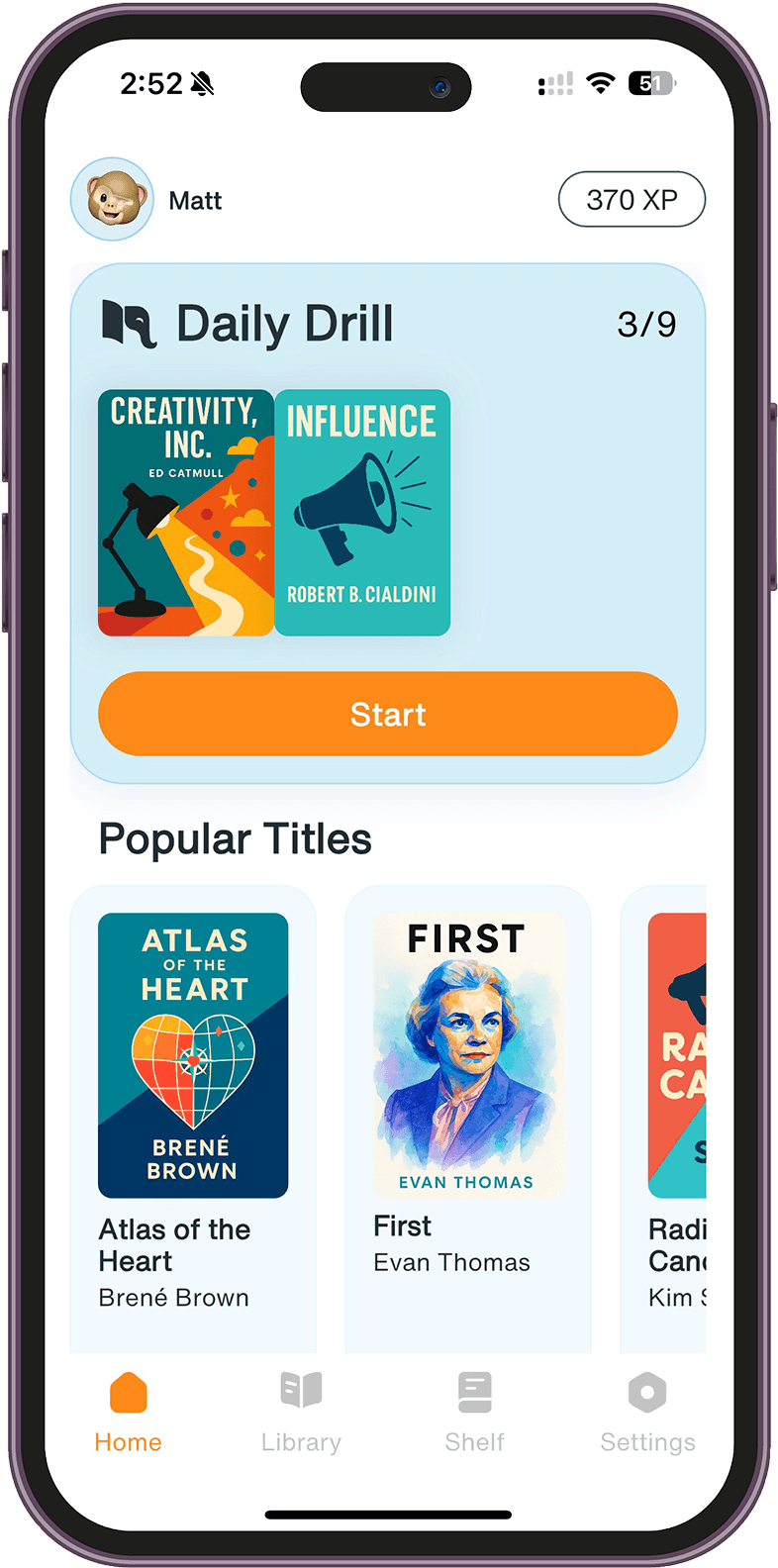
Loxie uses spaced repetition and active recall—the same evidence-based techniques that Magness champions—to help you internalize the concepts from Do Hard Things so they become automatic responses rather than forgotten theory. Instead of reading once and hoping for the best, you practice for just 2 minutes a day with questions that resurface ideas right before you'd naturally forget them.
The science behind this approach is exactly what Magness describes: working with your psychology rather than against it. Your memory has predictable patterns for how information fades. Loxie uses those patterns to strengthen retention at optimal intervals, building genuine knowledge that's available when pressure mounts. Do Hard Things is available in Loxie's free topic library, so you can start reinforcing these concepts immediately.
Frequently Asked Questions
What is the main idea of Do Hard Things?
The central argument is that real toughness comes from emotional intelligence and vulnerability, not suppressing feelings and pushing through pain. Traditional "tough it out" approaches actually undermine performance by increasing stress and preventing adaptive responses. Science-based resilience works with our psychology rather than against it.
What is wrong with traditional toughness according to Steve Magness?
Traditional toughness—gritting through pain and suppressing emotions—increases stress hormones, impairs decision-making, and prevents adaptive responses. It creates fragile self-esteem that crumbles under real pressure and leads to emotional rebound effects where suppressed feelings return stronger at worse times.
What is the difference between growth pain and harm pain?
Growth pain feels sharp but purposeful with a clear connection to progress—it's the discomfort of meaningful challenge. Harm pain feels dull, persistent, and disconnected from goals—it signals depletion rather than development. Recognizing this distinction helps you know when to push and when to recover.
Why does value-aligned challenge create sustainable motivation?
Goals connected to core beliefs and identity generate internal drive that persists through difficulties without depleting willpower. Intrinsic motivation taps into autonomous drive and mastery desires that regenerate energy rather than deplete it, unlike external rewards that require constant replenishment.
What techniques help create space between stimulus and response?
Techniques like the 4-7-8 breath, naming emotions, and the 10-second pause engage the prefrontal cortex rather than defaulting to fight-or-flight reactions. These can be trained like physical skills through deliberate practice, starting with low-stakes situations before applying them to higher-pressure moments.
How can Loxie help me remember what I learned from Do Hard Things?
Loxie uses spaced repetition and active recall to help you retain the key concepts from Do Hard Things. Instead of reading the book once and forgetting most of it, you practice for 2 minutes a day with questions that resurface ideas right before you'd naturally forget them. Loxie includes Do Hard Things in its full topic library.
We're an Amazon Associate. If you buy a book through our links, we earn a small commission at no extra cost to you.
Stop forgetting what you learn.
Start learning for good with your 7-day FREE trial.