Emotional Intelligence: Key Insights & Takeaways from Daniel Goleman
Master Daniel Goleman's groundbreaking framework for developing the emotional skills that matter more than IQ for life success.
by The Loxie Learning Team
What if your ability to understand and manage emotions matters more than your IQ? Daniel Goleman's Emotional Intelligence makes exactly this case, drawing on neuroscience and psychology to show that self-awareness, self-regulation, empathy, and social competence often determine success more powerfully than raw cognitive ability. The evidence is compelling: brilliant people frequently fail when they can't manage frustration or collaborate effectively, while those with moderate IQs but high emotional intelligence build thriving careers and relationships.
This guide breaks down Goleman's complete framework for understanding and developing emotional intelligence. Whether you've read the book and want to reinforce its concepts, or you're encountering these ideas for the first time, you'll gain a deep understanding of how emotions work in the brain, why they matter so much for success, and how to systematically improve your emotional capabilities at any age.
 Start practicing Emotional Intelligence free for 7 days ▸
Why does emotional intelligence predict success better than IQ?
Emotional intelligence predicts life success more powerfully than IQ because it determines how effectively we apply whatever other talents we possess. You can have the highest IQ in the room, but if you can't manage frustration during a setback, collaborate with colleagues who challenge your ideas, or recover from rejection, your intellectual gifts remain largely unrealized.
Goleman points to studies tracking high-IQ individuals over decades that reveal a striking pattern: those who struggle with emotional skills like impulse control, empathy, and social awareness achieve far less than their intellectual potential would predict. Meanwhile, emotionally adept people consistently exceed expectations. The research suggests that as you rise in organizations, emotional intelligence becomes increasingly important while technical skills become table stakes—which explains why brilliant individual contributors often fail as managers while seemingly average performers excel in leadership roles.
This doesn't mean IQ is irrelevant. Cognitive intelligence and emotional intelligence involve separate brain circuits that operate independently. Both matter, but they contribute to success in different ways. IQ gets you in the door; EQ determines what you do once you're there. Understanding this distinction is crucial—but understanding it intellectually and actually developing these skills are two very different things. Loxie helps bridge that gap by reinforcing the specific emotional intelligence concepts and strategies you need to remember when emotional situations arise.
Can emotional intelligence actually be developed, or is it fixed?
The brain's emotional circuits mature through experience, meaning emotional intelligence can be systematically developed at any age through deliberate practice. This stands in stark contrast to IQ, which remains relatively fixed after adolescence. Neuroplasticity—the brain's ability to form new neural pathways—continues throughout life, offering hope that anyone can improve their emotional capabilities regardless of their starting point.
However, Goleman emphasizes that developing emotional intelligence requires extended practice, not quick fixes. Changing emotional habits resembles physical training: consistent practice gradually builds new capacities rather than producing instant transformation. You need months of repetition, not days, to override old patterns and establish new neural pathways. This extended timeline explains why reading about emotional intelligence once rarely produces lasting change—the insights fade before new habits can form.
This is precisely why active recall and spaced repetition matter so much for developing emotional intelligence. Loxie reinforces these concepts over time, ensuring that key strategies for self-awareness, emotional regulation, and empathy stay fresh in your memory when you actually need them in real emotional situations.
Practice these concepts in Loxie ▸
What is emotional hijacking and why does it make smart people do stupid things?
Emotional hijacking occurs when the amygdala—the brain's emotional alarm system—declares an emergency and recruits the rest of the brain to its urgent agenda before the neocortex can evaluate whether the threat is real. This explains road rage, crimes of passion, and all those moments when we're "possessed by emotion" and act in ways we later regret.
The amygdala can trigger an emotional response in as little as 12 milliseconds—before the visual signal even reaches the conscious brain. This speed served our ancestors well when survival depended on split-second responses to physical threats. Jump away from the snake-like stick first; figure out it's just wood later. But these same mechanisms misfire in modern contexts where threats are psychological rather than physical. Your boss's critical email triggers the same fight-or-flight response as a predator attack.
Understanding this neural mechanism provides the biological basis for developing emotional regulation strategies. The key insight is that you need to create a pause between trigger and response—enough time for your thinking brain to catch up with your feeling brain. Goleman describes techniques like cognitive reframing and cooling-off periods that interrupt the hijack cycle. But knowing these techniques and remembering to use them in the heat of the moment are different challenges entirely.
The dual-processing system
We're always operating with two minds: a feeling mind that reacts instantly and a thinking mind that comprehends slowly. Emotional intelligence involves learning when to trust each system and how to get them working together. The amygdala's emotional memories are rough and imprecise—it can mistake a slamming door for gunfire based on a single similarity—which means our feelings often respond to present situations based on past experiences that may be only superficially similar. Self-awareness becomes crucial for distinguishing between legitimate intuitions and false alarms.
What does the marshmallow test reveal about emotional self-regulation?
The marshmallow test revealed that four-year-olds who could delay gratification for a second marshmallow scored 210 points higher on SATs fourteen years later, showing that emotional self-regulation in childhood predicts academic success better than IQ. This landmark study demonstrates that the ability to manage impulses and emotions creates a cascade of advantages that compound over time.
Children who could wait for the second marshmallow developed better focus, stronger relationships, and experienced less stress throughout their lives. The skill of impulse control proved foundational—not because waiting for marshmallows matters, but because the same self-regulation ability transfers to staying focused during boring classes, persisting through difficult problems, and managing frustration when learning gets hard.
The hopeful message is that these skills can be taught. The children who succeeded weren't simply born with more willpower; they used specific strategies like covering their eyes, singing songs, or imagining the marshmallow was just a picture. Emotional self-regulation isn't about white-knuckling through temptation—it's about deploying specific techniques that make resistance easier. Loxie helps you internalize these evidence-based strategies so they're available when you need them.
Start retaining what you learn ▸
What is self-awareness and why is it the foundation of emotional intelligence?
Self-awareness operates like an observing self that watches your thoughts and feelings without being swept away by them—noticing "I am angry" rather than just being angry. This creates space between feeling and action, giving you the opportunity to choose your response rather than simply react.
This metacognitive ability to observe your own mental states as they unfold is the foundation of all emotional intelligence because you cannot manage what you don't notice. Goleman describes three styles of emotional awareness: the self-aware who understand their emotions, the engulfed who are overwhelmed by emotions, and the accepting who are clear about feelings but don't try to change them. Only the self-aware group can actively manage their emotional lives.
The good news is that this witnessing consciousness can be strengthened through practice. Mindfulness techniques train the observing self, building the neural pathways that support emotional self-awareness. But developing this capacity requires consistent practice over time—exactly the kind of sustained engagement that Loxie's spaced repetition system supports.
How does optimism affect performance and can it be learned?
Optimists view setbacks as temporary, specific, and changeable while pessimists see them as permanent, pervasive, and personal. This explanatory style profoundly affects motivation because optimists try harder after failure while pessimists give up. The interpretation of events matters as much as the events themselves.
Goleman draws on research showing that this thinking style can be deliberately retrained. Cognitive therapy techniques that challenge pessimistic interpretations have proven effective at converting pessimists into optimists. When you catch yourself thinking "I always fail at this" (permanent, pervasive), you can consciously reframe it as "This attempt didn't work; I'll try a different approach" (temporary, specific).
Related to optimism is hope—defined as believing you have both the will and the way to accomplish goals. Hope predicts academic success better than prior grades. Unlike wishful thinking, genuine hope involves agency (motivation to pursue goals) plus pathways thinking (generating multiple routes to success). Students taught to break large goals into steps while developing contingency plans show measurable improvement in achievement.
Understanding optimism is one thing. Being optimistic is another.
Loxie helps you internalize the specific cognitive reframing techniques that transform pessimistic thinking patterns into optimistic ones—so they're available when setbacks actually happen.
Try Loxie free for 7 days ▸How does empathy work and why does it matter?
Empathy begins with emotional attunement—literally feeling what another feels through unconscious mimicry of facial expressions and body language. This happens automatically unless we actively suppress it. We're biologically wired to resonate with others' emotions, but modern life often trains us to ignore these signals.
Rebuilding empathy requires consciously paying attention to facial expressions, tone, and posture rather than just words. Research shows that children who can't read emotional cues become social outcasts by age eight, as their inability to recognize when they're annoying others or misreading social situations leads to rejection that compounds over time. This early social failure creates a vicious cycle where rejected children miss opportunities to learn social skills through peer interaction.
The practical implication is that empathy skills can be taught through explicit training in emotional recognition. Teaching children (and adults) to notice and correctly interpret emotional expressions dramatically improves social outcomes. This is another area where consistent practice matters—recognizing emotions becomes more automatic the more you practice it.
What emotional patterns predict divorce?
Couples who divorce show a specific emotional pattern: criticism leads to contempt, which triggers defensiveness and ultimately stonewalling. This cascade becomes increasingly difficult to reverse once contempt enters the relationship. Researcher John Gottman can predict divorce with 94% accuracy based on these emotional interactions, demonstrating that relationship success depends less on compatibility than on how couples manage negative emotions during conflict.
Goleman explains the biological basis for gender differences in conflict management. Men's tendency to stonewall during conflict stems from being more easily physiologically overwhelmed by negative emotions, with their heart rate and blood pressure spiking higher and recovering slower than women's during marital disputes. This difference suggests couples need different strategies based on physiological realities rather than assuming bad intentions.
Understanding these patterns provides a roadmap for intervention. Couples who learn to interrupt the criticism-contempt-defensiveness-stonewalling cascade—by taking breaks when overwhelmed, expressing needs without blame, and acknowledging their partner's perspective—can reverse destructive dynamics. But remembering to use these techniques during actual conflicts requires having them deeply internalized, not just intellectually understood.
Why does emotional intelligence matter more than technical skills at work?
Star performers in organizations aren't distinguished by technical skills or IQ but by emotional intelligence competencies like initiative, collaboration, and persuasion. Studies across hundreds of companies show that EQ matters twice as much as IQ and expertise combined for outstanding performance. As you rise in organizations, emotional intelligence becomes increasingly important while technical skills become table stakes.
This explains a common paradox: brilliant individual contributors often fail as managers while seemingly average performers excel in leadership roles. Technical expertise gets you promoted, but emotional intelligence determines whether you succeed in the new role. Leaders must read team dynamics, motivate diverse personalities, navigate political situations, and inspire others toward shared goals—all emotional intelligence competencies.
Organizational emotional intelligence emerges when companies systematically develop practices that maximize collective EQ—team emotional norms, feedback systems that address feelings, and leadership development focused on emotional competencies. Companies that treat emotional dynamics as legitimate business concerns see measurable improvements in innovation, retention, and profitability because emotions drive the human behaviors that determine organizational outcomes.
How should parents teach emotional intelligence to children?
Parents who acknowledge children's emotions while setting limits—"I see you're angry your brother took your toy, but hitting isn't okay"—raise kids with better emotional regulation than those who dismiss or punish emotional expression. This emotional coaching approach teaches children that feelings are valid but actions have boundaries, providing the scaffolding for developing emotional intelligence rather than suppressing emotions or acting them out impulsively.
Children absorb emotional lessons through thousands of daily interactions, learning from how parents handle their own emotions more than from what parents explicitly teach about feelings. Parents who demonstrate emotional intelligence in their own lives—managing stress constructively, expressing feelings appropriately, showing empathy—naturally transmit these capabilities to their children through observation and imitation.
Temperament sets emotional range but not destiny. Introverted children can learn social skills, anxious children can develop confidence, and aggressive children can master self-control through targeted interventions that work with, not against, their nature. The key is expanding emotional repertoire within constitutional limits, using self-awareness to play to strengths while compensating for vulnerabilities.
How do schools successfully teach emotional intelligence?
Successful emotional literacy programs embed SEL (Social-Emotional Learning) throughout the curriculum rather than treating it as a separate subject. Teachers use literature to explore feelings, cooperative learning to build social skills, and conflict resolution to practice emotional regulation. This integrated approach ensures emotional learning happens daily rather than in isolated lessons.
Schools teaching emotional intelligence report not just behavioral improvements but academic gains. Students who can manage test anxiety, collaborate on projects, and persist through frustration naturally perform better on traditional metrics. This dual benefit makes emotional intelligence programs economically viable for schools focused on test scores while simultaneously addressing the deeper mission of preparing students for life success.
The evidence is clear that youth violence stems from emotional deficits—inability to calm down, perspective-taking failures, and misreading neutral cues as threats. Aggressive children consistently misinterpret ambiguous social situations as hostile, responding with violence to imagined threats. Teaching accurate emotion recognition and impulse control dramatically reduces violent incidents, demonstrating the preventive power of early emotional education.
Practice these concepts in Loxie ▸
The real challenge with Emotional Intelligence
Goleman's book is packed with research-backed insights that could genuinely transform your relationships, career, and wellbeing. The concepts are compelling: understanding emotional hijacking, developing self-awareness, retraining optimism, reading emotional cues, and breaking destructive relationship patterns. But here's the uncomfortable truth: within weeks of finishing the book, most people forget the specific strategies that make emotional intelligence actionable.
Think about it: when you're actually in an emotional hijack—heart racing, thoughts spiraling—can you recall the specific cognitive reframing techniques Goleman recommends? When you're interpreting a setback, do you remember to check whether you're framing it as permanent and pervasive versus temporary and specific? The forgetting curve works against you, erasing the very insights you need most in emotionally charged moments.
This is the gap between knowing and doing that Goleman himself emphasizes. Developing emotional intelligence requires months of consistent practice to build new neural pathways. Reading the book once simply isn't enough exposure to create lasting change.
How Loxie helps you actually remember what you learn
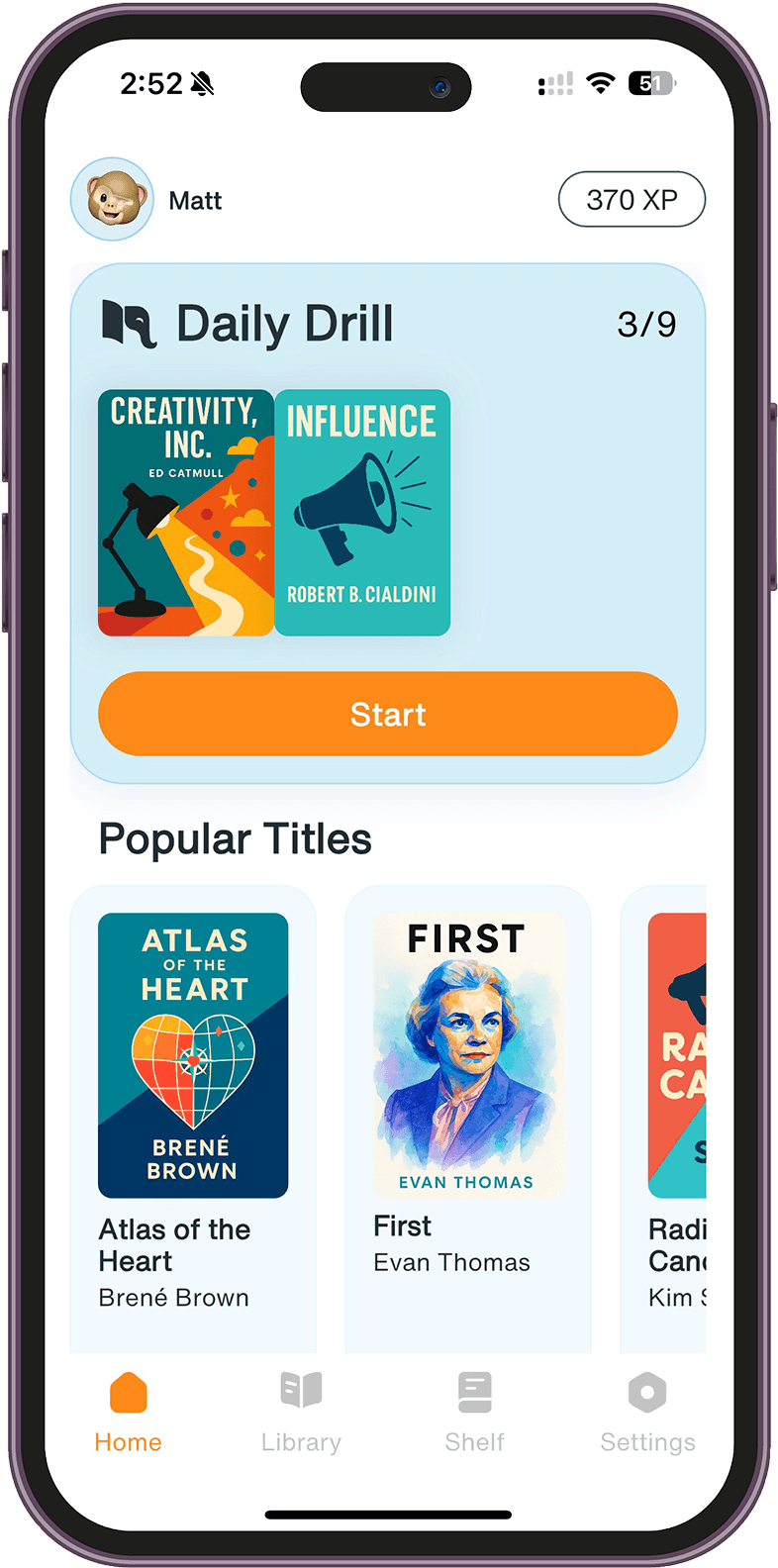
Loxie uses spaced repetition and active recall—the same evidence-based learning techniques that Goleman's neuroplasticity research supports—to help you internalize the key concepts from Emotional Intelligence. Instead of reading the book once and forgetting most of it, you practice for just 2 minutes a day with questions that resurface ideas right before you'd naturally forget them.
This means the specific strategies for managing emotional hijacking, the criteria for optimistic explanatory style, the four-step cascade that predicts divorce, and the emotional coaching techniques for parenting stay fresh and accessible in your memory. When you actually face an emotionally challenging situation, you have the tools available rather than a vague memory that you once read something useful about this.
Loxie includes Emotional Intelligence in its full topic library, so you can start reinforcing these concepts immediately. Because developing emotional intelligence requires consistent practice over time—and Loxie is designed to make that practice effortless.
Frequently Asked Questions
What is the main idea of Emotional Intelligence?
The central argument is that emotional intelligence—the ability to recognize, understand, and manage emotions in ourselves and others—predicts success in life more powerfully than IQ. Goleman demonstrates through neuroscience and psychology that self-awareness, self-regulation, empathy, and social competence determine how effectively we apply our other talents.
What are the key components of emotional intelligence?
Emotional intelligence consists of self-awareness (recognizing your own emotions), self-regulation (managing impulses and emotions), motivation (persisting despite setbacks), empathy (understanding others' feelings), and social skills (managing relationships effectively). These five domains work together to determine emotional competence.
Can emotional intelligence be improved in adults?
Yes. Unlike IQ, which remains relatively fixed after adolescence, emotional intelligence can be developed at any age through deliberate practice. The brain's emotional circuits mature through experience, and neuroplasticity allows new neural pathways to form. However, change requires months of consistent practice, not quick fixes.
What is emotional hijacking?
Emotional hijacking occurs when the amygdala triggers an emergency response before the thinking brain can evaluate the situation. This explains why smart people do stupid things under emotional stress—the amygdala can respond in 12 milliseconds, hijacking the brain before rational thought catches up.
Why does the marshmallow test matter?
The marshmallow test showed that four-year-olds who could delay gratification scored 210 points higher on SATs fourteen years later. This demonstrates that emotional self-regulation in childhood predicts academic and life success better than IQ, and that impulse control creates compounding advantages over time.
How can Loxie help me remember what I learned from Emotional Intelligence?
Loxie uses spaced repetition and active recall to help you retain the key concepts from Emotional Intelligence. Instead of reading the book once and forgetting most of it, you practice for 2 minutes a day with questions that resurface ideas right before you'd naturally forget them. Loxie includes Emotional Intelligence in its full topic library.
We're an Amazon Associate. If you buy a book through our links, we earn a small commission at no extra cost to you.
Stop forgetting what you learn.
Start learning for good with your 7-day FREE trial.