Financial Acumen for Leaders: Key Concepts & What You Need to Know
Master the financial metrics and statements that drive business decisions—even if you've never taken an accounting class.
by The Loxie Learning Team
Every strategic conversation eventually comes back to the numbers. Whether you're discussing a new initiative, evaluating a team's performance, or making a case for resources, financial literacy separates leaders who influence decisions from those who watch them get made. The problem isn't that finance is impossibly complex—it's that most non-financial leaders never learned how to read the story the numbers tell.
This guide breaks down the essential financial concepts every leader needs. You'll learn to read P&L statements like a diagnostic tool, understand why profitable companies can run out of cash, interpret the metrics that reveal business health, and evaluate investments with the same frameworks finance teams use. This is the language of business—and once you speak it, you'll never sit silently in another strategy meeting.
 Start practicing financial concepts ▸
How do you read a P&L statement to find where value gets created or destroyed?
P&L statements flow through four critical stages: revenue (total sales) → gross profit (revenue minus direct costs) → operating income (after overhead expenses) → net profit (after interest and taxes). Each stage reveals different aspects of business performance. A company with strong revenue but negative operating income has a cost structure problem. One with good operating income but poor net profit may have excessive debt costs eating away returns.
This cascading structure acts like a diagnostic tool. By comparing percentages at each stage, you can pinpoint exactly where problems lie. If gross margin is healthy but operating income is negative, overhead is too high relative to sales. If operating income is strong but net profit is weak, look at interest expenses or tax structure. This systematic analysis prevents jumping to wrong conclusions about business performance—something Loxie helps you practice until the diagnostic pattern becomes automatic.
Vertical versus horizontal analysis
Reading a P&L vertically means expressing each line as a percentage of revenue, revealing margin structure and cost efficiency. Reading horizontally means comparing periods to show growth trends and momentum. Combining both perspectives identifies whether problems are structural or temporary.
Vertical analysis shows if your cost structure is competitive—if COGS is 70% of revenue while competitors average 50%, you have a pricing or efficiency problem. Horizontal analysis reveals trends—if operating expenses grew 30% while revenue grew 10%, you're losing operating leverage. Using both methods together distinguishes between one-time issues and fundamental problems requiring strategic changes.
When does revenue actually hit the P&L?
Revenue recognition timing follows different rules depending on business model: cash businesses recognize at payment, product companies at delivery, subscription services over the contract period, and project businesses at milestone completion. A software company selling annual subscriptions for $120,000 recognizes $10,000 monthly even if paid upfront, while a construction company might recognize nothing until project completion despite receiving progress payments.
This timing creates major interpretation challenges. Two companies with identical cash receipts can show vastly different P&L revenue. Understanding recognition rules prevents misreading performance—a subscription business with declining revenue might actually be healthy if bookings are growing, while a construction company showing no revenue might have millions in contracted work. Always ask: when does revenue hit the P&L versus when does cash arrive?
What's the difference between COGS and operating expenses?
Cost of goods sold (COGS) includes only direct costs to produce products or deliver services—materials, direct labor, manufacturing overhead. Operating expenses (OPEX) cover everything else: sales, marketing, R&D, and administration. A restaurant's food and chef labor are COGS, but rent and marketing are OPEX. Software's hosting costs are COGS, but developer salaries building new features are OPEX.
This distinction reveals two different efficiency types. High COGS relative to revenue indicates production inefficiency or weak pricing power—every sale barely covers direct costs. High OPEX relative to gross profit indicates overhead bloat or insufficient scale—the business can't support its infrastructure. Improving COGS requires operational excellence; reducing OPEX relative to revenue requires growth or restructuring.
Practice P&L analysis in Loxie ▸
Why is gross profit the first gate of business viability?
Gross profit (revenue minus COGS) represents money available to cover operating expenses and generate profit. If gross profit is $30 on $100 revenue (30% margin) and operating expenses are $40, you lose $10 per sale regardless of volume. No amount of growth fixes negative unit economics at this level—you must either raise prices or reduce direct costs.
Gross profit is the first gate of business viability. If you can't generate enough gross profit to eventually cover overhead, the business model is broken. This is why venture-backed companies obsess over gross margins—high margins mean growth can eventually create profitability through scale, while low margins might never overcome fixed costs even at massive scale. Loxie helps you internalize these relationships so you can spot troubled business models instinctively.
How can a profitable company fail from negative cash flow?
Profitable companies can fail from negative cash flow when growth consumes cash faster than operations generate it. A software company doubling revenue might show 20% net profit but need bankruptcy protection because customer payments arrive in 90 days while salaries, rent, and servers require immediate payment. The P&L shows success while the bank account shows crisis.
This profit-cash disconnect kills more businesses than losses do. Fast growth requires funding inventory, receivables, and capacity before receiving payment. A retailer stocking up for holidays ties up cash months before sales. A consulting firm hiring for new contracts pays salaries before collecting fees. Understanding this timing gap prevents the deadly surprise of profitable bankruptcy.
Working capital: the hidden cash lever
Working capital changes—the cash trapped in accounts receivable (customer IOUs), inventory (unsold goods), minus accounts payable (vendor IOUs)—create massive swings between profit and cash. Collecting receivables 15 days faster or paying vendors 15 days slower can free millions in cash without affecting P&L profit, transforming a cash-starved business into a cash-generating one.
Working capital is the hidden cash lever most leaders ignore. Amazon's negative working capital (collecting immediately, paying vendors in 60+ days) funds its growth. Dell revolutionized PC manufacturing by collecting payment before ordering components. Small improvements compound—reducing receivables from 60 to 45 days in a $10M revenue business frees $400K+ in permanent cash.
Knowing the cash-profit distinction is one thing. Remembering it when reviewing financials is another.
Loxie uses spaced repetition to help you internalize these relationships so they're available when you need them—not just when you're reading about them.
Try Loxie free for 7 days ▸What do the three sections of a cash flow statement tell you?
Cash flow statements divide into three sections: operating (core business cash generation), investing (asset purchases and sales), and financing (debt and equity changes). Positive operating cash flow with negative investing flow indicates healthy growth. Negative operating flow with positive financing flow signals unsustainable dependence on external funding.
These three sections tell the business story. Strong operating cash funds investing without financing—self-funded growth. Negative operating cash despite profits reveals working capital problems. Large investing outflows might mean expansion or desperation acquisitions. Positive financing could indicate growth funding or distress borrowing. The pattern across all three reveals true financial health.
Free cash flow: the ultimate flexibility measure
Free cash flow—operating cash flow minus capital expenditures—represents cash available for growth, debt payment, dividends, or acquisitions after maintaining current operations. Companies with $10M operating cash flow but $12M in required equipment purchases have negative $2M free cash flow, requiring external funding despite operational profitability.
Free cash flow is the ultimate measure of financial flexibility. It's what remains after keeping the business running. Companies with strong free cash flow control their destiny—they can pursue opportunities or weather downturns without external help. Those with weak free cash flow remain dependent on markets and lenders, vulnerable to credit crunches or market sentiment changes.
What does gross margin reveal about a business?
Gross margin—calculated as (Revenue - COGS) ÷ Revenue—reveals pricing power and operational efficiency in one number. A 70% gross margin means keeping 70 cents of every dollar after direct costs, indicating strong differentiation or efficiency. A 20% margin suggests commodity competition where 80 cents goes to production, leaving little for overhead and profit.
Gross margin is the business model's DNA. High margins (software at 80%, luxury goods at 60%) enable aggressive investment in growth and innovation. Low margins (grocery at 25%, airlines at 20%) require massive scale and operational excellence. Understanding your margin relative to competitors reveals whether you're winning through differentiation or efficiency—context that transforms how you interpret the raw number.
Learn margin analysis for good ▸
Why do companies use EBITDA and what does it actually measure?
EBITDA (Earnings Before Interest, Taxes, Depreciation, Amortization) strips away financing decisions, tax jurisdictions, and accounting choices to approximate operating cash generation. Two companies with identical operations show the same EBITDA regardless of whether one is debt-funded and the other equity-funded. Calculate as: Net Income + Interest + Taxes + Depreciation + Amortization.
EBITDA enables apples-to-apples comparison by removing non-operational factors. A company with heavy debt shows lower net income due to interest, while one with major equipment shows lower income due to depreciation. EBITDA reveals both generate similar cash from operations. This is why private equity and acquisition multiples reference EBITDA—it shows operational performance independent of capital structure.
Operating margin: the clearest measure of business model efficiency
Operating margin—operating income divided by revenue—measures profitability from core business operations after all operating expenses but before financing costs and taxes. A 15% operating margin means the core business generates 15 cents of profit per dollar of revenue before considering how it's financed.
Operating margin is the clearest measure of business model efficiency. It includes all costs to run the business (COGS, sales, marketing, R&D, administration) but excludes capital structure choices. Companies with sustainable competitive advantages show consistent operating margins above industry averages. Declining operating margins signal either competition intensifying or operational discipline weakening.
How do liquidity ratios warn you about financial distress?
Current ratio (current assets ÷ current liabilities) measures ability to pay bills due within 12 months—ratios below 1.0 signal potential liquidity crisis. Quick ratio excludes inventory for businesses where inventory isn't easily converted to cash. A retailer with 0.8 current ratio faces immediate cash pressure, unable to meet obligations without new financing.
These liquidity ratios provide early warning of financial distress. Current ratio below 1.0 means you owe more in the next year than you can pay with existing resources. Quick ratio matters for companies with slow-moving inventory—a furniture retailer might show healthy current ratio but poor quick ratio if inventory takes months to sell. Tracking these ratios prevents liquidity surprises.
Asset turnover ratios reveal operational efficiency
Asset turnover ratios reveal operational efficiency: inventory turnover (COGS ÷ average inventory) shows how fast products sell, receivables days (AR ÷ daily revenue) shows collection speed, payables days (AP ÷ daily COGS) shows payment timing. A company turning inventory 12 times yearly versus industry average of 6 has half the working capital needs.
These ratios expose operational excellence or weakness. High inventory turns mean less cash trapped in warehouse shelves. Low receivables days mean faster cash collection. High payables days mean using vendor financing. Best-in-class operators optimize all three—Walmart turns inventory 40+ times yearly while competitors average 8-10, freeing billions in cash.
How do you evaluate investment opportunities with ROI and NPV?
ROI calculation—(gain from investment - cost of investment) ÷ cost of investment—quantifies return percentage but ignores timing. A $100K investment returning $150K shows 50% ROI whether it takes one year or five years. This is why ROI alone misleads without considering time horizon and comparing to annual required returns.
ROI's simplicity is both strength and weakness. It's intuitive—50% return sounds good. But 50% over five years is only 8.4% annually, possibly below your cost of capital. Always annualize ROI for multi-year projects. Also consider risk—50% ROI on proven technology differs from 50% on experimental initiatives. Time and risk context transforms ROI interpretation.
Net present value: the discipline of time value
Net present value (NPV) discounts future cash flows to today's dollars using your cost of capital. A project generating $100K annually for 5 years has NPV of $379K at 10% discount rate, not $500K face value. Positive NPV means the investment creates value above your required return; negative NPV destroys value even if showing accounting profit.
NPV incorporates time value of money—the principle that dollars today are worth more than future dollars due to investment opportunity and inflation. This reveals true value creation. A project might show positive accounting profit but negative NPV if returns don't exceed cost of capital. NPV forces discipline: only pursue projects creating value above your hurdle rate.
Practice investment analysis ▸
What is customer acquisition cost and why does it matter?
Customer acquisition cost (CAC) equals total sales and marketing expenses divided by new customers acquired—including advertising, sales salaries, commissions, onboarding costs, and attribution technology. Rising CAC often signals market saturation (best customers already acquired) or increased competition (bidding up ad prices), requiring strategy shifts toward retention or new channels.
CAC reveals market dynamics and go-to-market efficiency. Early-stage companies often see CAC decline as brand awareness grows. Mature companies see CAC rise as they exhaust easy customers. Track CAC by channel—social media might cost $50 per customer while TV costs $200. This granularity guides investment allocation. When CAC exceeds customer gross profit, you're literally paying people to be customers.
Customer lifetime value: what a customer relationship is worth
Customer lifetime value (LTV) estimates total gross profit from a customer relationship: average order value × purchase frequency × customer lifespan × gross margin. A subscription business with $50 monthly revenue, 70% gross margin, and 24-month average retention has LTV of $840 ($50 × 24 × 0.70).
LTV quantifies customer relationship value, enabling rational acquisition spending. But LTV calculations embed dangerous assumptions. Small changes in retention assumptions create huge LTV swings—24 versus 30 month retention changes LTV by 25%. Use conservative estimates and track actual cohort performance. Many failed startups justified high CAC with optimistic LTV that never materialized.
What does contribution margin tell you about unit economics?
Contribution margin—revenue minus variable costs per unit—determines whether each sale contributes to covering fixed costs. If you sell a product for $100 with $60 in variable costs (materials, shipping, transaction fees), contribution margin is $40 or 40%. Negative contribution margin means you lose money on every sale; growth accelerates losses.
Contribution margin is the first gate of unit economics viability. Positive contribution margin means each sale helps cover fixed costs—sell enough and you'll be profitable. Negative contribution margin means you're subsidizing customers—no amount of scale fixes this. Food delivery companies with negative contribution margins after delivery costs learned this painfully. You can't make it up in volume if every transaction loses money.
LTV/CAC ratio: the summary of acquisition efficiency
LTV/CAC ratio indicates unit economics health: below 1.0 means losing money on every customer, 1.0-3.0 suggests marginal economics requiring optimization, above 3.0 signals profitable growth opportunity worth accelerating. But context matters—early-stage companies might accept 2.0 while scaling, mature companies need 4.0+ for sustainable profitability.
This ratio summarizes acquisition efficiency but requires nuance. A 5.0 ratio seems great but might indicate under-investment in growth. A 2.0 ratio seems weak but might be acceptable if payback is quick and capital is available. The ratio also varies by stage—venture-backed growth companies might target 3.0 while profitable companies maintain 5.0+. Track trajectory: improving ratios indicate strengthening business model.
The real challenge with learning financial acumen
You've just absorbed a significant amount of financial knowledge—P&L structure, cash flow dynamics, margin analysis, investment evaluation, unit economics. But here's the uncomfortable truth: within a week, you'll forget most of it. Research on the forgetting curve shows we lose 70% of new information within 24 hours without reinforcement.
The problem isn't your intelligence or attention. It's that reading creates the illusion of learning without the reality of retention. You understand these concepts right now. But will you remember how to calculate contribution margin when evaluating a new product line? Will you recall the three sections of a cash flow statement when reviewing quarterly reports? Understanding in the moment doesn't equal access when you need it.
How Loxie helps you actually remember financial concepts
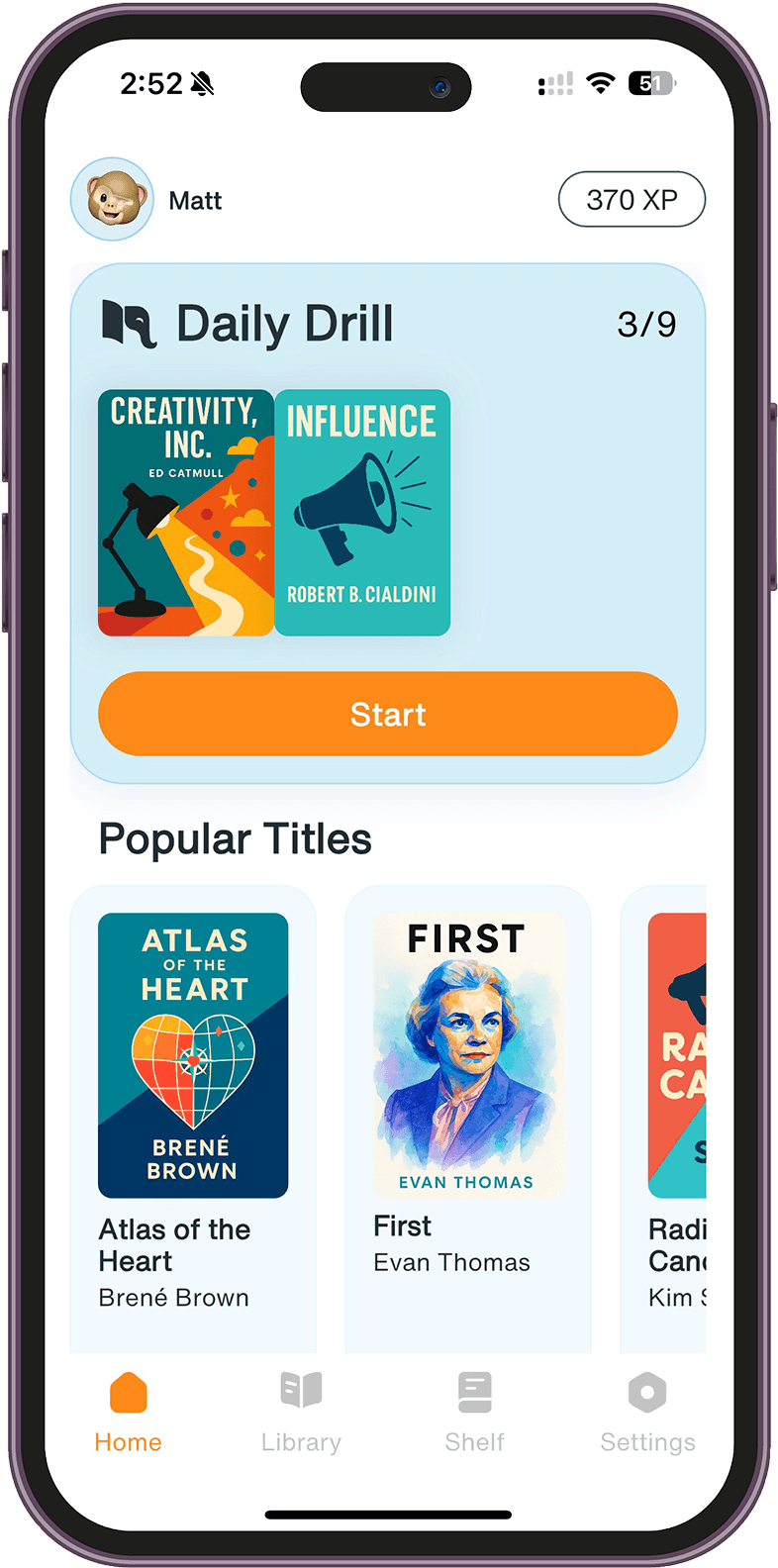
Loxie uses spaced repetition and active recall—the two most evidence-backed learning techniques—to help you retain financial concepts long-term. Instead of reading once and forgetting, you practice for 2 minutes a day with questions that resurface ideas right before you'd naturally forget them.
The app adapts to your memory. Concepts you know well appear less frequently. Ideas you struggle with come back sooner. Over time, financial acumen moves from something you read about to knowledge you actually possess—available when you're in a strategy meeting, evaluating a business case, or making resource decisions. Loxie's free version includes financial acumen in its full topic library.
Frequently Asked Questions
What is financial acumen for leaders?
Financial acumen for leaders is the ability to understand and interpret financial statements, metrics, and concepts well enough to participate in strategic business decisions. It includes reading P&L statements and cash flow reports, understanding metrics like gross margin and EBITDA, evaluating investments using ROI and NPV, and grasping unit economics like CAC and LTV.
What are the four stages of a P&L statement?
P&L statements flow through four stages: revenue (total sales), gross profit (revenue minus direct costs), operating income (after overhead expenses), and net profit (after interest and taxes). Each stage reveals where value gets created or destroyed—strong revenue with negative operating income indicates cost structure problems, while good operating income with poor net profit suggests excessive debt costs.
Why can profitable companies run out of cash?
Profitable companies fail from cash shortages when growth consumes cash faster than operations generate it. Customer payments might arrive in 90 days while salaries, rent, and equipment require immediate payment. The P&L shows profits while the bank account shows crisis. This timing mismatch kills more businesses than actual losses do.
What is the difference between gross margin and operating margin?
Gross margin measures revenue remaining after direct production costs (COGS), revealing pricing power and production efficiency. Operating margin measures profit after all operating expenses including sales, marketing, and administration, showing overall business model efficiency. A company can have strong gross margins but weak operating margins if overhead is too high.
What does an LTV/CAC ratio below 3.0 mean?
An LTV/CAC ratio below 3.0 indicates marginal unit economics requiring optimization. Below 1.0 means losing money on every customer. Between 1.0-3.0 suggests the business might eventually be profitable but needs improvement. Above 3.0 signals profitable growth opportunity worth accelerating. Context matters—early-stage companies may accept lower ratios while scaling.
How can Loxie help me learn financial acumen?
Loxie uses spaced repetition and active recall to help you retain financial concepts long-term. Instead of reading once and forgetting, you practice for 2 minutes a day with questions that resurface formulas, frameworks, and distinctions right before you'd naturally forget them. Loxie includes financial acumen in its full topic library.
Stop forgetting what you learn.
Start learning for good with your 7-day FREE trial.