Four Thousand Weeks: Key Insights & Takeaways from Oliver Burkeman
Discover Oliver Burkeman's radical philosophy for making peace with your finite time and focusing on what genuinely matters.
by The Loxie Learning Team
If you live to eighty, you'll have roughly four thousand weeks. That's it. Oliver Burkeman's Four Thousand Weeks uses this stark arithmetic to dismantle everything we've been told about productivity, time management, and getting things done. His argument is unsettling: the problem isn't that we're bad at managing time—it's that we're trying to manage something we can never control.
This guide explores Burkeman's complete philosophy for confronting our finite existence. Rather than another system for squeezing more from your calendar, you'll discover why embracing your limitations—not fighting them—leads to deeper meaning, better decisions, and genuine peace with the time you have. Whether you've read the book and want to reinforce its ideas or you're encountering them for the first time, these insights will change how you think about every week you have left.
 Start practicing Four Thousand Weeks free for 7 days ▸
Why does embracing our finite lifespan lead to better choices?
Accepting that you have roughly four thousand weeks forces you to confront what truly matters rather than pretending you can do everything. When you stop believing you'll eventually "get around to" all your dreams, you're compelled to choose now. This constraint isn't a limitation—it's a clarifying force that cuts through the noise of endless options and reveals what you actually value.
Most productivity advice operates on the assumption that with the right system, you can fit everything in. Burkeman exposes this as a fantasy. The math simply doesn't work: there will always be more worthwhile things to do than time to do them. Recognizing this isn't pessimism—it's liberation. You stop feeling guilty about what you're not doing and start engaging fully with what you've chosen to do.
The four thousand weeks framework transforms abstract mortality into something viscerally real. "Someday" stops being a comfortable placeholder and becomes an urgent question: if not now, when? And if not this, what? These questions, properly faced, produce better decisions than any planning app ever could.
How do attempts to control the future prevent us from living fully?
Planning and optimization feel productive, but they often serve as sophisticated avoidance mechanisms. When you're constantly organizing your future, you're not fully inhabiting your present—the only time where life actually happens. Burkeman argues that our obsession with getting everything under control is really an attempt to escape the discomfort of uncertainty.
The future doesn't exist yet. No amount of planning can make it real or controllable. When we treat our calendars as something to be conquered, we miss the simple truth that right now is all we ever have. The meeting you're preparing for will eventually become "right now," and you'll likely be preparing for the next thing instead of experiencing it.
This doesn't mean abandoning all planning—it means recognizing its proper place. Planning is useful for coordination and logistics, but it becomes destructive when it substitutes for actual engagement with life. The person who spends their vacation planning their next vacation has missed the point entirely.
Why do efficiency gains lead to more work instead of more free time?
Every time you clear your inbox faster, you train people to expect faster responses—which generates more emails. Every task you complete efficiently raises expectations and creates additional responsibilities. This is the efficiency trap: getting better at doing things only increases the volume of things to be done.
Burkeman calls this the "efficiency paradox." Technological advances that promise to save time invariably create new demands that consume those savings. Email was supposed to reduce communication overhead compared to physical mail. Instead, it created an expectation of instant availability that turned communication into constant urgency.
The solution isn't to become less efficient—it's to stop believing that efficiency will ever produce the free time you're seeking. The goal posts will always move. Understanding this changes your relationship with productivity: instead of racing to get everything done (impossible), you can choose deliberately what deserves your finite attention.
Practice these concepts in Loxie ▸
How does commitment create deeper value than keeping options open?
Meaningful experiences emerge from sustained engagement rather than optimization. When you commit fully to a chosen path, relationship, or project, you gain access to depths that perpetual option-seeking never reaches. The person who has been married for decades knows something about love that the serial dater never will, regardless of how many "better matches" might theoretically exist.
Fear of missing out keeps us from this depth. Keeping options open feels safer than accepting the loss that every decision entails. But Burkeman points out the cruel irony: by refusing to commit, we miss out on everything. The person who can't choose a restaurant ends up hungry. The person who can't commit to a career path ends up with no career at all.
Every choice closes doors. That's not a bug—it's the mechanism by which choices become meaningful. A relationship that could be abandoned at any moment never develops the trust that emerges from demonstrated commitment. A skill pursued casually never reaches the mastery that years of focused practice produce.
Why does unlimited freedom lead to isolation and meaninglessness?
The pursuit of total flexibility and freedom paradoxically leads to emptiness because human flourishing requires constraints. Relationships, responsibilities, and community bonds aren't limitations on our freedom—they're the framework within which meaning becomes possible. The person with no obligations to anyone has no one who needs them.
Modern culture celebrates independence and self-sufficiency, but Burkeman argues these ideals, taken to extremes, produce lonely, purposeless lives. Community obligations define what matters and to whom we matter. Without them, we're free in the way a astronaut cut loose from the space station is free: floating, untethered, and fundamentally lost.
This insight applies to time as well. A completely unstructured day, with no commitments or responsibilities, sounds liberating but often produces anxiety and dissatisfaction. We need constraints to create focus, and we need other people to create meaning. Freedom exists within structure, not apart from it.
How does technological speed increase our impatience and dissatisfaction?
Faster devices and services create a paradox: instead of making us feel like we have more time, they increase our impatience and raise our expectations. Our standards for "fast enough" constantly escalate, leaving us feeling more behind and dissatisfied despite objectively having more convenience than any previous generation.
Consider how your reaction to a slow-loading webpage has changed. What felt miraculous twenty years ago now produces genuine frustration. The technology got better, but your experience of it got worse. This pattern repeats across every domain where speed has increased—we adjust to the new baseline and feel deprived when it's not met.
Burkeman suggests this reveals something important about our relationship with time: it's not about having more of it, but about how we experience what we have. The person waiting two seconds for a webpage and the person who once waited two weeks for a letter are experiencing the same human impatience, just calibrated to different expectations.
Understanding isn't the same as remembering
Burkeman's insights about time and mortality can shift how you live—but only if you recall them when making daily decisions. Loxie uses spaced repetition to keep these concepts accessible precisely when you need them, turning philosophical understanding into practical wisdom.
Try Loxie free for 7 days ▸What drives our obsession with productivity and time control?
Our frantic busyness stems from avoiding the psychological discomfort of mortality. We stay busy to avoid confronting the anxiety that our time is running out. Productivity becomes a way of feeling in control when we're fundamentally not in control of how much time we have or when it will end.
This explains why getting everything done never produces the peace we expect. The underlying anxiety isn't really about tasks—it's about death. No amount of inbox management addresses that. When you clear your to-do list, you don't feel liberated; you feel the need to fill it again, because an empty list means confronting what you were avoiding.
Burkeman's insight here is psychologically profound: time management is often death management in disguise. Understanding this doesn't eliminate the anxiety, but it does reveal why certain approaches to productivity feel so hollow despite their technical effectiveness.
How does time management misunderstand our relationship with time?
We exist within time rather than possessing it as a resource. The concept of "time management" fundamentally misunderstands our temporal existence by treating hours like money—something we have, can spend wisely or waste, and should maximize. But time isn't something we have; it's something we are.
You don't have a body; in a meaningful sense, you are your body. Similarly, you don't have time; you are a temporal being. The question isn't how to manage your time better, but how to be fully present in the time you're always already living through. This is a subtle but crucial shift in perspective.
When time is a resource, the goal becomes optimization. When time is your mode of existence, the goal becomes presence and engagement. The first framing produces anxiety about waste; the second produces appreciation for experience. Burkeman argues we've been operating from the wrong metaphor entirely.
Start retaining what you learn ▸
Why is strategic procrastination actually useful?
Strategic procrastination on unimportant tasks improves focus by acknowledging that we must neglect many things to do anything well. Since you can't do everything anyway, procrastinating on the wrong things is actually a prioritization strategy. The key is choosing what to neglect rather than letting neglect happen by accident.
Most people feel guilty about procrastination because they believe they should be able to do everything if they just tried harder. Burkeman argues this guilt is misplaced. Procrastination is mathematically inevitable because humans have finite time and energy but infinite potential tasks. You will always be putting something off; the question is whether it's the right thing.
This reframe turns procrastination from a character flaw into a tool. Instead of fighting your tendency to delay, you can harness it by deliberately putting off tasks that don't deserve your limited weeks. The result isn't doing more—it's doing better on what matters.
What makes distractions so compelling?
Distractions serve as escape mechanisms from confronting uncomfortable emotions like inadequacy, uncertainty, or the weight of mortality that difficult tasks often trigger. We don't reach for our phones because the phone is irresistible—we reach for them because what we're avoiding is uncomfortable.
This explains why eliminating distractions rarely works. You can delete social media apps, but you'll find other ways to escape if the underlying discomfort remains unaddressed. The distraction is a symptom; the anxiety is the disease. Treating symptoms doesn't cure patients.
Burkeman suggests addressing root anxieties through acceptance and self-compassion rather than willpower-based distraction elimination. When you can sit with the discomfort of a challenging task—acknowledging that it feels hard without needing to escape—the pull of distractions naturally decreases.
Why are activities without productive purpose essential?
Activities valuable purely for their own sake—like hobbies pursued without goals—resist the instrumentalization of time and restore our humanity. When every moment must serve some future purpose, we lose the ability to experience intrinsic value. A walk taken for exercise is different from a walk taken simply to walk.
Our culture has made leisure into another optimization project. Rest is for productivity. Hobbies should build skills. Vacations are investments in future work performance. Burkeman argues this colonization of free time by productivity logic impoverishes our experience and disconnects us from what makes life worth living.
Engaging in activities with no productive purpose—reading for pleasure, playing games, wandering aimlessly—affirms that existence has value beyond accomplishment. These "useless" activities are actually essential for a meaningful life precisely because they can't be justified in terms of outcomes.
How does accepting cosmic insignificance bring liberation?
Recognizing that you won't be remembered forever liberates you from the exhausting pressure to leave a lasting legacy. The drive to achieve immortality through accomplishment consumes enormous energy that could go toward experiencing connection, beauty, and presence in your actual life. When you accept that your impact will eventually fade, you're free to focus on what genuinely matters now.
This sounds depressing but actually produces relief. The weight of needing to matter eternally is crushing. Most of what you worry about won't matter in a hundred years—and certainly not in a thousand. Your great-great-grandchildren probably won't know your name. This isn't nihilism; it's perspective.
Once you stop building monuments to yourself, you can redirect that energy toward the people and experiences actually in front of you. The pressure to be special gives way to the freedom to be present. Your four thousand weeks don't need cosmic significance to be worth living fully.
What is the fundamental tension of human existence with time?
Our struggle with time reflects the fundamental human condition of being finite beings with infinite longings. We can imagine possibilities we'll never realize, love people we'll eventually lose, and conceive of timespans we'll never experience. Peace comes from embracing rather than defeating this tension—because it can't be defeated.
Every productivity system implicitly promises to resolve this tension: get enough done, and you'll finally feel complete. Burkeman exposes this as impossible. The feeling of having enough time would require being something other than human. Our time anxiety is built into the structure of consciousness itself.
This doesn't mean despair—it means acceptance. Human constraints like mortality, limited attention, and finite energy are features of meaningful existence rather than bugs to be fixed. They create the conditions for choice, commitment, and depth. A being with unlimited time would never need to choose, and choice is what makes actions meaningful.
The real challenge with Four Thousand Weeks
Here's the uncomfortable truth: reading about mortality and finite time produces insight, but insight fades. Within weeks, most readers return to their default relationship with time—busy, anxious, and optimizing. The forgetting curve doesn't care how profound the ideas are.
How many books have shifted your perspective in the moment but left no lasting trace? Burkeman's framework is only useful if it's accessible when you're actually making decisions about how to spend your weeks. Understanding the efficiency paradox intellectually is different from remembering it when you're tempted to download another productivity app.
The gap between reading and retention is especially cruel for a book about time. You've just invested hours engaging with ideas about making your weeks count—and without reinforcement, most of that investment disappears. The concepts that could change your daily choices fade into vague impressions.
How Loxie helps you actually remember what you learn
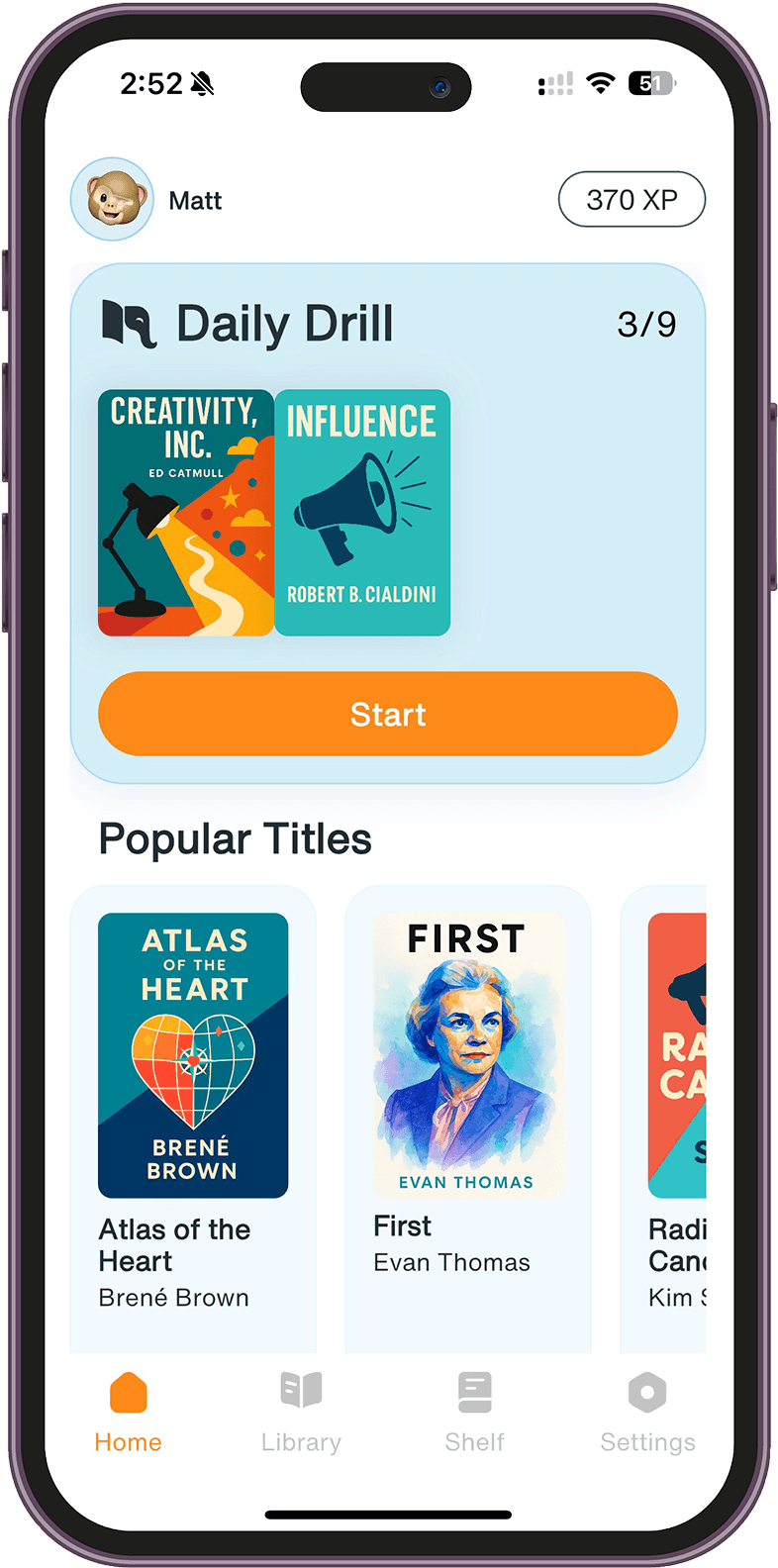
Loxie uses spaced repetition and active recall to keep important ideas accessible when you need them. Instead of reading Four Thousand Weeks once and forgetting most of it, you practice for 2 minutes a day with questions that resurface concepts right before you'd naturally forget them.
The science behind this is robust: actively retrieving information strengthens memory far more than re-reading or highlighting. And spacing that retrieval over time—rather than cramming—produces retention that lasts months and years rather than days. Loxie handles the scheduling automatically, presenting the right question at the right time.
Loxie includes Four Thousand Weeks in its full topic library, so you can start reinforcing these concepts immediately. Two minutes a day is enough to transform philosophical insight into practical wisdom that's available when you're deciding how to spend your four thousand weeks.
Frequently Asked Questions
What is the main idea of Four Thousand Weeks?
The core argument is that accepting our finite lifespan—roughly four thousand weeks if we live to eighty—leads to more meaningful choices than endlessly optimizing productivity. Rather than fighting our limitations, Burkeman argues we should embrace them as the conditions that make choice and commitment possible.
What are the key takeaways from Four Thousand Weeks?
Key insights include: efficiency gains paradoxically create more work, not more free time; commitment produces deeper value than keeping options open; distractions are escape mechanisms from uncomfortable emotions; and our productivity obsession often masks anxiety about mortality. The book advocates embracing limitations rather than fighting them.
Why does Oliver Burkeman say productivity advice doesn't work?
Burkeman argues that conventional productivity advice fails because it's based on a false promise: that the right system will let you do everything. Since there will always be more worthwhile tasks than time available, optimizing efficiency just accelerates the treadmill without ever reaching the promised free time.
What is the efficiency paradox in Four Thousand Weeks?
The efficiency paradox describes how getting better at tasks increases rather than decreases demands on your time. Clearing your inbox faster trains people to expect faster responses, generating more emails. Each efficiency gain raises expectations and creates new responsibilities, eliminating any time savings.
What does Four Thousand Weeks say about FOMO and commitment?
Fear of missing out prevents full commitment to our choices because keeping options open feels safer than accepting that every decision closes doors. But meaningful experiences require sustained engagement. By refusing to commit, we miss the depth that only comes from choosing fully.
How can Loxie help me remember what I learned from Four Thousand Weeks?
Loxie uses spaced repetition and active recall to help you retain key concepts from Four Thousand Weeks. Instead of reading the book once and forgetting most of it, you practice for 2 minutes a day with questions that resurface ideas right before you'd naturally forget them. Loxie includes the full topic library.
We're an Amazon Associate. If you buy a book through our links, we earn a small commission at no extra cost to you.
Stop forgetting what you learn.
Start learning for good with your 7-day FREE trial.