From Strength to Strength: Key Insights & Takeaways
Arthur C. Brooks' guide to finding deeper meaning in life's second half by embracing the natural shift from achievement to wisdom.
by The Loxie Learning Team
What if the decline you're dreading could become the transformation you need? Arthur C. Brooks' From Strength to Strength argues that the fading of certain abilities after midlife isn't a tragedy to resist but an invitation to a richer, more meaningful existence. The same cognitive changes that make you slower at innovation can make you wiser, more connected, and ultimately happier—if you know how to make the transition.
This guide breaks down Brooks' complete framework for thriving in life's second half. You'll learn why success can become addictive, how different types of intelligence evolve with age, and practical strategies for shifting from achievement to wisdom before the choice is made for you. Whether you're approaching midlife, already there, or watching someone you love struggle with decline, these insights offer a roadmap for what comes next.
 Start practicing From Strength to Strength free for 7 days ▸
What is the difference between fluid and crystallized intelligence?
Fluid intelligence is your ability to think quickly, process new information, and generate novel solutions—the raw cognitive horsepower that peaks in your 30s and declines steadily thereafter. Crystallized intelligence, by contrast, is your accumulated wisdom: the ability to synthesize knowledge across domains, recognize patterns, and teach what you've learned. Crucially, crystallized intelligence continues to grow through your 60s and 70s.
This distinction transforms how we should think about aging. The decline in fluid intelligence that terrifies high achievers is only half the story. While you're losing speed and innovative capacity, you're gaining superior ability to connect disparate ideas, mentor others, and provide strategic guidance—abilities that are often more valuable in complex organizations than raw brainpower.
Brooks argues that the key to thriving in life's second half is proactively shifting your focus from activities that depend on fluid intelligence to those that leverage crystallized intelligence. A mathematician might move from proving theorems to teaching and mentoring. An entrepreneur might shift from founding companies to advising founders. The transition requires intention and humility, but the payoff is continued relevance and contribution.
Why professional decline is both predictable and universal
Here's a uncomfortable truth: professional decline is coming for everyone, regardless of talent or effort. Brooks documents how even history's greatest minds—Bach, Darwin, Einstein—experienced dramatic drops in creative output after their peaks. Yet most successful people live in denial until the decline becomes undeniable, leading to desperate attempts to recapture past glory.
The evidence suggests that different professions peak at radically different ages. Mathematicians and tech entrepreneurs often peak before 40, while historians and philosophers may peak after 60. Understanding your field's typical trajectory enables strategic transitions before forced obsolescence, allowing you to shift gracefully rather than being pushed aside.
Accepting decline as inevitable rather than personal failure opens the door to proactive planning. You can begin cultivating crystallized intelligence—reading broadly, developing teaching skills, building mentoring relationships—while your fluid abilities are still strong enough to make the transition smooth.
How does success become addictive?
Success addiction operates through the same neurological pathways as substance addiction. Achievements trigger dopamine releases that create tolerance over time, requiring ever-bigger wins for the same satisfaction. The executive who once felt thrilled by a promotion now needs a bigger title. The entrepreneur who celebrated their first million now needs ten million to feel the same rush. Meanwhile, relationships and health deteriorate in pursuit of the next fix.
What makes success addiction particularly insidious is that society rewards and reinforces it. We celebrate the executive who works 80-hour weeks while recognizing the alcoholic as ill, though both are sacrificing wellbeing for a temporary high. This social blindspot allows the addiction to progress unchecked until relationships fail and health collapses.
The "striver's curse" means those who worked hardest to reach the top often fall hardest when decline begins. Their entire identity and self-worth became entangled with professional achievement. The very traits that drove their success—persistence, competitiveness, single-minded focus—become liabilities when adaptation is required.
Why the hedonic treadmill makes lasting happiness from achievement impossible
The hedonic treadmill ensures that each new level of success becomes your baseline within months. That corner office that once symbolized everything you wanted? It's now just where you work. The promotion that validated years of effort? It's now just your job. You adapt to every new level, requiring constant escalation to feel any improvement—like running faster and faster to stay in the same place.
This psychological principle explains why billionaires aren't measurably happier than millionaires, and why Olympic gold medalists often experience depression after their wins. External achievement cannot provide lasting satisfaction because we're wired to normalize whatever we have and want more.
Understanding this mechanism reveals why Brooks argues that the path to happiness in life's second half runs through reducing desires, not accumulating more achievements. The problem isn't that you haven't achieved enough—it's that achievement itself is an inherently unsatisfying source of wellbeing.
The gap between knowing and doing
Understanding that success addiction is real doesn't automatically free you from it. Loxie helps you internalize these insights through spaced repetition, so the wisdom becomes available when you're actually making career and life decisions—not just when you're reading about them.
Try Loxie free for 7 days ▸What are the Hindu life stages and why do they matter?
The Hindu concept of ashramas divides life into four stages: student, householder, forest dweller, and renunciant. The first two stages involve acquiring knowledge and then building a career, family, and material success. The second two involve progressively withdrawing from worldly striving to focus on wisdom, spiritual growth, and service to others.
This ancient framework normalizes the discomfort of stepping back from active leadership. Around age 50, according to this model, one becomes a "forest dweller"—not literally retreating to the wilderness, but shifting from provider and achiever to wisdom-keeper and mentor. The final stage involves releasing even these roles for pure contemplation and preparation for death.
What makes this framework powerful is that it provides cultural permission to prioritize inner development over external achievement in ways Western culture typically forbids. Rather than seeing the desire to step back as laziness or failure, the ashrama model treats it as the natural and appropriate progression of a well-lived life.
The transition from ingenious to sage
Brooks describes the shift from "ingenious" to "sage" work as moving from creating novel solutions to teaching and advising. Rather than competing with younger colleagues in areas of diminishing capacity, older workers can occupy the crucial niche of translating cutting-edge ideas into practical wisdom—a role that requires both experience and the ability to synthesize across domains.
Great teachers and mentors peak much later than great innovators precisely because teaching excellence requires crystallized intelligence. The very capacity that increases with age—plus the humility that often comes only after experiencing one's own limitations—makes older professionals uniquely qualified for this work.
The key is recognizing that this shift isn't settling for less. It's moving toward work that leverages your growing strengths rather than fighting against your declining ones. Many of history's greatest educators began their most impactful teaching careers after their creative peaks passed.
Practice these concepts in Loxie ▸
What does Eastern philosophy teach about detachment?
Eastern philosophy's concept of detachment doesn't mean not caring—it means holding goals lightly, pursuing excellence without attaching your identity to outcomes. Brooks compares it to playing tennis to win while being at peace with losing. You give full effort because the game matters, but your fundamental wellbeing doesn't depend on the result.
This distinction transforms ambition from a source of suffering into a source of joy. You can still work hard, still pursue meaningful goals, still care about results—but you're no longer enslaved by outcomes you cannot fully control. The desperate need to succeed that drives success addiction gives way to engaged effort without existential stakes.
Brooks introduces the "reverse bucket list" as a practical tool for cultivating detachment. Instead of adding new goals and desires, you list what you want to stop wanting—the status symbols, possessions, and recognition that you've been chasing. By systematically reducing attachments rather than accumulating achievements, you address the root cause of dissatisfaction: not the absence of success but the endless craving for more.
Why does contemplating death increase life satisfaction?
Contemplating death daily, as Stoics and Buddhists recommend, paradoxically increases life satisfaction by creating urgency for what matters while eliminating trivial concerns. When you genuinely internalize that your time is finite, petty anxieties and status games appear absurd in their ultimate insignificance. The things that actually matter—relationships, experiences, contribution—move to the foreground.
Brooks describes the "death clock" exercise: calculating your approximate remaining days and making that number concrete. Converting remaining lifetime into a specific number (like 10,000 days) creates visceral awareness that time is a depleting resource, motivating immediate action on long-postponed priorities.
Fear of death often masks fear of not having lived—the terror isn't dying but reaching death having spent decades on ultimately meaningless pursuits. This reframe suggests that mortality anxiety can be addressed not through denial but through ensuring current choices align with what you'd prioritize on your deathbed.
Start retaining what you learn ▸
What does the Harvard Study of Adult Development reveal about happiness?
The Harvard Study of Adult Development, which followed participants for over 80 years, provides an unequivocal answer to what makes a good life: relationship quality is the strongest predictor of happiness and health in old age, surpassing wealth, fame, and even genetic factors. The people who thrived weren't the most successful or the healthiest at middle age—they were the ones who had invested in deep, meaningful connections.
This finding definitively answers a question most people get wrong. We assume that achievement, security, or health will make us happy, but the data shows that human connection matters more than all of these. Making relationship investment your highest priority isn't sentimental advice—it's the highest-return activity for life satisfaction according to the best longitudinal research we have.
Deal friends versus real friends
Brooks distinguishes between "deal friends" (transactional relationships based on mutual usefulness) and "real friends" (relationships based on genuine affection). Deal friends are the colleagues who return your calls because you're useful to them, the contacts who show up when there's something to gain. Real friends are those who would visit you in prison, as the saying goes.
Most successful people discover too late that they cultivated mainly deal friends. The network that felt so robust while they held positions of power evaporates when the transactions end. Many executives experience profound loneliness after retirement because their relationships were built on utility rather than authentic connection.
The implication is stark: the time to invest in real friendships is now, while you still have the energy and opportunity. The relationships that will sustain you in life's second half require decades of cultivation through small moments of attention and care—they cannot be manufactured at the moment you need them.
How can weakness become a source of connection?
Brooks argues that weakness and vulnerability in life's second half become connection points rather than shame sources. Your struggles and failures often help others more than your successes ever could. When you share your diminishments honestly, you give others permission to be imperfect and create bonds that achievement-based relationships never achieve.
The "wounded healer" archetype captures this transformation: your deepest wounds, once integrated and understood, become your greatest teaching gifts. Someone who has struggled with addiction and recovered can guide other addicts in ways the never-addicted cannot. Your failures become credentials for service.
This inversion of values transforms aging's inevitable losses into gifts. Rather than hiding the ways you're declining, you can use them to create authentic connection. The executive who admits uncertainty helps subordinates feel safe to ask questions. The former expert who says "I don't know" opens space for genuine inquiry rather than performance.
Moving from résumé virtues to eulogy virtues
Brooks borrows David Brooks' distinction between "résumé virtues" (achievements that impress others) and "eulogy virtues" (qualities people remember at your funeral). Résumé virtues get you jobs and promotions; eulogy virtues get you tears at your memorial. The tragedy is that most people spend their lives building the former while neglecting the latter.
Moving from résumé to eulogy virtues requires consciously choosing to be forgotten professionally while being deeply remembered personally. It means measuring life's value by the depth of your relationships rather than the titles on your business card. This shift redefines success from public recognition to private significance.
Learn From Strength to Strength for good ▸
How do you make the transition to life's second half?
Brooks uses the metaphor of trapeze artists to describe the transition: you must release one bar before the next appears. Jumping off the first curve while still successful—leaving at your peak rather than after decline—requires faith that something better awaits. Most people cling to diminishing returns rather than risk the void between their current and future selves.
The "liminal space" between life chapters—after leaving the old but before finding the new—feels like death because it is: the death of an identity that must occur before rebirth into a new way of being. Understanding transition as a necessary death-and-rebirth process helps people endure the disorientation rather than abandoning the journey halfway through.
The ashrama transition often triggers intense grief—not for lost youth but for the identity built through decades of striving. Acknowledging this as genuine bereavement validates feelings often dismissed as self-pity. You're not weak for struggling with this transition; you're mourning something real.
The freedoms of life's second half
Life's second half offers freedoms the first half cannot: freedom from others' expectations, from the need to build an identity, and from the illusion that achievement brings happiness. These freedoms initially feel like deprivations because they remove familiar structures and motivations. But mastering them enables a creativity and authenticity impossible while imprisoned by external validation.
Service without recognition—volunteering, mentoring, or contributing where no one knows your past achievements—tests whether you've truly transitioned from ego-driven to purpose-driven motivation. Anonymous service reveals whether you've genuinely released attachment to status or are simply seeking validation in new venues.
The key insight is that these freedoms aren't consolation prizes for what you've lost—they're genuine advantages unavailable to younger people still building careers and identities. You can finally pursue what matters without worrying about how it looks on your résumé.
The real challenge with From Strength to Strength
Brooks' framework is compelling when you're reading it. The problem is that reading creates an illusion of understanding. You finish the book convinced you'll embrace crystallized intelligence, cultivate real friendships, and contemplate mortality daily. Then life intervenes, and within weeks you've forgotten most of what seemed so transformative.
Research on the forgetting curve shows we lose 70% of new information within 24 hours unless we actively work to retain it. That means most of Brooks' insights—the distinction between fluid and crystallized intelligence, the mechanics of success addiction, the power of detachment—fade before you can apply them. How many personal development books have you read that felt life-changing but left no lasting trace?
The gap between intellectual agreement and actual behavior change is enormous. Knowing that relationships matter more than achievements doesn't automatically make you invest in relationships. Understanding success addiction doesn't break its hold. These insights need to become part of your thinking, available when you're making real decisions about how to spend your time and energy.
How Loxie helps you actually remember what you learn
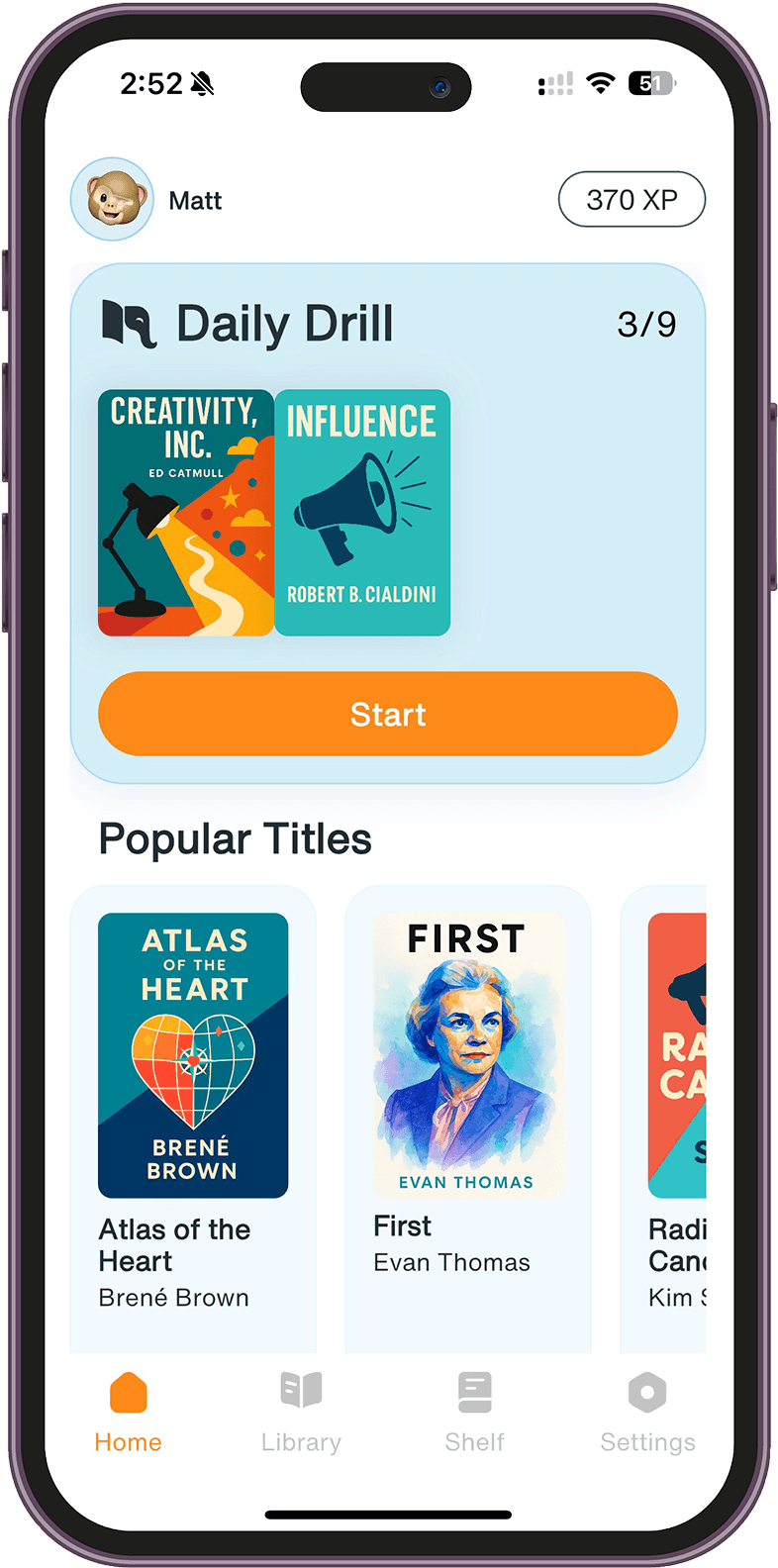
Loxie uses spaced repetition and active recall—the two most effective techniques cognitive science has discovered for long-term retention—to help you internalize what you learn from books like From Strength to Strength. Instead of reading once and hoping the ideas stick, you practice retrieving them at scientifically optimized intervals.
The process is simple: you answer questions about key concepts right before you would naturally forget them. Each successful recall strengthens the memory and extends the interval until the next review. In just 2 minutes a day, you can maintain access to an entire book's worth of insights.
Loxie includes From Strength to Strength in its complete topic library. You can start reinforcing Brooks' framework today—the shift from fluid to crystallized intelligence, the mechanics of success addiction, the importance of real friendships, all of it—so these ideas are available when you're actually making decisions about your career and life.
Frequently Asked Questions
What is the main idea of From Strength to Strength?
The central argument is that the natural decline of fluid intelligence (speed, innovation) after midlife becomes an opportunity for growth when you shift to crystallized intelligence (wisdom, pattern recognition, teaching). By embracing this transition rather than fighting it, you can make life's second half more fulfilling than the first.
What are the key takeaways from From Strength to Strength?
The key takeaways include: success can become addictive like substance abuse; crystallized intelligence continues to grow into your 60s and 70s; relationship quality predicts happiness better than wealth or fame; contemplating mortality increases life satisfaction; and transitioning from "ingenious" to "sage" work allows continued meaningful contribution.
What is the difference between fluid and crystallized intelligence?
Fluid intelligence is raw cognitive processing power—thinking quickly, learning new information, generating novel solutions. It peaks in your 30s and declines thereafter. Crystallized intelligence is accumulated wisdom—synthesizing knowledge, recognizing patterns, teaching others. It continues growing through your 60s and 70s.
What is success addiction according to Arthur Brooks?
Success addiction operates through the same neurological pathways as substance addiction. Achievements trigger dopamine releases that create tolerance over time, requiring ever-bigger wins for the same satisfaction. Unlike drug addiction, society rewards and reinforces this pattern, allowing it to progress until relationships and health collapse.
What are the Hindu ashramas mentioned in the book?
The Hindu ashrama system divides life into four stages: student (learning), householder (career and family), forest dweller (shifting to wisdom and mentoring around age 50), and renunciant (contemplation and spiritual preparation for death). This framework normalizes stepping back from worldly achievement in life's second half.
How can Loxie help me remember what I learned from From Strength to Strength?
Loxie uses spaced repetition and active recall to help you retain the key concepts from From Strength to Strength. Instead of reading the book once and forgetting most of it, you practice for 2 minutes a day with questions that resurface ideas right before you'd naturally forget them. Loxie includes this book in its full topic library.
We're an Amazon Associate. If you buy a book through our links, we earn a small commission at no extra cost to you.
Stop forgetting what you learn.
Start learning for good with your 7-day FREE trial.