Getting Things Done: Key Insights & Takeaways from David Allen
Master David Allen's complete GTD system for capturing, clarifying, and completing everything on your plate with stress-free productivity.
by The Loxie Learning Team
Your mind is terrible at remembering things—and that's actually good news. David Allen's Getting Things Done argues that your brain evolved for having ideas, not holding them. When you try to track dozens of commitments, projects, and half-formed intentions in your head, you create a constant low-grade stress that drains your cognitive resources and blocks creative thinking.
GTD offers an elegant solution: build a trusted external system that captures everything demanding your attention, then process those items into clear next actions organized by context. The result is what Allen calls "mind like water"—a state of relaxed control where you can respond appropriately to whatever comes your way because nothing is slipping through the cracks.
This guide breaks down the complete GTD methodology, from the five core workflow steps to the weekly review that keeps everything current. Whether you're drowning in obligations or simply want more mental bandwidth for meaningful work, you'll understand not just what to do, but why this system works with your psychology rather than against it.
 Start practicing GTD free for 7 days ▸
Why do traditional time management methods fail for modern knowledge work?
Traditional time management assumes work has clear boundaries, predictable durations, and stable priorities. Modern knowledge work has none of these. Your job likely involves ambiguous projects with shifting deadlines, commitments that emerge from conversations and emails, and priorities that change based on information you don't have yet. Trying to schedule "work on strategic plan" into a time slot fails because you haven't defined what "work on" actually means.
The sheer volume compounds the problem. Most professionals track hundreds of commitments across multiple contexts—work projects, personal obligations, family responsibilities, future possibilities. Your working memory can hold perhaps four items reliably. Asking it to track hundreds creates the mental equivalent of running too many programs on an old computer: everything slows down, crashes become common, and important processes get killed without warning.
GTD addresses this mismatch by externalizing everything into a system your mind can trust. When you know that every commitment lives in a reliable place and will surface at the right time, your brain stops the exhausting background process of trying to remember and remind. That freed-up mental bandwidth becomes available for actual creative and productive work.
What are the five core steps of the GTD workflow?
The GTD workflow consists of five interconnected steps: capture, clarify, organize, reflect, and engage. Each step addresses a specific cognitive challenge, and together they form a complete system for managing commitments without mental strain.
Capture: Get everything out of your head
Capture means collecting every thought, task, idea, and commitment that has your attention into external containers—physical in-trays, digital inboxes, voice memos, whatever tools you'll actually use. The key is completeness: if something is occupying mental space, it needs to move into your capture system. Half-captured systems don't work because your brain won't trust them and will keep running its own reminder processes.
Clarify: Determine what each item means
Clarifying transforms vague captured items into clear commitments. For each item, you ask: What is this? Is it actionable? If yes, what's the desired outcome, and what's the very next physical action? If no, you either trash it, file it as reference, or incubate it for later consideration. This step prevents the paralysis of staring at ambiguous entries like "Mom" or "Website" without knowing what to do.
Organize: Put reminders where you'll see them
Organizing places clarified items into appropriate holding systems. Next actions go on context-based lists (@Computer, @Phone, @Errands). Multi-step outcomes become projects with defined successful endpoints. Calendar entries hold time-specific commitments. Reference material gets filed for retrieval. Someday/Maybe captures future possibilities. Each category has its own location, ensuring items surface when relevant.
Reflect: Review your system regularly
Reflecting means looking at your complete system often enough to trust it. Daily reviews keep your action lists current. Weekly reviews—the critical practice that makes GTD work—involve processing all captured items, reviewing every project, updating your next actions, and ensuring nothing has slipped through cracks. Without regular reflection, systems decay into unreliable collections that your mind stops trusting.
Engage: Choose your actions with confidence
Engaging means actually doing the work, selecting from your options with confidence that you're choosing appropriately. When your system is complete and current, choosing becomes intuitive rather than anxious. You're not wondering what you're forgetting—you're simply picking the best option from a trusted inventory of everything that could be done.
Practice the GTD workflow in Loxie ▸
Why does capturing everything outside your head create mental clarity?
Your brain treats uncaptured commitments as "open loops"—incomplete patterns that demand cognitive attention until resolved. Each open loop consumes a small but measurable amount of working memory and generates low-level stress hormones. With dozens or hundreds of open loops running simultaneously, your mind operates in a constant state of low-grade overwhelm, unable to fully focus on anything because part of your attention is always monitoring unfinished business.
Cognitive science research confirms what GTD practitioners experience: externalizing commitments into trusted systems measurably reduces cortisol levels and frees cognitive resources. When your mind knows that every commitment lives in a reliable external system, it can release the background monitoring process. The mental bandwidth previously consumed by tracking and worrying becomes available for creative thinking, problem-solving, and present-moment engagement.
This explains why partial capture doesn't work. If some commitments are in your system and others are still floating in your head, your brain can't fully disengage from tracking mode. Only complete capture—getting literally everything external—allows the psychological release that creates genuine mental clarity.
What is a "next action" and why is defining it so important?
A next action is the very next physical, visible activity required to move something forward. Not "plan birthday party" but "text Sarah to confirm she can bring the cake." Not "handle taxes" but "download bank statements from Chase website." The distinction matters because vague tasks create friction while specific actions create momentum.
Most procrastination and project stagnation stems from unclear next steps. When you look at "work on proposal" on your list, your brain must first figure out what "work on" means before you can do anything. That figuring-out process takes mental energy and creates resistance. By contrast, "open Google Doc and write introduction paragraph" is immediately executable—you know exactly what to do and can start without preliminary thinking.
Defining next actions during the clarify phase means all the thinking happens once, upfront, rather than every time you see the item. This transforms your task list from a collection of ambiguous reminders into an inventory of discrete actions ready for execution. When you have five minutes at your computer, you can immediately start doing rather than spending those five minutes figuring out what to do.
The gap between knowing GTD and doing GTD
Understanding next actions intellectually is easy. Actually defining them for every commitment requires building new mental habits. Loxie helps you internalize GTD's core practices through spaced repetition, so "what's the next action?" becomes an automatic question rather than something you have to remember to ask.
Build GTD habits with Loxie ▸How do context-based lists make task management more effective?
Context-based lists organize next actions by where you can do them or what tools they require. Common contexts include @Computer (tasks requiring your laptop), @Phone (calls to make), @Errands (tasks requiring you to be out), @Home, @Office, and @Waiting For (tasks delegated to others). This organization solves a fundamental problem: showing you only what you can actually do right now.
Traditional to-do lists fail because they show everything regardless of executability. If you're on the train and see "update spreadsheet" on your list, you experience friction—you can't do it and must skip past it. Multiply this by dozens of items and reviewing your list becomes exhausting. Context lists eliminate this friction by filtering automatically. When you pull up @Phone, every single item is something you can do with your phone in hand.
Contexts also enable efficient batch processing. When you sit down at your computer for focused work, @Computer gives you a complete menu of digital tasks. When you're heading out, @Errands shows everything you could accomplish while mobile. This batching reduces the cognitive cost of task-switching and helps you make the most of whatever time and location you find yourself in.
Why is defining desired outcomes before choosing actions so powerful?
Clarifying the desired outcome before brainstorming actions ensures you're solving the right problem. When you capture "client unhappy," immediately jumping to actions like "send apology email" might address a symptom while missing the real issue. Instead, defining the outcome—"client fully satisfied and relationship strengthened"—opens up different and often better action possibilities.
This outcome-first thinking engages your brain's natural problem-solving capabilities. When you clearly envision a target state, your mind begins automatically identifying paths toward it, noticing relevant resources, and generating creative solutions. Without a clear outcome, your mind has nothing to aim at and produces scattered, unfocused thinking.
The practice applies at every scale: individual tasks, multi-step projects, and life areas. For a task, the outcome might be "dentist appointment scheduled." For a project, "new marketing website live and receiving traffic." For a life area, "physical health supporting my energy and longevity goals." Each level of clarity focuses attention and improves decision-making about how to allocate your limited time and energy.
What makes the weekly review essential to GTD success?
The weekly review is the practice that maintains system integrity over time. Without it, lists become stale, projects lose their next actions, captured items pile up unprocessed, and your mind gradually stops trusting the system. With a consistent weekly review, your GTD implementation stays current, complete, and reliable.
During a weekly review, you process all accumulated capture items, review every active project to ensure each has a defined next action, update your calendar and tickler files, scan your Someday/Maybe list for items ready to activate, and review your higher-level goals and areas of focus. The process typically takes one to two hours and creates the foundation for a week of clear, confident action.
The weekly review also provides perspective that daily work obscures. When you're heads-down executing tasks, you lose sight of the bigger picture. The weekly review lifts you up to see all your commitments together, identify emerging patterns, spot potential problems before they become crises, and make intentional choices about priorities rather than just reacting to whatever feels most urgent.
How does the four-criteria model help you choose what to do right now?
When you have a hundred potential next actions and need to pick one, the four-criteria model provides a systematic way to narrow your options. You filter sequentially through context, time available, energy level, and priority—and at each stage, impossible or inappropriate options drop away.
Context comes first: what can you actually do where you are with the tools you have? If you're on a plane, most @Computer tasks are possible but @Errands are not. Time available is next: if you have fifteen minutes before a meeting, you can handle quick tasks but not ones requiring deep concentration. Energy level is third: after an exhausting presentation, creative writing may be unrealistic while sorting email is manageable. Only after filtering through these three do you consider priority among the remaining options.
This approach prevents the common trap of always defaulting to urgent-seeming tasks while important but non-urgent work languishes. By the time you reach the priority filter, you're choosing from a manageable set of genuinely doable options rather than an overwhelming list that includes things you can't or shouldn't do right now.
What is the natural planning model and how does it improve project outcomes?
The natural planning model describes how your mind naturally approaches complex endeavors when working effectively. It consists of five phases: defining purpose and principles, envisioning the outcome, brainstorming ideas, organizing components, and identifying next actions. Most project planning failures occur when people skip phases or do them out of order.
Purpose and principles establish the foundation
Before generating ideas, clarify why you're doing this project and what principles will guide decisions. Purpose answers "why does this matter?" and keeps efforts aligned with genuine value. Principles—like "stay within budget" or "maintain team morale"—create boundaries that prevent wasted effort on unacceptable approaches.
Vision activates creative problem-solving
Envisioning the successful outcome in detail engages your brain's pattern-matching and solution-finding capabilities. When you can clearly imagine the finished result—the event running smoothly, the product launched and receiving positive feedback—your mind automatically begins identifying gaps between current reality and that vision, generating ideas for bridging them.
Brainstorming, organizing, and action planning
With purpose and vision established, brainstorming generates potential approaches without premature judgment. Organizing clusters related ideas into components, identifies dependencies, and reveals the project's structure. Finally, defining next actions for each component ensures momentum: you know exactly what to do to start moving forward.
What are the three stages of GTD mastery?
GTD mastery develops through three progressive stages: implementing the basics, integrating the practices, and achieving unconscious competence. Each stage unlocks deeper levels of mental clarity and life engagement, but most people stall at stage one because they never fully internalize the system.
Stage one involves mechanical technique application: setting up capture tools, processing inboxes, creating context lists, and establishing a weekly review routine. The focus is on getting the external infrastructure in place and using it consistently. This stage often feels effortful because you're building new habits that haven't yet become automatic.
Stage two shifts from doing GTD to being a GTD practitioner. The practices integrate into how you naturally think about and engage with commitments. You automatically capture things that catch your attention, reflexively ask "what's the next action?" when something lands on your plate, and feel genuinely uncomfortable when your system falls out of current.
Stage three is unconscious competence—GTD becomes simply how you operate rather than a methodology you're applying. The mental clarity and stress-free productivity Allen describes become baseline rather than aspirational. You no longer think about GTD; you just live in a state of relaxed control over all your commitments.
The real challenge with Getting Things Done
GTD is brilliantly designed—but that doesn't mean you'll remember it. The book presents dozens of interconnected concepts: the five workflow phases, the natural planning model, context-based organization, the four-criteria decision model, the weekly review checklist, and more. Most readers understand these ideas perfectly while reading, feel inspired to implement them, and then gradually drift back to old habits as the details fade.
This isn't a willpower problem. The forgetting curve—the natural decay of memory over time—means you lose approximately 70% of new information within 24 hours unless you actively work to retain it. You can read GTD cover to cover, highlight key passages, even take notes, and still find yourself three months later unable to recall the five workflow steps in order.
The irony is pointed: a system designed to get things out of your head requires first getting things into your head. The practices only work if you remember to use them. "What's the next action?" only helps if you automatically ask it when commitments arise. The four-criteria model only clarifies decisions if you can recall all four criteria in the moment.
How Loxie helps you actually remember and apply GTD
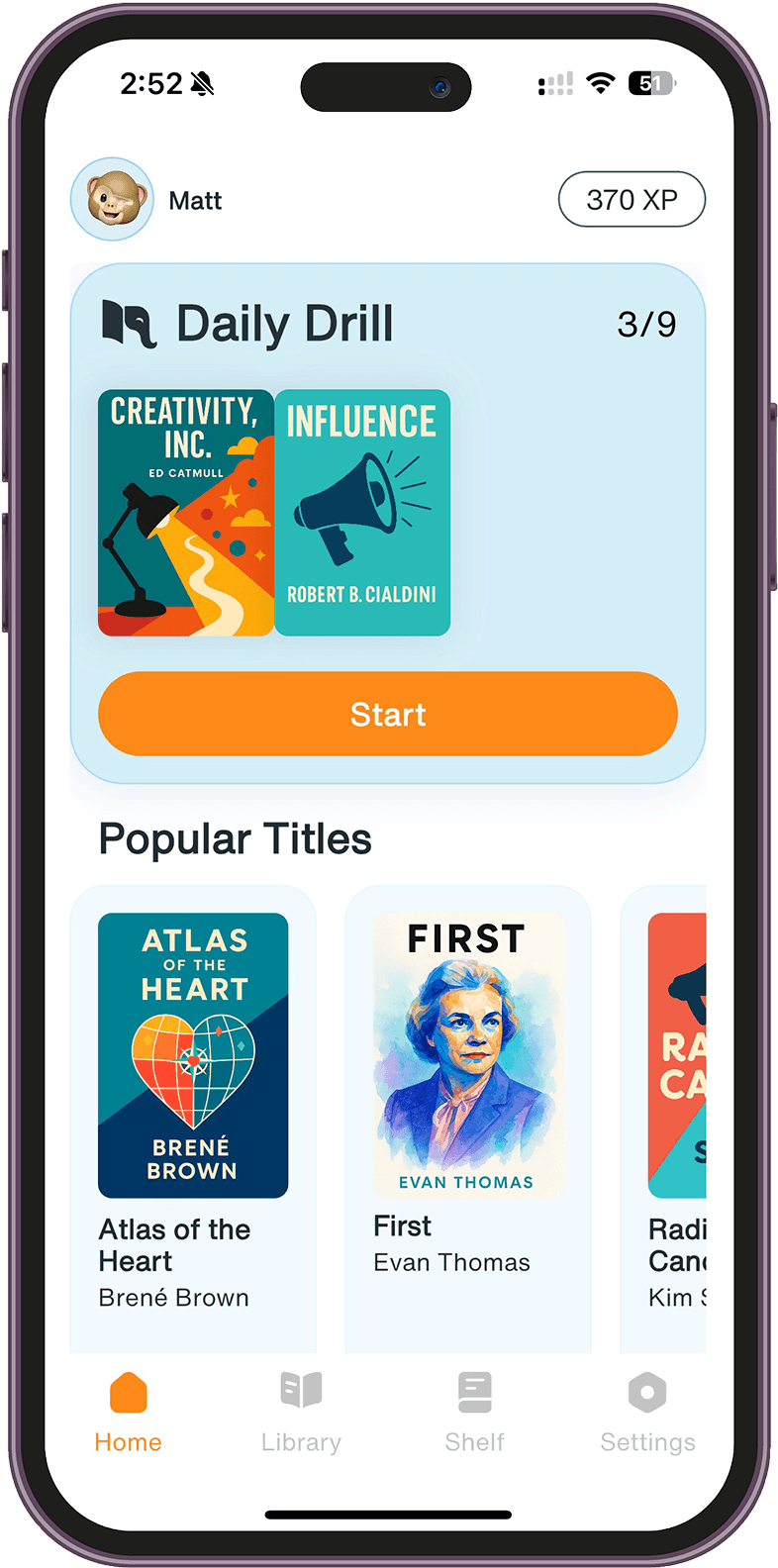
Loxie uses spaced repetition and active recall—the two most scientifically validated learning techniques—to help you internalize GTD's core practices. Instead of passively re-reading the book or hoping key concepts stick, you actively practice retrieving them at scientifically optimized intervals.
The process takes just two minutes a day. Loxie presents questions about GTD concepts—the five workflow phases, how to define next actions, what belongs in a weekly review—and resurfaces them right before you'd naturally forget. Each successful recall strengthens the memory trace and extends the interval until the next review. Over time, GTD's framework becomes genuinely embedded in how you think.
This matters because GTD only works if the practices are available when you need them. When an email lands in your inbox, you need to automatically think "capture, clarify, organize" rather than just reacting. When you're feeling overwhelmed, you need instant access to the question "have I done a recent weekly review?" Loxie builds these automatic thought patterns through consistent, low-effort practice.
Loxie includes Getting Things Done in its full topic library, so you can start reinforcing these concepts immediately. Spend two minutes a day practicing, and you'll actually become the GTD practitioner you intended to be when you first picked up the book.
Frequently Asked Questions
What is the main idea of Getting Things Done?
The core idea is that your mind is designed for having ideas, not holding them. By capturing every commitment into a trusted external system, clarifying what each item requires, and organizing reminders to surface at the right time, you free mental resources for creative thinking and achieve what David Allen calls "stress-free productivity."
What are the five steps of the GTD workflow?
The five GTD workflow steps are: Capture (collect everything that has your attention), Clarify (determine what each item means and requires), Organize (put reminders in appropriate places), Reflect (review your system regularly), and Engage (choose and complete actions with confidence). Together they form a complete system for managing commitments.
What is a "next action" in GTD?
A next action is the very next physical, visible activity required to move something forward. Instead of vague tasks like "plan vacation," you define concrete steps like "text Maria to ask about her available dates." This specificity eliminates the mental friction of figuring out what to do and breaks through procrastination.
Why is the weekly review so important in GTD?
The weekly review maintains system trust by ensuring every project has a defined next action, all loose ends are captured, and your lists accurately reflect current priorities. Without regular reviews, systems become stale and your mind stops trusting them, defeating the purpose of externalizing commitments.
What is the natural planning model?
The natural planning model describes how your mind naturally approaches complex projects: defining purpose and principles, envisioning the successful outcome, brainstorming possible approaches, organizing ideas into components, and identifying next actions. Following this sequence produces clearer thinking and better outcomes than jumping straight to action planning.
How can Loxie help me remember what I learned from Getting Things Done?
Loxie uses spaced repetition and active recall to help you retain GTD's key concepts. Instead of reading the book once and forgetting the workflow steps, you practice for 2 minutes a day with questions that resurface ideas right before you'd naturally forget them. Loxie includes Getting Things Done in its full topic library, so you can start reinforcing these practices immediately.
We're an Amazon Associate. If you buy a book through our links, we earn a small commission at no extra cost to you.
Stop forgetting what you learn.
Start learning for good with your 7-day FREE trial.