Giving Feedback: Key Concepts & What You Need to Know
Master the art of delivering developmental feedback that improves performance while strengthening trust and psychological safety.
by The Loxie Learning Team
Most leaders dread giving feedback because they've seen it go wrong—defensive reactions, damaged relationships, or changes that never stick. But the problem isn't feedback itself. It's that most people were never taught how to deliver it in a way that actually works. When done skillfully, feedback becomes one of the most powerful tools for growth, strengthening relationships rather than destroying them.
This guide breaks down the essential techniques for giving feedback that drives real improvement. You'll learn the SBI model for structuring objective feedback, how to reduce defensiveness before it starts, when to deliver feedback immediately versus scheduling a conversation, and how to turn feedback into concrete commitments that stick. These aren't abstract theories—they're practical techniques you can apply in your next conversation.
 Start practicing feedback skills ▸
What is the SBI feedback model and how does it work?
The SBI model structures feedback as Situation-Behavior-Impact, removing judgment by focusing on observable facts rather than character assessments. When you say "In yesterday's meeting, you interrupted the client three times, which caused them to appear frustrated," you create a verifiable conversation rather than triggering identity defense with "You're disrespectful."
Each component serves a distinct purpose. Situation provides context for verification—anchoring feedback in a specific moment the recipient can recall. Behavior describes actions without interpretation—what anyone present could have witnessed. Impact explains consequences without assuming intent—the observable results of the behavior. Together, these three elements create feedback that's impossible to deny yet preserves dignity.
This structure prevents the most common feedback failures. Without a specific situation, feedback becomes vague accusations that recipients can dismiss as inaccurate. Without behavioral focus, it becomes character assassination that triggers existential defense. Without impact explanation, it lacks meaning—recipients don't understand why the behavior matters. The combination makes feedback both undeniable and actionable.
Why specific situations matter
Specific situations anchor feedback in verifiable moments ("In Tuesday's 3pm budget review") rather than triggering defensive generalizations that occur with vague timeframes ("Sometimes you..." or "You always..."). Precision prevents recipients from dismissing feedback as inaccurate. When you cite specific instances, the conversation shifts from "That's not true" to "Let's discuss what happened."
Why impact statements need concrete outcomes
Impact statements describe actual consequences ("The client ended the meeting early and requested a different account manager") rather than assumed feelings ("You upset the client"). Recipients can verify that the meeting ended early but might dispute whether the client was upset. Focusing on measurable consequences rather than interpreted emotions keeps feedback factual and actionable.
Practice the SBI model in Loxie ▸
What's the difference between observable behaviors and interpretive judgments?
Observable behaviors are actions anyone could witness ("You checked your phone six times during her presentation"), while interpretive judgments add meaning or motive ("You don't respect her ideas"). This distinction determines whether feedback feels like objective observation or personal attack. Behaviors can be changed; character traits feel fixed.
The video test provides a simple filter: if a camera could record it, it's observable; if it requires inference about thoughts, feelings, or character, it's interpretation that should be removed or reframed into visible behaviors. Cameras capture actions, not intentions. Using this filter ensures feedback stays factual and discussable rather than becoming philosophical debates about someone's nature.
Converting judgments to specific behaviors
Converting judgments to behaviors requires specificity: "poor attitude" becomes "responded to three suggestions with eye rolling and audible sighing"; "not a team player" becomes "declined to help colleagues on four occasions when directly asked." This translation process transforms vague complaints into actionable feedback. Recipients can't directly fix a "poor attitude" but can stop rolling their eyes. The specificity provides clear behavioral targets for improvement.
Common judgmental phrases that trigger defense include "bad attitude," "not a team player," and "unprofessional." Each requires translation into specific observable behaviors to become useful feedback that enables improvement. The judgment-to-behavior translation follows a pattern: identify the judgment, recall specific incidents that triggered it, then describe only what you saw or heard.
Knowing the difference isn't the same as remembering it in the moment.
Under pressure, most people revert to judgmental language even when they know better. Loxie uses spaced repetition to help you internalize these distinctions so they're available when you need them—not just when you're reading about them.
Build feedback skills that stick ▸When should feedback be delivered immediately versus scheduled?
Immediate feedback is essential for safety violations, ethical breaches, and client-impacting errors—delivered privately within hours to prevent recurrence, escalation, or reputation damage that compounds with delay. Some situations can't wait for scheduled conversations. Safety issues risk injury, ethical breaches risk legal consequences, and client errors risk business loss. Quick intervention prevents small problems from becoming disasters while memories remain fresh for accurate discussion.
Teachable moments also require immediate feedback because delay breaks the connection between action and learning. Catching someone doing something right or wrong in the moment creates stronger neural pathways than discussing it days later. The brain links cause and effect most powerfully when they're temporally close.
When scheduled feedback works better
Scheduled feedback suits complex performance patterns, skill development needs, and sensitive topics—allowing both parties to prepare mentally, gather examples, and enter the conversation in a productive emotional state rather than reactive mode. Complex issues require thoughtful discussion, not reactive responses. Scheduling allows managers to organize observations and employees to prepare their perspective.
The 24-48 hour rule balances immediacy with emotional regulation—feedback delivered while events remain fresh but after initial emotional reactions cool. This timing sweet spot allows emotional processing without memory decay. Too soon risks emotional hijacking and saying things you'll regret. Too late loses detail and urgency.
How does developmental framing reduce defensiveness?
Framing feedback as developmental ("I want to help you succeed") versus punitive ("This is unacceptable") activates growth mindset instead of threat response. Neuroscience shows that perceived threat activates the amygdala, triggering fight-flight-freeze responses that impair learning. Developmental framing signals safety, keeping the prefrontal cortex engaged for processing feedback and planning improvement.
Developmental framing requires specific language choices: "Let's explore how to improve" instead of "You need to fix this," and "What would success look like?" instead of "Don't fail again." Collaborative words ("we," "together," "explore") create partnership. Future-focused words ("next time," "going forward") emphasize growth. This linguistic shift transforms feedback from judgment of past failure to investment in future success.
Why tone matters more than words
Tone modulation using calm, steady voice at moderate pace and volume signals safety rather than threat. Research shows tone accounts for 38% of message reception while words account for only 7% (Mehrabian, 1971), making how you speak more important than what you say. Voice tone triggers primitive threat detection systems before conscious processing occurs. A harsh tone activates defense regardless of supportive words, while a calm tone enables reception even of difficult messages.
Master developmental feedback techniques ▸
How do you create psychological safety when giving feedback?
Opening with genuine care ("I'm invested in your success") and closing with support ("What do you need from me?") creates safety bookends—containing difficult messages within a supportive framework that preserves relationship while addressing issues. Opening with investment establishes positive intent. Closing with support offers partnership. This structure allows honest discussion of problems without damaging the relationship.
Separating person from performance ("This specific behavior needs to change" versus "You need to change") preserves identity safety while addressing gaps. Behavior-focused feedback allows change without identity crisis. People can modify actions while maintaining self-concept. When feedback threatens who someone is rather than what they do, psychological defense mechanisms activate, blocking reception and learning.
Identity-preserving language techniques
Identity-preserving language includes "The behavior I observed..." instead of "You always..."; "This approach didn't work" instead of "You failed." These subtle shifts maintain personal worth while addressing performance issues. Using "the behavior" creates distance between action and person. Describing outcomes rather than labeling people preserves dignity while enabling honest performance discussion.
Permission-seeking ("Can I share an observation?") gives recipients control and mental preparation time—reducing surprise-triggered defensiveness while maintaining the leader's responsibility to deliver necessary feedback. Asking permission creates psychological readiness and sense of control. Even though leaders will share feedback regardless, the act of asking shifts recipients from ambush victims to willing participants.
How should you handle defensive reactions during feedback?
When defensiveness emerges through interrupting, justifying, or counter-attacking, pause and acknowledge emotions explicitly ("I can see this is difficult to hear") before returning to behavioral facts. This diffuses emotional charge without abandoning the message. Defensiveness signals emotional flooding that blocks cognitive processing. Acknowledging emotions validates the person's experience and reduces threat perception. Once emotions are recognized, the brain can re-engage with content rather than remaining in protection mode.
Physical defensive signals include crossed arms, leaning away, clenched jaw, or sudden stillness—body language indicating emotional protection mode that requires slowing down and increasing safety signals before proceeding. Verbal defensive patterns include "Yes, but..." responses, bringing up others' faults, or historical justifications—requiring gentle refocusing on current behavior rather than engaging in defensive debates.
Responding to emotional reactions
Emotional responses like tears, anger, or shutdown require shifting from content to care—offering break time, expressing empathy ("This is hard"), and returning to feedback only after emotional regulation is restored. Strong emotions temporarily disable learning capacity. Pushing through emotional flooding damages relationships and prevents message reception.
Offering specific breaks ("Let's take 10 minutes and return at 3:15") works better than vague pauses ("Take your time"). Structure helps emotionally flooded people regain composure more effectively than open-ended recovery time. Clear return times prevent anxiety about when to re-engage.
The pause technique—waiting 3 seconds after delivering feedback before continuing—provides processing time that prevents cognitive overload and reactive defensiveness. The brain needs time to process challenging information. Without pauses, feedback becomes a barrage that triggers overwhelm and shutdown.
Practice handling defensive reactions ▸
How do you adapt feedback for different relationships and contexts?
New team members need context and explicit standards in feedback ("In our team culture, we start meetings on time because..."), while experienced members benefit from briefer, direct feedback that assumes shared understanding of expectations. Experience level determines how much context to provide. New employees don't know unwritten rules and need explanation. Veterans understand expectations and need only behavioral correction.
High-trust relationships can handle direct, less cushioned feedback ("This didn't work—here's why"), while developing relationships require careful framing and relationship affirmation to prevent damage. Trust acts as a buffer that absorbs feedback impact. Strong relationships have enough positive history to weather direct criticism. New relationships lack this cushion, requiring more careful delivery.
Adapting for upward feedback
Upward feedback to senior leaders requires data-backed observations and business impact focus ("Customer satisfaction dropped 12% when response time increased") rather than personal development angles—delivered as observations for consideration, not directives. Power dynamics change feedback dynamics. Senior leaders respond to business metrics, not developmental coaching.
Language shifts for upward feedback: "You might consider..." instead of "You should..."; "I've observed..." instead of "You need to..." Softening language while maintaining message clarity prevents triggering hierarchical defensiveness. This positions feedback as input rather than instruction.
Cultural considerations in feedback delivery
Cultural context shapes feedback reception—direct cultures (German, Dutch) expect straightforward critique while indirect cultures (Japanese, Thai) require face-saving language and private settings. Leaders must recognize these differences and adapt delivery without sacrificing clarity.
Indirect culture adaptations include using "we" instead of "you" ("We might consider..."), suggesting rather than stating ("Perhaps..."), and allowing face-saving responses. In collective cultures, singling out individuals creates shame. Using inclusive language and indirect phrasing allows message delivery while preserving dignity.
Should feedback be delivered verbally or in writing?
Verbal feedback excels for sensitive topics, complex situations requiring dialogue, or relationship building—enabling tone modulation, immediate clarification, and real-time adjustment based on recipient reactions. Face-to-face feedback allows nuanced communication through voice, expression, and body language. Managers can adjust approach based on reactions and clarify misunderstandings immediately.
Written feedback works best for documenting performance issues, providing detailed development plans, or when recipients need processing time. It creates a permanent record and allows careful word choice but loses tone and real-time clarification ability. Email feedback requires extra clarity to compensate for missing non-verbal cues—using specific examples, avoiding sarcasm, and explicitly stating supportive intent.
The hybrid approach delivers verbal feedback for dialogue and relationship, followed by written summary for clarity and accountability—combining emotional connection with clear documentation. This dual approach maximizes both mediums' strengths.
What's the right balance of positive and corrective feedback?
Research shows high-performing teams receive five positive interactions for every corrective one (Gottman Institute), but positive feedback must be specific ("Your data analysis in yesterday's presentation clarified the decision perfectly") rather than generic praise that loses impact. The 5:1 ratio creates emotional reserves that buffer against corrective feedback. However, generic praise like "good job" becomes meaningless. Specific recognition reinforces exact behaviors you want repeated.
Positive feedback works best when delivered immediately after observed behavior—the closer recognition follows action, the stronger the reinforcement effect. Immediate recognition creates clear cause-effect connections in the brain. Delayed praise loses power because the emotional state during the behavior has passed.
Why the feedback sandwich often fails
The feedback sandwich (positive-negative-positive) often fails because recipients see through the pattern and discount positive comments as manipulation. People quickly recognize the sandwich pattern and begin bracing for criticism whenever they hear praise. Separate conversations for praise and correction feel more authentic and have greater impact.
Instead of sandwiching, try "frequent and separate"—regular positive recognition in daily interactions, with corrective feedback in focused conversations when needed. This separation preserves the power of both feedback types. Positive feedback can be spontaneous and joyful without ulterior motives. Corrective feedback can be thorough and serious without false cheerfulness.
How do you turn feedback into lasting behavior change?
Collaborative problem-solving shifts feedback from "Here's what you did wrong" to "Let's figure out how to improve this together"—transforming the leader from judge to partner. People commit more fully to solutions they help create versus those imposed upon them. When feedback becomes joint problem-solving, recipients shift from defending past actions to designing future improvements.
Questions that invite collaboration include "What obstacles are you facing?" and "What support would help?" rather than statements like "You should have..." Questions activate different brain regions than statements. They prompt reflection and analysis rather than defense and counter-argument.
Creating effective commitments
The commitment conversation transforms feedback into action by co-creating specific behavior changes, success metrics, and timelines—moving from vague intentions ("I'll try harder") to concrete commitments ("I'll submit reports by 3pm Fridays, measured by on-time percentage"). Effective commitments include three elements: observable behavior, measurement criteria, and review date. Specificity prevents misunderstanding and enables progress tracking.
Check-in cadence depends on change difficulty—weekly for new habit formation (21-day establishment), biweekly for skill development, monthly for complex capability building. Different changes require different support levels. Matching cadence to need prevents both micromanagement and abandonment.
Progress recognition during follow-ups ("I noticed you've been arriving on time consistently this week") reinforces positive change momentum. Waiting for perfect execution before acknowledging progress kills motivation. Recognizing incremental improvement maintains momentum and builds confidence.
Creating practice opportunities
Creating practice opportunities accelerates behavior change—role-playing difficult conversations before real ones, reviewing draft emails together, or observing senior colleagues. Feedback alone doesn't create capability; practice does. Providing safe spaces to try new behaviors with coaching builds competence faster than expecting solo improvement.
Support offerings must be specific and actionable: "Would weekly check-ins help?" or "Should I review your presentations beforehand?" Vague offers like "Let me know if you need anything" rarely generate requests for help. Specific support offers demonstrate genuine investment and make it easier for recipients to accept help.
The real challenge with learning to give feedback
You've just read through a comprehensive guide on giving effective feedback—the SBI model, observable behaviors versus judgments, timing considerations, defensive reaction handling, and commitment conversations. But here's the uncomfortable truth: within a week, you'll have forgotten most of it.
This isn't a criticism of your memory. It's how human brains work. The forgetting curve shows we lose about 70% of new information within 24 hours. You might remember that "SBI" stands for something, but will you remember the specific language shifts that reduce defensiveness? Will you recall the pause technique when emotions run high? Will the distinction between observable behaviors and interpretive judgments be available when you're in the middle of a difficult conversation?
Reading about feedback techniques and actually using them under pressure are two completely different things. The concepts need to move from short-term recognition to long-term recall—available automatically when you need them.
How Loxie helps you actually remember feedback techniques
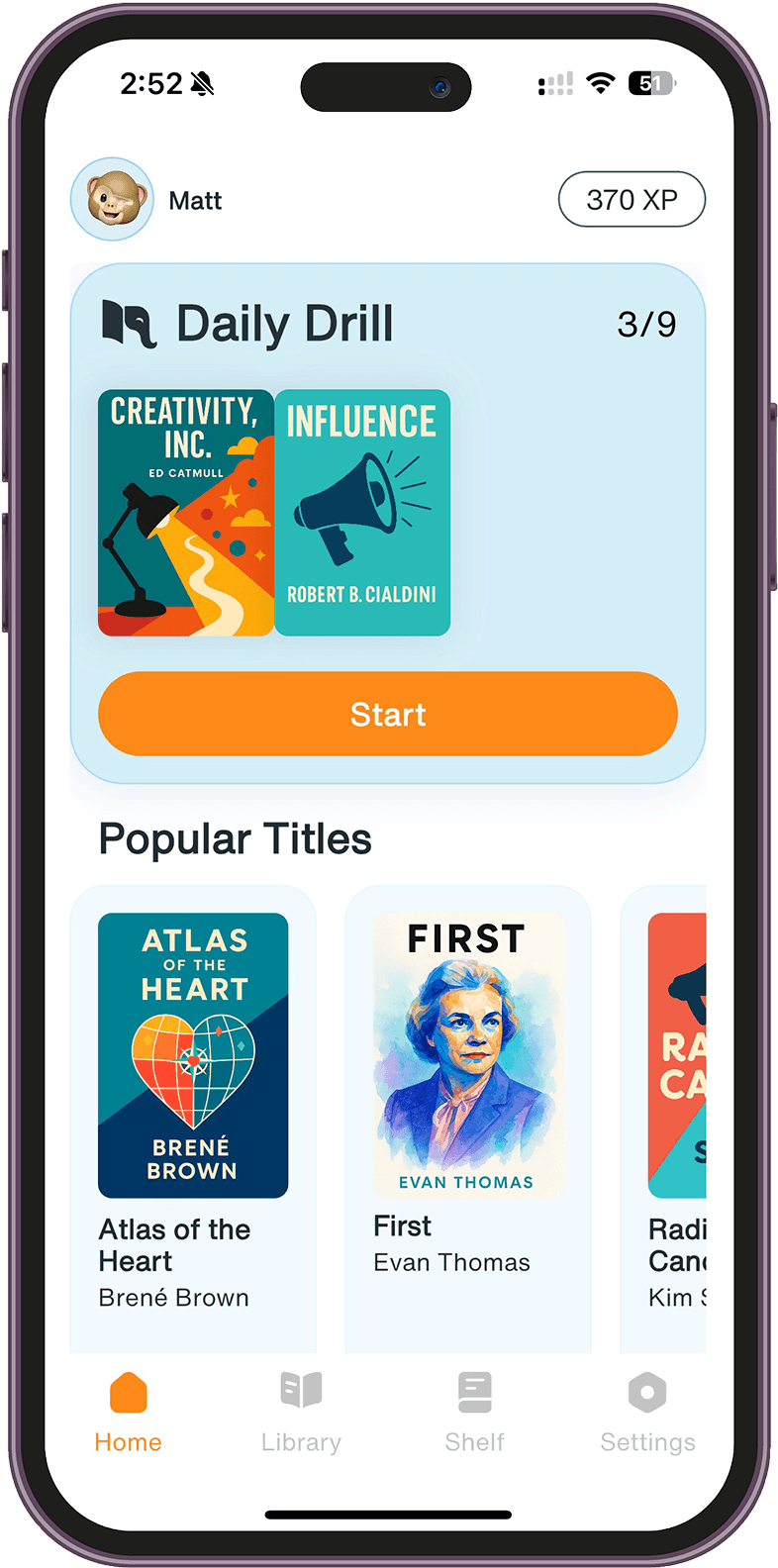
Loxie uses spaced repetition and active recall—the two most scientifically validated learning methods—to help you retain feedback skills permanently. Instead of reading once and hoping it sticks, you practice for just 2 minutes a day with questions that resurface concepts right before you'd naturally forget them.
The app tests your recall of specific techniques: What are the three components of SBI? How do you convert a judgment to an observable behavior? What language signals developmental versus punitive framing? Each time you successfully recall an answer, Loxie spaces it out further. Each time you struggle, it brings it back sooner. This optimized spacing means you study only what you need, exactly when you need it.
Giving Feedback is available in Loxie's free tier, along with hundreds of other leadership and professional development topics. You can start reinforcing these concepts today—and actually have them available the next time you need to deliver difficult feedback.
Frequently Asked Questions
What is the SBI feedback model?
The SBI model structures feedback as Situation-Behavior-Impact. Situation anchors feedback in a specific moment ("In yesterday's meeting"). Behavior describes observable actions without interpretation ("you interrupted three times"). Impact explains consequences ("which caused the client to appear frustrated"). This structure removes judgment and creates feedback that's undeniable yet preserves dignity.
What's the difference between observable behaviors and judgments in feedback?
Observable behaviors are actions anyone could witness ("You checked your phone six times during the presentation"), while judgments add interpretation or character assessment ("You don't respect her ideas"). The video test helps: if a camera could record it, it's observable. Behavioral feedback enables change; judgmental feedback triggers defensiveness.
How do you reduce defensiveness when giving feedback?
Frame feedback as developmental ("I want to help you succeed") rather than punitive. Use calm tone—research shows tone accounts for 38% of message reception. Pause after delivering feedback to allow processing. When defensiveness emerges, acknowledge emotions ("I can see this is difficult") before returning to behavioral facts.
When should feedback be immediate versus scheduled?
Immediate feedback is essential for safety violations, ethical breaches, and client-impacting errors. Teachable moments also benefit from immediate feedback. Scheduled feedback suits complex performance patterns and sensitive topics. The 24-48 hour rule balances freshness with emotional regulation for most situations.
Why does the feedback sandwich often fail?
The feedback sandwich (positive-negative-positive) fails because recipients recognize the pattern and discount positive comments as manipulation. Instead, use "frequent and separate"—regular positive recognition in daily interactions, with corrective feedback in focused conversations. This preserves authenticity in both types of communication.
How can Loxie help me learn to give better feedback?
Loxie uses spaced repetition and active recall to help you retain feedback techniques long-term. Instead of reading once and forgetting, you practice for 2 minutes a day with questions that resurface concepts right before you'd naturally forget them. Loxie includes Giving Feedback in its full topic library.
Stop forgetting what you learn.
Start learning for good with your 7-day FREE trial.