Good to Great: Key Insights & Takeaways from Jim Collins
Master Jim Collins' research-backed principles that separate truly great companies from merely good ones—and learn how to apply them.
by The Loxie Learning Team
What separates companies that achieve sustained excellence from those that remain perpetually average? Jim Collins spent five years analyzing 1,435 companies across four decades to answer this question. His research team identified eleven organizations that made the leap from good to great—and more importantly, discovered the systematic principles that enabled their transformation.
This guide breaks down Collins' complete framework for organizational excellence. You'll learn about Level 5 Leadership, the Hedgehog Concept, the Flywheel Effect, and the other principles that separated elite performers from their merely good competitors. Whether you're leading a team, building a company, or simply want to understand what drives lasting success, these concepts provide a roadmap for moving from competence to greatness.
 Start practicing Good to Great free for 7 days ▸
What is Level 5 Leadership and why does it matter?
Level 5 Leadership represents the highest level in Collins' leadership hierarchy, and every good-to-great transformation in the research exhibited this type of leadership at the helm. Level 5 leaders combine two seemingly contradictory qualities: extreme personal humility and intense professional will. They channel their ambition into the company rather than themselves, and they set up their successors for even greater success rather than positioning themselves as indispensable.
This combination proves essential because personal humility creates space for others to contribute and grow, while professional will ensures relentless pursuit of results. Level 5 leaders don't need credit or recognition—they need the company to succeed. When things go well, they look out the window to attribute success to factors outside themselves. When things go poorly, they look in the mirror and accept responsibility. This pattern appeared consistently across the good-to-great companies, while comparison companies often had leaders with larger-than-life personalities who eventually derailed their organizations.
The practical implication is profound: organizations should look for leaders who demonstrate humility alongside determination, not charismatic visionaries who position themselves as the source of all answers. Great companies build excellence that endures beyond any individual leader by creating strong succession planning, embedding values deeply, and establishing systems that outlast personalities. Loxie helps leaders internalize these leadership principles so they become instinctive rather than theoretical—because understanding Level 5 Leadership intellectually is very different from embodying it under pressure.
Why should you focus on people before strategy?
Great companies first get the right people on the bus and in the right seats, then figure out where to drive it. This principle inverts conventional wisdom, which suggests you should first determine your vision and strategy, then hire people to execute it. Collins' research revealed the opposite: the right people will adapt to changing conditions and create their own motivation, making them invaluable regardless of where the company ultimately heads.
The logic behind this approach becomes clear when you consider uncertainty. No one can predict the future with precision, and strategies must evolve as circumstances change. If you build your organization around a specific strategy, you'll need to change people every time the strategy shifts. But if you build around exceptional people with the right character traits, they'll navigate whatever challenges emerge.
What traits matter most when hiring?
Collins' research suggests prioritizing character traits like work ethic, basic intelligence, and dedication to fulfilling commitments over specialized knowledge that can be taught. When you have the right people in the right seats, they don't need to be tightly managed or motivated—they're self-motivated by an inner drive to produce the best results and be part of creating something great.
This has significant implications for hiring practices. Rather than filling positions based solely on technical qualifications, great companies ask whether this person shares the organization's core values and whether they would thrive in a demanding, results-oriented environment. The wrong person in a critical seat can do enormous damage, while the right person in the same seat can transform outcomes. Loxie can help you retain these hiring principles so you apply them consistently, even when you're under pressure to fill a role quickly.
Practice these concepts in Loxie ▸
What is the Hedgehog Concept and how do you find yours?
The Hedgehog Concept emerges at the intersection of three circles: what you are deeply passionate about, what you can be the best in the world at, and what drives your economic engine. Companies that achieve greatness develop a crystalline understanding of this intersection and use it to guide all major decisions. The concept gets its name from the ancient Greek parable about the fox who knows many things versus the hedgehog who knows one big thing—great companies are hedgehogs, not foxes.
Finding your Hedgehog Concept requires honest self-assessment across all three dimensions. Passion matters because sustained excellence requires energy that only genuine enthusiasm can provide—passion without economic viability leads to failure, while profit without passion creates mediocrity. Being the best matters because competing in areas where you can't achieve distinction wastes resources. And understanding your economic engine matters because even the most passionate pursuit must sustain itself financially.
How does a Hedgehog Concept simplify decisions?
A crystalline concept simplifies thousands of decisions by providing a clear standard against which all opportunities can be measured. When a new initiative arises, the question becomes straightforward: does this fit our Hedgehog Concept? If yes, pursue it vigorously. If no, decline it regardless of how attractive it might seem. This enables consistent strategic choices across the organization without requiring every decision to escalate to senior leadership.
The discipline required here is significant. Many appealing opportunities will fall outside your Hedgehog Concept, and saying no to them requires conviction. Good-to-great companies demonstrated this discipline repeatedly, turning down ventures that didn't align with their core concept even when they seemed profitable. Understanding this framework intellectually is one thing; actually applying it when a tempting opportunity arises is another. Loxie's spaced repetition approach helps the Hedgehog Concept become an automatic filter rather than something you have to consciously remember to apply.
What is the Stockdale Paradox and why is it essential?
The Stockdale Paradox requires retaining absolute faith that you will prevail in the end, regardless of difficulties, while simultaneously confronting the most brutal facts of your current reality. Named after Admiral Jim Stockdale, who survived eight years as a prisoner of war in Vietnam, this principle captures a psychological discipline that separated successful companies from those that failed when facing severe challenges.
The paradox matters because either quality alone proves insufficient. Optimists who refuse to confront brutal facts make poor decisions based on wishful thinking. Pessimists who wallow in harsh realities lose the motivation to persist. Great companies and great leaders hold both perspectives simultaneously—they face the truth about their current situation with unflinching honesty while maintaining unwavering confidence in ultimate victory.
Stockdale observed that the prisoners who didn't survive were the optimists who kept expecting rescue by specific dates—Christmas, Easter, the following Christmas. When those dates passed without rescue, they died of broken hearts. The survivors were those who confronted the reality of their situation while never losing faith that they would prevail eventually. Great companies confront brutal facts head-on while maintaining absolute faith in eventual success, using harsh realities as catalysts for breakthrough solutions rather than sources of despair.
The gap between knowing and doing
Understanding the Stockdale Paradox intellectually doesn't mean you'll apply it when facing your own brutal facts. Loxie uses spaced repetition to help these principles become automatic responses rather than concepts you struggle to recall under pressure.
Build lasting retention with Loxie ▸How does a culture of discipline create freedom?
A culture of discipline eliminates the need for bureaucracy by combining entrepreneurial freedom with fanatical adherence to the Hedgehog Concept. This creates self-managing systems that outperform traditional command-and-control structures. The key insight is that discipline and freedom are not opposites—properly implemented, discipline creates freedom by eliminating the need for excessive oversight and approval processes.
Collins breaks this down into three components: disciplined people eliminate the need for hierarchy, disciplined thought eliminates the need for bureaucracy, and disciplined action eliminates the need for excessive controls. When you have the right people who understand and commit to the Hedgehog Concept, they make decisions independently that align with the company's strategic direction.
Why do self-managing professionals outperform hierarchies?
Self-managing professionals who understand the company's Hedgehog Concept make better decisions faster than hierarchical approval systems because they combine deep expertise with clear strategic boundaries. They don't need someone checking their work or approving their choices—the Hedgehog Concept serves as their guiding framework, and their character ensures they apply it faithfully.
This has profound implications for organizational design. Rather than building elaborate approval processes and management layers, great companies invest in selecting the right people and ensuring deep understanding of the strategic concept. The result is an organization that moves faster, adapts more readily, and requires far less administrative overhead than traditionally managed competitors.
Start retaining what you learn ▸
What is the Flywheel Effect and how does momentum build?
The Flywheel Effect creates breakthrough momentum through thousands of consistent actions in the same direction, each push building on the last until the accumulated energy becomes unstoppable. Great companies achieve breakthrough results through a pattern of disciplined buildup followed by dramatic acceleration, not through single defining actions or radical restructuring programs.
Imagine pushing a massive flywheel—a heavy disk mounted on an axle. At first, pushing requires enormous effort for minimal movement. But with persistent effort in a consistent direction, the flywheel begins to move. Eventually, its own momentum helps it turn. The breakthrough comes not from any single push but from the accumulated effect of all the pushes in the same direction. Good-to-great companies understood this dynamic: there was no single miracle moment, no defining event, no killer innovation that explained their success. There were thousands of accumulated pushes.
This principle has important implications for expectations. Outsiders often look at great companies and assume there must have been some dramatic turning point—a brilliant strategy, a transformative acquisition, a revolutionary product. But the insiders rarely experienced it that way. They simply kept pushing the flywheel, making progress bit by bit, until momentum took over. Breakthrough momentum results from thousands of accumulated pushes in a consistent direction, each building upon the last until the flywheel reaches unstoppable speed.
How should great companies approach technology?
Technology serves as an accelerator of momentum, not a creator of it—great companies use technology to amplify their Hedgehog Concept rather than jumping on tech trends that don't fit their core strategy. This finding contradicts the common assumption that technology drives business transformation. In Collins' research, technology was never the primary cause of a good-to-great transition.
Technology investments must pass the Hedgehog test by directly supporting what the company can be best at, is passionate about, and drives its economic engine, or they become expensive distractions. Great companies approached technology with a simple question: does this help us execute our Hedgehog Concept more effectively? If yes, they became pioneers in applying that technology. If no, they ignored it regardless of how trendy it seemed.
This disciplined approach means great companies often appeared behind the curve on technological adoption—but they actually achieved better results because they only invested in technology that genuinely advanced their strategic position. When they did adopt technology, they applied it with singular focus and often achieved breakthrough results that technology-chasing competitors couldn't match.
How do great companies sustain excellence over time?
Companies sustain greatness by preserving core values and purpose while stimulating progress through changing strategies and practices, creating a dynamic of continuity and change. This balance proves essential because pure preservation leads to stagnation while constant change destroys organizational identity. Great companies maintain unwavering commitment to their core values while demonstrating remarkable willingness to change everything else.
This dynamic appears in how good-to-great companies handled succession, strategy shifts, and market disruptions. The core values remained constant—the definition of what the company stood for didn't change based on circumstances. But strategies, tactics, and practices evolved continuously as conditions demanded. Companies achieve greatness through disciplined people, thought, and action, but sustain it by preserving core values while stimulating progress through bold goals and continuous innovation.
Building this kind of enduring organization requires embedding principles so deeply that they persist beyond any individual's tenure. Great companies build excellence that endures beyond any individual leader by creating strong succession planning, embedding values deeply, and establishing systems that outlast personalities. The principles themselves must become part of the organization's DNA rather than residing in any single leader's mind.
The real challenge with Good to Great
Collins' research provides a comprehensive framework for organizational excellence—Level 5 Leadership, the Hedgehog Concept, the Flywheel Effect, the Stockdale Paradox, disciplined people, disciplined thought, disciplined action. These principles are powerful and well-documented. But here's the uncomfortable truth: most people who read Good to Great don't transform their organizations.
The problem isn't the ideas. The problem is that knowledge fades. Within a week of finishing the book, you'll remember the broad strokes but struggle to articulate the specific principles. Within a month, you might recall that the Hedgehog Concept involves three circles but forget what they are. Within a year, you'll vaguely remember that the book was about leadership and strategy, but the actionable frameworks will have dissolved into a general impression that companies should be disciplined.
How many books have you read that felt genuinely important but you can't recall the key concepts when you need them? The forgetting curve is merciless: without active reinforcement, we lose 70% of new information within 24 hours and 90% within a week. Reading alone doesn't create lasting change because reading alone doesn't create lasting memory.
How Loxie helps you actually remember what you learn
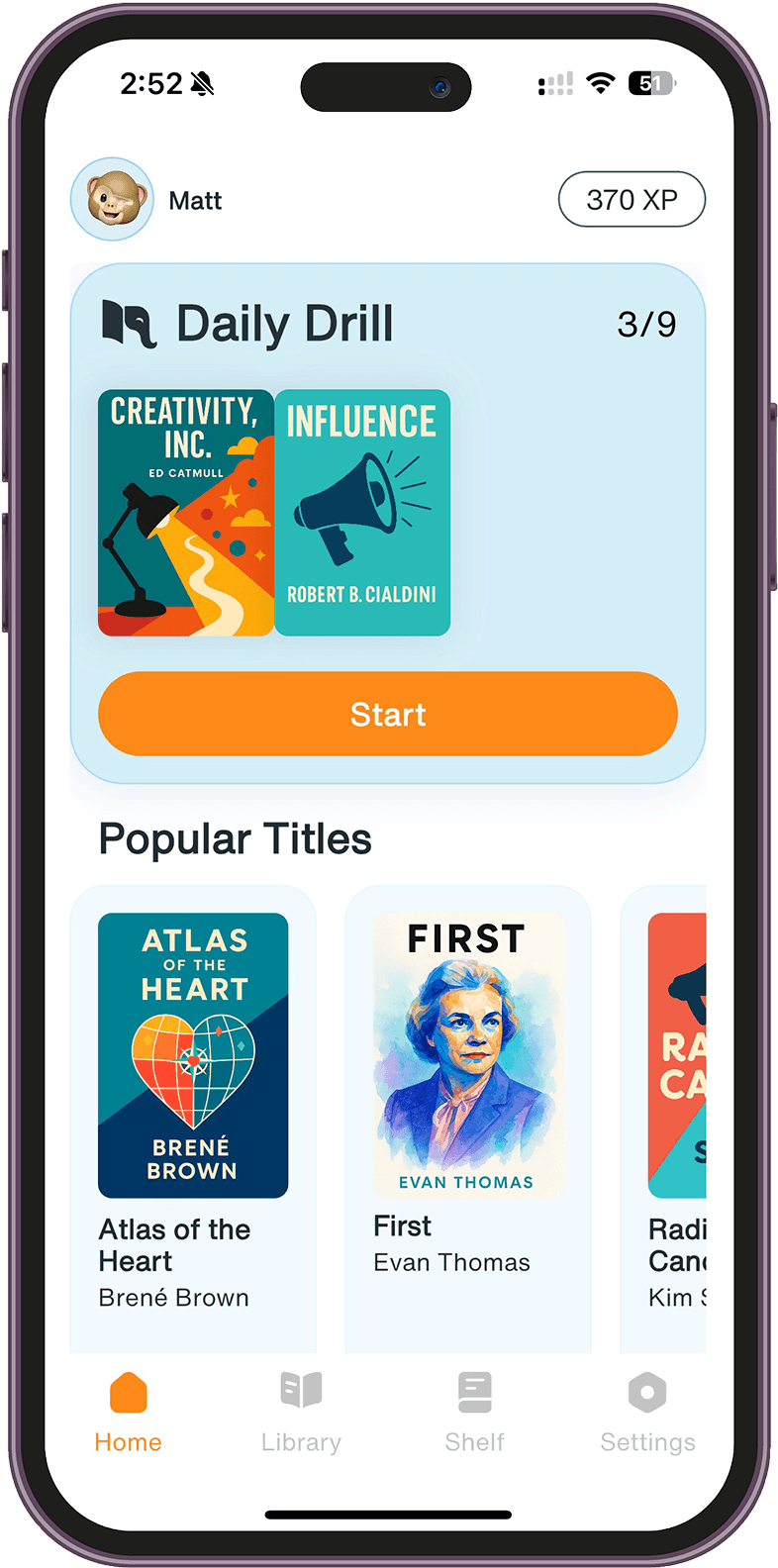
Loxie uses spaced repetition and active recall—the same techniques that made Collins' good-to-great companies successful—to help you retain the knowledge that matters. Instead of reading Good to Great once and watching the insights fade, you practice for just 2 minutes a day with questions that resurface concepts right before you'd naturally forget them.
The science behind this approach is well-established. Active recall (testing yourself rather than re-reading) strengthens memory far more effectively than passive review. Spaced repetition (reviewing at optimal intervals) ensures you retain information permanently rather than temporarily. Combined, these techniques transform how your brain stores and retrieves knowledge.
Good to Great is available in Loxie's free topic library, so you can start reinforcing these concepts immediately. Level 5 Leadership, the Hedgehog Concept, the Flywheel Effect, the Stockdale Paradox—all of them will stay with you, ready to apply when you need them rather than fading into vague recollections of a book you once read.
Frequently Asked Questions
What is the main idea of Good to Great?
Good to Great argues that companies achieve sustained excellence through systematic principles rather than luck, charismatic leaders, or dramatic transformations. Collins identifies specific frameworks—Level 5 Leadership, the Hedgehog Concept, and the Flywheel Effect—that separate truly great companies from merely good competitors.
What are the three circles of the Hedgehog Concept?
The Hedgehog Concept emerges at the intersection of three circles: what you are deeply passionate about, what you can be the best in the world at, and what drives your economic engine. Companies achieve greatness when they find an activity that satisfies all three criteria and pursue it with fanatical discipline.
What is Level 5 Leadership?
Level 5 Leadership combines extreme personal humility with intense professional will. Level 5 leaders channel their ambition into the company rather than themselves, credit others when things go well, accept responsibility when things go poorly, and set up successors for even greater success.
What is the Flywheel Effect?
The Flywheel Effect describes how great companies build momentum through thousands of consistent actions in the same direction, each push building on the last. There's no single breakthrough moment—just accumulated effort until the flywheel's own momentum makes it nearly unstoppable.
What is the Stockdale Paradox?
The Stockdale Paradox requires maintaining absolute faith that you will prevail in the end while simultaneously confronting the most brutal facts of your current reality. Named after Admiral Jim Stockdale, this psychological discipline enables organizations to face challenges without losing hope or making decisions based on wishful thinking.
How can Loxie help me remember what I learned from Good to Great?
Loxie uses spaced repetition and active recall to help you retain key concepts from Good to Great. Instead of reading the book once and forgetting most of it, you practice for 2 minutes a day with questions that resurface ideas right before you'd naturally forget them. Loxie includes Good to Great in its topic library.
We're an Amazon Associate. If you buy a book through our links, we earn a small commission at no extra cost to you.
Stop forgetting what you learn.
Start learning for good with your 7-day FREE trial.