Habits & Behavior Change: Key Concepts & What You Need to Know
Master the science of building automatic routines that stick and breaking patterns that sabotage your goals—without relying on willpower.
by The Loxie Learning Team
You've probably set the same goal a dozen times—exercise more, eat healthier, read daily—only to find yourself back at square one within weeks. The problem isn't your motivation or discipline. It's that you've been fighting your brain's natural programming instead of working with it. Habits operate through neurological patterns that run on autopilot, and lasting change requires understanding how to rewire these automatic systems rather than relying on willpower that inevitably runs out.
This guide breaks down the science of habits and behavior change. You'll learn how the habit loop creates automatic behaviors, why substituting routines beats trying to eliminate them, and how environmental design makes good habits inevitable while making bad habits nearly impossible. Most importantly, you'll discover why focusing on identity and systems—not goals and motivation—is the key to transformation that actually lasts.
 Start practicing behavior change concepts ▸
What is the habit loop and how does it control your behavior?
The habit loop is a three-component neurological pattern—cue, routine, and reward—that governs how habits form and persist. When an environmental trigger (cue) appears, your brain executes an automatic behavior (routine) in anticipation of satisfaction (reward). Through repetition, this sequence becomes hardwired, allowing your brain to run the behavior without conscious thought.
This neurological automation explains why you reach for your phone without deciding to, or why you automatically grab a snack when entering the kitchen. Your brain creates these shortcuts to conserve energy, turning repeated sequences into automatic programs. The more you repeat a cue-routine-reward sequence, the stronger the neural pathway becomes, until the behavior requires no conscious effort to initiate.
Understanding the habit loop is essential because you can't just try to stop a behavior without addressing the underlying pattern. The brain expects satisfaction when familiar cues appear and will resist changes that eliminate expected rewards entirely. Changing habits requires manipulating at least one component of the loop—either modifying the cue, substituting the routine, or adjusting the reward.
How do you break bad habits without fighting yourself?
Breaking bad habits requires keeping the same cue and reward while substituting a new routine. When stress (cue) triggers snacking for comfort (reward), replace chips with carrots or a walk. This substitution strategy works because you're not fighting the entire neurological pattern—you're redirecting it while satisfying the underlying craving.
Trying to eliminate a habit completely creates a void that your brain fills by reverting to the old pattern, especially under stress. By providing an alternative routine that delivers similar satisfaction, you satisfy the craving while changing the behavior. This is why nicotine gum helps smokers quit—it provides the chemical reward through a different routine, keeping the same cue-reward structure intact.
The key insight is that cravings drive habits, and cravings can only be satisfied, not suppressed. When you understand what reward your brain actually seeks—often emotional relief rather than the specific behavior—you can find healthier ways to deliver that satisfaction without the negative consequences of the original habit.
Practice habit change techniques ▸
What are implementation intentions and why do they work?
Implementation intentions use the formula "When [situation] occurs, I will [behavior]" to pre-decide responses to specific cues before you're in the tempting situation. For example: "When I feel the urge to check social media, I will do five deep breaths instead." This removes in-the-moment decisions that drain willpower and often default to old patterns.
Research shows people who form implementation intentions are 2-3x more likely to follow through on their goals (Gollwitzer & Sheeran, 2006). The technique works because it creates a mental link between a cue and a new response while you're calm and rational. When the situation arises, your brain has already programmed an automatic response, reducing the cognitive load of deciding what to do.
Specificity is critical for implementation intentions to work. Vague plans like "I'll eat healthier" fail because they don't program specific responses. But "When I open the fridge for a snack, I'll grab an apple" succeeds because it creates a direct cue-behavior link that your brain can execute automatically.
Why must rewards be immediate to build habits?
Rewards must be immediate to reinforce habits because the brain's reward system evolved for instant feedback, not long-term planning. Delayed gratification like "lose weight in 6 months" doesn't train the neural pathway—your brain can't connect behaviors to outcomes separated by months. Immediate rewards like endorphins from exercise or the satisfaction of checking off a habit tracker provide instant reinforcement.
This immediacy requirement explains why unhealthy habits form so easily. Junk food tastes good now, cigarettes provide instant relief, scrolling social media delivers immediate dopamine hits. To build healthy habits, you need to engineer immediate rewards that the brain can connect to the desired behavior—not just the delayed benefits that motivated you to start.
Practical immediate rewards include the satisfaction of marking an X on a habit tracker, a small celebration ritual after completing your routine, or pairing the behavior with something enjoyable. Loxie leverages this principle by providing immediate feedback when you practice—each correct answer reinforces the learning behavior while building toward long-term retention.
How does habit stacking build new behaviors on existing routines?
Habit stacking uses the formula "After I [current habit], I will [new habit]" to build new behaviors on existing neural pathways. For example: "After I pour morning coffee, I will write in my gratitude journal." This leverages established routines as automatic triggers, eliminating the need for remembering or deciding when to do the new behavior.
Your brain has already automated certain behaviors like making morning coffee, brushing teeth, or sitting down at your desk. Habit stacking hijacks these existing pathways by attaching new behaviors to established ones. The completion of the anchor habit becomes the cue for the new behavior, creating a chain reaction that requires no willpower to initiate.
This approach is more reliable than time-based cues like "I'll meditate at 7am" because the trigger behavior will happen regardless of schedule variations. Your coffee routine doesn't care if you woke up late or your meeting moved—it happens every day, making it a dependable anchor for new habits.
Understanding habit stacking is one thing. Remembering to use it is another.
Loxie reinforces behavior change concepts through spaced repetition, so you'll recall techniques like habit stacking precisely when you need them—not just when you first read about them.
Build lasting knowledge ▸How does environmental design make good habits automatic?
Environmental design makes good habits inevitable by restructuring physical spaces so your surroundings prompt desired behaviors without requiring willpower or conscious choice. Placing fruit at eye level while hiding cookies, keeping dumbbells in the living room, putting books on the nightstand—these environmental changes guide behavior automatically.
Your environment constantly sends behavioral cues that your brain processes without conscious awareness. When healthy options are visible and convenient while unhealthy options require effort to access, you naturally default to better choices. This isn't about motivation or discipline—it's about architecture. Casino designers understand this principle perfectly, carefully crafting environments that promote specific behaviors.
The same principles work for any habit. Want to read more? Put a book on your pillow. Want to practice guitar? Keep it on a stand in the living room, not in a case in the closet. Want to drink more water? Keep a filled bottle on your desk. Each environmental adjustment reduces the friction for good behaviors while increasing it for bad ones.
Why does reducing friction matter so much for behavior change?
Reducing friction means removing steps between you and good habits—sleeping in workout clothes, pre-chopping vegetables on Sunday, keeping a filled water bottle on your desk. Research suggests each additional step required to start a behavior decreases the likelihood of following through by approximately 20% (Fogg, 2019).
Friction is the silent killer of good intentions. The more steps between intention and action, the more opportunities for your brain to talk you out of it. This explains why gym attendance drops dramatically with distance from home—each additional minute of travel is another friction point where motivation can fail.
By removing steps, you make behaviors almost automatic. Sleeping in workout clothes eliminates the "get changed" step. Pre-chopping vegetables removes the prep barrier to healthy eating. The 20-second rule demonstrates this powerfully: decreasing activation time by just 20 seconds dramatically increases behavior frequency, while adding 20 seconds of friction significantly reduces unwanted behaviors.
What is temptation bundling and how do you use it?
Temptation bundling pairs necessary but unappealing tasks with enjoyable rewards—only watching favorite shows while on the treadmill, only getting coffee while reviewing flashcards. This creates anticipation for the difficult task through its exclusive association with pleasure, making you look forward to behaviors you'd otherwise avoid.
Studies show people exercise 51% more when bundling workouts with audiobooks they can only access at the gym (Milkman et al., 2013). The technique hijacks your brain's reward system to make difficult behaviors appealing. Instead of dreading the treadmill, you anticipate it as your only access to the podcast you're hooked on.
The exclusivity is critical—if you can get the reward elsewhere, the bundle loses power. Breaking bundle exclusivity destroys the technique's effectiveness. If you start watching your "treadmill only" show on the couch, the exercise motivation disappears because the reward is no longer contingent on the behavior.
What is the two-minute rule and why does it work?
The two-minute rule shrinks any habit to a version taking less than two minutes—"read 30 minutes" becomes "read one page," "run 3 miles" becomes "put on running shoes." This makes the starting barrier so low that beginning requires less effort than procrastinating.
Starting is the hardest part of any behavior. Once you overcome initial inertia, continuing feels easier than stopping. The two-minute version isn't the goal—it's the gateway. But even if you only do two minutes, you're reinforcing the identity and neural pathway. It's better to read one page daily than to read nothing while planning to read for hours.
Motion creates momentum through neurological activation. Putting on workout clothes activates exercise-related neural networks, opening a book activates reading circuits. Once these circuits are active, continuing the behavior requires less activation energy than starting from complete rest. The two-minute rule exploits this by getting your brain into the right state.
How does consistency build identity over time?
Consistency at the two-minute level builds identity before performance. Doing one pushup daily for a month makes you "someone who never misses workouts," establishing the self-concept that later supports doing 50 pushups because that's "what someone like me does."
Identity change happens through accumulated evidence, not declaration. Each time you do even the minimum version, you're casting a vote for a new identity. After enough votes, your self-concept shifts. This identity then drives behavior—you work out not because you have to, but because you're a person who works out.
Small wins accumulate to shift identity through evidence collection. Each healthy meal proves "I'm someone who eats well," each writing session confirms "I'm a writer." Your brain maintains identity through evidence, constantly collecting data about who you are through your actions. Build the identity first with easy consistency, then expand the behavior from that foundation.
How do you add friction to break bad habits?
Adding friction to bad habits—logging out of social media after each use, storing junk food in the basement, unplugging the TV—creates decision points that interrupt automaticity. This forces conscious choice rather than mindless execution of unwanted behaviors.
Most bad habits operate below consciousness. You check your phone without deciding to, eat snacks without choosing to. Friction disrupts this automaticity by requiring deliberate action. When you have to log back into Instagram, walk to the basement for cookies, or plug in the TV, your prefrontal cortex engages, creating an opportunity to choose differently.
Multiple friction layers compound effectiveness. Deleting apps requires reinstalling, logging out requires remembering passwords, enabling parental controls requires bypass codes. Each additional barrier multiplies the effort required. Time delays are particularly effective because impulsive behaviors require immediate gratification—a 5-minute delay on a website often allows the urge to pass before you can act on it.
What are identity-based habits and why do they last?
Identity-based habits focus on becoming a type of person rather than achieving outcomes—"I'm someone who doesn't miss workouts" instead of "I want to lose 20 pounds." Each behavior becomes a vote for the identity you're building rather than a step toward a distant goal.
Outcome-based motivation fails because it's externally focused and temporary—what happens after you lose the weight? Identity-based change is internally driven and permanent. When you see yourself as a healthy person, you make healthy choices automatically because that's who you are. Each workout isn't about burning calories; it's evidence that you're an athlete.
Identity statements must be process-focused rather than outcome-focused. "I'm someone who reads daily" works better than "I'm a bestselling author" because you can control processes but not outcomes, and immediate evidence reinforces achievable identities. Identity questions guide behavior in decision moments: "What would a healthy person order?" provides clear direction by consulting your aspirational identity rather than current impulses.
Why is willpower unreliable for behavior change?
Willpower depletion occurs because self-control draws from a limited daily reserve. Resisting morning donuts depletes the same cognitive pool used for afternoon focus and evening exercise. This explains why people make progressively worse decisions throughout the day despite starting with good intentions.
Research shows that all forms of self-control—resisting temptation, maintaining focus, controlling emotions—deplete the same cognitive resource. This is why stressed people eat poorly and tired people skip workouts. Each act of willpower is like a rep that fatigues the muscle. By evening, you've done hundreds of small acts of self-control, leaving little reserve for major challenges.
Decision fatigue compounds this problem. Every choice, even trivial ones like what to wear, drains cognitive resources. This is why successful people eliminate unnecessary decisions through routines, uniforms, and meal prep—preserving mental energy for important choices rather than depleting it on daily minutiae.
Start retaining what you learn ▸
How do systems bypass willpower entirely?
Systems bypass willpower through environmental design, automatic rules, and pre-commitment. Meal prep eliminates "what to eat" decisions, automatic savings removes "whether to save" choices, calendar blocking prevents "when to work" negotiations. Good behaviors happen without requiring self-control.
The most effective behavior change doesn't require willpower because it doesn't require decisions. When healthy meals are already prepared, you eat them. When savings automatically transfer, you accumulate wealth. When deep work is calendar-blocked, you do it. These systems work during willpower valleys because they've eliminated the choice point where willpower would be needed.
Pre-commitment strategies lock in good decisions when willpower is high. Scheduling workouts with friends creates social obligation, paying for classes in advance creates loss aversion, public goal announcements create reputation stakes. Using current motivation to constrain future behavior ensures follow-through when enthusiasm fades.
Why do process goals beat outcome goals?
Process goals focus on systems you control—"write 500 words daily," "exercise 3x weekly"—while outcome goals target results you don't fully control—"publish bestseller," "lose 30 pounds." Sustainable change comes from falling in love with the process rather than fixating on outcomes.
You control whether you write daily but not whether your book becomes a bestseller. You control your workouts but not how quickly your metabolism responds. Outcome goals create frustration when results are slow and complacency when they're achieved. Process goals provide daily wins and continuous improvement regardless of external results.
Winners and losers often have the same goals. Every Olympian wants gold, every startup wants success—but different systems separate those who achieve their goals from those who don't. The goal didn't differentiate success from failure; the system did. Spend less time visualizing outcomes and more time optimizing the process that produces them.
Why does daily consistency beat sporadic intensity?
Daily consistency beats sporadic intensity because habit formation depends on repetition frequency, not effort intensity. Five minutes daily creates stronger neural pathways than two-hour weekly sessions. The brain strengthens patterns through consistent activation rather than occasional overload.
Neural pathways strengthen through repeated firing, not intense firing. This is why daily practice of a musical instrument for 10 minutes produces better results than weekly 70-minute sessions. The brain needs frequent repetition to myelinate pathways and make behaviors automatic. Intensity might feel more productive, but consistency creates lasting change.
The "never miss twice" rule maintains consistency while allowing human imperfection. Missing one workout is a normal exception; missing two starts a new negative pattern. This provides psychological recovery without the all-or-nothing thinking that causes people to quit after single failures. Perfectionism kills more habits than laziness.
The real challenge with learning about habits and behavior change
You've just absorbed powerful concepts—the habit loop, implementation intentions, habit stacking, environmental design, identity-based habits, the two-minute rule. But here's the uncomfortable truth: within a week, you'll have forgotten most of what you just read. Research on the forgetting curve shows that we lose 70% of new information within 24 hours without reinforcement.
This creates a frustrating paradox. The very techniques designed to help you build better habits will slip from memory before you can apply them. You'll face a cue, try to recall the substitution strategy, and find the details fuzzy. You'll attempt habit stacking but forget the proper formula. The concepts were clear when you read them, but clarity fades fast.
The irony is that learning about behavior change often fails for the same reasons your other habits fail—you rely on a single exposure (reading) rather than building systems that reinforce the knowledge over time.
How Loxie helps you actually remember what you learn
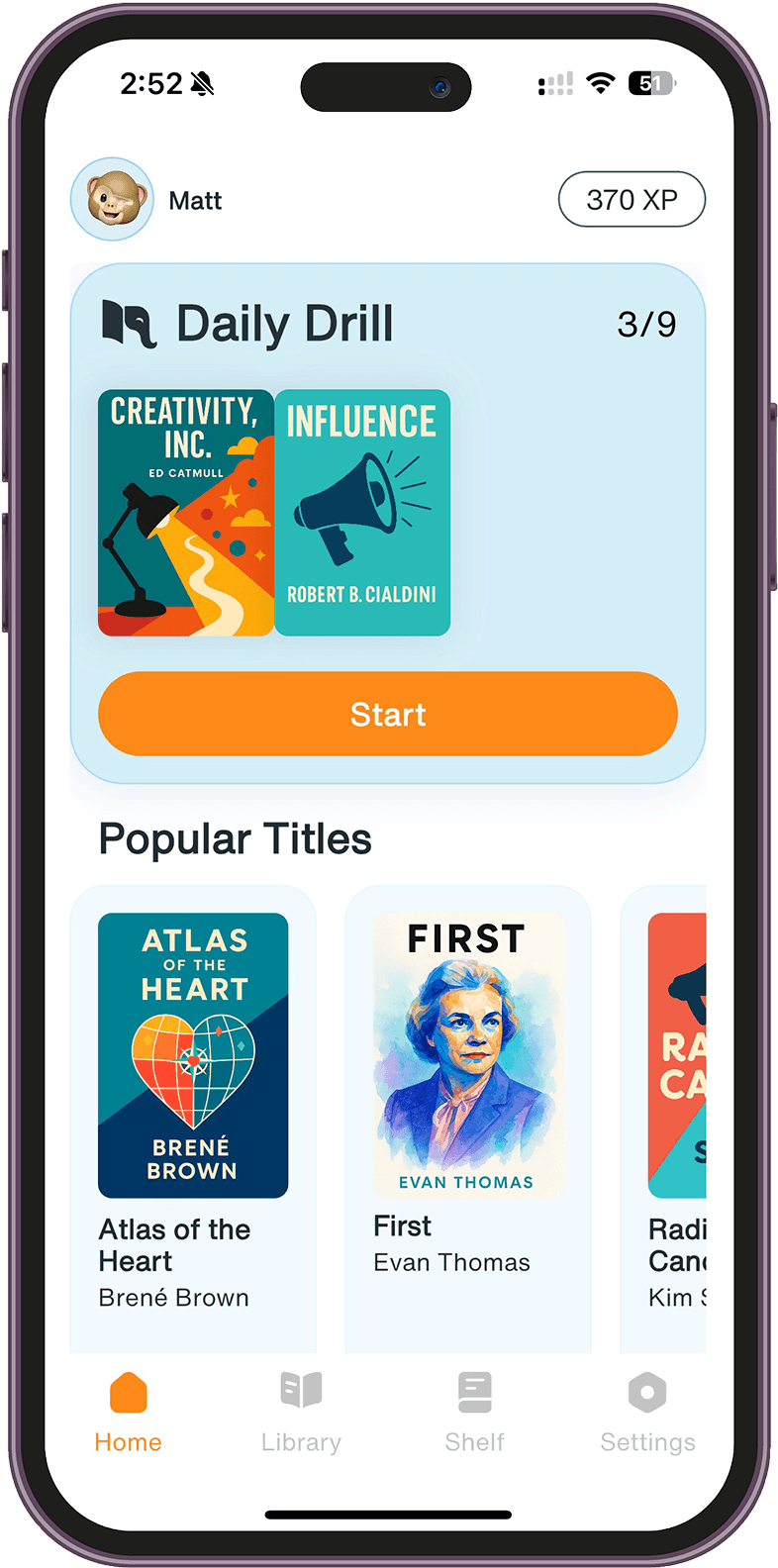
Loxie uses spaced repetition and active recall—the same principles that make habits stick—to help you retain knowledge permanently. Instead of reading about behavior change once and hoping it sticks, you practice for 2 minutes a day with questions that resurface concepts right before you'd naturally forget them.
Think of it as applying habit science to learning itself. Loxie creates the cues (daily practice reminders), the routine (quick retrieval practice), and the rewards (progress tracking and mastery) that turn knowledge retention into an automatic system. You build the identity of "someone who actually remembers what they learn" through consistent daily evidence.
Loxie includes habits and behavior change in its full topic library. Every concept you just read—the habit loop components, implementation intention formulas, friction strategies, identity questions—becomes knowledge you can actually access when you need it, not just information you read once.
Frequently Asked Questions
What is the habit loop?
The habit loop is a three-component neurological pattern—cue, routine, and reward—that governs how habits form. When an environmental trigger (cue) appears, the brain executes an automatic behavior (routine) in anticipation of satisfaction (reward). Through repetition, this sequence becomes hardwired, running without conscious thought.
How long does it take to form a new habit?
Simple habits take around 21 days to feel automatic, while complex habits average 66 days, with a range from 18 to 254 days depending on the behavior and person. The popular "21-day" myth applies only to simple habits; most meaningful behavior changes require 2-3 months of consistent practice before becoming truly automatic.
What is the two-minute rule for habits?
The two-minute rule shrinks any habit to a version taking less than two minutes—"read 30 minutes" becomes "read one page," "run 3 miles" becomes "put on running shoes." This makes starting so easy that beginning requires less effort than procrastinating, and once you start, continuing feels easier than stopping.
Why do habits fail even when motivation is high?
Motivation follows a predictable cycle—peak excitement when setting goals, steady decline during execution. Since willpower draws from a limited daily reserve that depletes throughout the day, systems relying on motivation fail during inevitable low points. Effective behavior change requires environmental design and automatic systems that work without motivation.
What's the difference between outcome goals and process goals?
Outcome goals target results you don't fully control ("lose 30 pounds"), while process goals focus on systems you can control ("exercise 3x weekly"). Process goals provide daily wins and feedback, while outcome goals create long delays between effort and results. Sustainable change comes from optimizing processes, not fixating on outcomes.
How can Loxie help me learn about habits and behavior change?
Loxie uses spaced repetition and active recall to help you retain behavior change concepts permanently. Instead of reading once and forgetting most of it, you practice for 2 minutes a day with questions that resurface techniques like the habit loop, habit stacking, and implementation intentions right before you'd naturally forget them.
Stop forgetting what you learn.
Start learning for good with your 7-day FREE trial.