Impact Players: Key Insights & Takeaways from Liz Wiseman
Master the five practices that separate ordinary contributors from the go-to people who deliver extraordinary value at work.
by The Loxie Learning Team
Why do some professionals become the go-to people everyone relies on during critical moments, while others with similar skills remain ordinary contributors? Liz Wiseman's Impact Players answers this question through extensive research across organizations, revealing that extraordinary impact comes from five specific, learnable practices—not innate talent or simply working harder. The data is compelling: Impact Players create 3-10x more value than typical contributors.
This guide breaks down Wiseman's complete framework for becoming indispensable at work. Whether you're early in your career looking to accelerate your trajectory or a seasoned professional wanting to elevate your contribution, you'll learn not just what Impact Players do differently, but the mindsets and micro-behaviors that make their approach work.
 Start practicing Impact Players free for 7 days ▸
What are the five practices that define Impact Players?
Impact Players differentiate themselves through five core practices: doing the job that's needed (not just assigned), stepping up then stepping back, finishing stronger, asking and adjusting, and making work light. These behaviors emerged from Wiseman's research studying top performers across industries who consistently became trusted crisis navigators and indispensable team members.
What makes these practices powerful is that they're learnable behaviors rather than personality traits or natural gifts. Any professional can develop these capabilities through deliberate practice. The key insight is that Impact Players don't necessarily work more hours—they work on different things and in different ways than their peers.
The cumulative effect of these five practices creates what Wiseman calls the multiplier effect. Impact Players don't just deliver personal excellence—they raise the performance of everyone around them. They make others' jobs easier while tackling the hardest problems themselves, effectively multiplying organizational capacity rather than just adding to it.
How do Impact Players identify and do the job that's actually needed?
Impact Players treat their job description as a starting point rather than a boundary. While typical contributors focus on executing their assigned responsibilities well, Impact Players actively scan for gaps between what's being done and what's actually needed, then pivot their efforts to address the organization's most pressing priorities—even when those priorities fall outside their formal role.
The mindset shift here is fundamental. Contributors ask "What's my job?" while Impact Players ask "What job needs to be done?" This subtle reframing opens up entirely different ways of creating value. It means constantly reassessing where your skills and attention can have the greatest organizational impact rather than optimizing within the confines of your title.
The W.I.N. mindset: What's Important Now
Impact Players use what Wiseman calls the W.I.N. mindset—constantly asking "What's Important Now?"—to recalibrate their efforts as priorities shift. Rather than rigidly sticking to original plans when circumstances change, they regularly reassess what winning looks like today. This dynamic prioritization enables them to deliver relevant value even in volatile environments where yesterday's priorities no longer apply.
The practical application involves building regular checkpoints into your work rhythm. Before diving into tasks, pause to verify they still represent the highest-value use of your time. When new information emerges, ask whether it changes what matters most. This prevents the common trap of delivering excellent work on problems that no longer matter.
Decoding unspoken organizational needs
Impact Players develop skill at reading between the lines to understand implicit expectations that are rarely articulated. They watch what leaders pay attention to in meetings, notice recurring pain points that keep surfacing, and identify what causes stress at the executive level. Then they proactively address these hidden priorities.
This ability to decode unspoken needs makes Impact Players indispensable precisely because they solve problems others don't even recognize. While contributors wait for explicit instructions, Impact Players are already working on what leadership will ask for next—or addressing issues leadership doesn't yet realize are problems.
Practice these concepts in Loxie ▸
What does stepping up then stepping back look like in practice?
Impact Players lead without authority by stepping up in leadership voids—moments of ambiguity, conflict, or unclear ownership—then stepping back gracefully once direction is established or the rightful leader emerges. This fluid approach allows them to provide stability during transitions and fill critical gaps without threatening formal hierarchies.
The key is recognizing what Wiseman calls "leadership moments"—situations where taking charge for even five minutes can unlock progress for an entire team. These moments include clarifying confusion when everyone seems lost, breaking deadlocks when discussions stall, or initiating action when everyone's waiting for someone else to go first.
Earning the leadership passport
Impact Players earn the right to lead through competence and trust before taking charge. Wiseman calls this building a "leadership passport"—accumulating credibility through smaller contributions that demonstrate expertise and reliability. By first proving themselves as capable performers, they create psychological safety for others to follow their lead during critical moments, even without formal authority.
The stepping back component is equally important. Impact Players don't cling to control once they've provided temporary direction. They willingly defer to formal leaders or subject matter experts once the immediate crisis passes. This combination of confidence to lead and humility to follow earns them reputation as both capable leaders and collaborative team players.
The assist mindset
Impact Players become powerful followers who amplify others' leadership by asking "How can I help you succeed?" rather than competing for control. This collaborative approach builds political capital and trust that pays dividends when they need to lead, as colleagues remember who helped them succeed versus who fought for the spotlight.
This isn't passive followership—it's strategic support that makes formal leaders more effective while demonstrating the Impact Player's own capabilities. When the leader looks good, the person who helped them looks good too.
Why do Impact Players consistently finish stronger than their peers?
Impact Players treat obstacles as puzzles to solve rather than excuses to stop. They deliver complete solutions even when initial approaches fail, while contributors often deliver partial work with explanations for why full completion wasn't possible. This completion mindset drives them to find workarounds, marshal additional resources, or redesign approaches when blocked.
The difference shows up in what stakeholders receive: usable outcomes versus status reports about problems encountered. Impact Players understand that a 100% complete deliverable builds exponentially more trust than 90% complete work with good excuses. The last 10% of any project often matters most, yet it's where most people lose momentum.
Building finishing power
Impact Players maintain what Wiseman calls "finishing power" through deliberate practices: building buffer time into commitments, creating contingency plans before problems arise, and treating the final stretch with the same energy as the beginning. They recognize that most professionals lose steam near completion, so they actively guard against this tendency.
The FIFO principle—Figure It Out—characterizes how Impact Players approach ambiguous problems without clear solutions. Rather than waiting for detailed instructions, they take ownership and use resourcefulness and persistence to transform vague directions into concrete outcomes through experimentation and iteration.
Understanding finishing isn't the same as doing it under pressure
Knowing that Impact Players finish stronger is one thing. Actually delivering complete work when you're exhausted and facing obstacles requires having these principles deeply internalized—not just read once. Loxie helps you build the automatic thinking patterns that make finishing power second nature.
Build Impact Player habits with Loxie ▸How do Impact Players use feedback differently than typical contributors?
Impact Players practice "aggressive learning" by seeking feedback before, during, and after work—not just in annual reviews. They treat every interaction as intelligence gathering for performance improvement, creating a continuous feedback loop that allows them to course-correct in real-time rather than discovering misalignment after significant investment.
The technique that makes this effective is asking specific questions rather than generic queries. Instead of "Any feedback?" which yields vague responses, Impact Players ask "What would make this a 10 instead of an 8?" or "What's the one thing I could change to make this more useful?" These targeted questions extract actionable intelligence that dramatically increases work quality.
Adaptive performance in action
Impact Players demonstrate adaptive performance by rapidly incorporating feedback even when it contradicts their initial approach. They view pivots as optimization rather than criticism of their work. This ego-free adaptability allows them to iterate faster than peers who defend original ideas, ultimately delivering solutions that better match stakeholder needs.
The pre-mortem practice takes this further: before starting work, Impact Players imagine failure scenarios and ask stakeholders "What would cause this project to fail?" This proactive risk assessment surfaces unspoken expectations and potential derailers that wouldn't emerge until too late, allowing them to build solutions that address concerns others didn't know they had.
What does it mean to make work light for your team?
Impact Players reduce drama, simplify complexity, and inject positive energy—they make hard things feel easier rather than making easy things feel hard. This emotional labor of managing team energy and morale multiplies their value beyond task execution, as they create psychological conditions where others perform better and projects maintain momentum through difficulties.
The "drama deficit" approach means Impact Players actively prevent and defuse interpersonal conflicts rather than contributing to them. They treat emotional fires as problems to solve rather than entertainment to engage with. By refusing to participate in gossip, blame games, or political maneuvering, they become trusted neutral parties who can broker solutions when relationships strain.
Cognitive load reduction
Impact Players break complex problems into digestible pieces, create clear frameworks, and present solutions in ways that make decision-making easier for stakeholders. Rather than impressing with complexity, they recognize that making things simple and clear is harder but more valuable. This enables faster decisions and reduces the mental burden on already overwhelmed leaders.
This skill becomes increasingly valuable as you work with more senior stakeholders who have less time and more competing demands. The ability to synthesize complexity into clear options and recommendations marks the difference between being seen as a helper versus a burden.
How do Impact Players navigate difficult managers and organizational politics?
Under difficult managers, Impact Players use what Wiseman calls the "workaround strategy"—delivering value to the organization through alternate channels while maintaining professional relationships with their direct supervisor. Rather than becoming victims of bad management or engaging in open conflict, they find ways to contribute through cross-functional projects, skip-level visibility, or peer collaboration.
The key is keeping their manager informed but not dependent. This requires political savvy: building relationships with other leaders without appearing to go around your boss, finding projects that create visibility while still supporting your team's core mission, and maintaining professionalism even when your manager doesn't deserve it.
Building the credibility account
Impact Players build trust deposits through consistent delivery before attempting to influence upward or challenge poor decisions. By first establishing themselves as reliable performers who make their manager's life easier, they accumulate political capital that allows them to later advocate for changes or resist bad directions without being labeled as difficult.
The "upward empathy" practice helps here: understanding your manager's pressures, KPIs, and stakeholder relationships, then aligning your efforts to reduce their biggest pain points. This strategic empathy transforms you from a task executor into a thought partner who anticipates needs and prevents problems.
The two-levels-up perspective
Impact Players think beyond their immediate manager to understand their boss's boss's priorities. They frame their work in terms that resonate at that altitude, making contributions visible and valuable to senior leadership. This elevated thinking ensures their work aligns with strategic initiatives rather than just tactical execution.
When dealing with poor leadership, Impact Players focus on what they can control—their work quality, peer relationships, and learning—rather than exhausting energy trying to change unchangeable managers. This strategic detachment preserves their motivation and reputation while they either wait for organizational changes or position themselves for better opportunities.
The real challenge with Impact Players
Here's an uncomfortable truth: most people who read Impact Players won't become Impact Players. Not because the ideas are wrong—they're research-backed and practical—but because knowledge doesn't automatically translate into behavior. Understanding the five practices intellectually is very different from deploying them instinctively when you're under pressure, facing ambiguity, or dealing with a difficult stakeholder.
The forgetting curve works against you. Within a week of finishing this book, you'll have forgotten the majority of its specific frameworks and techniques. Within a month, you might remember that Impact Players "do the job that's needed" but struggle to recall the W.I.N. mindset, the leadership passport concept, or the specific feedback questions that make aggressive learning work.
How many business books have you read that felt transformative in the moment but left no lasting trace on how you actually work? The gap between reading about Impact Player behaviors and embodying them when it matters is where most professional development fails.
How Loxie helps you actually become an Impact Player
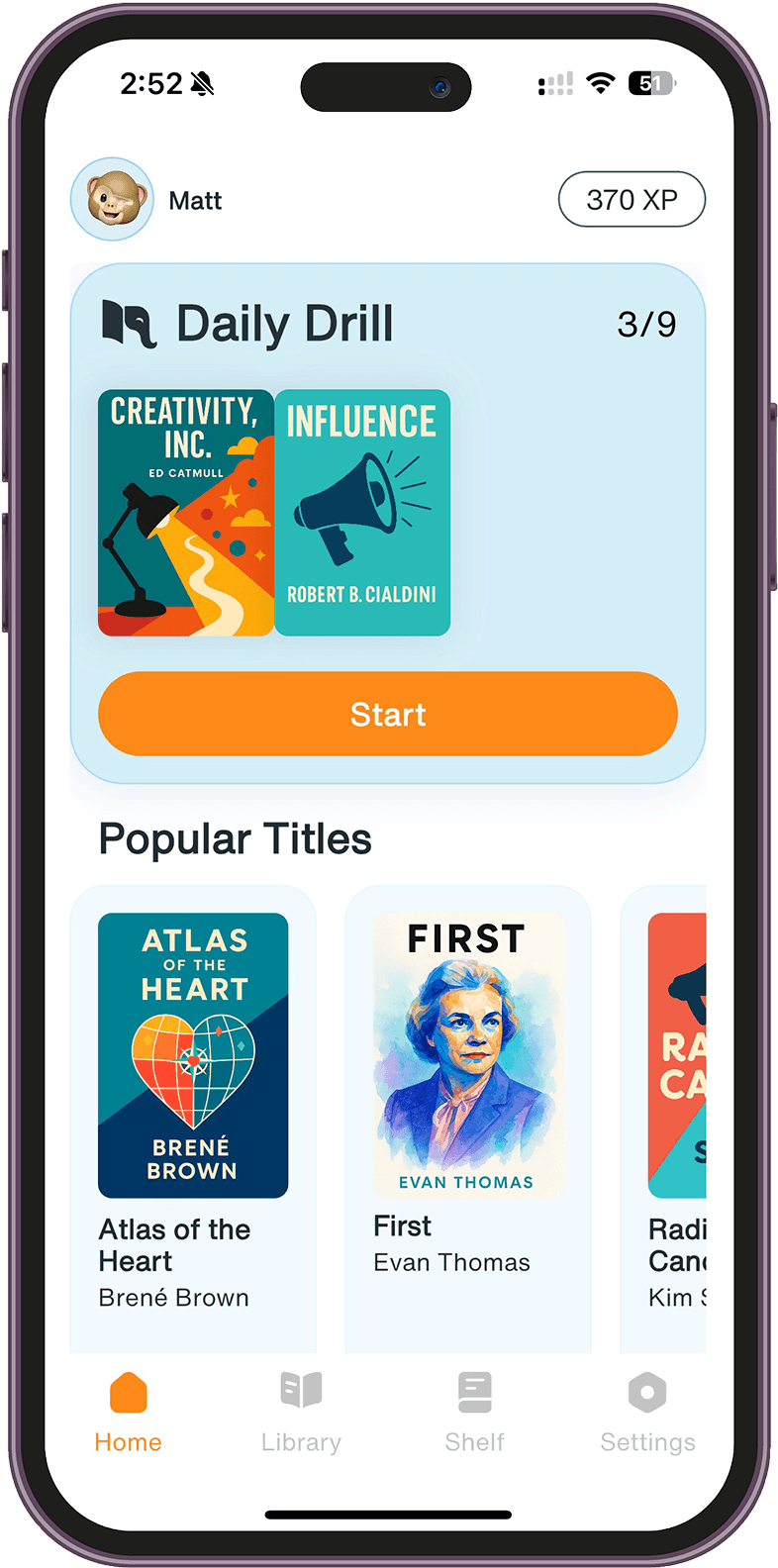
Loxie uses spaced repetition and active recall—the same techniques that help medical students retain vast amounts of information—to help you internalize Impact Players' core concepts so they're available when you need them. Instead of reading the book once and hoping the ideas stick, you practice for just 2 minutes a day with questions that resurface frameworks right before you'd naturally forget them.
The difference is between knowing about the W.I.N. mindset and automatically asking "What's Important Now?" when your priorities shift. Between having heard of the pre-mortem technique and actually using it before your next project kickoff. Loxie transforms passive knowledge into active capability by ensuring these frameworks stay fresh and accessible in your thinking.
Loxie includes Impact Players in its full topic library, so you can start reinforcing these concepts immediately. Within weeks, you'll notice these ideas surfacing naturally in your work—not because you're trying to remember them, but because they've become part of how you think.
Frequently Asked Questions
What is the main idea of Impact Players?
Impact Players argues that extraordinary workplace impact comes from five learnable practices rather than innate talent: doing the job that's needed (not just assigned), stepping up then stepping back, finishing stronger, asking and adjusting, and making work light. These behaviors create 3-10x more value than typical contributors while making others' jobs easier.
What are the key takeaways from Impact Players?
The core takeaways include treating your job description as a starting point rather than a boundary, leading in moments of ambiguity then deferring when appropriate, delivering complete work rather than partial results with excuses, seeking continuous feedback to course-correct in real-time, and reducing drama while simplifying complexity for your team.
What is the W.I.N. mindset from Impact Players?
W.I.N. stands for "What's Important Now"—a mental habit of constantly recalibrating your priorities as circumstances change. Rather than rigidly following original plans, Impact Players regularly ask what winning looks like today, ensuring their efforts stay aligned with current organizational needs rather than outdated priorities.
How do Impact Players lead without formal authority?
Impact Players step up during "leadership moments"—situations with ambiguity, conflict, or no clear owner—providing temporary direction to unlock team progress. They then step back gracefully once the situation stabilizes or formal leaders emerge. This fluid approach earns them reputation as both capable leaders and collaborative team players.
What does it mean to make work light?
Making work light means reducing drama, simplifying complexity, and injecting positive energy so hard things feel easier. Impact Players actively prevent interpersonal conflicts, break complex problems into digestible pieces, and create psychological conditions where teammates perform better and projects maintain momentum through difficulties.
How can Loxie help me remember what I learned from Impact Players?
Loxie uses spaced repetition and active recall to help you retain the key concepts from Impact Players. Instead of reading the book once and forgetting most of it, you practice for 2 minutes a day with questions that resurface frameworks like W.I.N., the leadership passport, and the pre-mortem technique right before you'd naturally forget them.
We're an Amazon Associate. If you buy a book through our links, we earn a small commission at no extra cost to you.
Stop forgetting what you learn.
Start learning for good with your 7-day FREE trial.