Lead Now!: Key Insights & Takeaways from Daniel Stewart
Master the 21 leadership dimensions that transform good managers into exceptional leaders with immediate, measurable impact.
by The Loxie Learning Team
What separates leaders who consistently deliver results from those who struggle despite good intentions? Daniel Stewart's Lead Now! answers this question with a comprehensive framework of 21 specific leadership dimensions that can be systematically assessed, practiced, and mastered. Rather than offering vague advice about "being a better leader," the book transforms leadership development into a concrete, measurable discipline.
This guide breaks down Stewart's complete framework for leadership effectiveness. You'll learn how the four-quadrant model balances competing demands, why behavioral specificity matters more than abstract qualities, and how to build the psychological safety that enables high-performing teams. Whether you're stepping into your first leadership role or refining decades of experience, these insights provide a roadmap for immediate, tangible improvement.
 Start practicing Lead Now! free for 7 days ▸
What are the 21 leadership dimensions and why do they matter?
The 21 leadership dimensions are specific, measurable competencies organized into four quadrants that together define comprehensive leadership effectiveness. Each dimension contains 5-7 behavioral indicators that transform abstract qualities like "strategic thinking" into observable actions such as "connects daily decisions to long-term objectives" or "identifies patterns across disparate data sources."
This behavioral specificity solves a critical problem in leadership development: most advice is too vague to act on. When someone tells you to "communicate better" or "think strategically," you're left wondering what that actually looks like in practice. Stewart's framework eliminates this ambiguity by breaking each dimension into concrete behaviors that can be practiced, observed, and improved systematically.
The framework also reveals how leadership dimensions interact synergistically. Weakness in one area undermines strengths in others—poor self-management erodes team trust despite strong technical competence, for example. Understanding these interdependencies helps leaders recognize why isolated skill development often fails and why comprehensive assessment across all dimensions reveals hidden performance barriers that targeted coaching can address.
How does the four-quadrant model balance competing leadership demands?
The four-quadrant model organizes the 21 dimensions into four essential leadership areas: business results (what gets done), interpersonal skills (how you work with others), personal leadership (who you are), and leading change (where you're going). This structure ensures leaders develop balanced capabilities rather than over-investing in strengths while ignoring critical gaps.
Each quadrant represents a distinct set of challenges. Business results encompasses managing execution, establishing plans, and producing consistent outcomes. Interpersonal skills covers communication, coaching, and building collaborative relationships. Personal leadership addresses self-development, emotional intelligence, and integrity. Leading change includes innovation, championing transformation, and creating vision.
The model's power lies in forcing equal attention across all four areas. Leaders naturally gravitate toward their strengths—a technically-minded manager might excel at business results while neglecting interpersonal development. The four-quadrant structure prevents this trap by making balanced development explicit and measurable. Loxie helps leaders internalize this framework by reinforcing the key concepts from each quadrant through daily practice, ensuring the model becomes an automatic lens for self-assessment rather than something remembered only during annual reviews.
Practice these leadership dimensions in Loxie ▸
Why has the half-life of leadership skills shortened so dramatically?
The half-life of leadership skills has collapsed from approximately 30 years to just 5 years due to technological disruption, market volatility, and accelerating organizational change. This means the leadership capabilities that made someone successful a decade ago may now be insufficient or even counterproductive.
This acceleration creates a fundamental shift in how leaders must approach their development. Previously, leaders could build expertise early in their careers and coast on that foundation. Now, continuous skill renewal through structured frameworks becomes essential for maintaining relevance. Leaders who rely on past success patterns without systematic capability updates risk obsolescence as organizational needs evolve faster than their abilities.
The implication is profound: leadership development can no longer be episodic training events or occasional workshops. Effective leaders must build micro-learning habits that compound over time through consistent daily application. This is precisely where Loxie's spaced repetition approach proves valuable—by embedding leadership concepts into daily practice routines, leaders create sustainable growth patterns rather than experiencing the rapid forgetting that follows traditional training programs.
What is the Context-Content-Connection framework for effective communication?
The Context-Content-Connection framework structures communication into three essential phases that ensure messages resonate and drive action. Context establishes why the information matters to the audience. Content delivers the clear, specific message. Connection confirms understanding through dialogue and addresses questions or concerns.
Most communication failures happen because leaders skip directly to content without establishing context. They announce decisions, share information, or give instructions without explaining why it matters to the people receiving the message. Without context, even clear content becomes noise that people filter out or misinterpret through their own assumptions.
The connection phase is equally critical and often neglected. Leaders assume that sending a message equals the message being received and understood. Effective communication requires closing the loop—asking questions, inviting feedback, and confirming that the intended meaning was actually conveyed. This three-part structure becomes particularly crucial when leading diverse teams with varying perspectives, priorities, and communication preferences.
How do you build psychological safety in teams?
Psychological safety—the confidence to take risks, make mistakes, and challenge ideas without fear of punishment—is built through specific leader behaviors: demonstrating vulnerability, admitting errors openly, and consistently rewarding truth-telling rather than punishing the messenger. Without psychological safety, teams hide problems, avoid creative risks, and miss opportunities to improve.
Leaders create psychological safety not through declarations but through repeated actions. When a leader admits "I was wrong about that approach" or "I don't know the answer," they signal that fallibility is acceptable. When someone raises a concern and is thanked rather than dismissed, others learn that candor is valued. When early warnings of problems are rewarded rather than penalized, information flows freely.
The absence of psychological safety produces predictable dysfunction: hidden problems that grow until they become crises, innovation stifled by fear of failure, and cultures where people tell leaders what they want to hear rather than what they need to know. Building psychological safety requires sustained, visible commitment from leaders—a single instance of punishing honesty can destroy months of trust-building efforts.
Leadership concepts fade without reinforcement
You might understand psychological safety intellectually, but can you recall and apply it when you're feeling defensive about criticism? Loxie helps you internalize these frameworks so they're available when you need them most.
Try Loxie free for 7 days ▸What's the difference between coaching for problem-solving versus capability-building?
Coaching shifts from problem-solving to capability-building when leaders ask "What patterns do you notice?" instead of "What should you do?" This reframes the conversation from finding immediate fixes to developing the judgment that enables team members to handle novel challenges independently.
Problem-solving coaching creates dependency. When leaders consistently provide answers, team members learn to bring problems rather than proposed solutions. They develop the habit of escalating rather than thinking critically. The leader becomes a bottleneck, and the team's collective capability remains limited to the leader's individual expertise.
Capability-building coaching multiplies leadership capacity. By asking questions that develop pattern recognition and judgment, leaders help team members build mental frameworks they can apply to future situations. The short-term investment of longer coaching conversations pays dividends as team members become increasingly self-sufficient, freeing the leader to focus on higher-leverage activities.
How does deliberate practice accelerate self-development?
Deliberate practice accelerates leadership development by focusing intensely on specific weaknesses with immediate feedback loops rather than general skill building or strengths reinforcement. This targeted approach produces rapid improvement in critical gaps that limit overall effectiveness.
The key distinction is intentionality. General practice—doing leadership activities without focused attention on improvement—produces minimal growth. Deliberate practice isolates specific behaviors, creates conditions for immediate feedback, and pushes slightly beyond current capability. A leader working on listening skills might record meetings, review them for specific interruption patterns, and track improvement over time.
Unfocused development often reinforces existing patterns without addressing performance barriers. Leaders naturally gravitate toward activities where they already excel, creating a comfort zone that feels productive but produces diminishing returns. Deliberate practice requires the discomfort of working on weaknesses, which is precisely why it accelerates growth where it matters most.
Start retaining what you learn ▸
What is emotion labeling and how does it improve emotional intelligence?
Emotion labeling is the practice of precisely naming feelings as they arise—saying "frustrated by ambiguity" rather than "upset" or "anxious about the presentation outcome" rather than "stressed." This specificity activates prefrontal cortex control over limbic reactions, transforming emotional awareness from abstract concept to practical skill.
The neuroscience behind this technique explains its effectiveness. When we name emotions with precision, we engage the brain's language centers, which naturally dampens the amygdala's emotional intensity. Vague labels like "bad" or "upset" don't provide enough cognitive engagement to trigger this regulatory effect. Specific labels require more processing, creating the mental distance needed for thoughtful response rather than reactive behavior.
Leaders who master emotion labeling model emotional maturity for their teams. When a leader can say "I'm feeling defensive because this feedback challenges assumptions I've held for years" rather than becoming visibly upset, they demonstrate that emotions can be acknowledged and managed rather than suppressed or acted upon impulsively.
How do protected failure zones enable innovation?
Protected failure zones are designated experiments where teams can test radical ideas without career consequences, resolving the innovation paradox where organizations demand creativity but punish failure. These zones create safe spaces for the experimentation essential to competitive advantage while managing organizational risk.
The structure of protected failure zones matters. Clear boundaries define what can be tested, how much resource can be invested, and what success or failure looks like. Teams understand upfront that negative results are acceptable outcomes—the goal is learning, not guaranteed success. This explicit permission transforms the psychological environment from risk-averse to exploratory.
Without protected failure zones, innovation initiatives typically produce incremental improvements rather than breakthroughs. People propose ideas they know will work rather than ideas that might work spectacularly. The most promising innovations often carry the highest uncertainty, and organizations that can't tolerate uncertainty systematically filter out their best opportunities.
What is coalition mapping and why does it matter for change initiatives?
Coalition mapping is the practice of identifying and recruiting influential skeptics early in change initiatives, converting potential resistors into change advocates before opposition crystallizes. This proactive approach to stakeholder management prevents the typical pattern where change initiatives fail due to unexpected resistance from overlooked but powerful constituencies.
Effective coalition mapping starts by identifying who has formal authority, informal influence, and critical expertise related to the change. Then it assesses each person's likely position—supporter, neutral, or resistor—and their reasons for that position. The strategic insight is that early engagement with thoughtful skeptics produces better outcomes than avoiding or dismissing their concerns.
Skeptics converted to supporters become the most powerful change advocates because their credibility with other resistors exceeds that of original champions. When someone known for rigorous questioning endorses a change, their endorsement carries weight that enthusiastic supporters can't match. Coalition mapping treats resistance as a resource to be harnessed rather than an obstacle to be overcome.
How does triangulated feedback reveal leadership blind spots?
Triangulated feedback compares self-ratings with peer evaluations, direct report input, and objective performance data to overcome the blind spots and self-serving biases that limit leadership effectiveness. This multi-source approach reveals gaps between self-perception and reality that single-source feedback cannot detect.
The power of triangulation lies in the patterns that emerge across sources. When self-assessment differs dramatically from how others perceive the same behaviors, that gap itself is valuable information. A leader who rates their listening skills highly while direct reports consistently rate them low has discovered a blind spot that targeted development can address.
Objective performance data adds another crucial dimension. Subjective assessments—both self and others—can be influenced by liking, recent events, or impression management. Performance metrics provide an anchor in reality that contextualizes subjective feedback. The combination of multiple perspectives and objective data produces the honest baseline essential for meaningful development planning.
What are keystone habits and how do they accelerate leadership development?
Keystone habits are single behavior changes that trigger positive cascades across multiple dimensions, maximizing impact from focused effort. This leverage approach recognizes that certain behavioral changes create ripple effects—improving listening skills, for example, simultaneously enhances coaching effectiveness, collaboration quality, and emotional intelligence.
Identifying keystone habits requires understanding the interdependencies between leadership dimensions. Some behaviors are foundational—they enable or constrain performance in many other areas. Leaders who identify and target these high-leverage behaviors get compounding returns on their development investment rather than additive improvements from isolated skill building.
Development plans built around keystone habits are more sustainable than comprehensive plans targeting many behaviors simultaneously. Focusing on one transformational change is more achievable than attempting modest improvements across ten areas. Success with one keystone habit also builds confidence and momentum that makes subsequent changes easier.
How does behavioral contagion shape organizational culture?
Behavioral contagion means leaders' visible actions spread through organizations 5-7 times more powerfully than formal policies or stated values. This multiplier effect makes executive behavior change the highest-leverage culture intervention available—what leaders do matters far more than what they say.
The mechanism is observation and imitation. People watch what leaders do, especially under pressure, and calibrate their own behavior accordingly. A leader who publicly admits a mistake signals that vulnerability is acceptable. A leader who works through lunch signals that work-life balance rhetoric is empty. The observed behaviors become implicit norms that override any formal statements about values.
This contagion effect means leadership development at senior levels cascades throughout organizations. When executives visibly adopt new behaviors—asking more questions, admitting uncertainty, celebrating learning from failure—those behaviors propagate downward. The investment in developing top leaders produces returns far beyond those individual leaders' direct contributions.
Why does managing execution require leading indicators over lagging metrics?
Managing execution effectively requires shifting from activity tracking to outcome monitoring through leading indicators that predict results rather than lagging metrics that confirm what already happened. This predictive approach enables course correction before problems become crises.
Lagging indicators—revenue, customer satisfaction scores, employee turnover—tell you what happened but arrive too late to influence outcomes. By the time these metrics reveal problems, the damage is done and options for intervention are limited. Leaders who rely primarily on lagging indicators are constantly conducting post-mortems on failures rather than preventing them.
Leading indicators—pipeline activity, customer engagement patterns, employee sentiment trends—predict future outcomes while there's still time to intervene. A leader monitoring leading indicators can see problems developing and adjust before they manifest in results. This proactive posture transforms execution from reactive firefighting to systematic steering.
The real challenge with Lead Now!
You've now encountered a comprehensive framework for leadership excellence—21 dimensions, four quadrants, specific behavioral indicators, and practical techniques for everything from coaching to change management. The insights are powerful. The framework is actionable. But here's the uncomfortable truth: within a week, you'll have forgotten most of what you just read.
This isn't a criticism of your memory or motivation. It's how human cognition works. Research on the forgetting curve shows we lose 70% of new information within 24 hours without reinforcement. That means the four-quadrant model, the Context-Content-Connection framework, the concept of keystone habits—all of it starts fading almost immediately.
How many leadership books have you read that felt transformative in the moment but left almost no lasting impact on your actual behavior? The problem isn't the quality of the ideas. It's that reading about leadership concepts and internalizing them enough to apply under pressure are completely different things.
How Loxie helps you actually remember what you learn
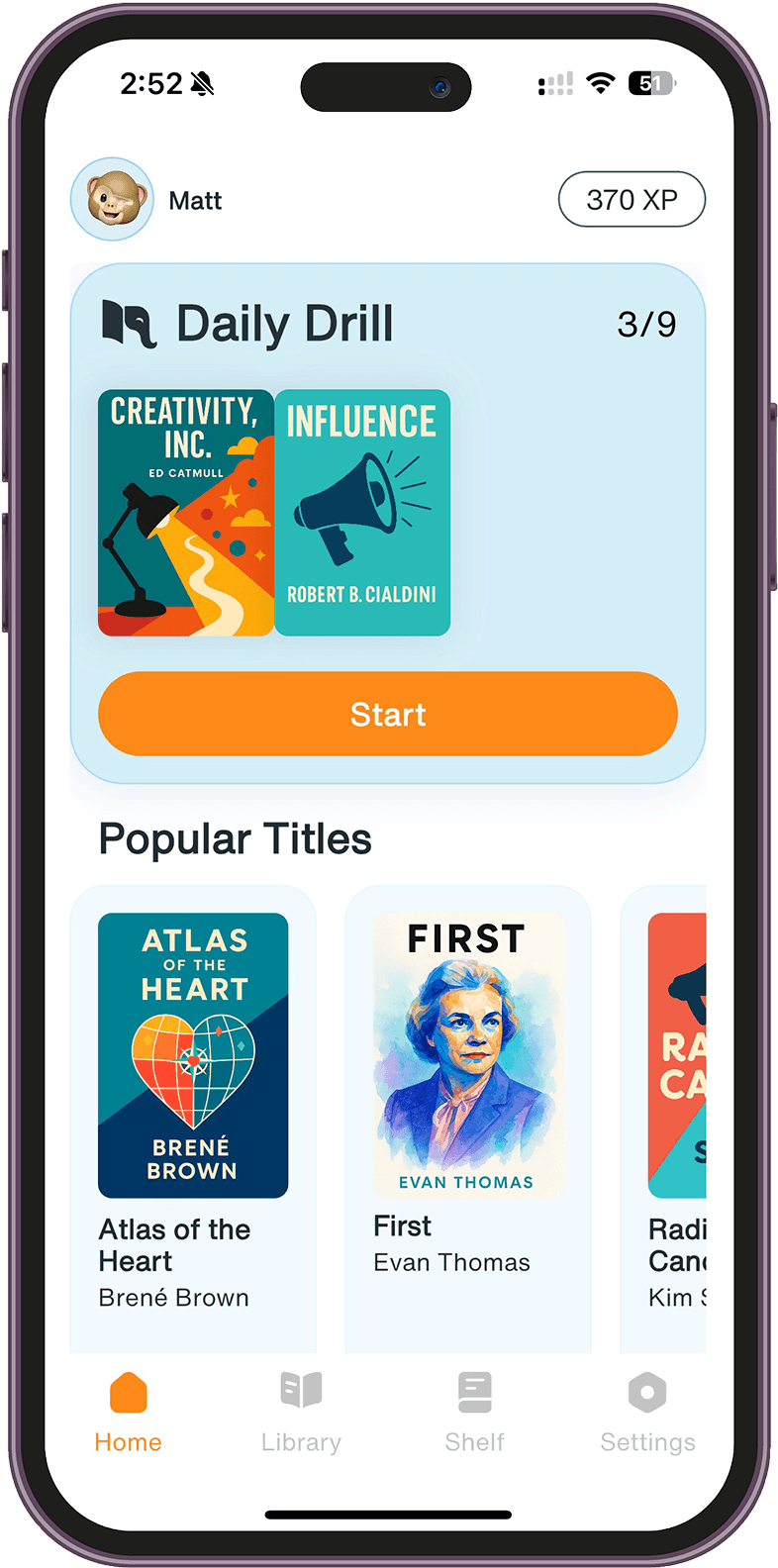
Loxie solves the forgetting problem through spaced repetition and active recall—the same techniques that make medical students retain vast amounts of information for decades. Instead of reading Lead Now! once and hoping the concepts stick, you practice for just 2 minutes a day with questions that resurface ideas right before you'd naturally forget them.
When you need to build psychological safety in your team, you won't be vaguely remembering that it was important. You'll recall the specific behaviors that create it—demonstrating vulnerability, admitting errors openly, rewarding truth-telling. When facing a change initiative, coalition mapping won't be a concept you once read about. It will be an approach you can immediately apply.
Loxie includes Lead Now! in its full topic library, so you can start reinforcing these leadership dimensions immediately. Two minutes a day transforms reading into lasting capability—the kind that's available when you're in a difficult conversation, facing resistance to change, or trying to coach someone through a challenge.
Frequently Asked Questions
What is the main idea of Lead Now!?
Lead Now! presents a framework of 21 specific leadership dimensions organized into four quadrants—business results, interpersonal skills, personal leadership, and leading change. Each dimension contains measurable behavioral indicators that transform abstract leadership qualities into concrete, developable skills that can be assessed and improved systematically.
What are the four quadrants of leadership in Lead Now!?
The four quadrants are: business results (what gets done), interpersonal skills (how you work with others), personal leadership (who you are), and leading change (where you're going). This structure ensures balanced development across all critical leadership areas rather than over-investing in natural strengths.
What is psychological safety and why does it matter for teams?
Psychological safety is the confidence to take risks, make mistakes, and challenge ideas without fear of punishment. Leaders build it through vulnerability, admitting errors, and rewarding truth-telling. Without it, teams hide problems, avoid creative risks, and produce cultures where people tell leaders what they want to hear rather than what they need to know.
What is the Context-Content-Connection framework?
This communication framework has three phases: establishing why information matters (context), delivering the clear message (content), and confirming understanding through dialogue (connection). Most communication fails because leaders skip context and neglect connection, assuming sent messages equal received and understood messages.
What are keystone habits in leadership development?
Keystone habits are single behavior changes that trigger positive cascades across multiple leadership dimensions. For example, improving listening skills simultaneously enhances coaching, collaboration, and emotional intelligence. Focusing on keystone habits maximizes development impact through compounding rather than additive improvement.
How can Loxie help me remember what I learned from Lead Now!?
Loxie uses spaced repetition and active recall to help you retain the key concepts from Lead Now! Instead of reading the book once and forgetting most of it, you practice for 2 minutes a day with questions that resurface ideas right before you'd naturally forget them. Loxie includes Lead Now! in its full topic library.
We're an Amazon Associate. If you buy a book through our links, we earn a small commission at no extra cost to you.
Stop forgetting what you learn.
Start learning for good with your 7-day FREE trial.