Leaders Eat Last: Key Insights & Takeaways from Simon Sinek
Discover why great leaders put their people first—and how the biology of trust transforms teams into unstoppable forces.
by The Loxie Learning Team
Why do some teams pull together through impossible challenges while others fracture under the slightest pressure? Simon Sinek's Leaders Eat Last answers this question by revealing the biological underpinnings of trust and cooperation. The title comes from a Marine Corps tradition: officers eat last in the chow line, ensuring their troops are fed first. This simple act of sacrifice creates loyalty that transcends job descriptions.
This guide breaks down Sinek's complete framework for building organizations where people naturally work together. Drawing on brain chemistry, evolutionary biology, and compelling examples from both military and business contexts, you'll understand not just what great leaders do differently, but why it works at a fundamental human level.
 Start practicing Leaders Eat Last free for 7 days ▸
What is the Circle of Safety and why does it matter?
The Circle of Safety is an environment where people feel protected from both external dangers and internal politics, allowing them to focus their energy on opportunities and threats outside the organization rather than defending themselves from colleagues. When leaders establish this circle, team members stop watching their backs and start watching each other's backs instead.
This concept draws from our evolutionary history. For hundreds of thousands of years, human survival depended on group membership. Being expelled from the tribe meant almost certain death. This is why rejection and workplace insecurity trigger such powerful stress responses—our brains interpret them as survival threats. Leaders who understand this create environments where people feel psychologically safe, which paradoxically makes them more willing to take risks, share ideas openly, and commit fully to organizational goals.
The boundaries of the Circle of Safety are defined by leadership decisions. When leaders extend protection to everyone in the organization—from executives to front-line workers—they create unified teams. When they protect only an inner circle, they create factions that compete with each other instead of external threats. Loxie helps leaders internalize these principles so they can consistently make decisions that expand rather than contract their Circle of Safety.
How does brain chemistry explain team performance?
Four primary chemicals drive human behavior in organizations, and understanding them reveals why certain leadership approaches work while others fail. Endorphins mask physical pain and create the "runner's high" that helps us push through challenges. Dopamine rewards progress and achievement, giving us hits of pleasure when we accomplish goals or check items off lists. Serotonin reinforces status and pride, making us feel good when we're recognized or respected. Oxytocin creates bonds of trust and love, released when we feel safe with others or act generously.
The selfish chemicals vs. the selfless chemicals
Sinek divides these into two categories. Endorphins and dopamine are "selfish" chemicals—they reward individual achievement and help us get things done on our own. Serotonin and oxytocin are "selfless" chemicals—they reward social bonds and cooperation. Both categories served crucial evolutionary purposes, but modern organizations have become dangerously imbalanced.
Today's workplace culture overproduces dopamine through constant achievement metrics, notifications, and performance bonuses while starving us of oxytocin and serotonin that come from meaningful relationships and service to others. This chemical imbalance creates organizations where people are productive but disconnected, hitting targets but never building the trust that enables extraordinary results.
The cortisol problem
When people feel unsafe at work, their bodies produce cortisol—the stress hormone. Chronic cortisol exposure shuts down immunity, impairs cognitive function, and directly inhibits oxytocin production. This means that high-stress environments don't just feel bad; they literally make trust and cooperation biologically impossible. Leaders who create fear-based cultures aren't just being unkind—they're chemically preventing the collaboration they claim to want.
Practice these concepts in Loxie ▸
Why did human hierarchies evolve—and what does this mean for leaders today?
Human hierarchies evolved not for domination but for protection. We grant leaders status and resources in exchange for their commitment to shield the group from danger. This biological contract explains why we instinctively respect leaders who sacrifice for us and despise those who exploit their position for personal gain.
In our evolutionary past, the alpha in a group got first access to food and choice of mates. But this came with an expectation: when danger appeared, the alpha was expected to run toward it, not away. The group granted privileges in exchange for protection. This is why "leaders eat last" resonates so deeply—it fulfills an ancient expectation encoded in our biology.
Modern leaders who violate this contract—taking bonuses while laying off workers, prioritizing shareholders over employees, or protecting themselves from consequences their teams must face—trigger deep biological responses of betrayal. People don't just disagree with such leaders intellectually; they feel visceral distrust that no amount of communication or team-building can overcome. Understanding this helps explain why some leaders inspire fierce loyalty while others, despite identical results, generate only compliance.
What does it mean for leaders to sacrifice for their teams?
When leaders sacrifice their own comfort and privileges for their teams—eating last, taking pay cuts during downturns, or shielding employees from layoffs—they trigger deep loyalty and discretionary effort that transforms organizational performance. This isn't about grand gestures; it's about consistent choices that demonstrate where the leader's priorities truly lie.
Real leadership requires moral courage to make personal sacrifices that protect and benefit the team, even when it costs the leader status, comfort, or financial reward. A leader who takes a smaller bonus so the team can keep their jobs, who absorbs blame from above so the team can focus on their work, or who stays late so others can go home—these actions communicate more than any mission statement.
The sacrifice paradox
Leaders who prioritize employee wellbeing over short-term metrics paradoxically achieve better performance. Fulfilled employees naturally work harder, innovate more, and stay loyal during difficult periods. But this only works when the commitment is genuine—people can sense when sacrifice is strategic manipulation versus authentic care.
Build these leadership habits with Loxie ▸How does shared adversity build the strongest teams?
Facing challenges together builds the strongest team bonds because shared adversity triggers endorphin and dopamine releases that create powerful memories. These experiences become part of the team's identity, making people willing to sacrifice for each other long after the challenge ends. Veterans often describe their combat units as closer than family—this bond comes from shared hardship, not shared success.
This doesn't mean leaders should manufacture crises. But it does mean that protecting teams from all difficulty actually weakens them. The key is facing challenges together—the leader must be in the trenches with the team, not observing from safety. When people suffer alongside their leader, oxytocin flows and bonds form. When they suffer while the leader remains comfortable, cortisol flows and resentment builds.
Organizations that have weathered genuine adversity together—startups that survived near-death experiences, companies that navigated recessions without layoffs, teams that pulled off impossible deadlines—often describe those periods as their finest hours despite the stress. The shared experience created bonds that no team-building exercise could replicate.
Why do results-at-any-cost cultures ultimately fail?
Results-at-any-cost leaders create cultures of fear and internal competition that achieve short-term gains but destroy the trust essential for long-term success. Leadership cultures focused on quarterly earnings, individual bonuses, and internal competition trigger cortisol and reduce oxytocin, creating stress responses that block cooperation.
Sinek points to the 2008 financial crisis as a case study. Banks that prioritized short-term profits and personal bonuses over long-term sustainability and employee wellbeing created environments where unethical behavior became normalized. When leaders stop caring for their people and focus only on numbers, systemic collapse becomes inevitable. The organizations didn't fail despite their culture—they failed because of it.
This pattern repeats across industries. Companies that treat employees as costs to minimize rather than humans to protect trigger chronic stress responses that damage both health and performance. Even when these organizations hit their numbers, they're hollowing out the foundation of trust and cooperation that would enable sustained success.
How does trust actually form in organizations?
Trust emerges when leaders consistently align their actions with their words, creating psychological safety that enables teams to take risks, share ideas openly, and commit fully to organizational goals. Trust is not built through trust falls or team retreats—it's built through repeated small actions that demonstrate reliability and care.
True leaders shield those in their care from danger by absorbing uncertainty, taking responsibility for failures, and protecting their teams from external pressures and threats. When problems arise, trustworthy leaders don't ask "who screwed up?" but "how can we fix this together?" This seemingly small distinction creates profoundly different cultures.
The abstraction problem
Technology and organizational scale create abstraction layers that physically and emotionally disconnect leaders from their people, breaking the biological bonds of trust that form when humans interact face-to-face. Modern organizations replace personal relationships with metrics and digital communication, making it nearly impossible for leaders to see their people as individuals rather than resources.
Physical and emotional distance between leaders and those affected by their decisions leads to dehumanization, enabling choices that harm people because the decision-makers never witness the human cost. A CEO who has never met the workers being laid off finds the decision easier than one who knows their names, families, and stories. This isn't about CEOs being cruel—it's about how abstraction removes the biological feedback that would otherwise make such decisions painful.
Why is people-first leadership both moral and profitable?
People-first leadership is both moral and profitable because companies that invest in employee security and development achieve lower turnover, higher innovation, and better customer service, ultimately outperforming those focused solely on shareholder returns. This isn't idealism—it's observable across decades of business performance data.
Treating employees as human beings rather than resources creates loyalty by acknowledging their whole lives, providing job security, and investing in their growth even when it doesn't directly benefit the bottom line. When people feel secure, they give discretionary effort—the extra creativity, care, and commitment that transforms adequate performance into excellence.
The shift from stakeholder capitalism (balancing employee, customer, and shareholder needs) to shareholder primacy (maximizing stock price above all) fundamentally broke the social contract between organizations and their people. Sinek argues that restoring this balance isn't just ethically right—it's strategically necessary for organizations that want to thrive long-term.
How does service to others transform organizations?
Service to others breaks destructive organizational patterns by shifting focus from internal competition to external contribution, triggering oxytocin and serotonin releases that build trust and cooperation instead of cortisol-driven stress responses. When teams unite around serving customers, communities, or causes larger than themselves, internal politics diminish.
New generation leaders must prioritize service over self-interest by consistently choosing team welfare over personal gain. This activates others' mirror neurons and creates cascading servant leadership throughout the organization. Organizational culture flows directly from leadership behavior because humans are biologically wired to mirror those in positions of authority, making every leadership action a cultural signal.
Individual leaders can transform entire cultures through consistent modeling because humans respond more strongly to repeated behaviors from authority figures than to policies. A single leader who genuinely puts people first can shift the norms of an entire organization over time—not through proclamations but through daily choices that others observe and gradually adopt.
Why do humans need to belong in organizations?
Humans have a deep evolutionary need to belong in organizations because our survival historically depended on group membership, making psychological safety as important as physical safety in modern workplaces. When people don't feel they belong, their bodies respond as if their lives are in danger—because for most of human history, that was true.
Workplace friendships drive performance by triggering oxytocin release, which reduces stress hormones, increases cooperation, and makes people willing to go beyond job descriptions to help colleagues succeed. Organizations that discourage personal relationships in the name of professionalism are undermining the biological foundation of high performance.
Organizations become resilient when genuine human connections create a Circle of Safety where people protect each other from external threats rather than competing internally for survival. This resilience can't be manufactured through policies—it emerges naturally when leaders create environments where belonging is real.
The real challenge with Leaders Eat Last
You've now encountered powerful ideas about leadership, brain chemistry, and organizational culture. The biological mechanisms that drive trust. The importance of the Circle of Safety. Why sacrifice creates loyalty. How results-at-any-cost cultures ultimately destroy themselves. These concepts can transform how you lead.
But here's the uncomfortable truth: reading about leadership doesn't make you a better leader. Research on memory shows we forget roughly 70% of new information within 24 hours. A week later, most of what you just read will be inaccessible. You might remember that leaders should "eat last" but forget the neurochemistry that explains why it works. You might recall the Circle of Safety concept but struggle to explain it to your team.
This isn't a character flaw—it's how human memory works. The same brain chemistry Sinek describes also governs learning and retention. Without active practice, even the most powerful ideas fade into vague impressions.
How Loxie helps you actually remember what you learn
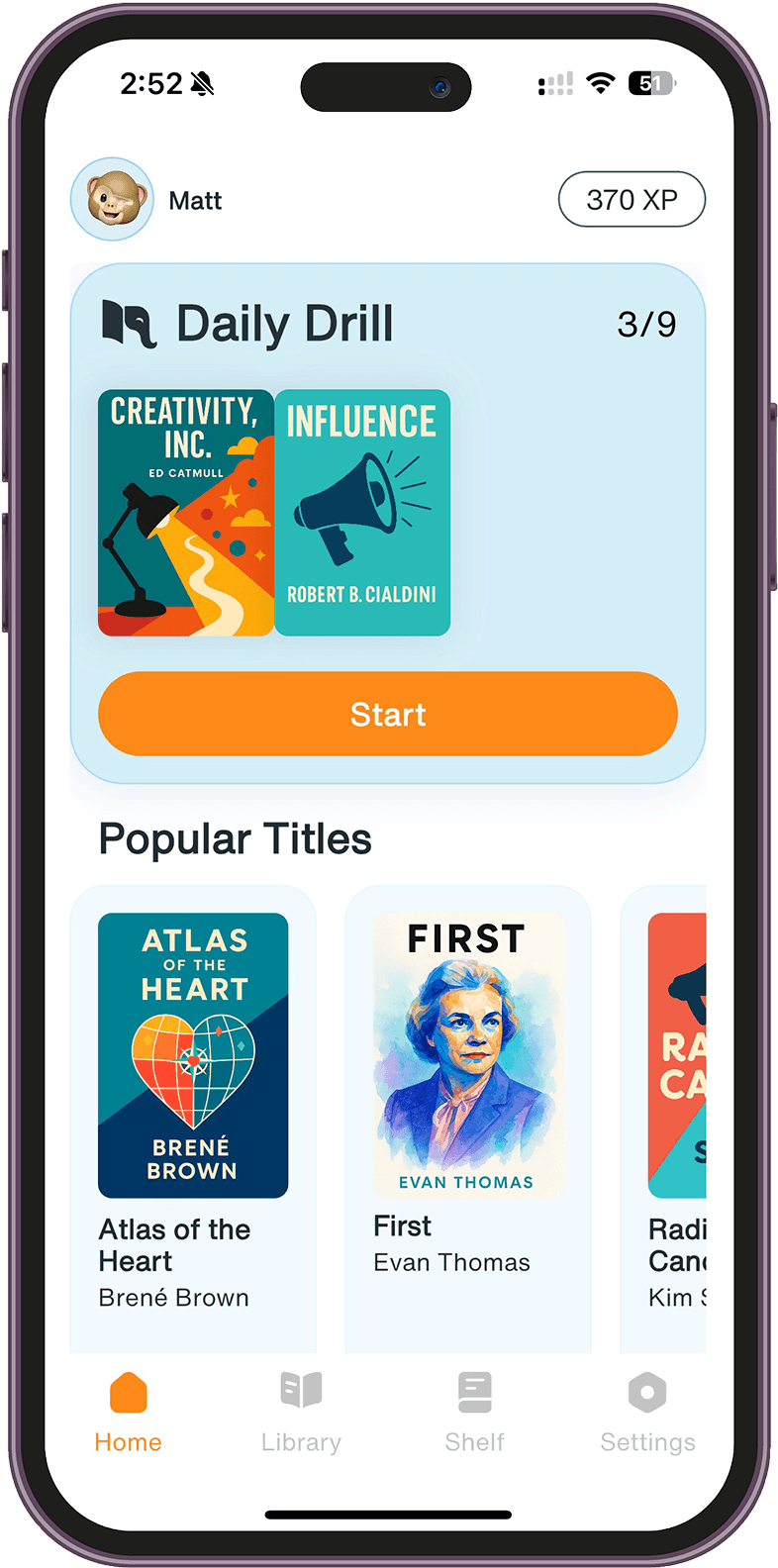
Loxie uses spaced repetition and active recall—the two most proven techniques in learning science—to help you actually retain what you learn from books like Leaders Eat Last. Instead of reading once and forgetting, you practice for just 2 minutes a day with questions that resurface concepts right before you'd naturally forget them.
The app adapts to your memory, spacing reviews optimally so you build permanent knowledge without wasting time on what you already know. Loxie includes Leaders Eat Last in its full topic library, so you can start reinforcing these leadership principles immediately.
Imagine being in a leadership moment six months from now and actually remembering that serotonin reinforces status while oxytocin builds trust. Or being able to explain the Circle of Safety to your team because you've practiced articulating it dozens of times. That's the difference between reading a book and learning from it.
Frequently Asked Questions
What is the main idea of Leaders Eat Last?
The central argument is that great leaders create environments of trust and cooperation by putting their people's safety and wellbeing first. Drawing on brain chemistry and evolutionary biology, Sinek shows that when leaders sacrifice their own comfort for their teams, they trigger deep loyalty and collaboration that produces extraordinary results.
What is the Circle of Safety?
The Circle of Safety is an environment where people feel protected from external dangers and internal politics. When leaders establish this circle, team members stop competing with each other and focus their energy on challenges outside the organization. The boundaries are defined by leadership decisions about who receives protection.
What are the four chemicals that drive team behavior?
Endorphins mask physical pain and help us push through challenges. Dopamine rewards progress and achievement. Serotonin reinforces status and pride. Oxytocin creates bonds of trust and love. The first two are "selfish" chemicals for individual achievement; the second two are "selfless" chemicals for social bonds.
Why do results-at-any-cost leaders ultimately fail?
Leaders focused solely on metrics create fear-based cultures that trigger chronic cortisol production. This stress hormone literally inhibits oxytocin, making trust and cooperation biologically impossible. Short-term gains come at the cost of the foundation needed for sustained success.
What does "leaders eat last" actually mean?
The phrase comes from a Marine Corps tradition where officers eat after their troops. It symbolizes the biological contract of leadership: we grant leaders status and resources in exchange for their commitment to protect the group. Leaders who sacrifice for their teams fulfill this ancient expectation and earn genuine loyalty.
How can Loxie help me remember what I learned from Leaders Eat Last?
Loxie uses spaced repetition and active recall to help you retain the key concepts from Leaders Eat Last. Instead of reading the book once and forgetting most of it, you practice for 2 minutes a day with questions that resurface ideas right before you'd naturally forget them. Loxie includes Leaders Eat Last in its full topic library.
We're an Amazon Associate. If you buy a book through our links, we earn a small commission at no extra cost to you.
Stop forgetting what you learn.
Start learning for good with your 7-day FREE trial.