Letting Go: Key Insights & Takeaways from David R. Hawkins
Master Dr. David R. Hawkins' powerful surrender technique to release emotional pain and achieve lasting inner peace.
by The Loxie Learning Team
What if the path to emotional freedom isn't about managing, expressing, or escaping your feelings—but simply allowing them to pass through you? Dr. David R. Hawkins' Letting Go presents a deceptively simple technique that cuts through decades of accumulated emotional baggage: surrender. Not defeat, not giving up, but the conscious choice to stop fighting what's already inside you.
This guide breaks down Hawkins' complete framework for emotional release. You'll learn the mechanics of the letting go technique, understand why conventional approaches to emotions often backfire, and discover how releasing suppressed feelings can transform not just your mental state but your relationships, health, and success. Whether you've read the book and want to deepen your practice, or you're encountering these ideas for the first time, you'll walk away with practical tools you can use immediately.
 Start practicing Letting Go free for 7 days ▸
What is the letting go technique and how does it work?
The letting go technique works by allowing yourself to fully experience and then release suppressed emotions without resistance, expression, or escape—simply observing the feeling until it naturally dissipates on its own. Unlike traditional emotional management strategies that either fight against feelings or act them out, this approach uses conscious awareness to dissolve emotional energy that has been trapped in your body and psyche.
The process is straightforward: when an emotion arises, you notice it, let it be there without trying to change it, and watch it move through you. You're not analyzing why you feel this way, not telling yourself stories about the feeling, not pushing it down or acting it out. You're simply allowing the energy to complete its natural cycle.
Think of it like releasing your grip on a hot coal rather than trying to throw it away or pretend it doesn't burn. The distinction matters because trying to eliminate emotions creates more resistance, while simply ceasing to grasp them allows natural release without creating additional struggle.
Focus on sensation, not story
A critical aspect of the technique is focusing on the physical sensation of the emotion in your body—the tightness, pressure, heaviness, or energy movement—rather than the thoughts about it. The body sensation is the emotion itself; the thoughts are just commentary. By going directly to the somatic experience, you bypass the mind's tendency to create stories that perpetuate the feeling and access the energetic source where actual release can occur.
This somatic approach explains why talking about problems or analyzing them often doesn't resolve emotional pain. The intellectual understanding stays in the head while the emotional charge remains trapped in the body. Letting go works at the level where emotions actually live.
What does surrender really mean in the context of emotional release?
Surrender is not defeat or giving up—it's the conscious choice to stop resisting what is already present within you, allowing trapped emotional energy to complete its natural cycle and dissolve. This reframing transforms surrender from weakness into the ultimate act of courage, as it requires facing uncomfortable emotions directly rather than using the defensive strategies that keep suffering in place.
Most people use three ineffective strategies for handling emotions: suppression (pushing feelings down), expression (acting them out), or escape (avoiding through distraction). All three perpetuate rather than resolve emotional pain. Suppression compresses emotional energy further. Expression transfers it to others without actually releasing it from yourself. Escape temporarily bypasses the feeling but leaves it intact for later.
Surrender differs from all three because it actually dissolves the energy at its source. You're not fighting, not venting, not running—you're simply allowing what is to be, without needing it to change. Paradoxically, this acceptance is what creates change.
Practice the surrender technique with Loxie ▸
Why do we accumulate so much suppressed emotion?
The average person suppresses and accumulates thousands of minor emotional reactions daily, creating an enormous invisible pressure that drives compulsive behaviors, physical illness, and psychological suffering. This accumulated emotional pressure operates like psychological debt with compound interest—each suppressed feeling adds to an internal reservoir that must eventually be discharged through symptoms, acting out, or conscious release.
We suppress because we learned early that certain emotions weren't acceptable. We were told to stop crying, calm down, not be angry. We developed the habit of pushing feelings down to function in school, work, and relationships. This adaptive strategy comes at a cost: the emotions don't disappear, they just go underground.
Over time, this creates a state of chronic internal pressure. The stress response triggered by suppressed emotions keeps the body in constant fight-or-flight mode, depleting immune function and creating vulnerability to disease. The nervous system never gets to rest in parasympathetic healing mode because it's always dealing with the low-grade emergency of unprocessed feelings.
The mind-body connection in suppressed emotions
Chronic suppressed emotions create specific patterns of muscle tension and organ dysfunction. Hawkins draws on traditional understanding that different emotions affect different systems: anger impacts the liver, fear affects the kidneys, grief weakens the lungs. Whether you accept this specific mapping or not, the broader principle is well-established—decades of suppressed feelings literally reshape physiology.
This means emotional release can be a direct path to physical healing. Conditions that seem purely physical may have emotional roots, and releasing these emotions can reverse symptoms that medication alone cannot address. The body knows how to heal when it's not constantly fighting emotional battles.
How do negative emotions transform into positive ones through surrender?
Every negative emotion contains compressed life energy that, when released through surrender, automatically transforms into its positive counterpart—fear becomes courage, anger becomes determination, pride becomes humility. This natural transmutation occurs because emotions exist on a spectrum of consciousness, and removing the resistance that holds energy in negative states allows it to rise spontaneously to higher frequencies.
The key insight is that you don't have to work at creating positive emotions. You simply release the negative ones, and positive states emerge naturally. It's subtraction rather than addition. The energy itself isn't bad—it's just stuck in a contracted form. Free it, and it naturally expands.
This explains why people who do deep emotional work often report not just relief from pain but spontaneous experiences of joy, love, and peace they weren't trying to generate. These states were always available; they were just obscured by the accumulated weight of unsurrendered emotions.
Understanding is just the beginning
Reading about surrender and actually practicing it are different things. Loxie helps you internalize these concepts through daily active recall, so the technique becomes second nature when you need it most—in the middle of emotional activation.
Try Loxie free for 7 days ▸Can you practice letting go anywhere, or do you need special conditions?
The letting go technique requires no special conditions—you can release emotions while driving, working, or talking by simply becoming aware of the feeling and letting it be there without resistance until it dissolves. This accessibility makes emotional freedom available to everyone regardless of circumstances, as the practice requires only consciousness and willingness rather than special environments or extended time periods.
This is one of the technique's greatest strengths. You don't need to retreat to a meditation cushion every time something triggers you. You can practice in the moments when emotions actually arise—in a difficult conversation, stuck in traffic, facing a deadline. The emotion becomes the teacher, and life itself becomes the practice.
Of course, deeper work often benefits from dedicated time and space. But knowing you can apply the technique anywhere removes the excuse that you don't have time for emotional work. You have exactly as much time as emotions arise, because the work happens in real time with real feelings.
How does fear keep us trapped, and how does surrender break the cycle?
Fear operates through endless 'what if' projections into the future, consuming enormous life energy in defending against possibilities that rarely materialize. But surrendering the energy of fear itself eliminates thousands of imaginary scenarios that were being unconsciously rehearsed and prepared for. Rather than addressing each specific fear individually, releasing the core fear energy dismantles the entire fear-generating mechanism.
Most fears are not about actual dangers but about the feeling of fear itself—we're afraid of experiencing fear, creating a self-reinforcing loop. This meta-fear keeps people trapped in avoidance patterns. But discovering that fear is just an uncomfortable energy that passes when not resisted removes its power to control behavior.
Fear also disguises itself in socially acceptable forms: prudence, planning, preparation. Recognizing these disguises reveals how much of normal life is actually fear-driven activity that appears productive but primarily serves to avoid facing underlying anxieties. Letting go doesn't mean being reckless; it means acting from clarity rather than from the compulsion to manage imaginary threats.
Start releasing fear patterns today ▸
What's the connection between emotional resistance and our beliefs about emotions?
Resistance to letting go often comes from the belief that negative emotions protect us or motivate us, but this confusion mistakes the energy for the emotion—you can have energy without anger, boundaries without fear. This insight dissolves a major block to emotional release by showing that positive qualities attributed to negative emotions actually come from life energy itself, which flows more powerfully when not filtered through negativity.
People resist releasing anger because they think it gives them strength. They hold onto fear because they think it keeps them safe. They maintain resentment because they think it protects them from being hurt again. But these beliefs confuse the byproduct with the source. The strength, alertness, and protective instinct are all available without the suffering that accompanies negative emotions.
When you let go of anger, you don't become passive—you become clear. When you release fear, you don't become reckless—you become present. The qualities you wanted to preserve actually become more accessible when separated from the emotional charge that distorted them.
How does letting go transform relationships?
Relationships improve not by changing the other person but by letting go of your emotional reactions to them—when you stop needing them to be different, they often spontaneously change. This paradox occurs because emotional pressure creates resistance while acceptance creates space for natural evolution. People unconsciously mirror the consciousness level you hold them in.
Every relationship trigger points to an unhealed part of yourself. Partners and family members are unconsciously recruited to activate suppressed emotions that need releasing. This reframes relationship conflicts as healing opportunities—the most difficult people in your life may be providing the greatest service by surfacing what needs to be surrendered.
Acceptance versus approval
Acceptance doesn't mean resignation or approval—it means acknowledging what is already here without wasting energy on internal resistance that changes nothing externally. This distinction frees people from the false dilemma of either fighting reality or being passive. Acceptance creates the clear seeing from which effective action naturally arises.
When you accept others exactly as they are, you become free from the exhausting job of trying to control or fix them, and they become free to evolve without defending against your judgments. This mutual liberation creates space for genuine connection and organic growth that forced change never achieves.
Attachment versus love
Letting go of expectations in relationships reveals whether you love the person or just love how they make you feel. Attachment is not love but fear of loss disguised as caring. True love holds lightly while attachment grasps desperately, creating the very loss it fears. Possessiveness destroys what it claims to protect, while releasing attachment actually deepens genuine connection by removing the fear that distorts love.
Learn relationship insights for good ▸
Why does desire create suffering, and what does letting go reveal?
Desire creates suffering not through wanting but through believing that fulfillment comes from outside. Letting go reveals that the feeling of fulfillment was always available internally. External objects merely trigger internal states we already possess; we can access satisfaction directly by surrendering the belief in external sources.
This insight breaks the endless cycle of seeking. We achieve the goal, feel temporary satisfaction, then immediately begin wanting the next thing. The problem isn't getting what we want—it's that fulfillment from external achievement is always temporary. Letting go allows direct access to the underlying state of contentment that doesn't depend on circumstances.
This doesn't mean abandoning all goals or becoming passive. It means pursuing goals from a place of wholeness rather than lack, enjoying the process rather than desperately needing the outcome, and remaining open to the possibility that what we think we want isn't actually what will make us happy.
How does emotional release create success?
Success becomes effortless when you let go of the fear of failure and the desperate need to succeed, allowing natural competence to emerge without the interference of emotional static. This paradox reveals that trying too hard creates the very tension that blocks performance, while surrendering attachment to outcomes creates the relaxed focus where excellence naturally occurs.
Inner obstacles to success are more powerful than external ones. The fear of visibility, guilt about surpassing others, and unworthiness beliefs sabotage achievement more than any market condition or competition. These internal barriers operate unconsciously, causing self-sabotage patterns that appear as bad luck or external obstacles but actually originate from suppressed emotional programs.
As emotional baggage decreases through letting go, synchronicities and opportunities increase because you're no longer unconsciously repelling positive experiences that conflict with negative self-concepts. Suppressed emotions create an invisible force field that blocks experiences inconsistent with your emotional baseline. Releasing these blocks allows life to flow toward you naturally.
What happens when emotions feel overwhelming during letting go?
When overwhelming emotions arise during letting go, surrender to the feeling of being overwhelmed itself rather than to the specific emotion, moving to the meta-level where release becomes possible. This advanced technique recognizes that resistance often operates at a higher level than the emotion itself. Surrendering the resistance or overwhelm opens a doorway through which the underlying emotion can then flow out.
Physical symptoms that intensify during letting go indicate that suppressed emotions stored in the body are surfacing for release—the healing crisis that precedes breakthrough. Understanding this process prevents abandoning the practice just when it's working most deeply. Temporary intensification signals that long-buried material is finally becoming available for release.
The way out of hopelessness is counterintuitive: let go of wanting to change the feeling and instead surrender to it completely. Even the darkest emotions have a finite amount of energy that exhausts itself when fully experienced. Resistance to despair actually feeds it energy, while complete surrender allows the emotion to burn through its fuel and naturally transform.
What is the relationship between emotions, the body, and the mind?
The mind's thoughts are primarily rationalizations of emotional states—change the underlying emotion through letting go and thoughts automatically shift to match the new feeling. This reverses the common belief that thinking creates feeling, showing instead that releasing emotional pressure causes immediate corresponding changes in mental content without trying to control thoughts.
Emotions are survival programs from earlier evolution that persist despite being mostly obsolete. The same fear response that saved ancestors from predators now triggers in traffic jams and difficult emails. Understanding emotions as outdated biological software rather than truth about current reality makes it easier to let them pass through without believing their messages or acting on their impulses.
Anger is always secondary to hurt or fear—letting go of the underlying vulnerability dissolves anger automatically without needing to express or suppress it. This reveals anger as a protective mechanism that becomes unnecessary when the wounded feeling beneath it is acknowledged and released.
What does the path to peace and higher consciousness look like?
Consciousness shifts happen in sudden jumps rather than gradual progression. Months of letting go create invisible preparation until a critical mass triggers a quantum leap to a new level of awareness. This non-linear progression explains why practice can feel ineffective for periods before dramatic breakthrough—apparent plateaus are actually integration phases.
Each level of consciousness has its own worldview that seems absolutely true from within it. Letting go allows movement between levels, revealing that reality itself changes with consciousness. This explains why argument is futile; only direct experience through emotional release can shift someone's fundamental perception of reality.
The gateway of courage
The shift from negative to positive emotions happens at courage—the willingness to face what is. Courage is not the absence of fear but the willingness to tell the truth in the presence of fear. Letting go of fear reveals that courage was always there underneath; it's not something to develop but something to uncover by removing what obscures it.
The nature of peace
True peace is not the opposite of conflict but the space that holds all opposites without taking sides—achieved through surrendering the need to have a position about everything. Peace is already present beneath all agitation, like the depths of ocean unaffected by surface waves, accessible instantly through surrendering the attachment to drama and stimulation.
Love as what we are
Love is not an emotion but a state of being that emerges when all that is not love has been surrendered—it's what you are, not what you feel. Unconditional love doesn't mean loving everyone's behavior; it means recognizing the same consciousness in all beings while maintaining appropriate boundaries with their actions.
The real challenge with Letting Go
Here's the uncomfortable truth: understanding these concepts intellectually and actually practicing them are entirely different things. You can read Letting Go, nod along with every insight, feel inspired for a few days—and then forget most of it when you're actually triggered, stressed, or overwhelmed.
The forgetting curve is relentless. Within a week of finishing a book, most people retain less than 20% of what they read. Within a month, it's closer to 10%. All those powerful insights about surrender, the body sensations, the difference between attachment and love—they fade into vague impressions that don't help when you're in the middle of an emotional storm.
How many books have you read that felt genuinely transformative while reading them, but you can barely recall three key points a month later? The problem isn't your intelligence or dedication. It's that passive reading doesn't create lasting neural pathways. You need active engagement to move knowledge from short-term to long-term memory.
How Loxie helps you actually remember and apply what you learn
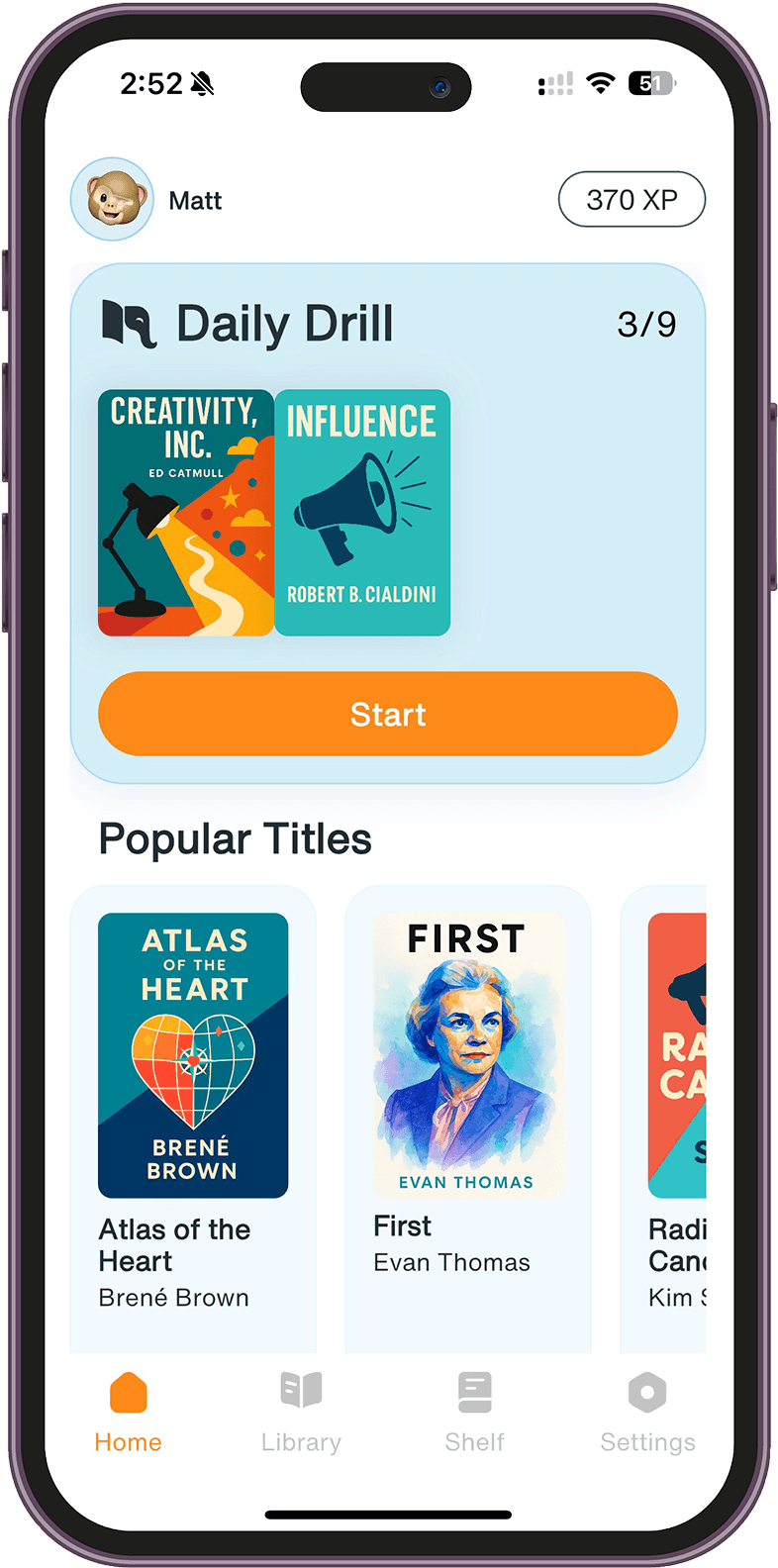
Loxie uses spaced repetition and active recall—the two most scientifically-validated learning techniques—to help you retain the concepts from Letting Go. Instead of reading the book once and hoping the ideas stick, you practice for just 2 minutes a day with questions that resurface key insights right before you'd naturally forget them.
The questions aren't just memory drills. They're designed to help you internalize the distinctions that matter: the difference between surrender and giving up, between acceptance and approval, between attachment and love. When these concepts are truly embedded in memory, they become available in the moments when you actually need them.
Loxie includes Letting Go in its full topic library, so you can start reinforcing these concepts immediately. Whether you just finished the book or read it years ago, daily practice rebuilds and strengthens the neural pathways that make this wisdom accessible when emotions arise.
Frequently Asked Questions
What is the main idea of Letting Go?
The central idea is that emotional freedom comes through surrender—allowing yourself to fully experience feelings without resistance, expression, or escape until they naturally dissolve. This simple technique releases accumulated emotional pressure that drives suffering, unhealthy patterns, and even physical illness.
What are the key takeaways from Letting Go by David Hawkins?
The key takeaways include: focus on body sensations rather than thoughts about emotions; surrender is strength not weakness; negative emotions transform into positive ones when released; suppressed feelings accumulate daily creating chronic pressure; and the technique works anywhere without special conditions.
How is the letting go technique different from suppression or expression?
Suppression pushes feelings down, compressing them for later. Expression acts them out, transferring energy to others without releasing it from yourself. Letting go neither fights nor acts out emotions—it simply allows them to be present until they naturally dissolve, actually eliminating the energy at its source.
What does David Hawkins mean by surrender?
Surrender means consciously choosing to stop resisting what is already present within you. It's not defeat or giving up, but the courageous act of facing emotions directly. When you stop fighting a feeling, its trapped energy completes its natural cycle and dissolves on its own.
Can emotional release improve physical health?
Yes, according to Hawkins. Suppressed emotions keep the body in chronic stress, impairing immune function. Releasing emotional pressure allows the nervous system to shift from fight-or-flight into healing mode. Many physical conditions have emotional roots that release work can address.
How can Loxie help me remember what I learned from Letting Go?
Loxie uses spaced repetition and active recall to help you retain the key concepts from Letting Go. Instead of reading the book once and forgetting most of it, you practice for 2 minutes a day with questions that resurface ideas right before you'd naturally forget them. Loxie includes Letting Go in its full topic library.
We're an Amazon Associate. If you buy a book through our links, we earn a small commission at no extra cost to you.
Stop forgetting what you learn.
Start learning for good with your 7-day FREE trial.