Likeable Badass: Key Insights & Takeaways from Alison Fragale
Master Alison Fragale's research-backed strategies for combining warmth and assertiveness to build influence without sacrificing authenticity.
by The Loxie Learning Team
Why do women face backlash for the same assertive behaviors that earn men respect? In Likeable Badass, Alison Fragale tackles this question head-on, revealing that the solution isn't choosing between warmth and strength—it's strategically deploying both. Her research-backed framework shows how women can build influence and advance their careers without sacrificing authenticity or relationships.
This guide breaks down Fragale's complete approach to navigating workplace dynamics as a woman. You'll learn why traditional assertiveness advice fails women, how to sequence warmth and strength for maximum impact, and specific tactics for negotiation, leadership, and managing up. Whether you're early in your career or a senior leader, these strategies will help you claim the respect and success you deserve.
 Start practicing Likeable Badass free for 7 days ▸
What is the warmth-competence double bind and why does it only affect women?
The warmth-competence double bind is the impossible standard women face: when they display competence without warmth, they're perceived as threatening and unlikeable; when they show only warmth, they're seen as weak and not leadership material. Research consistently shows this trade-off only applies to women—men can be perceived as both competent and likeable simultaneously.
This asymmetry creates a fundamental problem with standard professional advice. Behaviors that build credibility for men—like self-promotion, disagreeing publicly, or displaying confidence—can actively damage women's reputations. The same assertive presentation that signals leadership potential in a man gets interpreted as abrasive, aggressive, or difficult when displayed by a woman.
Understanding this double bind is essential because it explains why so many talented women plateau despite excellent performance. Technical excellence alone isn't enough when the same behaviors are filtered through different perceptual lenses based on gender. Women need entirely different strategies for professional advancement—not because they're less capable, but because identical actions produce different social consequences.
What is the likeable badass framework and how does it work?
The likeable badass framework is a strategic approach to deploying warmth and assertiveness based on context, audience, and goals—rather than asking women to fundamentally change their personalities. It treats warmth not as weakness but as a power multiplier that makes assertiveness more palatable and effective in organizations that penalize women for directness.
The core insight is that warmth and strength aren't opposites but complementary tools. When women establish warmth first, they create psychological safety that allows their subsequent assertiveness to be interpreted as helpful rather than hostile. The same strong stance that would trigger backlash from a stranger becomes acceptable—even admirable—when it comes from someone who has already demonstrated care and investment in the relationship.
This sequencing strategy resolves the core dilemma: lead with warmth to establish trust, then follow with assertiveness once relationship capital is built. Your strength amplifies rather than undermines your influence because people interpret your directness through the lens of positive intent you've already established.
Practice these strategies with Loxie ▸
How does status work differently for women than for men?
Status operates on two distinct dimensions: respect (based on perceived competence) and liking (based on perceived warmth). While men can gain organizational status primarily through respect—demonstrating expertise and achieving results—women need both dimensions to achieve equivalent influence and career outcomes.
This dual requirement means women must excel at a more complex balancing act than men to reach the same positions. A technically brilliant woman who hasn't also built liking-based status may struggle to advance, even when her competence is undeniable. Her male counterpart with similar technical skills but less warmth faces no such barrier.
Understanding status as multidimensional helps explain frustrating career plateaus. If you're excelling at your work but not advancing, the problem may not be your competence—it may be that you haven't invested enough in the warmth dimension that women specifically need. The solution isn't to become less capable but to strategically build liking alongside respect.
What is strategic warmth and how do you implement it?
Strategic warmth involves calculated displays of care and connection before, during, and after assertive actions. These warmth "bookends" serve as interpretive frames that shape how assertive behavior is received. By providing clear signals of positive intent and relationship value, women can exercise the same level of directness as men while minimizing backlash risk.
Before assertiveness: establish connection
Prefacing disagreement with genuine appreciation creates cognitive space for others to receive challenging input. Phrases like "I really value your perspective on this, and I want to add another angle" signal that your pushback isn't an attack on the person. This warmth preamble doesn't weaken your point—it increases the likelihood it will be heard.
After assertiveness: maintain the relationship
Following tough feedback or difficult conversations with supportive check-ins reinforces that your assertiveness was about the issue, not the person. A simple follow-up message expressing confidence in someone's ability to address concerns prevents your directness from festering into resentment.
These tactics might feel like extra work—and they are. But they're the price of entry for women who want to be both effective and well-regarded. The goal isn't to be less assertive but to wrap assertiveness in context that ensures it's interpreted correctly.
These strategies only work if you remember them in the moment
Reading about strategic warmth is easy. Deploying it when you're in a tense meeting requires the concepts to be second nature. Loxie uses spaced repetition to help you internalize these frameworks so they're available when you need them most.
Build lasting skills with Loxie ▸What are power substitutes and why do women need them?
Power substitutes are forms of credibility—expertise credentials, strategic network positions, and reputation capital—that provide objective justification for assertiveness. These external validators make it harder for others to dismiss women's contributions as pushy or inappropriate because the authority backing their stance is undeniable.
When assertiveness is backed by recognized expertise, it becomes difficult to attribute it to negative personality traits rather than legitimate leadership. A woman pushing back on a technical decision carries more weight when she's the acknowledged expert in that domain. Her directness reads as professional judgment rather than personal aggression.
Strategic network positions work similarly. When you're the bridge between groups, the person with crucial relationships, or the holder of information others need, your influence becomes structural rather than personal. You can be assertive because your position demands it, not because you're being "difficult."
Building these power substitutes requires deliberate investment: pursuing credentials, positioning yourself at network intersections, and systematically building reputation through visible contributions. These aren't substitutes for warmth—they're complementary armor that protects your assertiveness from gender-biased interpretation.
How should women time their assertiveness for maximum impact?
Timing assertiveness strategically—being more assertive in private than public settings, and more assertive after establishing credibility than immediately upon arrival—allows women to build influence while minimizing backlash exposure. The same assertive behavior triggers dramatically different responses depending on context and relationship stage.
Private versus public assertiveness
Pushing back in a one-on-one conversation is far safer than challenging someone in a meeting. Private assertiveness avoids publicly threatening others' status, which is often the real trigger for backlash. You can be just as direct behind closed doors while preserving the other person's public face—and your own reputation for collegiality.
Delayed versus immediate assertiveness
New to a role or team, your assertiveness lacks the credibility that makes it seem earned rather than presumptuous. The same strong opinion that reads as valuable perspective from an established team member can read as arrogance from someone who just arrived. Build your track record first, then increase your assertiveness as your contributions justify it.
This temporal strategy isn't about being passive—it's about being strategic. Your goal is influence, not just self-expression. Sometimes waiting to be assertive gets you more of what you want than being assertive immediately.
Why does framing assertiveness as advocacy for others reduce backlash?
Framing assertiveness as advocacy for others rather than self-interest makes identical behaviors more acceptable from women. When you frame a forceful argument as pushing for team success rather than personal advancement, you leverage gender stereotypes instead of fighting them. The expectation that women should be communal becomes a tool rather than a constraint.
This framing hack works because it satisfies the underlying expectation while achieving your goals. "I'm pushing for this raise because it will help me better support my team" pursues the same objective as "I deserve this raise" but packages it in a narrative that doesn't trigger backlash. The outcome is identical; only the framing changes.
You can apply this approach broadly: advocating for resources "so the team can deliver better results," pushing back on timelines "because quality matters for our clients," or requesting a promotion "to have more impact on the organization's mission." Each frames personal advancement within a communal narrative that aligns with gendered expectations.
What is the warm demander leadership style?
The warm demander leadership style maintains high performance standards while actively demonstrating care for team members' growth and wellbeing. This approach allows women leaders to be tough on standards without being perceived as tough on people—separating performance accountability from personal attack.
Warm demanders consistently pair high expectations with high support. When they push for excellence, team members experience it as investment rather than criticism. The demanding part signals confidence in people's potential; the warmth part provides the psychological safety to pursue that potential without fear of failure.
Women who master this style can drive exceptional results while building loyal, motivated teams. The key is consistency: you can't be warm when things are easy and demanding when things are hard. Both dimensions must be present continuously, creating a culture where high standards feel like an expression of care rather than a source of stress.
How can women negotiate more effectively using relational accounts?
Women improve negotiation outcomes by using relational accounts—explicitly explaining how their requests benefit others rather than relying on pure self-advocacy. Research shows women face social penalties for negotiating that men don't, but these penalties largely disappear when negotiations are framed relationally.
A relational account connects personal gains to others' benefits. Instead of "I want a raise because I've earned it," try "This raise will help me focus fully on leading my team rather than worrying about finances" or "With this title change, I'll have more credibility to advocate for our department's needs." The ask is identical; the framing protects you from backlash.
The negotiation portfolio approach
Another effective strategy is spreading asks across multiple smaller negotiations rather than one big ask. By disaggregating requests into several conversations over time, you achieve comparable total gains while appearing less demanding. Each individual ask seems reasonable, and the time between asks lets you demonstrate additional value that justifies the next request.
Collaborative framing
Positioning negotiations as joint problem-solving rather than adversarial bargaining also helps. Questions like "How can we make this work for everyone?" transform zero-sum competition into collaborative dialogue. You can still pursue firm objectives while maintaining the relationship—and often achieve better outcomes than competitive tactics would produce.
How should women respond to gendered criticism using reframe and redirect?
The reframe and redirect response helps women maintain composure and credibility when facing gendered pushback. This three-step process—acknowledge the feedback, reframe it positively, then redirect to constructive action—prevents defensive responses that can escalate conflict while maintaining professional standing.
When someone criticizes you in ways that feel gendered ("You're being too aggressive" or "You need to smile more"), the instinct is often to defend yourself or call out the bias. Both reactions can backfire: defensiveness confirms you're difficult, while calling out bias makes you seem like a complainer.
The reframe and redirect approach offers a third path. Acknowledge: "I appreciate you sharing that feedback." Reframe: "I take strong positions because I care about getting this right." Redirect: "Let me share my thinking and see if we can find common ground." You've responded professionally, reframed the criticism as a strength, and moved the conversation forward—all without escalating.
What is tempered radicalism and how can women drive systemic change?
Tempered radicalism is the practice of making small, strategic challenges to gender norms while maintaining insider status and credibility to influence from within. Rather than choosing between conformity and revolution, this approach uses incremental actions to slowly shift organizational culture while protecting individual career prospects.
Examples include publicly crediting other women's ideas in meetings, questioning all-male panels or project teams, advocating for transparent promotion criteria, or sharing salary information with other women. Each action is small enough to avoid serious backlash but meaningful enough to chip away at biased systems.
Women who reach senior positions can accelerate change by "normalizing the path"—openly discussing the strategies they used to navigate bias rather than presenting their success as pure merit. When senior women share specific tactics rather than just inspiration, they provide actionable blueprints that help the next generation advance faster.
How can women build resilience for sustained assertiveness?
The extra effort required to be a likeable badass creates unique burnout risks. Navigating bias, deploying strategic warmth, and managing perceptions all consume emotional resources that men don't have to spend. Building "resilience reserves" through deliberate recovery practices helps women sustain assertiveness over time.
Effective resilience strategies include peer support networks of other women who understand gendered challenges, regular recovery practices like exercise or mindfulness, and reframing exercises that prevent isolated incidents from becoming catastrophic narratives. The goal is to build emotional resources faster than bias depletes them.
Women's professional networks serve a dual purpose: they provide practical advice on navigating specific situations and emotional support when bias takes its toll. Men can often succeed with primarily bridging networks that connect them to opportunities. Women benefit from combining those bridging connections with bonding connections within women's communities.
The real challenge with Likeable Badass
The strategies in Likeable Badass are powerful—but only if you can access them in the moment you need them. When you're in a tense negotiation, facing unfair criticism, or deciding whether to speak up in a meeting, you don't have time to flip through a book. The concepts need to be internalized deeply enough that they guide your behavior automatically.
This is where most professional development fails. You read the book, feel inspired, maybe even take notes. But three months later, when you're facing exactly the situation the book prepared you for, you can't recall the specific tactic that would help. The forgetting curve is relentless: without active reinforcement, we lose 70% of new information within 24 hours.
How Loxie helps you actually remember what you learn
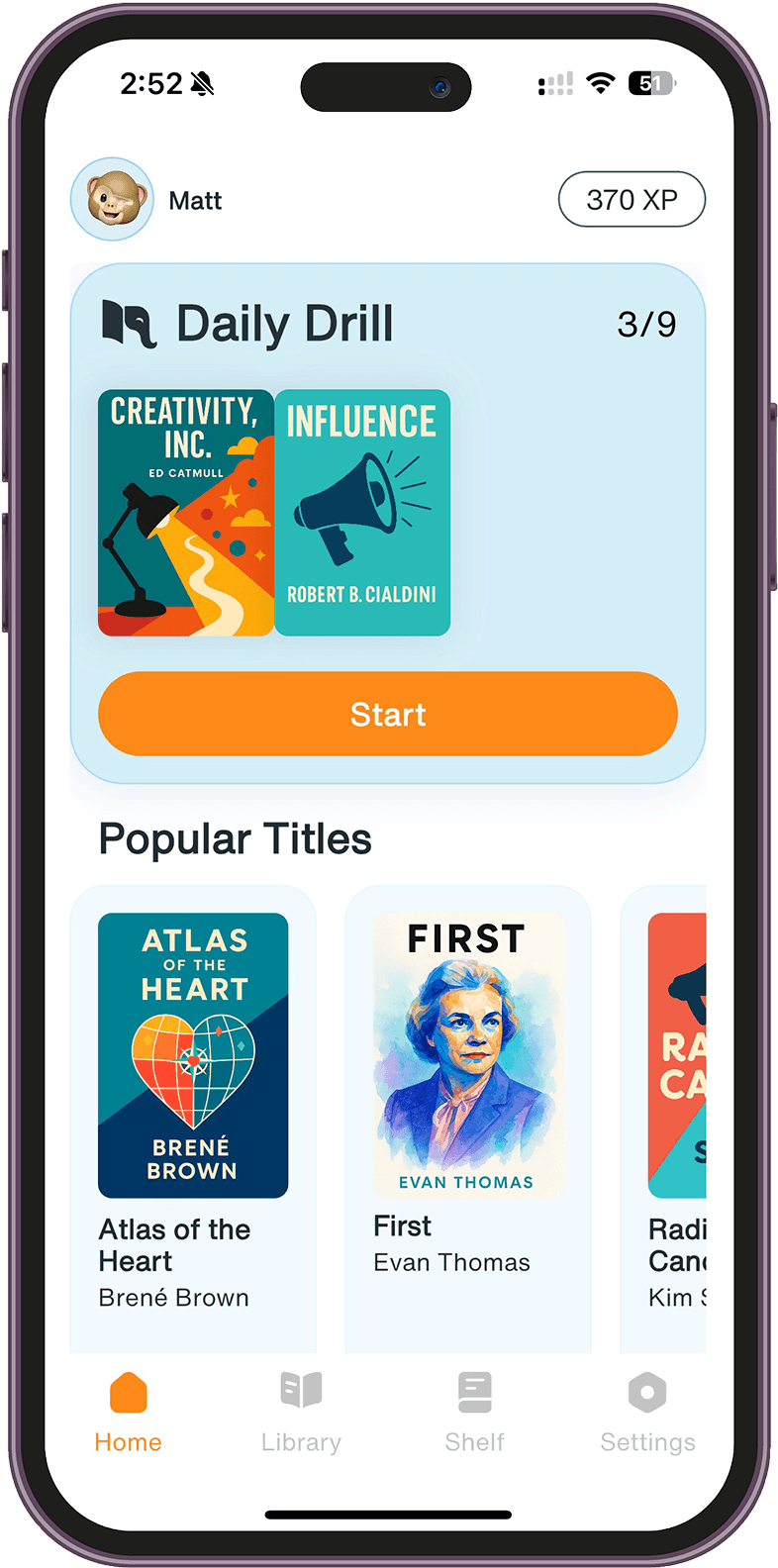
Loxie uses spaced repetition and active recall—the two most effective learning techniques known to cognitive science—to help you retain the strategies from Likeable Badass. Instead of reading once and forgetting, you practice for just 2 minutes a day with questions that resurface concepts right before you'd naturally forget them.
The difference is dramatic. With Loxie, the frameworks for strategic warmth, relational negotiation, and the reframe-and-redirect response become part of your working memory—available when you need them, not buried in a book on your shelf. You transform knowledge into capability.
Loxie includes Likeable Badass in its complete topic library. You can start reinforcing these career-critical concepts today, building the kind of deep retention that turns reading into real professional advantage.
Frequently Asked Questions
What is the main idea of Likeable Badass?
The main idea is that women can escape the warmth-competence double bind by strategically sequencing behaviors—leading with warmth to build trust, then following with assertiveness once relationship capital is established. This makes strength amplify rather than undermine influence.
What is the warmth-competence double bind?
The warmth-competence double bind is the impossible standard where women who display competence are perceived as less warm, while women who show warmth are seen as less capable. Research shows this trade-off only affects women—men can be seen as both competent and likeable simultaneously.
What are the key strategies for women in negotiations?
Women improve negotiation outcomes by using relational accounts (explaining how requests benefit others), collaborative framing (positioning negotiations as joint problem-solving), and the portfolio approach (spreading asks across multiple smaller conversations rather than one big request).
What is the warm demander leadership style?
The warm demander style maintains high performance standards while actively demonstrating care for team members' growth. This allows women leaders to be tough on standards without being perceived as tough on people, driving results while building loyal teams.
How should women respond to gendered criticism?
The reframe and redirect approach has three steps: acknowledge the feedback, reframe it positively, then redirect to constructive action. This prevents defensive escalation while maintaining credibility and moving the conversation forward productively.
How can Loxie help me remember what I learned from Likeable Badass?
Loxie uses spaced repetition and active recall to help you retain the key strategies from Likeable Badass. Instead of reading once and forgetting, you practice for 2 minutes a day with questions that resurface concepts right before you'd naturally forget them. Loxie includes this book in its complete topic library.
We're an Amazon Associate. If you buy a book through our links, we earn a small commission at no extra cost to you.
Stop forgetting what you learn.
Start learning for good with your 7-day FREE trial.