Pitch Anything: Key Insights & Takeaways from Oren Klaff
Master Oren Klaff's neuroscience-based framework for controlling any pitch and winning high-stakes deals.
by The Loxie Learning Team
Why do some people walk into a room and command immediate attention while others struggle to be heard? Oren Klaff's Pitch Anything reveals that successful persuasion has little to do with logic, data, or eloquence. Instead, it depends on understanding how the primitive brain makes decisions—and learning to control the invisible psychological structures that determine who holds power in any interaction.
This guide breaks down Klaff's complete system for mastering pitches, negotiations, and high-stakes conversations. You'll learn about frame control, the croc brain, the STRONG method, and the counterintuitive techniques that transform you from someone chasing deals into someone deals chase. Whether you're raising capital, closing sales, or simply trying to be more persuasive, these principles fundamentally change how you approach any interaction.
 Start practicing Pitch Anything free for 7 days ▸
What is the croc brain and why do traditional pitches fail?
The croc brain is the primitive, reptilian part of the brain that controls attention and makes snap decisions based on survival instincts rather than logic. Traditional presentations fail because they target the neocortex—the analytical, rational brain—with data, spreadsheets, and logical arguments. But here's the problem: the croc brain acts as a gatekeeper. If your message doesn't pass its filters first, it never reaches the parts of the brain capable of sophisticated analysis.
The primitive brain filters all incoming information through three questions: Is it dangerous? Is it interesting? Is it new? Only information that successfully passes these filters gets forwarded to higher brain functions. This explains why brilliant presentations filled with compelling data often fall flat—they're speaking to the wrong part of the brain entirely. The croc brain dismisses complex information as boring and potentially threatening, filtering it out before it can be properly evaluated.
Understanding this biological reality transforms how you approach any pitch. Instead of leading with your credentials, market analysis, or detailed projections, you must first capture the croc brain's attention through novelty, intrigue, and emotional triggers. Only after you've engaged the primitive brain can you introduce more complex information—and even then, it must be delivered in digestible chunks that don't trigger the croc brain's boredom response.
What are frames and why do they control every interaction?
Frames are invisible psychological structures that determine who controls an interaction. Whoever holds the stronger frame sets the rules, context, and ultimately the outcome of any conversation. When two people meet, their frames collide—and only one survives intact. This collision happens instantly and unconsciously, revealing who truly holds power regardless of official titles, stated authority, or apparent status differences.
Consider walking into an investor's office. They might use a power frame (making you wait, taking calls during your pitch) or an analyst frame (demanding excessive detail to slow momentum). These frames aren't consciously deployed—they're ingrained patterns that automatically attempt to establish dominance. If you accept their frame by waiting patiently or diving into granular data, you've already lost the interaction before it begins.
Common frames you'll encounter
The power frame attempts to establish dominance through displays of authority, making you feel subordinate. The time frame creates artificial urgency or, conversely, signals that time is unlimited and your pitch doesn't matter. The analyst frame demands endless detail, slowing momentum and shifting focus from emotion to logic. The prize frame positions someone as the catch to be won rather than the pursuer.
Maintaining frame control requires constant vigilance because frames are dynamic. They can be lost through small concessions, regained through unexpected moves, and strengthened through consistent boundary enforcement. Every word, gesture, and response either reinforces or weakens your frame. The moment you defer unnecessarily or seek validation, you've handed control to the other party.
Practice frame control with Loxie ▸
How do you seize the dominant frame in any situation?
Seizing the dominant frame requires recognizing common frames (power, time, analyst, prize) and deploying specific counter-frames that disrupt expectations and establish your authority. The key is never to accept the frame being imposed on you. When someone deploys a power frame by making you wait or interrupting your pitch, you don't get angry or compliant—you use humor, defiance, or redirection to break their frame and impose your own.
Frame collision is inevitable in any negotiation. When an investor leans back and says "convince me why I should care," they're deploying a power frame. The natural response is to try harder, speak faster, pile on more benefits—all of which reinforce their dominance. The correct response is to deploy a counter-frame: perhaps the prize frame ("I'm not sure this opportunity is right for you—let me explain what kind of investor we're looking for") or the time frame ("I have fifteen minutes before my next meeting, so let's see if there's a fit").
The goal isn't to be combative but to establish equality or dominance in the psychological dynamic. Once you hold the stronger frame, the other party unconsciously defers to your lead, making them more receptive to your message and more likely to act on your terms.
What is the prize frame and how does it reverse power dynamics?
Prize frame positioning reverses traditional buyer-seller dynamics by making yourself the prize to be won rather than the supplicant seeking approval. This triggers the target's croc brain to chase what appears scarce and valuable instead of evaluating whether to accept your pursuit. The psychological shift is profound: when you position yourself as the selector rather than the selected, the entire dynamic of the interaction transforms.
Traditional sales and pitching approach treats the buyer as the prize. Salespeople chase, follow up relentlessly, and signal neediness through every interaction. This approach fails because the croc brain interprets validation-seeking behavior as low status. When someone appears desperate for approval, the primitive brain automatically triggers rejection to avoid aligning with perceived weakness. This explains why the most eager, hardest-working salespeople often underperform their more aloof colleagues.
Deploying the prize frame requires genuine belief in your value and willingness to walk away. You communicate through your words and actions that you're evaluating whether this opportunity meets your standards—not desperately hoping they'll choose you. Phrases like "I'm not sure we're a fit for everyone" or "Let me explain what we look for in partners" signal that selection is happening in both directions.
Understanding prize framing is one thing—deploying it under pressure is another
The concepts in Pitch Anything require practice to internalize. Loxie helps you move from intellectual understanding to automatic recall, so these techniques are available when you need them in real negotiations.
Start practicing free for 7 days ▸Why does neediness destroy persuasive power?
Neediness kills deals and destroys persuasive power because the croc brain interprets validation-seeking behavior as low status, automatically triggering rejection. When you need something from someone—their approval, their money, their agreement—that need leaks through your words, body language, and choices. The primitive brain detects this instantly and responds with protective distancing.
The mechanism is evolutionary. Aligning with weak or desperate individuals historically meant sharing in their vulnerability. The croc brain learned to reject neediness as a survival strategy, and this response remains hardwired regardless of modern context. An investor's gut-level resistance to a needy entrepreneur isn't rational—it's primal.
Eliminating neediness requires genuine detachment from outcomes. This doesn't mean not wanting success; it means not needing any specific person to provide it. When you approach interactions from a position of abundance—knowing that this opportunity is one of many—your entire demeanor shifts. The croc brain across the table senses confidence rather than desperation, and responds with interest rather than retreat.
How does status determine persuasion effectiveness?
Perceived status determines persuasion effectiveness because the croc brain automatically defers to higher-status individuals. This response is hardwired—we instinctively pay more attention to, and are more influenced by, those we perceive as higher status. Making status elevation through situational dominance essential for pitch success means finding ways to raise your perceived position regardless of formal hierarchies.
Status in a pitch isn't determined by your net worth, title, or achievements—it's determined by behavior in the moment. Someone with impressive credentials who acts subordinate will be treated subordinately. Someone without credentials who maintains frame control and demonstrates local expertise will command respect.
Local star power
Local star power creates temporary status elevation by demonstrating domain expertise, social proof, or unique value within the specific context of the pitch. This concept is crucial: you don't need global status (celebrity, wealth, fame) to command a room. You need local status within the domain being discussed. An expert in biotech commands status in biotech discussions regardless of their net worth relative to the investor they're addressing.
Maintaining high status throughout your pitch prevents frame collapse by continuously signaling to the target's croc brain that you are the alpha in the interaction. This triggers automatic deference and attention. Status maintenance requires awareness of every interaction—not just your pitch delivery, but how you handle questions, interruptions, and challenges.
Master status dynamics with Loxie ▸
What is the STRONG method for structuring pitches?
The STRONG method (Setting frame, Telling story, Revealing intrigue, Offering prize, Nailing hookpoint, Getting decision) provides a systematic framework for crafting pitches that bypass analytical resistance and trigger primal engagement. Each element targets specific aspects of how the brain processes information and makes decisions.
Setting the frame establishes who controls the interaction from the first moment. Before you speak about your idea, you've already communicated through your entrance, positioning, and opening whether you're the prize or the supplicant.
Telling the story creates narrative momentum using the problem-solution-market structure. First establish pain points the croc brain recognizes as threats, then present your solution as the escape route, followed by market validation that signals social proof.
Revealing intrigue maintains attention by creating mystery and incomplete patterns the brain wants to resolve. The croc brain is drawn to novelty and unresolved tension—use this to keep engagement high.
Offering the prize positions your opportunity as scarce and valuable. Rather than selling, you're selecting. Rather than convincing, you're evaluating fit.
Nailing the hookpoint creates the moment of maximum emotional engagement where the target's croc brain commits before the neocortex can generate objections.
Getting the decision compresses the commitment window before analytical resistance rebuilds. Time constraints activate the croc brain's fear of missing out, making targets more likely to decide rather than defer.
Why must effective pitches fit within 20 minutes?
Effective pitches follow a structured 20-minute format because the croc brain loses focus after 20 minutes. This biological attention window is non-negotiable—regardless of how compelling your content, the primitive brain's engagement drops dramatically after this threshold. Delivering your message within this timeframe maintains the engagement and decision-making capacity needed for success.
This constraint forces discipline. Most presenters, given an hour, will fill an hour—burying key messages in excessive detail, losing momentum, and triggering the analytical brain's objection-generating machinery. The 20-minute limit forces you to prioritize ruthlessly, leading with impact and maintaining intensity throughout.
The structure also prevents the croc brain from becoming comfortable. Comfort leads to analysis; analysis leads to objections; objections lead to deferrals. By keeping the interaction tight and dynamic, you maintain the emotional engagement necessary for immediate commitment.
How do hot cognitions trigger immediate decisions?
Hot cognitions trigger immediate emotional decision-making by presenting information that activates desire, fear, or excitement in the croc brain before the neocortex can analyze and create objections. This is the opposite of how most pitches work—leading with logical arguments that immediately engage the analytical brain's capacity for skepticism.
The brain has two processing systems: hot cognition (fast, emotional, action-oriented) and cold cognition (slow, analytical, cautious). Successful pitches activate hot cognition first, creating emotional commitment before the slower analytical system can generate reasons not to act. This doesn't mean deceiving people—it means sequencing information to create engagement before resistance.
Push-pull dynamics are a specific technique for maintaining hot cognition throughout an interaction. By alternating between showing interest and withdrawing attention, you activate the croc brain's chase instinct and prevent the comfort that leads to cold analytical thinking. The target stays emotionally engaged, working to close the gap you create rather than settling into evaluation mode.
How does stacking frames create irresistible presentations?
Stacking multiple frames creates irresistible presentations by layering the intrigue frame (creating mystery), prize frame (positioning as scarce), and time frame (adding urgency) to overwhelm the croc brain's resistance mechanisms. Each frame alone has power; combined, they create a psychological environment where saying yes becomes nearly automatic.
The intrigue frame keeps attention locked by introducing unresolved patterns and curiosity gaps. The prize frame reverses the chase dynamic so the target pursues you. The time frame creates urgency that prevents analytical deferral. When all three operate simultaneously, the croc brain experiences the interaction as a scarce, fascinating opportunity that must be seized now.
Advanced frame combinations amplify persuasive power by creating cognitive dissonance between the target's logical objections and their emotional desires. The croc brain resolves this tension through action—committing before the discomfort of internal conflict becomes unbearable. High-stakes negotiations demand simultaneous mastery of multiple frame control principles because the croc brain processes all elements within seconds to make its decision.
Practice frame stacking with Loxie ▸
What does the billion-dollar airport deal reveal about these principles?
The billion-dollar airport deal case study proves that combining frame control, status elevation, and the STRONG method creates a repeatable system for winning high-stakes negotiations. Klaff's account of pitching this massive infrastructure deal demonstrates that these principles scale—the same techniques that work in a small sales meeting work when billions are on the table.
The case study illustrates several critical lessons: maintaining frame control against extremely high-status opponents, using local star power to establish domain expertise, deploying time constraints to force decisions, and reversing the chase dynamic even when you appear to be the obvious supplicant. The deal succeeded not because of superior terms or credentials, but because of superior psychological positioning.
What makes this example powerful is its demonstration that these techniques aren't manipulative tricks—they're fundamental to how humans make decisions. The investors in the airport deal weren't fooled; they were engaged in a way that allowed them to process the opportunity clearly. Frame control and status dynamics create conditions for genuine evaluation, cutting through the noise that typically clouds high-stakes decisions.
How do you reverse the chase and make others pursue you?
Reversing the chase dynamic—making investors pursue you rather than you pursuing them—fundamentally shifts power by triggering the croc brain's desire for what seems scarce and valuable. This instantly elevates your status and perceived worth. The mechanism is psychological: we value what we must work to obtain and dismiss what comes too easily.
Practical reversal requires genuine willingness to walk away combined with signals of scarcity and selectivity. You communicate that your time, attention, and opportunity are limited—not through desperation, but through demonstrated value and competing demands. When the other party senses they might miss out, their croc brain shifts from evaluation mode to acquisition mode.
This reversal transforms every aspect of the interaction. Questions change from challenges to qualification attempts. Silence shifts from pressure on you to anxiety for them. Objections become obstacles they want to overcome rather than barriers they're erecting. The entire dynamic inverts, and persuasion becomes almost effortless.
The real challenge with Pitch Anything
Reading about frame control, the croc brain, and status dynamics is intellectually stimulating. You might feel a surge of insight, mentally replay past negotiations you now understand differently, and resolve to approach your next pitch with these new tools. But here's the uncomfortable truth: understanding these concepts is the easy part. Deploying them under pressure is entirely different.
When you're sitting across from someone holding something you want—capital, a job offer, a crucial sale—your croc brain activates too. It floods you with anxiety, neediness, and the desperate urge to please. In that moment, the intellectual knowledge you gained from reading the book becomes nearly inaccessible. The concepts you understood so clearly while reading evaporate under real-world pressure.
This gap between knowing and doing isn't a character flaw—it's how memory works. Research shows we forget most of what we read within days. Without reinforcement, even powerful frameworks like the STRONG method fade into vague recollections that can't guide action in the moments that matter.
How Loxie helps you actually remember what you learn
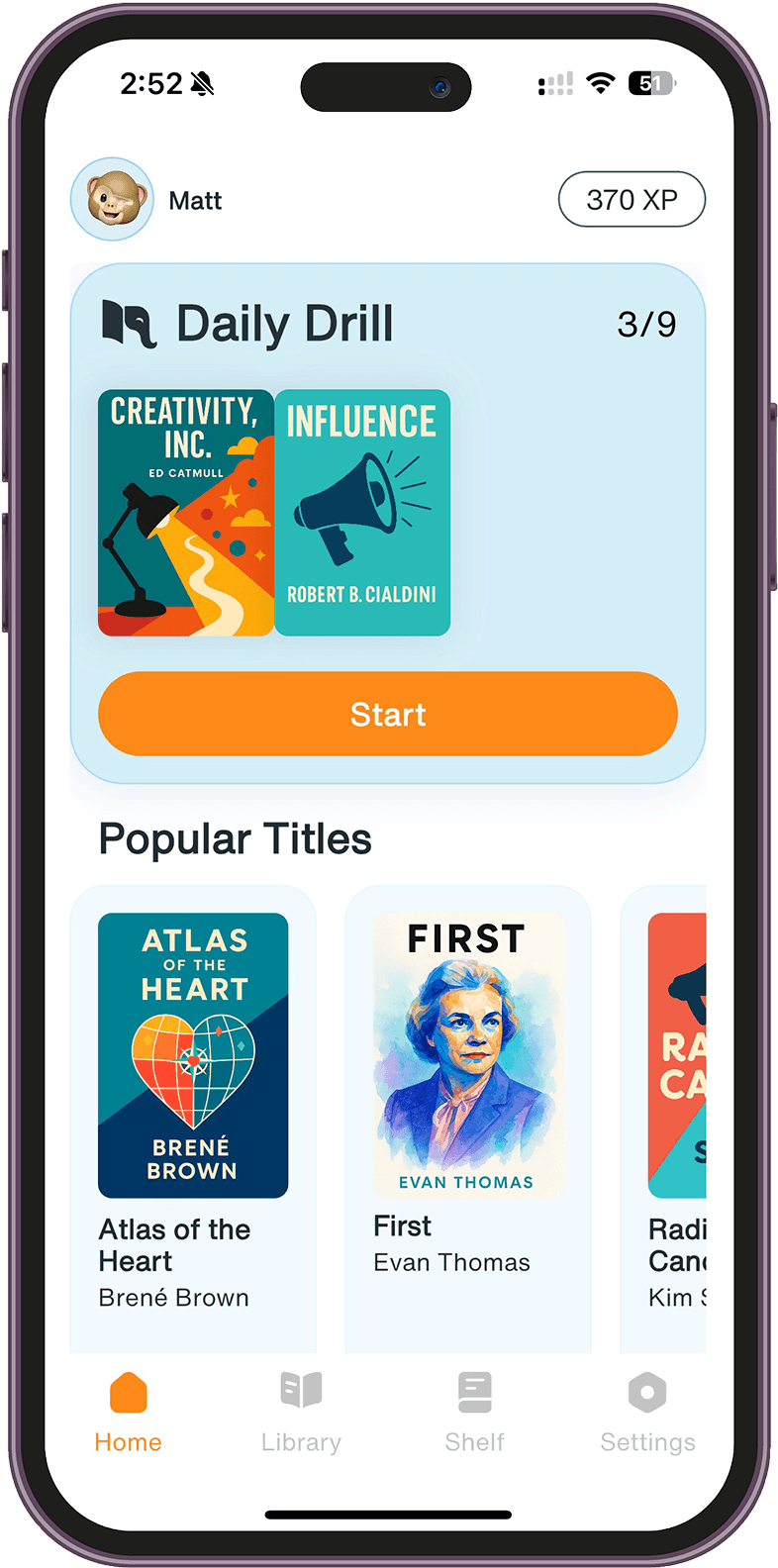
Loxie uses spaced repetition and active recall—the same techniques neuroscience has proven most effective for long-term retention—to help you internalize the concepts from Pitch Anything so they're available when you need them. Instead of passively re-reading your highlights, you actively engage with the material through questions that surface right before you'd naturally forget.
The practice takes just 2 minutes daily. Over time, ideas like frame control, hot cognitions, and the prize frame move from intellectual understanding to automatic recall. When you walk into your next high-stakes meeting, these concepts aren't buried in a book you read months ago—they're present, accessible, and ready to guide your behavior.
Pitch Anything is included in Loxie's free topic library, so you can start reinforcing these principles immediately. Whether you're preparing for a funding round, a crucial negotiation, or simply want to become more persuasive, Loxie helps you retain the frameworks that make the difference between knowing about influence and actually being influential.
Frequently Asked Questions
What is the main idea of Pitch Anything?
The main idea is that successful persuasion depends on controlling psychological frames and appealing to the primitive "croc brain" that makes snap decisions based on survival instincts. Traditional pitches fail because they target the analytical brain with logic while ignoring the primitive brain that actually controls attention and commitment.
What is the croc brain in Pitch Anything?
The croc brain is the primitive, reptilian part of the brain that acts as a gatekeeper for all incoming information. It filters everything through three questions: Is it dangerous? Is it interesting? Is it new? Only information that passes these filters reaches higher brain functions capable of sophisticated decision-making.
What is the STRONG method?
STRONG stands for Setting frame, Telling story, Revealing intrigue, Offering prize, Nailing hookpoint, and Getting decision. It's a systematic framework for structuring pitches that bypass analytical resistance and trigger primal engagement by targeting the croc brain rather than the neocortex.
What are frames in Pitch Anything?
Frames are invisible psychological structures that determine who controls an interaction. When two people meet, their frames collide and only one survives. Whoever holds the stronger frame sets the rules, context, and ultimately the outcome, regardless of official titles or authority.
What is the prize frame?
The prize frame reverses traditional buyer-seller dynamics by positioning yourself as the prize to be won rather than a supplicant seeking approval. This triggers the target's croc brain to chase what appears scarce and valuable, transforming you from pursuer into the pursued.
How can Loxie help me remember what I learned from Pitch Anything?
Loxie uses spaced repetition and active recall to help you retain the key concepts from Pitch Anything. Instead of reading the book once and forgetting most of it, you practice for 2 minutes a day with questions that resurface ideas right before you'd naturally forget them. Loxie includes Pitch Anything in its full topic library, so you can start reinforcing these concepts immediately.
We're an Amazon Associate. If you buy a book through our links, we earn a small commission at no extra cost to you.
Stop forgetting what you learn.
Start learning for good with your 7-day FREE trial.