Practical Optimism: Key Insights & Takeaways from Dr. Sue Varma
Master evidence-based strategies from neuroscience and psychology to build lasting resilience and well-being.
by The Loxie Learning Team
What if optimism isn't about ignoring reality or forcing yourself to smile through hardship? Dr. Sue Varma's Practical Optimism presents a fundamentally different approach: evidence-based strategies drawn from neuroscience and psychology that acknowledge difficult emotions while building genuine resilience. The research is compelling—optimists live 11-15% longer on average, not because they think happy thoughts, but because they develop specific coping strategies that translate into concrete health behaviors.
This guide breaks down Varma's complete framework for cultivating sustainable well-being. Whether you've struggled with traditional positive thinking advice or you're looking for science-backed tools to navigate life's challenges, you'll discover that optimism operates as a learnable skill set—one that creates measurable changes in your brain, body, and behavior within weeks of practice.
 Start practicing Practical Optimism free for 7 days ▸
What is practical optimism and how does it differ from toxic positivity?
Practical optimism combines realistic assessment of challenges with specific, evidence-based tools to navigate them effectively. Unlike toxic positivity—which demands constant cheerfulness and dismisses negative emotions—practical optimism acknowledges that difficult feelings are valid responses to difficult situations. The difference lies in what happens next: rather than suppressing distress or pretending problems don't exist, practical optimism builds skills for moving through hardship while maintaining hope.
This balanced approach prevents the harmful effects that occur when people deny their genuine experiences. Research shows that forced positivity often backfires, creating shame about negative emotions and undermining authentic well-being. Practical optimism sidesteps this trap by treating optimistic thinking as a tool for resilience, not a requirement for worthiness. You can feel afraid, sad, or angry and still cultivate the cognitive patterns that help you recover and grow.
The sustainability factor matters enormously here. Toxic positivity collapses under genuine hardship because it has no framework for processing real pain. Practical optimism, by contrast, becomes more valuable during difficult times because it was designed for exactly those moments. The tools work precisely because they don't require you to pretend everything is fine.
Can optimism actually be learned, or is it a fixed personality trait?
Optimism operates as a learnable skill set rather than an innate characteristic you're either born with or without. Research demonstrates that optimistic thinking patterns can be deliberately cultivated through consistent practice, regardless of natural temperament. Think of it like physical fitness: some people may have genetic advantages, but anyone can become stronger through training.
The training process involves specific cognitive and behavioral techniques practiced regularly over time. Just as you wouldn't expect one gym session to transform your body, building optimism requires ongoing practice. However, measurable changes begin appearing within 8-12 weeks—a timeframe that makes the skill-building approach accessible and motivating. This reframes well-being from something you passively have or lack into something you actively develop.
Understanding this distinction matters because it shifts responsibility in an empowering direction. If optimism were purely genetic, pessimistic people would have no path forward. But if it's trainable, then anyone willing to engage in the practice can build these capabilities. The research consistently supports the trainable model, making practical optimism available to everyone rather than reserved for the naturally cheerful.
Practice these concepts in Loxie ▸
What happens in your brain when you practice optimistic thinking?
Optimistic thinking activates the left prefrontal cortex while simultaneously dampening reactivity in the amygdala, the brain's threat-detection center. This neural pattern creates measurable downstream effects: stress hormone levels decrease, immune function improves, and cardiovascular markers shift toward healthier baselines. These changes aren't subtle—they appear on brain scans and blood tests within 8-12 weeks of consistent practice.
The cascade of physical benefits demonstrates that optimism isn't merely psychological. When your brain interprets situations through an optimistic lens, it triggers different hormonal responses than when it defaults to threat perception. Lower cortisol means reduced inflammation markers. Improved heart rate variability indicates a more resilient stress-response system. These biological changes compound over time, creating lasting improvements rather than temporary mood boosts.
This neuroscience perspective transforms abstract advice about "thinking positive" into concrete, measurable change. You're not just telling yourself feel-good stories; you're literally rewiring neural pathways and shifting hormonal patterns. Understanding the mechanism makes the practice feel less like wishful thinking and more like evidence-based intervention.
Why do optimists live longer, and what can you learn from their behavior?
Longitudinal studies show optimists live 11-15% longer on average, but the longevity effect comes from active coping strategies rather than passive positive thinking. Optimists take more preventive health actions—they're more likely to get screenings, follow treatment protocols, and persist with exercise programs. They also recover faster from setbacks because they interpret obstacles as temporary and solvable rather than permanent and defining.
This distinction shifts the focus from simply "thinking positive" to developing specific behavioral patterns that optimists naturally adopt. The good news is that these patterns can be deliberately cultivated. When you understand that optimism's health benefits flow through actions—eating better, exercising more, maintaining social connections, seeking medical care—you have a roadmap for capturing those benefits regardless of your natural disposition.
The behavioral pathway also explains why optimism doesn't protect against all negative outcomes. Optimists aren't magically immune to disease or hardship. They simply respond to challenges in ways that improve their odds. This realistic framing avoids the trap of blaming people for their health problems while still empowering them to take constructive action.
Understanding optimism's benefits is only half the battle
The research on optimism is clear, but knowing this intellectually doesn't automatically change your thinking patterns. Loxie helps you internalize these concepts through spaced repetition, so the principles of practical optimism become available when you actually need them—during stress, setbacks, and daily challenges.
Try Loxie free for 7 days ▸How should you practice gratitude for maximum benefit?
Gratitude practices work best when they focus on surprise and specificity rather than generic thankfulness. Noting unexpected kindnesses or capturing detailed appreciation creates stronger neural encoding than repeating the same general blessings. The brain's novelty-seeking system responds more powerfully to unexpected positive events, which means a gratitude journal documenting unique daily moments outperforms one that lists "family, health, home" repeatedly.
The specificity requirement transforms vague gratitude into vivid memory. Instead of writing "I'm grateful for my friend," you might write "I'm grateful that Maria noticed I seemed stressed and brought me coffee without being asked." The concrete details create richer associations and stronger emotional resonance. Your brain encodes the specific moment rather than filing away another abstract positive thought.
This research-backed refinement explains why many people abandon gratitude practices—generic lists become boring and feel performative. When you understand that novelty and detail drive the benefits, you can design practices that remain engaging over time. Each day becomes a hunt for unexpected positives, which itself shifts attention toward noticing good things as they occur.
What is the secret formula for achieving flow states?
Flow states emerge predictably when challenge level sits approximately 4% above current skill level. Too easy and boredom sets in; too hard and anxiety takes over. But when difficulty hovers just beyond comfortable reach, the brain enters a state of optimal engagement characterized by deep focus, lost sense of time, and intrinsic motivation. This sweet spot triggers both immediate satisfaction and accelerated skill development.
The precision of this calibration principle transforms vague advice about "finding your passion" into a measurable formula. You can engineer flow experiences in any domain by deliberately adjusting difficulty to maintain growth. A musician practices pieces slightly beyond current ability. A chess player seeks opponents marginally stronger. A writer tackles projects that stretch existing capabilities without overwhelming them.
Understanding flow's mechanics makes engagement accessible rather than mysterious. Instead of waiting for inspiration or hoping the right activity reveals itself, you can actively create conditions for flow in your existing pursuits. The key is continuous recalibration as skills improve—what challenged you last month may bore you now, requiring deliberate escalation to maintain the flow-inducing sweet spot.
Start retaining what you learn ▸
Why do brief positive interactions matter more than the number of friends you have?
High-quality connections—brief positive interactions characterized by mutual regard, active engagement, and physiological synchrony—improve well-being more than the sheer quantity of relationships. Research shows that even 40-second positive exchanges can boost immune function and mood for hours afterward. This means the quality of micro-interactions throughout your day matters more than how many friends you have or how long your conversations last.
The physiological synchrony component reveals something fascinating: during high-quality connections, people's heart rates, breathing patterns, and even brain activity begin to align. This synchronization creates a felt sense of connection that persists beyond the interaction itself. Two people genuinely engaged in a brief exchange can create more well-being impact than a lengthy conversation marked by distraction or disconnection.
This research reframes social well-being away from the pressure to maintain extensive social networks. You don't need more friends; you need more presence in your existing interactions. The barista you thank warmly, the colleague you truly listen to, the stranger you share a genuine moment with—these accumulate into a daily diet of connection that sustains emotional health regardless of your formal relationship count.
How should you think about purpose to build lasting resilience?
Purpose operates at three distinct levels: life purpose (your overarching mission), purpose in specific roles (as parent, professional, friend), and daily purpose (meaningful moments within ordinary activities). Cultivating all three creates resilience across different types of challenges because each level provides motivation and meaning under different circumstances.
While grand life purpose offers direction during major transitions and existential questions, it can feel distant during mundane daily struggles. Role-specific purpose—being the best parent, teammate, or mentor you can be—provides more immediate motivation for everyday decisions. And daily purpose—finding meaning in small moments like a well-prepared meal or a helpful conversation—offers satisfaction that doesn't depend on achieving long-term goals.
This multi-level approach proves more sustainable than seeking one ultimate calling. People who rely solely on life purpose can feel purposeless during phases when that direction isn't clear. Those who cultivate purpose at all three levels maintain motivation and meaning even when one level is disrupted. If work purpose falters, family purpose sustains you. If role identities shift, daily meaning-making continues.
What is the most effective goal-setting technique according to the research?
Implementation intentions using if-then planning achieve 91% goal completion rates compared to 35% for motivation alone. The format is simple: "If it's 7am, then I meditate before checking email." By pre-deciding your response to a specific situational cue, you bypass the need for willpower in the moment and automate the desired behavior through environmental triggers.
The power of this technique lies in its elimination of decision fatigue. Each morning decision about whether to exercise, when to start work, or how to respond to interruptions depletes mental energy. Implementation intentions make these decisions in advance, during calm moments with full cognitive resources. When the trigger occurs, you execute the pre-planned response without deliberation.
The dramatic difference in completion rates—91% versus 35%—illustrates how much behavior change fails not from lack of motivation but from lack of planning. Most people know what they should do; they struggle with doing it consistently. Implementation intentions bridge this gap by converting abstract intentions into concrete situational responses that fire automatically. Loxie's spaced repetition can help you internalize these if-then patterns until they become second nature.
Why is exercise more effective for anxiety than relaxation techniques?
Exercise acts as a "stress inoculation"—moderate physical stress followed by recovery teaches your nervous system to distinguish between real threats and daily hassles. Regular exercise creates a controlled stress-recovery cycle that trains your body to return to baseline faster after psychological stressors. This makes exercise more effective for anxiety than relaxation alone because it builds stress resilience rather than just providing temporary relief.
The mechanism involves recalibrating your body's threat-response system. Anxiety often results from an overactive alarm system that treats minor stressors as major threats. Exercise provides practice at experiencing elevated heart rate, heavy breathing, and physical tension in a safe context. Your nervous system learns that these sensations don't always signal danger, reducing false-alarm anxiety in everyday situations.
This understanding explains why exercise often outperforms relaxation for anxious individuals. Relaxation techniques teach calming, which is valuable, but they don't address the underlying hypersensitivity to stress arousal. Exercise attacks both sides: it provides immediate mood benefits while systematically training a more resilient stress-response system over time.
How does cognitive reappraisal differ from positive thinking?
Cognitive reappraisal outperforms positive thinking by acknowledging negative situations while finding alternative interpretations that are equally valid but more constructive. Instead of pretending a job loss is purely positive, reappraisal might frame it as a forced opportunity for growth that you wouldn't have chosen but can use productively. The negative reality is acknowledged; the interpretation shifts.
This approach maintains emotional authenticity while building resilience. Positive thinking often creates internal conflict when forced cheerfulness collides with genuine distress. Your emotional system knows something is wrong even while your conscious mind insists everything is fine. Reappraisal avoids this conflict by accepting that the situation is difficult while exploring what else might also be true about it.
The practical application involves asking different questions. Instead of "How can I see this positively?" you ask "What other ways could I interpret this situation?" or "What might I learn from this?" or "How might this look different in a year?" These questions invite alternative perspectives without demanding you dismiss legitimate negative reactions.
What are the pathways to post-traumatic growth?
Post-traumatic growth follows five distinct pathways: appreciation of life, relating to others, personal strength awareness, new possibilities recognition, and spiritual development. Understanding these specific domains allows trauma survivors to intentionally cultivate growth in targeted areas rather than waiting passively for time to heal or hoping for general improvement.
Appreciation of life often emerges first—confronting mortality or loss can sharpen gratitude for ordinary moments. Relationships frequently deepen as people who've suffered together develop stronger bonds and survivors learn who shows up during hard times. Personal strength awareness develops as people recognize capacities they didn't know they had: "I survived something I didn't think I could survive."
New possibilities recognition involves seeing paths forward that weren't visible before the trauma. A career change that seemed impossible now seems necessary. Values that were abstract become concrete. And spiritual development—whether religious or existential—often deepens as people grapple with questions of meaning that suffering raises. Targeted exercises for each pathway accelerate this natural growth process.
What is the PERMA-W framework and how do you use it?
The PERMA-W framework identifies six measurable intervention points for well-being: Positive emotions, Engagement, Relationships, Meaning, Achievement, plus Wellness. Each dimension represents a distinct pathway to flourishing, and developing all six creates synergistic effects where improvements in one area naturally boost others. This comprehensive approach makes well-being more resilient because setbacks in any single domain don't collapse the entire structure.
The synergy effect proves crucial for sustainability. When you invest in relationships, you often gain positive emotions and meaning as natural byproducts. Physical wellness improves focus, enhancing engagement and achievement. This interconnection means that effort in any area generates returns across multiple dimensions, creating an upward spiral rather than isolated gains.
Practical application involves assessing your current state across all six dimensions and identifying which areas offer the most leverage for improvement. Someone strong in achievement but weak in relationships might find that social investment produces outsized overall gains. The framework prevents the common mistake of over-optimizing one dimension while neglecting others that could provide easier wins.
Learn Practical Optimism for good ▸
How do you build well-being as a skill across multiple domains?
Well-being emerges from trainable skills across five domains—cognitive, emotional, social, physical, and spiritual—rather than from fixing what's wrong or achieving external success. This multi-dimensional skill-building approach makes exceptional well-being achievable through deliberate practice rather than luck or circumstance. It shifts mental health from pathology treatment to capability development.
Each domain contains specific, practicable skills. Cognitive skills include reappraisal and attentional control. Emotional skills involve regulation and savoring. Social skills encompass active listening and constructive responding. Physical skills cover exercise, nutrition, and sleep optimization. Spiritual skills include meaning-making and value clarification. Treating these as trainable capabilities—like learning a language or instrument—provides a path forward regardless of current starting point.
The preventive orientation matters as much as the skill content. Just as physical fitness training builds reserves that help you recover from illness, psychological fitness training builds reserves that help you navigate adversity. The goal isn't to wait for problems and then apply solutions; it's to develop capabilities in advance that make you naturally more resilient when challenges inevitably arise.
The real challenge with Practical Optimism
The insights in Practical Optimism are transformative—when you can remember and apply them. Research on the forgetting curve shows we lose 70% of new information within 24 hours and 90% within a week. That means the sophisticated framework you just learned about PERMA-W, implementation intentions, and cognitive reappraisal will largely fade from accessible memory within days of putting this guide down.
This isn't a failure of intelligence or motivation. It's how human memory works. The gap between understanding something intellectually and having it available when you need it—during a stressful moment, a difficult decision, or a setback—is enormous. How many books have felt life-changing as you read them, yet you struggle to recall three key points six months later? Practical optimism requires practiced optimism, and practice requires retention.
How Loxie helps you actually remember and apply what you learned
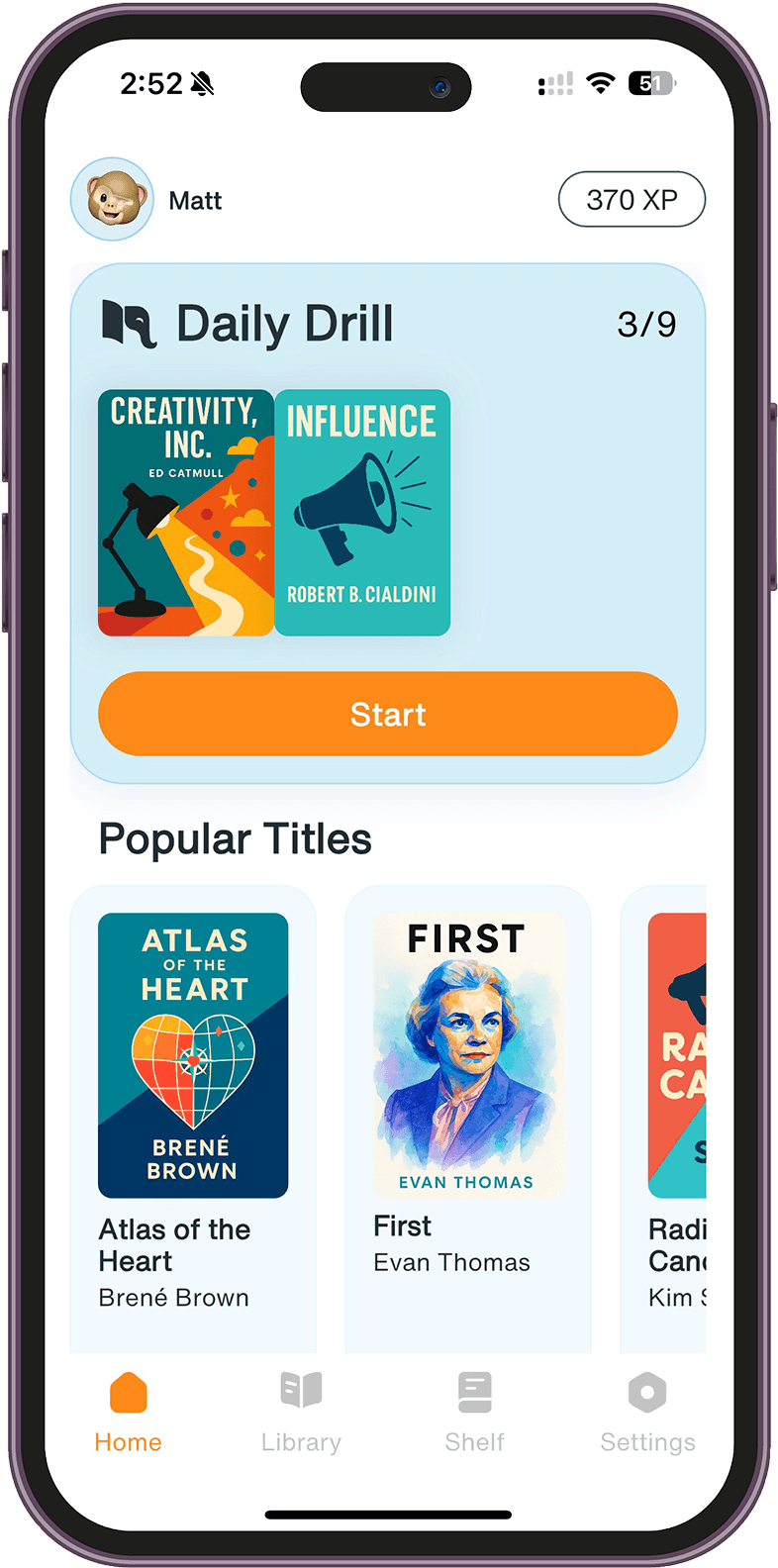
Loxie uses spaced repetition and active recall—the same evidence-based techniques Varma advocates—to help you internalize the concepts from Practical Optimism. Instead of reading once and hoping ideas stick, you practice for just 2 minutes a day with questions that resurface concepts right before you'd naturally forget them. The timing isn't random; it's optimized based on memory science to maximize retention with minimal effort.
Active recall—retrieving information rather than passively reviewing it—strengthens neural pathways far more effectively than rereading. When Loxie asks you about the five pathways of post-traumatic growth or the difference between cognitive reappraisal and positive thinking, the act of retrieving that knowledge from memory makes it more accessible for future use. This is how the principles of practical optimism become available during actual moments of stress and decision-making.
Loxie includes Practical Optimism in its full topic library, so you can start reinforcing these concepts immediately. Building optimism as a skill requires ongoing practice—exactly what Loxie is designed to support.
Frequently Asked Questions
What is the main idea of Practical Optimism?
The core idea is that optimism is a learnable skill set, not a fixed personality trait. Dr. Sue Varma presents evidence-based strategies from neuroscience and psychology that acknowledge difficult emotions while building genuine resilience. Unlike toxic positivity, practical optimism combines realistic assessment of challenges with specific tools to navigate them effectively.
What is the difference between practical optimism and toxic positivity?
Toxic positivity demands constant cheerfulness and dismisses negative emotions as invalid. Practical optimism acknowledges that difficult feelings are appropriate responses to difficult situations, then builds skills for moving through hardship while maintaining hope. This balanced approach proves sustainable through genuine challenges rather than collapsing when forced positivity meets real distress.
What is the PERMA-W framework?
PERMA-W stands for Positive emotions, Engagement, Relationships, Meaning, Achievement, and Wellness. These six dimensions provide measurable intervention points for building well-being. Developing all six creates synergistic effects where improvements in one area naturally boost others, making overall well-being more resilient to setbacks in any single domain.
How do implementation intentions work?
Implementation intentions use if-then planning to achieve 91% goal completion rates compared to 35% for motivation alone. The format is simple: "If [situation], then [behavior]." By pre-deciding responses to specific triggers, you automate desired behaviors without relying on willpower in the moment.
What are the five pathways to post-traumatic growth?
Post-traumatic growth follows five distinct pathways: appreciation of life, relating to others, personal strength awareness, new possibilities recognition, and spiritual development. Understanding these specific domains allows trauma survivors to intentionally cultivate positive change rather than waiting passively for time to heal.
How can Loxie help me remember what I learned from Practical Optimism?
Loxie uses spaced repetition and active recall to help you retain the key concepts from Practical Optimism. Instead of reading the book once and forgetting most of it, you practice for 2 minutes a day with questions that resurface ideas right before you'd naturally forget them. Loxie includes Practical Optimism in its full topic library, so you can start reinforcing these concepts immediately.
We're an Amazon Associate. If you buy a book through our links, we earn a small commission at no extra cost to you.
Stop forgetting what you learn.
Start learning for good with your 7-day FREE trial.