Quit by Annie Duke: Key Insights & Takeaways
Master Annie Duke's framework for knowing when to walk away—because strategic quitting is the hidden skill behind every success story.
by The Loxie Learning Team
What if the secret to success isn't never giving up—but knowing exactly when to walk away? Annie Duke's Quit dismantles our cultural worship of persistence and reveals an uncomfortable truth: the most successful people quit constantly. They're just strategic about what they quit and when.
This guide breaks down Duke's complete framework for making smarter quitting decisions. You'll learn why we chronically quit too late, how to set up decision-making systems that protect you from your own biases, and why treating quitting as a skill to develop—rather than a character flaw to overcome—might be the most important career move you ever make.
 Start practicing Quit free for 7 days ▸
Why is quitting actually a skill rather than a character flaw?
Quitting is a skill that enables success because it allows you to redeploy limited resources—time, energy, money, attention—away from losing situations toward better opportunities. Duke reframes quitting from something that happens when you fail to a strategic competency that creates the conditions for winning.
Think about it this way: your time and energy are finite. Every hour spent grinding away at something that isn't working is an hour not spent discovering what could work brilliantly. The most successful entrepreneurs, athletes, and professionals aren't the ones who never quit—they're the ones who quit the right things quickly so their persistence can be focused on truly worthwhile pursuits.
This is why grit and quit are actually complementary skills, not opposites. Knowing when to persist requires knowing when to walk away. The cultural celebration of never giving up overlooks a crucial pattern: successful people quit all the time. They quit bad investments, failing strategies, wrong career paths, and toxic relationships. Their success comes from being better at choosing what to quit and when—making strategic quitting the hidden partner that makes their grit effective.
What is the opportunity cost framework for quitting decisions?
Every moment spent on one path is a moment not spent on another—making quitting not about giving up but about opportunity cost and resource allocation. Duke transforms the emotional question of "am I a quitter?" into a rational calculation: "where will my limited time and energy generate the highest returns?"
This economic framing changes everything. Instead of viewing quitting as failure, you recognize it as portfolio management for your life. A venture capitalist doesn't agonize over "giving up" on a failing investment—they reallocate capital to better opportunities. Duke argues you should think about your time the same way.
The math becomes clearer when you include what you're giving up by continuing. Most people calculate only the direct costs and benefits of sticking with something, ignoring that time spent on low-probability ventures prevents you from discovering and pursuing higher-value opportunities. That calculation changes the decision entirely—suddenly, quitting a mediocre situation to explore alternatives isn't failure, it's intelligent resource allocation.
Why do people quit too late instead of too early?
We quit too late rather than too early because the signals to quit accumulate gradually while we explain each one away. This creates a pattern of rationalization that keeps us stuck until catastrophe forces our hand—by which point we've wasted enormous resources we'll never recover.
Duke explains that warning signs rarely arrive as dramatic wake-up calls. Instead, they trickle in slowly: a missed milestone here, a disappointed customer there, a goal that gets quietly moved back. Each individual signal is easy to dismiss. "That's just a one-time thing." "The market is tough right now." "Next quarter will be different." The gradual accumulation of these warnings gets normalized through daily exposure.
This is precisely why it's nearly impossible to recognize the tipping point from inside the situation. You're too close to see the pattern. Each rationalization makes perfect sense in isolation—it's only when an outsider connects the dots that the picture becomes clear. This is why external perspectives and pre-set criteria are so valuable: they see what you can't because they're not living inside your daily justifications.
What is the monkeys and pedestals mental model?
The monkeys and pedestals mental model teaches you to tackle the hardest part first. If you're trying to teach monkeys to juggle while standing on pedestals, work on the monkey training before building expensive pedestals. The pedestal is the easy part—if the monkey can't learn to juggle, the whole project fails regardless of how beautiful your pedestals are.
This framework exposes a common trap: we naturally gravitate toward the easy, tangible work while avoiding the hard, uncertain work that will actually determine success or failure. Building pedestals feels productive. You can measure progress. But all that effort is wasted if the core challenge—the monkey—proves impossible.
By frontloading the elements most likely to cause failure, you discover early whether a project is viable. This creates natural quitting points throughout a project's lifecycle. If the monkey can't learn to juggle after serious effort, you quit before investing in pedestals. You've saved massive resources and freed yourself to find a project where success is actually possible. Loxie helps you internalize this framework so it becomes automatic when evaluating your own projects and decisions.
What are kill criteria and why do they work?
Kill criteria are pre-commitment devices that specify exactly when you'll quit—set when you're thinking clearly rather than when you're emotionally invested and rationalizing failure. Like Odysseus tying himself to the mast before sailing past the Sirens, kill criteria protect your future self from predictable biases.
Duke recommends using what she calls "states and dates"—concrete triggers like "If I haven't reached X milestone by Y date, I quit." This specificity is crucial. Vague intentions like "I'll quit if it's not working" are useless because you can always convince yourself it might start working tomorrow. A concrete criterion—"If I don't have 100 paying customers by December 1st"—can't be rationalized away.
The power of kill criteria comes from making quitting decisions in advance, when you can think rationally about probabilities and acceptable losses. In the moment, when you're deep in a project and your identity is wrapped up in its success, your brain will generate endless justifications for continuing. Kill criteria bypass this by committing you to action based on observable outcomes, not current feelings.
Understanding kill criteria intellectually isn't the same as applying them
Duke's framework is powerful, but concepts fade quickly without reinforcement. Loxie uses spaced repetition to keep these decision-making tools fresh and accessible when you actually face a quitting decision.
Practice these concepts in Loxie ▸How does the sunk cost fallacy keep you trapped?
The sunk cost fallacy weaponizes your past investments against your future interests—making you a prisoner of previous decisions rather than an agent of future ones. Every dollar, hour, or emotional investment already spent is gone forever, yet we let these irretrievable costs dictate choices that should be based entirely on future prospects.
Duke illustrates how this plays out everywhere. You stay in a bad movie because you already paid for the ticket. You continue a failing project because of the months already invested. You stay in a relationship that stopped working because of the years you've put in. In each case, the logic is identical—and identically flawed. The money, time, and emotional energy are gone whether you continue or not.
The mental accounting trick Duke suggests is to consider sunk costs as "tuition" for learning. This reframe can reduce the psychological pain of quitting, but with a crucial caveat: it only works if you actually quit and apply the lessons elsewhere. Using this as rationalization to continue—"well, I've learned so much, might as well keep going"—defeats the purpose entirely. The lesson has value only if you extract it and redirect your efforts.
What is identity foreclosure and why does it make quitting so hard?
Identity foreclosure occurs when "what you do" becomes "who you are"—making quitting feel like self-betrayal rather than strategic redirection. When careers, relationships, or beliefs become central to your sense of self, walking away threatens your psychological coherence, not just your activities.
This is why elite athletes struggle to retire, why founders can't leave failing startups, and why people stay in marriages that make them miserable. The issue isn't rational—they can see the situation isn't working. The issue is that walking away means losing a piece of who they believe themselves to be. Quitting the situation means quitting an identity, and that feels like psychological death.
Duke argues that identity flexibility—the ability to quit outdated versions of yourself—is the meta-skill that enables all other forms of growth. People who can let go of who they were to become who they might be navigate career changes, relationship evolution, and personal growth more successfully. They treat identity as something that evolves rather than something that must be defended at all costs.
Why do you need quitting coaches and outside advisors?
Quitting coaches and truth-telling advisors see what you can't—providing the outside view that penetrates the fog of rationalization and self-deception keeping you stuck. While you're explaining away each warning sign and moving goalposts, an external advisor can pattern-match your situation to thousands of similar failures they've observed.
The problem with our own perspective is that we're too close to the situation. We've lived through every micro-justification, every small compromise, every adjusted expectation. An outside observer sees the pattern clearly: "You've moved your success criteria three times in six months. You're describing classic signs of a failing venture." What seems reasonable to you from inside looks obvious to anyone viewing it from outside.
But there's a paradox here: we seek advice most when we're least able to hear it. Emotional investment and identity attachment make us shop for validation rather than truth. We unconsciously select advisors who will support our existing plans, or we dismiss those who challenge us as "not understanding our unique situation." Finding and actually listening to someone who will tell you uncomfortable truths may be the most important quitting skill of all.
Why is optionality more valuable than commitment?
Optionality is more valuable than commitment because building reversible decisions and multiple paths forward prevents single points of failure while enabling opportunistic pivots. The cult of commitment ignores that uncertainty and change are constants; preserving flexibility to adapt as new information emerges often yields better outcomes than rigid adherence to predetermined plans.
Duke points to Jeff Bezos's framework of Type 1 and Type 2 decisions. Most choices are Type 2—reversible two-way doors where quick experimentation beats prolonged analysis. You can try something, see if it works, and reverse course if it doesn't. Only truly irreversible Type 1 decisions merit careful deliberation and full commitment.
This connects to diversification as systematic quitting. Whether in investing, career development, or innovation, spreading resources across multiple bets acknowledges that you can't predict winners perfectly. Building a portfolio that survives individual failures is more robust than betting everything on perfect prediction. The successful pivot preserves learning while abandoning approach—keeping what works from failed attempts while changing what doesn't.
How do great organizations build cultures that reward strategic quitting?
Organizations that celebrate intelligent failures and fast kills outperform those that punish quitting—creating cultures where admitting "this isn't working" is rewarded rather than hidden. Companies like Google and Amazon institutionalize quitting through formal processes for killing projects, making it psychologically safe to advocate for shutting down your own initiative.
Duke contrasts this with the more common organizational response: escalation of commitment. When a project shows signs of failure, the natural response is to double down—invest more resources to prove the original decision was right. Admitting failure becomes psychologically harder as the accumulated losses grow larger. This pattern destroys value but protects egos.
The scientific method, Duke points out, is essentially a quitting algorithm. Hypotheses are designed to be falsifiable so researchers can abandon wrong ideas quickly. Science progresses precisely because it institutionalizes quitting through falsification, treating the abandonment of disproven theories as success rather than failure. Organizations that adopt this mindset—where killing a bad project is celebrated as protecting resources rather than punished as failure—make systematically better decisions.
Start retaining what you learn ▸
What does it mean to work on the constraint first?
Working on the constraint first means identifying the single factor most likely to cause total failure and validating it before investing in anything else. This reverses our natural instinct to save hard parts for last and builds in natural quitting points throughout any project or decision.
Most projects fail due to one critical bottleneck—technical impossibility, no market demand, regulatory barriers, or a key person who won't cooperate. Duke argues for discovering this early through targeted experimentation. The minimum viable test extracts maximum information with minimum investment, building just enough to validate or falsify your riskiest assumption before full commitment.
This approach treats every project as a series of experiments designed to fail fast and cheap. Each test either proves viability or provides clear reason to quit before resources are wasted. It's the opposite of building elaborate infrastructure around an unproven core—instead, you validate the monkey can juggle before ordering a single pedestal. Loxie reinforces this thinking pattern so it becomes your default approach to evaluating new ventures.
The real challenge with Quit
Duke's framework is immediately compelling—the logic is airtight, the examples are memorable, and you finish the book feeling equipped to make better decisions. But here's the problem: the cognitive biases she describes don't disappear just because you've read about them. Status quo bias, sunk cost fallacy, identity foreclosure—they'll be just as powerful next month as they were before you picked up the book.
How many concepts from the last five books you read can you actually recall and apply? The forgetting curve is brutal: within a week, most people lose 70-80% of what they learned. Within a month, it's effectively gone. All those frameworks and mental models that felt so powerful while reading? Largely inaccessible when you actually face a tough quitting decision.
How Loxie helps you actually remember what you learn
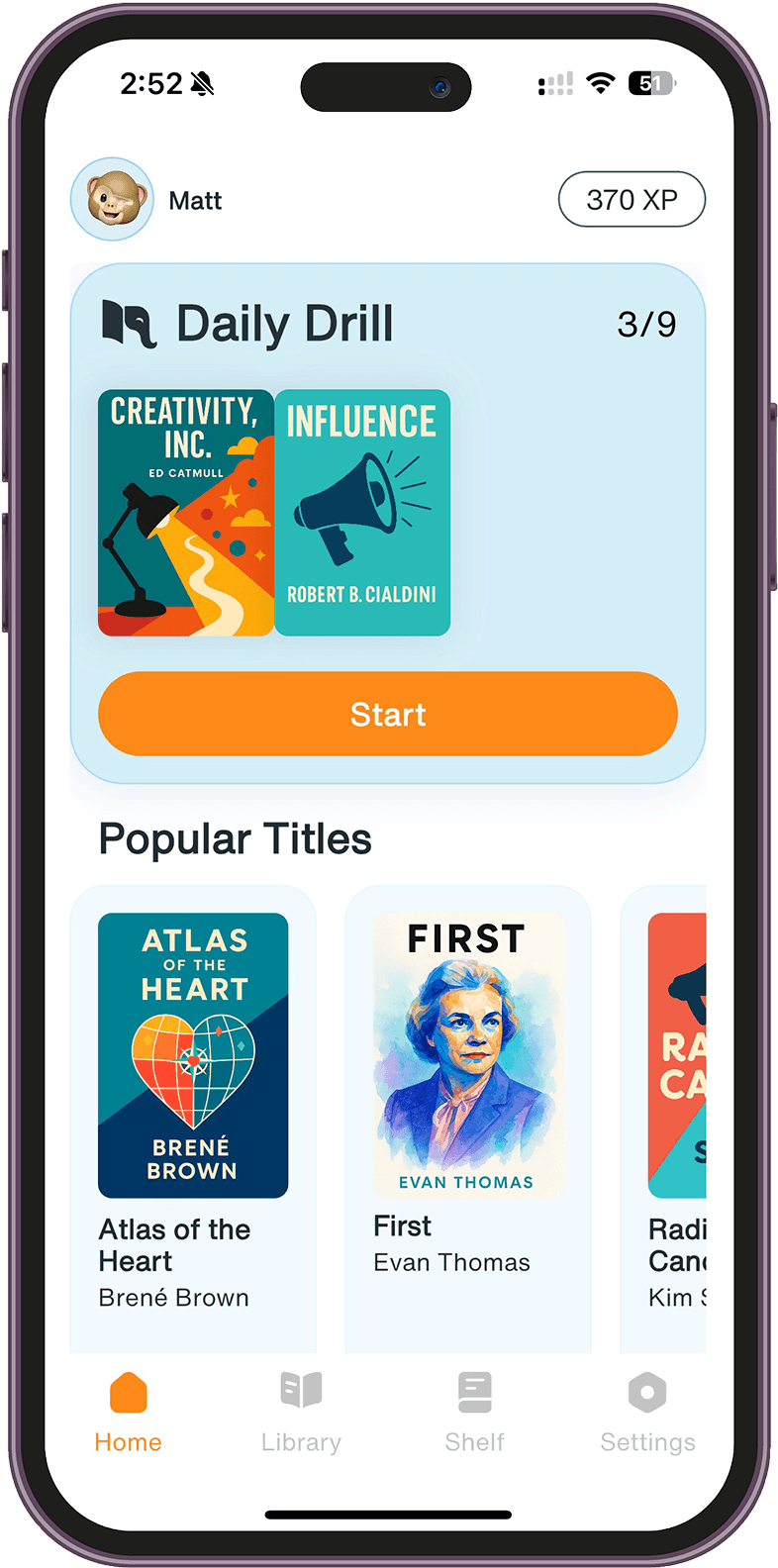
Loxie uses spaced repetition and active recall to help you internalize the concepts from Quit so they're available when you need them. Instead of reading the book once and watching the insights fade, you practice for just 2 minutes a day with questions that resurface ideas right before you'd naturally forget them.
The difference between knowing about kill criteria and actually setting them—between understanding the sunk cost fallacy and catching yourself falling for it—is whether these concepts are accessible in the moment of decision. Loxie's approach is based on decades of cognitive science research showing that retrieval practice creates durable, accessible memory. Loxie includes Quit in its full topic library, so you can start reinforcing these concepts immediately.
Frequently Asked Questions
What is the main idea of Quit by Annie Duke?
The central argument is that quitting is a skill that enables success, not a character flaw. Knowing when to walk away allows you to redeploy limited resources toward better opportunities. Strategic quitting and grit are complementary—successful people quit constantly, they're just better at choosing what to quit and when.
What are the key takeaways from Quit?
Key insights include: set kill criteria in advance when thinking clearly; tackle the hardest part first (monkeys before pedestals); recognize that sunk costs are gone regardless of what you do; watch out for identity foreclosure making quitting feel like self-betrayal; and use outside advisors who can see patterns you can't from inside the situation.
What is the monkeys and pedestals concept?
It's a mental model for prioritizing work on the riskiest element first. If your project requires teaching monkeys to juggle on pedestals, validate that monkeys can learn to juggle before building expensive pedestals. This approach creates natural quitting points by exposing impossible challenges early.
How do kill criteria help with quitting decisions?
Kill criteria are pre-set triggers like "If I haven't reached X milestone by Y date, I quit." They work by committing you to action when you're thinking clearly, before emotional investment and rationalization corrupt your judgment. Concrete criteria prevent endless goalpost-moving that keeps people trapped in failing situations.
Why do people quit too late instead of too early?
Warning signs accumulate gradually while we explain each one away individually. This slow drip of rationalization gets normalized through daily exposure, making it nearly impossible to recognize the tipping point from inside. External perspectives and pre-set criteria help because they see patterns we can't.
How can Loxie help me remember what I learned from Quit?
Loxie uses spaced repetition and active recall to help you retain key concepts from Quit. Instead of reading the book once and forgetting most of it, you practice for 2 minutes a day with questions that resurface ideas right before you'd naturally forget them. Loxie includes Quit in its full topic library.
We're an Amazon Associate. If you buy a book through our links, we earn a small commission at no extra cost to you.
Stop forgetting what you learn.
Start learning for good with your 7-day FREE trial.