Range: Key Insights & Takeaways from David Epstein
Discover why generalists thrive in our complex world and how broad experience beats early specialization.
by The Loxie Learning Team
What if the key to success isn't starting early and specializing deeply, but exploring widely and connecting dots across different fields? David Epstein's Range challenges the popular Tiger Woods narrative of early specialization, presenting compelling evidence that generalists often outperform specialists in our increasingly complex and unpredictable world.
This guide breaks down Epstein's complete framework for why breadth beats depth in most modern pursuits. You'll understand why outsiders solve problems that stump experts, how diverse experiences build stronger foundations than narrow focus, and why the most innovative breakthroughs come from people who can think across domains. Whether you're questioning your own career path or raising children in a culture obsessed with early specialization, these insights will reshape how you think about learning and success.
 Start practicing Range free for 7 days ▸
Why do generalists outperform specialists in complex environments?
Generalists excel in unpredictable environments because they can transfer knowledge between domains, seeing connections that specialists miss entirely. While experts develop deep pattern recognition within their field, generalists build broader mental models that allow them to adapt strategies from one area to solve problems in completely different contexts.
The advantage becomes clear when you consider how modern challenges work. Most real-world problems don't come with labels identifying which expertise applies. A generalist who has worked across marketing, engineering, and psychology can recognize when a product design problem is actually a user behavior problem—a connection a pure engineer might never see. This ability to match problems to solutions across domains gives generalists a significant edge when situations don't fit neatly into established categories.
Epstein demonstrates this through research showing that Nobel laureates are far more likely than typical scientists to have serious hobbies outside their field—art, music, writing, acting. These aren't distractions from their work; they're sources of analogies and fresh perspectives that fuel breakthrough thinking. The breadth creates depth of a different kind: the ability to see what others cannot.
What is cognitive entrenchment and why does expertise become a liability?
Cognitive entrenchment occurs when deep expertise becomes a mental trap, causing experts to reflexively apply familiar solutions even when circumstances demand entirely new approaches. The more experience someone accumulates in a stable domain, the more automatically they respond—which works beautifully until conditions change and those automatic responses become dangerous liabilities.
Epstein uses the Challenger disaster as a stark example. NASA engineers were so entrenched in their standard risk assessment frameworks that they couldn't process information that didn't fit their models. The warning signs were there, but expertise had created blinders. The engineers weren't stupid or careless—they were victims of their own deep experience, which made it nearly impossible to see the situation with fresh eyes.
This pattern repeats across industries. Experienced firefighters who have survived dozens of wildfires can be killed by situations that violate their pattern recognition. Expert cardiologists misdiagnose unusual presentations because they've seen thousands of typical ones. The very experience that makes experts valuable in normal circumstances makes them vulnerable when the rules change. Understanding cognitive entrenchment helps explain why outsiders so often drive innovation—they haven't yet learned to see problems in the conventional way.
Practice these concepts in Loxie ▸
How does lateral thinking with existing technologies create innovation?
Lateral thinking with existing technologies creates revolutionary innovations by combining mature, well-understood components in novel ways rather than pushing the cutting edge. This approach leverages the reliability and low cost of proven technology while applying creative insight to find unexpected applications.
Gunpei Yokoi's creation of the Game Boy exemplifies this principle perfectly. While competitors raced to build handheld devices with the most advanced graphics, Yokoi deliberately chose "outdated" technology—cheap calculator screens and simple processors. His insight was that portability, battery life, and affordability mattered more to users than visual sophistication. The result dominated the market for over a decade and sold hundreds of millions of units.
This principle extends far beyond consumer electronics. Many breakthrough medical devices repurpose technology from completely unrelated industries. Successful entrepreneurs often describe their innovations not as inventing something new, but as seeing a novel combination of existing pieces. The skill isn't technical expertise in any single domain—it's the ability to see how mature tools from different fields might combine to create something none of them could achieve alone. This is precisely why generalists with exposure to multiple domains have an advantage in innovation.
Why does broad experience beat early specialization in complex fields?
Broad experience and late specialization outperform early specialization in complex and unpredictable fields because diverse knowledge enables pattern recognition across domains and creative problem-solving that specialists miss. While early specializers may initially pull ahead, generalists who sample widely before committing often surpass them in the long run.
The research is striking. Studies of musicians show that those who eventually reach elite levels actually sampled more instruments early on, not fewer. They specialized later than their peers who plateaued at lower levels. The sampling period wasn't wasted time—it built broader musical understanding and helped them find the instrument that truly matched their abilities and interests.
This pattern holds across domains. Scientists who have worked in multiple fields produce more impactful research. Entrepreneurs who have held diverse jobs before starting companies have higher success rates. The explanation is that complex fields reward the ability to see problems from multiple angles and draw on varied mental models. Early specialization optimizes for a narrow set of conditions; broad experience builds the adaptability needed when those conditions inevitably change. Loxie helps you retain insights from multiple domains, building the broad knowledge base that enables this kind of cross-domain thinking.
How do outsiders solve problems that stump domain experts?
Outsiders solve problems that stump domain experts by bringing fresh perspectives unconstrained by field-specific assumptions and conventional approaches. Where experts see a problem through the lens of their training, outsiders see it as a novel puzzle with no predetermined solution path.
The platform InnoCentive provides dramatic evidence of this phenomenon. When organizations post their most intractable problems—challenges their internal experts have failed to solve—solutions come disproportionately from people outside the relevant field. The success rate for these previously "unsolvable" problems hovers around 30%, with solutions often coming from adjacent or completely unrelated disciplines. A chemist solves a physics problem. A veterinarian cracks a human medical challenge.
The mechanism is straightforward: experts know too much about why existing approaches should work, making it psychologically difficult to abandon them. Outsiders don't carry that baggage. They ask naive questions that turn out not to be naive at all. They try approaches that experts "know" won't work—and sometimes those approaches succeed precisely because they violate the field's assumptions. This is why diverse teams consistently outperform homogeneous expert teams on complex problems, and why Epstein argues organizations should actively seek input from non-specialists.
What is interleaved practice and why does it improve learning?
Interleaved practice means mixing different skills and concepts during training rather than practicing one thing repeatedly before moving to the next. While this approach feels harder and produces slower initial progress, it creates better long-term retention and transfer by forcing the brain to continuously retrieve and apply different strategies.
Traditional "blocked" practice—doing twenty of the same math problem type, then twenty of another type—feels productive because performance improves quickly within each block. But research consistently shows this is an illusion. When tested later on mixed problems, interleaved learners dramatically outperform blocked learners. The struggle of constantly switching between problem types builds the discrimination skills needed to identify which approach to use—a skill blocked practice never develops.
This has profound implications for how we should learn. The most efficient-feeling practice is often the least effective for building durable, transferable skills. Interleaved practice forces you to constantly retrieve different strategies from memory and decide which applies, strengthening both the knowledge itself and the meta-skill of knowing when to use it. Loxie's spaced repetition system incorporates this principle, mixing questions from different concepts rather than drilling one topic exhaustively before moving on.
Interleaved learning works—but only if you actually do it
Understanding why mixing topics improves retention is valuable, but the real challenge is implementing it consistently. Loxie automatically interleaves concepts from Range and other books you're learning, so you build durable knowledge without having to design your own practice schedule.
Start interleaved practice free ▸What are wicked learning environments and why do generalists thrive in them?
Wicked learning environments are situations where patterns change unpredictably, feedback is delayed or misleading, and rules are unclear or constantly shifting. In these environments, specialists' narrow pattern recognition fails because the contexts they've mastered no longer apply, while generalists' broader toolkit allows them to adapt.
Epstein contrasts wicked environments with "kind" environments like chess or golf, where the rules are clear, patterns are stable, and feedback is immediate and accurate. In kind environments, deliberate practice and early specialization produce mastery. The ten-thousand-hour rule applies. But most of modern life doesn't work this way. Business strategy, medical diagnosis, parenting, career navigation—these are all wicked environments where yesterday's successful pattern may be tomorrow's failure.
The critical difference is that kind environments reward pattern matching, while wicked environments reward pattern recognition across contexts and the ability to detect when familiar patterns don't apply. A chess grandmaster's skill doesn't transfer to poker, but a person who has played many different strategy games might recognize deeper principles that apply across all of them. This is why Epstein argues that our increasingly complex and rapidly changing world favors generalists—we're making more domains wicked, not kind.
How does experimenting with different roles reveal your true strengths?
Experimenting with different identities and roles reveals true interests and strengths by providing real-world feedback about what energizes and suits us—information we simply cannot obtain through introspection or planning alone. We learn who we are by trying different versions of ourselves.
Frances Hesselbein's journey illustrates this perfectly. She never planned to become CEO of the Girl Scouts and transform it into a model organization. She started as a volunteer troop leader, taking on incrementally larger roles because each one revealed new capabilities and interests she hadn't known she possessed. Her path wasn't a strategic career plan—it was a series of experiments that taught her what she was capable of and passionate about.
This challenges the common advice to find your passion first, then pursue it. Epstein shows that passions are developed through engagement, not discovered through reflection. People who try multiple career paths before committing report higher satisfaction than those who specialized early, even when the early specializers are more conventionally "successful." The sampling period isn't wasted time—it's essential information gathering that prevents committing to paths that seem right in theory but feel wrong in practice.
What is analogical thinking and how does it drive breakthrough innovation?
Analogical thinking across domains drives breakthrough innovations by allowing people to recognize patterns and apply solutions from one field to problems in completely different areas. The further the analogy travels—from music to astronomy, from biology to computer science—the more potential it has to generate truly novel insights.
Johannes Kepler's discovery of planetary motion exemplifies the power of distant analogies. Struggling to explain why planets moved as they did, he drew on his knowledge of musical harmony, asking whether the planets might follow proportions similar to musical scales. This seemingly bizarre analogy led him to the laws of planetary motion that Newton would later explain with gravity. The breakthrough came not from deeper astronomical knowledge, but from connecting astronomy to an entirely different domain.
Research confirms that the most creative problem-solvers systematically generate analogies from distant fields. When facing a new challenge, they ask "What is this like?" and search broadly for structural similarities, not just surface ones. A resistance problem in engineering might be analogous to a traffic flow problem, which might be analogous to how rumors spread in social networks. Each analogy opens new solution paths that narrow expertise would never reveal. This is why breadth of knowledge—actively maintained through tools like Loxie—becomes a competitive advantage in creative work.
What are desirable difficulties and how do they deepen understanding?
Desirable difficulties are challenges that slow initial learning but deepen understanding, creating more durable knowledge by forcing learners to generate connections and retrieve information rather than simply recognizing patterns. The struggle is the point, not the obstacle.
This principle explains why teaching methods that feel effective often aren't, and vice versa. Students rate clear, fluent lectures more highly than challenging ones, yet perform worse on later tests. The easy lecture creates an illusion of understanding—the information feels familiar—but hasn't been deeply processed. The difficult, interactive approach that forces students to struggle and make errors actually builds stronger mental models that last.
Desirable difficulties include spacing practice over time rather than cramming, testing yourself rather than re-reading, and varying the conditions of practice rather than keeping them constant. All of these make learning feel harder while making it more effective. The key word is "desirable"—the difficulty must be the right kind, forcing deeper processing rather than simply creating confusion. Loxie's spaced repetition system is built on this research: by making you actively recall concepts at increasing intervals, it creates the productive struggle that transforms surface understanding into lasting knowledge.
Why do foxes outperform hedgehogs at predicting complex events?
Foxes—people who draw from diverse knowledge domains and multiple perspectives—consistently outperform hedgehogs who rely on one big idea when forecasting complex events. The fox's advantage comes from aggregating multiple viewpoints and updating beliefs based on new evidence rather than forcing everything through a single explanatory lens.
Philip Tetlock's research on expert political judgment revealed this pattern starkly. He tracked thousands of predictions by experts over decades and found that specialists with grand unifying theories performed worse than educated laypeople. The hedgehogs who "knew one big thing" made confident predictions that frequently failed. The foxes who "knew many little things" made more nuanced, qualified predictions that proved far more accurate.
The mechanism is psychological. Hedgehogs become attached to their big idea and rationalize away contradictory evidence. Foxes maintain intellectual humility, treating each prediction as a hypothesis to be tested rather than a truth to be defended. They're comfortable with uncertainty and complexity. In a world where most important events result from the interaction of many factors, the fox's multi-model approach captures reality better than any single theory can. This is another argument for cultivating range: diverse knowledge creates diverse mental models, which improves judgment in complex situations.
How do polymaths and deliberate amateurs solve intractable problems?
Polymaths and deliberate amateurs solve intractable problems by connecting insights across disciplines and bringing fresh perspectives that specialists miss due to their field's conventional wisdom and methodological constraints. Their lack of deep expertise in any single area becomes an asset rather than a limitation.
The history of science is filled with breakthrough discoveries by people working outside their formal training. Darwin was a geology enthusiast who revolutionized biology. Mendel was a monk with no professional scientific position. More recently, major contributions to mathematics have come from engineers, contributions to biology from physicists, and contributions to economics from psychologists. The pattern is consistent: outsiders see what insiders cannot.
This happens for several reasons. Each field develops tacit assumptions that practitioners absorb unconsciously—ways of framing problems, methods considered legitimate, questions considered important. These assumptions are often useful but can become blinders. The deliberate amateur hasn't absorbed them and therefore asks questions that insiders would dismiss as naive or already answered. Sometimes those questions lead nowhere, but sometimes they reveal that the "answers" were actually assumptions that deserved challenge. Maintaining amateur interests outside your specialty isn't a distraction—it's a source of the perspective diversity that drives innovation.
Start retaining what you learn ▸
Why is strategic quitting essential for finding your optimal path?
Strategic quitting is essential for finding optimal person-pursuit matches because it allows individuals to sample different paths and redirect effort toward areas where their unique combination of skills and interests create the most value. Persistence in the wrong direction wastes the most precious resource: time.
Our culture celebrates grit and stigmatizes quitting, but Epstein shows this is often counterproductive. People who quit activities that aren't working and try something else frequently end up more successful and satisfied than those who persist through poor matches. The Army's Special Forces selection process explicitly tests candidates' willingness to quit—not because quitting is bad, but because the ability to recognize a poor match and redirect is valuable.
The key distinction is between quitting when things get hard (often counterproductive) and quitting when mounting evidence suggests a fundamental mismatch (often wise). Van Gogh was a failure at theology, teaching, and art dealing before finding his path as a painter. If he had "persisted" in any of those earlier pursuits, we would have lost one of history's greatest artists. Strategic quitting requires honest self-assessment and the courage to abandon sunk costs—skills that Epstein argues should be cultivated rather than suppressed.
How do diverse early experiences create stronger foundations?
Diverse early experiences create stronger foundations than early specialization by developing broader pattern recognition, preventing cognitive entrenchment, and building a wider toolkit for future learning. The sampling period isn't a delay before "real" development—it's an essential phase that shapes long-term capability.
Research on elite athletes reveals that those who eventually reach the highest levels typically played multiple sports in childhood, specializing later than peers who plateaued at lower levels. The multi-sport athletes developed broader athletic literacy—coordination, spatial awareness, strategic thinking—that transferred to their eventual specialty. Early specializers optimized for one narrow set of movements and contexts.
The same pattern appears in cognitive domains. Children who explore multiple subjects and skills build more connected knowledge structures than those pushed into early academic specialization. They develop the meta-learning skills—how to learn new things, how to recognize what type of problem they're facing, how to find and evaluate information—that matter more than any specific content as the world changes. This argues for protecting children's exploration time rather than scheduling every moment with specialized instruction, and for adults to continue cultivating diverse interests rather than narrowing focus as careers progress.
The real challenge with Range
Reading Range is intellectually exciting. The research is compelling, the stories are memorable, and the conclusions feel liberating—especially if you've ever felt guilty about not specializing earlier or having diverse interests. But here's the uncomfortable truth: within a month, you'll struggle to recall more than a few key ideas. Within a year, the detailed concepts that make the book actionable will have faded almost entirely.
This isn't a personal failing—it's how human memory works. The forgetting curve is steep and relentless. We forget roughly 70% of new information within 24 hours and most of the rest within a week. That brilliant insight about cognitive entrenchment? The specific evidence for why outsiders solve problems experts can't? The framework for identifying wicked versus kind environments? All of it fades unless you actively work to retain it.
The irony is painful: a book about the value of broad knowledge loses much of its value if you can't actually retain and apply that knowledge when you need it. Understanding why generalists succeed is meaningless if you can't remember the principles well enough to use them.
How Loxie helps you actually remember what you learn
Loxie solves the retention problem using the same research-backed principles Epstein describes. Spaced repetition resurfaces concepts right before you'd naturally forget them, creating the desirable difficulty that builds durable memory. Active recall forces you to generate answers rather than passively recognize them, strengthening retrieval paths. Interleaved practice mixes concepts from different books and domains, building the broad, connected knowledge that characterizes effective generalists.
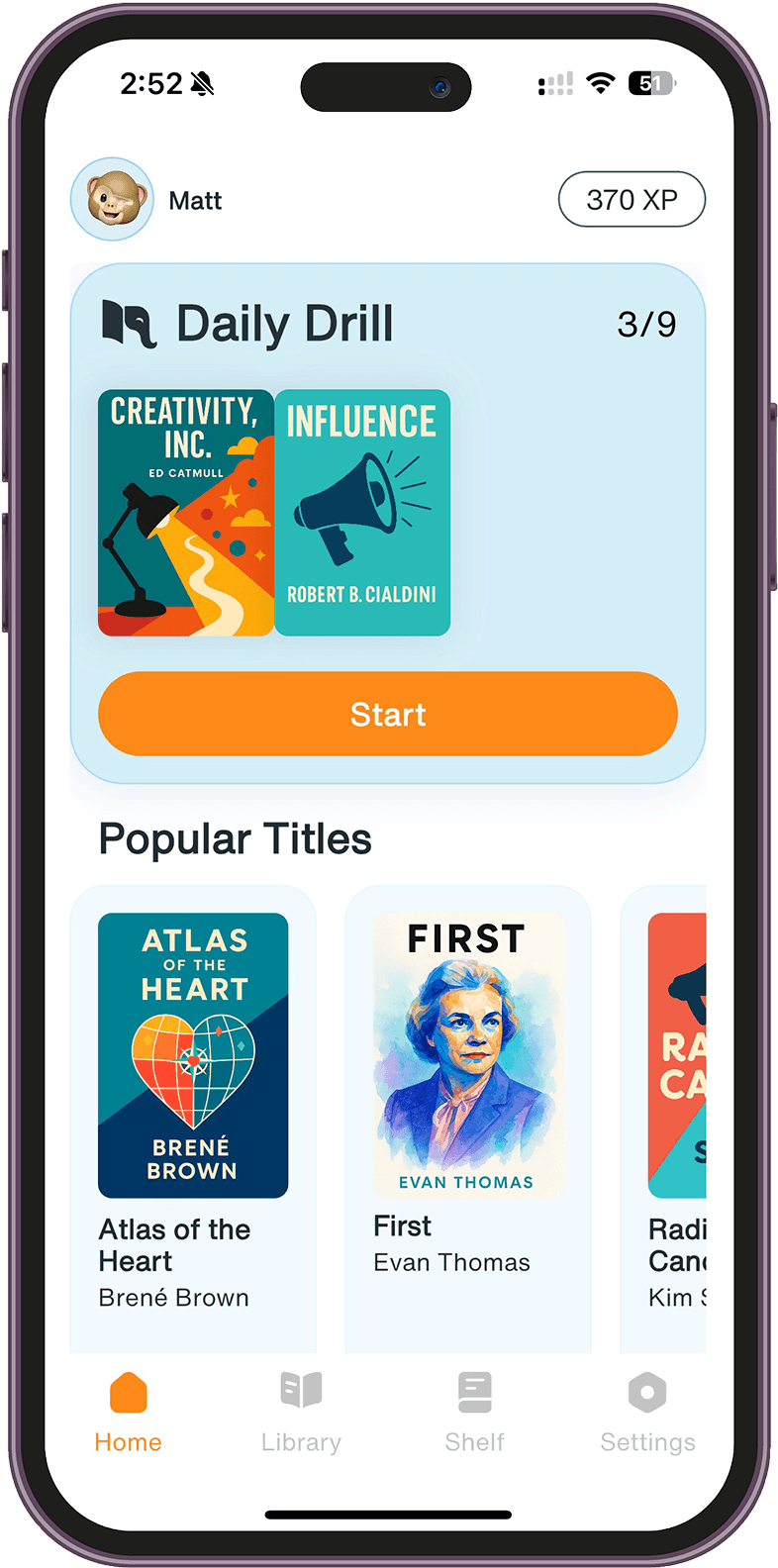
Instead of reading Range once and watching its insights fade, you practice for just two minutes a day. Questions about cognitive entrenchment appear alongside questions about interleaved learning and analogical thinking—not drilled in isolation, but woven together the way real problems demand. Loxie includes Range and hundreds of other book summaries, so you can build exactly the kind of broad, retainable knowledge that Epstein shows creates success in our complex world.
Frequently Asked Questions
What is the main idea of Range?
Range argues that generalists who explore broadly and specialize late often outperform specialists in complex and unpredictable fields. David Epstein presents evidence that diverse experiences build stronger foundations, enable creative problem-solving across domains, and prevent the cognitive entrenchment that limits narrow experts.
What are the key takeaways from Range?
The key takeaways include: generalists thrive in wicked learning environments where patterns change unpredictably; outsiders often solve problems that stump domain experts; interleaved practice creates better retention than blocked practice; strategic quitting helps find optimal paths; and analogical thinking across domains drives breakthrough innovation.
What is cognitive entrenchment according to Range?
Cognitive entrenchment is when deep expertise becomes a mental trap, causing experts to reflexively apply familiar solutions even when circumstances demand new approaches. The more automatically experts respond based on past experience, the more vulnerable they become when conditions change in unexpected ways.
What is the difference between kind and wicked learning environments?
Kind environments like chess have clear rules, stable patterns, and immediate accurate feedback—ideal for specialization. Wicked environments like business strategy involve hidden information, changing rules, and delayed consequences. Most modern careers are wicked environments where generalist skills provide significant advantages.
Why does Range say early specialization is often counterproductive?
Early specialization optimizes for narrow conditions that may change, prevents development of broader pattern recognition and adaptability, and can lead to cognitive entrenchment. Research shows that elite performers in most complex fields actually sampled more widely and specialized later than peers who plateaued at lower levels.
How can Loxie help me remember what I learned from Range?
Loxie uses spaced repetition and active recall to help you retain the key concepts from Range. Instead of reading the book once and forgetting most of it, you practice for 2 minutes a day with questions that resurface ideas right before you'd naturally forget them. Loxie includes Range in its full topic library.
We're an Amazon Associate. If you buy a book through our links, we earn a small commission at no extra cost to you.
Stop forgetting what you learn.
Start learning for good with your 7-day FREE trial.