Slow Productivity: Key Insights & Takeaways from Cal Newport
Master Cal Newport's framework for sustainable accomplishment—do fewer things, work at a natural pace, and obsess over quality.
by The Loxie Learning Team
What if the path to exceptional work isn't doing more, but doing less? Cal Newport's Slow Productivity challenges our culture's obsession with busyness and offers a compelling alternative: sustainable accomplishment through natural rhythms, deep focus, and relentless attention to quality. Newport argues that constant activity isn't just exhausting—it's actively preventing us from producing our best work.
This guide breaks down Newport's complete framework for achieving meaningful results without burning out. Drawing from the work habits of history's most creative minds, you'll learn why fewer priorities lead to better outcomes, how to align work with your natural energy cycles, and why obsessing over quality beats chasing quantity every time. Whether you're drowning in commitments or simply sensing that constant hustle isn't sustainable, these principles offer a path to both exceptional results and a balanced life.
 Start practicing Slow Productivity free for 7 days ▸
Why does the industrial model of productivity fail knowledge workers?
The industrial model of productivity fails knowledge workers because it measures output by visible activity and hours worked rather than by the quality and impact of ideas produced. Factory productivity is straightforward: more hours on the assembly line means more widgets. But knowledge work doesn't operate this way. The value of a strategy, design, or piece of writing has almost nothing to do with how quickly it was produced or how busy the creator appeared while making it.
This mismatch creates a toxic dynamic. Without clear metrics for knowledge work, organizations default to proxy measures—email response times, meeting attendance, visible busyness. Workers become trapped performing productivity rather than actually producing value. The result is calendars packed with meetings, inboxes demanding constant attention, and deep thinking relegated to whatever scraps of time remain. Newport calls this "pseudo-productivity," and it's exhausting precisely because it fails to produce genuine satisfaction.
The solution isn't to work harder within this broken system. It's to reject the system entirely and adopt a fundamentally different approach—one that prioritizes results over appearance and recognizes that meaningful accomplishments unfold over months and years, not days. Understanding why the industrial model fails is the first step toward building a sustainable alternative. Loxie can help you internalize these distinctions so you recognize pseudo-productivity when you see it—in your own work and in your organization's expectations.
What is slow productivity and how does it differ from hustle culture?
Slow productivity is an approach to work that aligns with natural human rhythms—periods of intense focus followed by recovery—rather than maintaining constant busyness that leads to burnout and mediocre results. It stands in direct opposition to hustle culture's premise that more activity equals more accomplishment. Where hustle culture celebrates the packed calendar and the 4am wake-up call, slow productivity asks a different question: what actually produces lasting, meaningful work?
Newport draws from history's most accomplished figures to answer this question. Darwin, Einstein, and Virginia Woolf didn't achieve lasting greatness through constant grinding. They worked intensely on a small number of projects, took long walks, allowed ideas to develop over extended periods, and maintained strict boundaries around their time. Their productivity looked slow by modern standards, but their output shaped human civilization. This pattern appears consistently across creative geniuses throughout history, suggesting that constant activity is a recent cultural deviation from humanity's natural approach to meaningful work.
The principles of slow productivity predate our modern obsession with busyness. What we call "hustle culture" is actually the historical anomaly. For most of human history, work followed natural rhythms—intense effort during planting and harvest seasons, lighter work during winter. Knowledge workers have inherited industrial-age expectations that make no sense for cognitive labor. Slow productivity is less a new invention than a return to what actually works for producing exceptional results.
Practice these concepts in Loxie ▸
Why does limiting your commitments lead to better work?
Limiting commitments to a small number of important projects enables the deep focus required for exceptional work, because attention is a finite resource that dilutes with each additional obligation. When you're juggling ten projects, none of them receive the sustained concentration needed for breakthrough thinking. You become a task-switcher rather than a deep thinker, spending more mental energy managing your workload than actually advancing it.
Fewer priorities create space for sustained attention on each project, allowing ideas to develop fully rather than producing rushed, superficial work across many initiatives. A designer working on one major project can obsess over details, explore unconventional approaches, and iterate toward excellence. The same designer juggling five projects can only execute the obvious solution and move on. The math is counterintuitive but consistent: fewer projects at any given time often means more completed work over the long run, and significantly higher quality in what you complete.
The challenge is psychological. Saying no to new commitments feels like falling behind, missing opportunities, or disappointing others. But this fear is based on a misunderstanding. The constraint isn't your willingness to take on work—it's your attention. Every yes to a new project is an implicit no to depth on existing ones. Loxie helps you internalize this principle through regular practice, building the mental models that make it easier to protect your focus when the next "urgent" request arrives.
How does visible activity create the illusion of productivity?
Visible activity like constant email checking, back-to-back meetings, and immediate responses creates an illusion of productivity while preventing the deep thinking that produces actual value. In knowledge work, being busy and being productive are not the same thing—and often they're opposites. The worker who responds to every email within minutes appears productive but may accomplish nothing of lasting significance. The worker who disappears for four hours to think deeply appears absent but may produce the year's most valuable insight.
This illusion persists because visible activity is easy to measure while deep thinking is not. Managers can see who's in meetings and who responds quickly to messages. They cannot easily see who's developing innovative solutions to complex problems. The result is a workplace that rewards performance of work over actual work, creating incentives that actively undermine quality output.
Escaping this trap requires both personal discipline and organizational education. On a personal level, you must develop comfort with appearing less busy while accomplishing more. On an organizational level, you may need to help colleagues understand why your slower, more deliberate approach ultimately serves everyone better. Newport emphasizes that this isn't about being lazy—it's about directing your finite attention toward what actually matters.
Why should you obsess over quality rather than quantity?
Obsessing over quality rather than quantity transforms work from a volume game into a craft, producing exceptional results while maintaining work-life balance through focused attention on fewer, more meaningful projects. When you're committed to producing excellent work, you naturally resist taking on more than you can do well. Quality becomes a constraint that protects your time and attention.
Betting on quality over quantity produces superior results because deeply focused work on fewer projects allows for iterative refinement, mastery of craft, and the creation of outputs that stand the test of time rather than quickly forgotten busywork. Consider the difference between producing ten mediocre presentations or one exceptional one. The ten might feel more productive in the moment, but the exceptional one builds your reputation, advances your career, and generates opportunities the mediocre work never could.
High-quality work also creates more satisfying professional experiences. There's a profound difference between the anxiety of managing multiple half-finished projects and the pride of crafting something excellent. Quality work generates genuine accomplishment rather than the hollow feeling of perpetual busyness. It attracts better opportunities because reputation compounds over time. And it reduces stress because you're not constantly worried about which balls you're dropping. Loxie helps you remember why quality matters—so when you're tempted to take on more than you can do well, the principles of slow productivity are readily available.
Understanding these ideas isn't enough—you need to remember them when it matters.
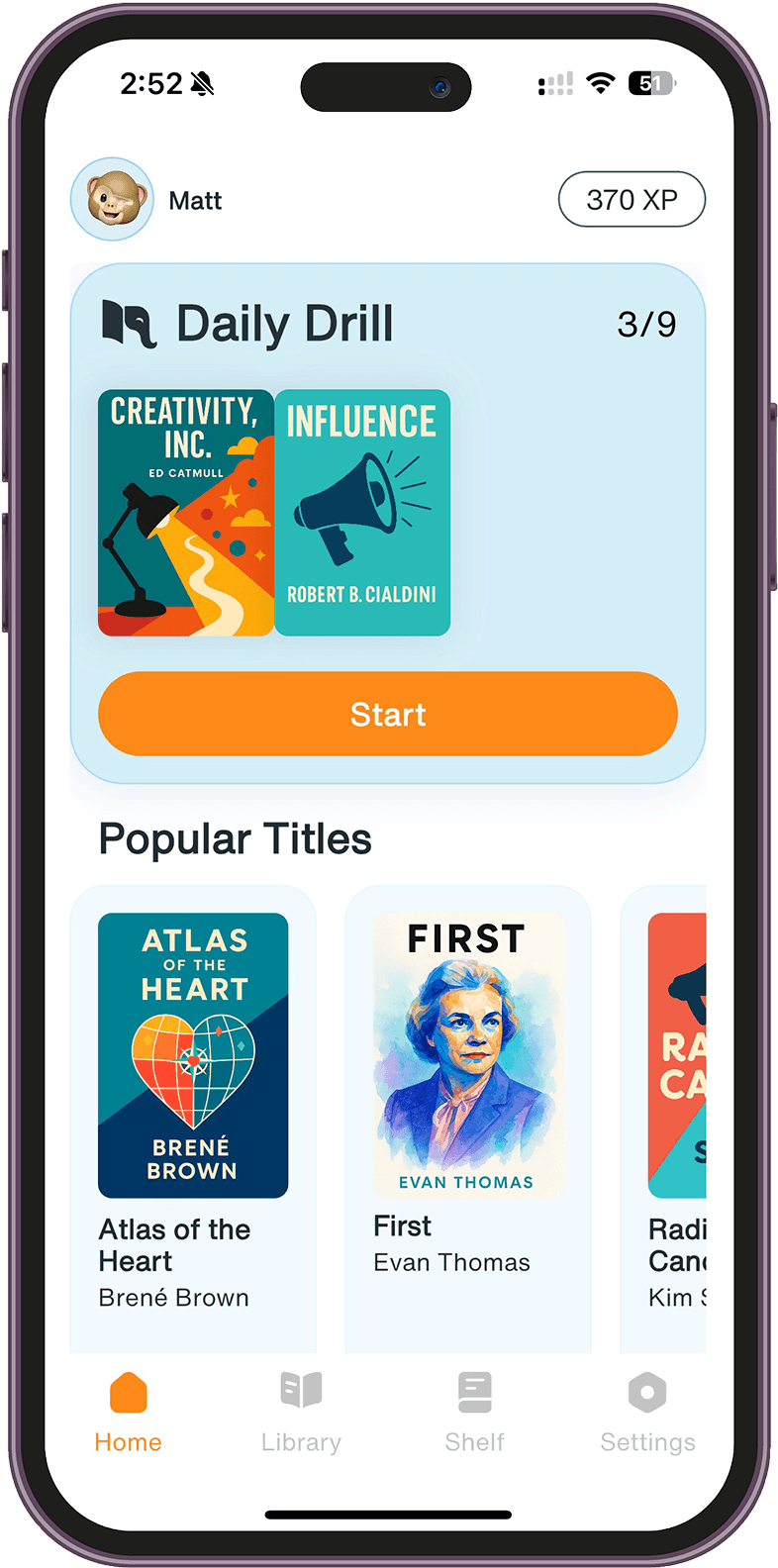
Loxie uses spaced repetition to help you internalize slow productivity principles so they're available when you're deciding whether to take on that next commitment.
Try Loxie free for 7 days ▸How do natural energy cycles affect sustainable productivity?
Working with your natural energy cycles—high focus in the morning, creative tasks in the afternoon, and rest in the evening—creates sustainable output by matching task difficulty to cognitive capacity rather than forcing productivity at all hours. Your brain doesn't operate at the same level throughout the day. Ignoring this reality means either wasting peak cognitive hours on low-value tasks or exhausting yourself trying to do deep work when your mind needs rest.
Most people have their highest cognitive capacity in the morning hours, making this the ideal time for work requiring deep concentration. Afternoons often suit more creative, exploratory thinking—brainstorming, making unexpected connections, considering new approaches. Evenings are for recovery, not for squeezing in more work. This pattern varies between individuals, but the principle remains: sustainable productivity means understanding your personal rhythms and designing your days around them.
This approach rejects the hustle culture notion that discipline can override biology. You cannot will yourself into peak cognitive performance at 10pm after a full day of mental work. What you can do is protect your high-energy hours for your most important work, use your natural dips for less demanding tasks, and respect your need for genuine rest. The result is more accomplished with less exhaustion—the core promise of slow productivity.
What is seasonality and how does it prevent burnout?
Embracing seasonality prevents burnout by planning intense work periods followed by lighter phases, mimicking natural cycles like academic semesters or quarterly business rhythms that allow for recovery and reflection. Humans are not designed for constant intensity. We need variation—periods of pushing hard followed by periods of consolidation and rest. Seasonality formalizes this need into a sustainable work structure.
The academic calendar provides one model: semesters of intense teaching and research followed by breaks for recovery and longer-term projects. Businesses often follow quarterly rhythms with natural intensity peaks and valleys. Even freelancers and entrepreneurs can create artificial seasons—perhaps pushing hard on client work for two months, then taking a month focused on learning and recovery. The specific structure matters less than the principle: sustainable accomplishment requires planned variation in intensity.
Without intentional seasonality, knowledge workers tend toward constant medium-intensity effort that's exhausting without being productive. You're always somewhat busy, always somewhat tired, never fully focused, never fully recovered. Seasonality provides permission to push hard when it matters because you know rest is coming—and permission to truly rest because you know intense work is scheduled. This rhythm feels more natural because it is more natural.
Start retaining what you learn ▸
Why are strategic breaks essential for productivity and creativity?
Strategic breaks enhance long-term productivity and creativity by allowing the unconscious mind to process information, form new connections, and restore depleted attention reserves through activities like walking, napping, or engaging in unrelated hobbies. Rest isn't the opposite of productivity—it's a component of it. Your brain continues working on problems even when you're not consciously thinking about them, often producing insights that focused effort couldn't achieve.
This explains why so many breakthroughs occur during walks, showers, or other moments of apparent inactivity. Darwin took multiple long walks daily. Einstein played violin when stuck on physics problems. The pattern appears across creative fields and centuries: peak performers understand that stepping away from work is often the fastest path to solving difficult problems. They're not being lazy; they're leveraging how the brain actually works.
Strategic breaks also restore attention capacity. Deep focus depletes mental resources that require time to replenish. Pushing through exhaustion produces diminishing returns—eventually negative returns as errors accumulate and quality drops. Scheduled breaks, whether fifteen minutes or fifteen days, allow you to return to work with renewed capacity. The question isn't whether you can afford to take breaks; it's whether you can afford not to.
What psychological shifts are required to reject speed-obsessed culture?
Rejecting speed-obsessed culture requires psychological shifts including redefining success from activity to accomplishment, developing confidence to say no to non-essential requests, and trusting that deliberate pace produces better outcomes than frantic busyness. These shifts are difficult because they run counter to everything modern work culture teaches us. But they're essential for sustainable, high-quality output.
The first shift is redefining what productivity means. Instead of measuring your days by tasks completed or emails answered, you measure by progress on meaningful projects. This feels uncomfortable at first—you may end a day with an empty inbox and a full to-do list feeling "productive," while a day of deep work on one important project feels somehow lacking. But the latter produced actual value while the former merely managed busywork. Mental reframing from "falling behind" to "investing in excellence" helps embrace this slower work pace by recognizing that rushed work often requires costly revisions while deliberate progress builds compound advantages over time.
The second shift is building genuine comfort with saying no. Every commitment you accept takes attention from existing ones. Protecting your focus isn't selfish; it's how you maintain the capacity to do excellent work on anything. Developing this confidence requires practice and often requires explaining your reasoning to others who expect constant availability. Loxie helps reinforce these psychological frameworks through regular practice, building the mental muscles that make these shifts feel natural rather than forced.
How can you implement slow productivity in a modern workplace?
Implementing slow productivity in modern workplaces requires establishing clear project limits, creating visible work-in-progress boards, scheduling regular deep work blocks, and educating colleagues about the long-term benefits of this approach to gain organizational buy-in. You can't simply announce that you're working differently; you need systems that support the change and communication that brings others along.
Establish clear project limits
Set explicit limits on how many major projects you'll have active at any time. Three is often a reasonable number for knowledge workers—one primary focus, one secondary project, and one on the back burner. When something new comes in, it goes on a waiting list until a current project completes. This makes your constraints visible and gives you clear language for declining or deferring new requests.
Create work-in-progress visibility
A simple board showing your current projects, waiting list, and completed work makes your workload visible to colleagues and managers. This reduces the perception that you're not busy enough when you decline requests—your constraints become obvious rather than hidden. It also helps you maintain discipline by making overcommitment visually apparent.
Schedule deep work blocks
Protect specific times for focused work and treat them as non-negotiable. Put them on your calendar, communicate them to colleagues, and defend them from meeting requests. Even two hours of daily protected time can transform your output if you use it for genuine deep work rather than administrative tasks.
What practices sustain slow productivity over the long term?
Long-term sustainability in slow productivity requires daily rituals that protect deep work time, regular reviews to prune commitments, and the discipline to resist urgency culture by remembering that meaningful accomplishments unfold over months and years, not days. These practices turn slow productivity from an aspiration into a sustainable way of working.
Daily rituals anchor your practice. This might mean a morning routine that transitions you into deep work, an end-of-day shutdown that creates psychological closure, or specific triggers that help you resist distraction. The particular rituals matter less than their consistency—they create structure that protects your focus without requiring constant decision-making.
Regular reviews keep your commitments aligned with your capacity. Weekly or monthly, examine what you've taken on and actively prune projects that no longer deserve attention. This is harder than it sounds because abandoning work feels like failure. But strategic pruning is essential—not everything you start deserves to be finished, and recognizing this frees attention for what matters most.
Finally, resist the daily tyranny of urgency. Most things that feel urgent aren't actually important. The email demanding immediate response, the meeting scheduled for tomorrow, the deadline moved up "just this once"—these create constant pressure to abandon slow productivity principles. Remembering that meaningful accomplishments unfold over months and years helps you resist the gravitational pull of daily urgency. Loxie reinforces these long-term perspectives through regular practice, keeping the big picture accessible when short-term pressures mount.
How can slow productivity apply to personal projects?
Adapting slow productivity to personal projects means choosing one meaningful pursuit at a time, setting multi-month rather than daily goals, and building in fallow periods between projects to maintain enthusiasm and prevent creative burnout. The principles translate directly from professional to personal contexts, often with even more freedom since you control the expectations.
The temptation with personal projects is to pursue multiple interests simultaneously—learn a language, write a novel, train for a marathon, develop a new skill. This scatters attention and typically results in little progress on anything. Instead, choose one meaningful pursuit for a season. Give it the sustained attention it deserves. Complete it or reach a natural stopping point before adding something new.
Multi-month goals replace the pressure of daily metrics. Instead of "write 500 words every day," you might aim to "complete the first draft this quarter." This creates space for variation—some days you'll write more, some less, some not at all—while maintaining forward progress on what matters. It also acknowledges that creative work doesn't proceed linearly; breakthroughs often follow fallow periods.
What does a life organized around slow productivity look like?
A life organized around slow productivity creates lasting fulfillment by aligning daily work with natural human rhythms, focusing deeply on fewer meaningful projects, and maintaining sustainable practices that prevent burnout while producing exceptional results. It's not about doing less in some absolute sense—it's about doing less at any given moment so you can do more over a lifetime.
In practice, this means mornings protected for deep work on your most important project. It means afternoons for meetings, email, and collaborative work that requires less intense focus. It means evenings genuinely free from work rather than filled with anxious catch-up. It means seasons of intensity followed by seasons of recovery. It means a small number of projects receiving sustained attention rather than a large number receiving scattered effort.
The result isn't just better work—it's a better life. The constant low-grade anxiety of overcommitment fades. The pride of genuine craftsmanship replaces the hollow feeling of perpetual busyness. You accomplish more over time precisely because you've stopped trying to accomplish everything at once. This is Newport's ultimate argument: slow productivity isn't a sacrifice of ambition. It's the path to achieving your most ambitious goals while maintaining the sustainable practices that let you keep producing for decades.
The real challenge with Slow Productivity
Reading about slow productivity feels clarifying. Newport's arguments are compelling, his historical examples inspiring, his frameworks practical. You finish the book convinced that you need to work differently. And then you return to your inbox, your calendar, your demanding colleagues—and within weeks, the insights have faded. You're back to the same patterns of overcommitment and busyness that brought you to the book in the first place.
This isn't a failure of willpower. It's how human memory works. We forget most of what we read, even when it feels important in the moment. Studies suggest we lose up to 70% of new information within 24 hours without active reinforcement. The forgetting curve is relentless, and reading a book once—no matter how impactful—doesn't create lasting change. How many books have you read that felt transformative, only to struggle recalling three key points months later?
How Loxie helps you actually remember what you learn
Loxie solves the forgetting problem through spaced repetition and active recall—the two most effective techniques for long-term retention. Instead of reading Slow Productivity once and hoping the ideas stick, you practice with questions that resurface concepts right before you'd naturally forget them. Two minutes a day keeps Newport's frameworks accessible when you need them—when you're deciding whether to take on a new project, when you're tempted to check email during deep work time, when urgency culture is pulling you away from what matters.
Loxie includes Slow Productivity in its full topic library. You can start reinforcing these concepts immediately, building the mental models that make slow productivity principles feel natural rather than theoretical. It's the difference between having read about slow productivity and having internalized it—between knowing what to do and actually doing it when the moment arrives.
Frequently Asked Questions
What is the main idea of Slow Productivity?
Slow Productivity argues that sustainable, meaningful accomplishment comes from working at a natural pace, focusing on fewer projects, and obsessing over quality—rather than maintaining constant busyness. Newport shows that history's most accomplished creative minds achieved greatness through deliberate rhythms, not hustle culture.
What are the key takeaways from Slow Productivity?
The core takeaways are: limit active commitments to enable deep focus, work with your natural energy cycles rather than against them, embrace seasonality with intense periods followed by recovery, obsess over quality to transform work into craft, and take strategic breaks that enhance rather than hinder productivity.
How is slow productivity different from being lazy?
Slow productivity isn't about doing less overall—it's about doing less at any given moment so you can do more over a lifetime. It replaces scattered effort across many projects with focused attention on fewer meaningful ones. The result is often more accomplished work of higher quality than constant busyness produces.
What is pseudo-productivity and why is it harmful?
Pseudo-productivity is visible busyness—constant email checking, back-to-back meetings, immediate responses—that creates the appearance of work without producing actual value. It's harmful because it prevents the deep thinking required for meaningful output while exhausting knowledge workers through endless low-value activity.
How do I implement slow productivity at work?
Start by setting explicit limits on active projects, creating visible work-in-progress boards, and protecting daily time blocks for deep work. Educate colleagues about why this approach produces better results and communicate your constraints clearly rather than simply appearing less available.
How can Loxie help me remember what I learned from Slow Productivity?
Loxie uses spaced repetition and active recall to help you retain the key concepts from Slow Productivity. Instead of reading the book once and forgetting most of it, you practice for 2 minutes a day with questions that resurface ideas right before you'd naturally forget them. Loxie includes Slow Productivity in its full topic library, so you can start reinforcing these concepts immediately.
We're an Amazon Associate. If you buy a book through our links, we earn a small commission at no extra cost to you.
Stop forgetting what you learn.
Start learning for good with your 7-day FREE trial.