Smart Brevity: Key Insights & Takeaways from Axios Founders
Master the Axios communication formula that cuts through information overload and ensures your message actually gets read.
by The Loxie Learning Team
Your readers are drowning. They process five times more information than people did thirty years ago, make keep-or-delete decisions in under three seconds, and scan rather than read. Most of your carefully crafted emails, memos, and presentations? They're getting skipped, skimmed, or forgotten. Smart Brevity by Jim VandeHei, Mike Allen, and Roy Schwartz offers a solution—the exact communication formula that helped Axios revolutionize digital media.
This guide breaks down the complete Smart Brevity system. You'll learn why traditional communication fails in the digital age, how to structure messages that get read and remembered, and the specific techniques for writing headlines, emails, and updates that cut through the noise. Whether you're writing to your team, your boss, or your customers, these principles will transform how your words land.
 Start practicing Smart Brevity free for 7 days ▸
Why do traditional communication methods fail in the digital age?
Traditional communication methods fail because they were designed for a world where people actually read. Today's readers scan rather than read, process vastly more information than previous generations, and have attention spans that demand immediate value—often measured in single-digit seconds. The long email, the detailed memo, the thorough presentation? They assume a captive audience that no longer exists.
The shift from desktop to mobile consumption compounds the problem. Dense paragraphs that worked on full screens become impenetrable walls of text on phones. Readers scrolling through dozens of messages don't have time to hunt for your point. If you bury the lead in paragraph three, most people will never find it.
This creates a fundamental mismatch: we write like people will read every word, but they won't. They're making split-second decisions about whether your message deserves attention. Understanding this reality is the first step toward communicating effectively in the modern world.
What is Smart Brevity and how does it work?
Smart Brevity is a communication methodology that combines radical conciseness with strategic structure to ensure messages are not just shorter but actually read, understood, and remembered. It's not about cutting words for the sake of cutting—it's about respecting readers' limited attention while delivering maximum value per word.
The formula works by front-loading value. Rather than building to a conclusion, you lead with your single most important point, then layer in context and details for those who want more. This approach matches how people actually consume information: scanning for the essentials, then deciding whether to go deeper.
What makes Smart Brevity different from simply being brief is its emphasis on structure. Shortness without strategic organization creates confusion. Readers need logical flow, context cues, and visual signposts to process information quickly. The methodology provides all three through specific formatting conventions that guide the eye and the mind.
What is the Axios communication formula?
The Axios communication formula structures messages using bold headlines, bullet points, and explicit "Why it matters" sections to transform how digital content is consumed and retained. This approach became the signature style of Axios newsletters and news coverage, proving that structured brevity could compete—and win—in the attention economy.
The What-Why-Go Deeper structure
Smart Brevity layers information using a three-part structure. First, the headline delivers the news—the core message in its most compressed form. Second, bolded context explains why it matters to the reader. Third, optional details sit below for those who want to go deeper. This structure lets readers choose their level of engagement rather than forcing everyone through the same linear path.
Why visual hierarchy matters
Visual formatting including bold headers, white space, short paragraphs, and strategic indicators increases digital readability dramatically because it matches how people scan screens rather than read linearly. When you use visual hierarchy, you're not just making content prettier—you're creating a scannable structure that highlights key points and guides readers through your logic.
Practice these principles in Loxie ▸
How do strong headlines capture attention?
Strong headlines capture attention and convey your core message instantly, functioning as both a hook and a summary that readers can grasp in seconds. They're not just labels for what follows—they're complete thoughts that deliver value even to readers who go no further.
Effective headlines combine specificity, urgency, and value. A subject line like "Budget cuts: 3 departments affected by Friday" outperforms generic titles by a factor of two to three times because it tells readers exactly what they'll learn and why it matters now. The headline does the heavy lifting so the body can provide depth rather than setup.
Opening statements must deliver the core message within the first few words using active voice and concrete details. Readers decide whether to engage before finishing the first sentence. If your opening is throat-clearing context, you've lost them before delivering your point.
Why should every communication lead with one main message?
Every communication must lead with one unmistakable primary message because attempting to convey multiple equal points guarantees none will be remembered. When you give readers three equally weighted ideas, you've actually given them zero—they can't determine what matters most, so they remember nothing.
This principle runs counter to how most people communicate. We want to share everything we know, cover all our bases, and anticipate every question. But readers prioritize actionable information over context. They scan for keywords before reading. They make decisions in seconds. Giving them one clear takeaway respects these realities.
The discipline of identifying your single most important point also clarifies your own thinking. If you can't decide what matters most, your reader certainly can't. The constraint of one primary message forces you to understand what you're actually trying to communicate.
Knowing the formula isn't the same as using it.
Smart Brevity principles are simple to understand but hard to apply consistently. Loxie uses spaced repetition to help you internalize these communication habits so they become automatic when you're writing under pressure.
Build better communication habits ▸How does strategic word choice maximize clarity?
Strategic word choice maximizes clarity by using strong verbs, eliminating jargon, choosing familiar over complex terms, and cutting filler words. These techniques can reduce word count dramatically while actually increasing comprehension—you're removing noise, not signal.
Short sentences under fourteen words and active voice increase reading speed and retention because they reduce cognitive load. They match how our brains naturally process information. Compare "The decision was made by the committee to delay implementation" with "The committee delayed implementation." Same information, half the words, twice the clarity.
Direct language eliminates jargon, passive voice, and corporate speak to create messages that communicate clearly without requiring translation. If a reader has to parse your sentence to understand it, you've already lost. Confident communication is inherently concise because it eliminates hedging, filler words, and unnecessary qualifiers that dilute your message's power.
Why must you explicitly state why your message matters?
Writers must explicitly state why their message matters using phrases like "Why it matters" or "The big picture" because readers won't automatically grasp importance, especially when skimming digital content. You can't assume your audience will connect the dots—you have to connect them yourself.
This principle fights our natural assumption that significance is obvious. You've spent time thinking about your topic; you understand its implications. Your reader hasn't and doesn't. Explicitly stating relevance increases action rates by making importance impossible to miss. It transforms passive information into active motivation.
The "Why it matters" section connects information to reader interests. It answers the question every reader is silently asking: "What does this mean for me?" Without this bridge, even well-crafted information can feel abstract and forgettable.
How does brevity demonstrate respect for readers?
Brevity demonstrates respect for readers' time and attention by delivering your message in the fewest possible words without sacrificing meaning or impact. When you write concisely, you're saying: "I value your time enough to do the hard work of compression so you don't have to do the hard work of extraction."
This creates competitive advantage. In crowded inboxes and feeds, messages that deliver maximum value per word stand out. The reader who receives one tight, clear email after ten bloated ones notices the difference. Brevity with clarity makes your communications memorable precisely because they're rare.
But there's a crucial distinction: being too terse sacrifices clarity for misguided brevity. Messages that save words but waste time through confusion and misinterpretation defeat the purpose. Smart Brevity isn't about the shortest possible message—it's about the shortest message that fully communicates your meaning.
How do Smart Brevity principles apply to workplace communication?
Workplace emails using Smart Brevity structure—compelling subject line, one-line summary, bullet points for details, and clear call-to-action—achieve dramatically higher response rates and faster decision-making. The same principles that work for media work for internal communication because human attention patterns don't change based on context.
The structure is straightforward: lead with what you need, explain briefly why it matters, provide supporting details in scannable bullets, and end with a specific ask. A manager scanning dozens of emails can quickly identify your message, understand its importance, and take action—or delegate it appropriately.
Effective communication starts with understanding your audience's specific needs, time constraints, and decision-making priorities rather than what you want to say. This audience-first mindset shapes everything from word choice to structure. You're not writing to express yourself; you're writing to create understanding and action in someone else's mind.
Do Smart Brevity principles work outside professional settings?
Smart Brevity principles—strong subject lines, one main point, and visual hierarchy—work equally well in personal texts, family emails, and social posts because human attention patterns remain constant across contexts. Your family members are just as overwhelmed and distracted as your colleagues. They benefit from clarity too.
The techniques scale up and down. A text to your partner about dinner plans benefits from leading with the decision needed. A family email about holiday logistics benefits from bullet points and clear asks. Social posts perform better when they lead with the hook rather than building to it.
This universality makes Smart Brevity a meta-skill. Master it once, and you communicate better in every channel and relationship. The underlying principle—respect for the reader's attention and time—applies whether you're writing to your CEO or your cousin.
The real challenge with Smart Brevity
Understanding Smart Brevity principles is easy. The formula is straightforward: lead with your point, explain why it matters, structure for scanning, cut ruthlessly. You can grasp all of this in an hour. But applying these principles consistently when you're rushing to send an email or stressed about a presentation? That's where most people fail.
The forgetting curve works against you. Research shows we forget roughly 70% of new information within 24 hours if we don't actively reinforce it. You read this guide today, feel confident about the principles, and by next week you're writing the same dense paragraphs and buried leads you always have. Knowing isn't the same as doing.
How many books have you read that felt immediately useful but you can't recall the key frameworks when you need them? Smart Brevity is particularly vulnerable to this pattern because the principles feel obvious once you've heard them. That sense of familiarity tricks your brain into thinking you've mastered something you've merely encountered.
How Loxie helps you actually remember what you learn
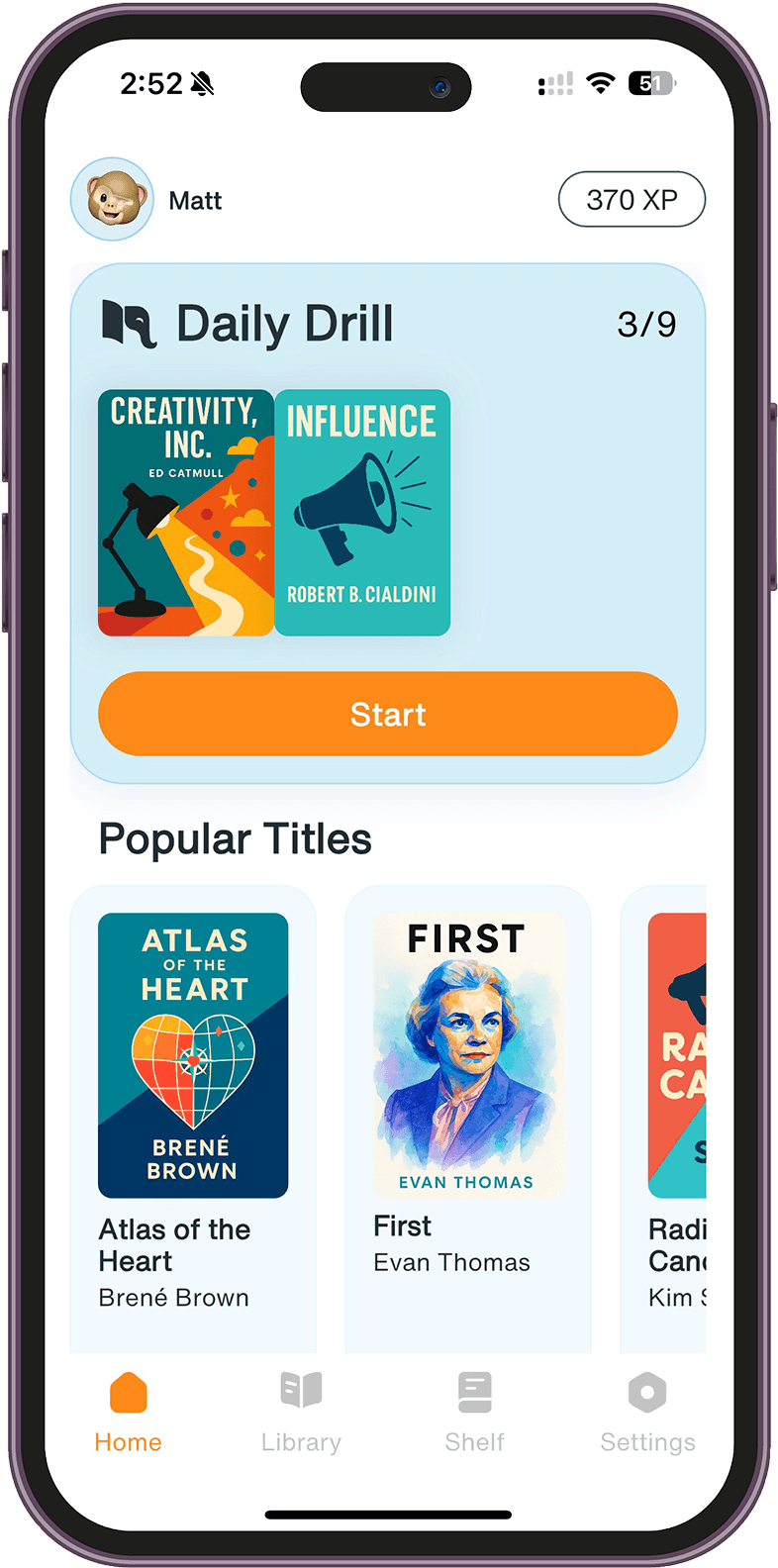
Loxie uses spaced repetition and active recall to help you retain the key concepts from Smart Brevity so they're available when you're actually writing. Instead of reading about the formula once and forgetting it, you practice for two minutes a day with questions that resurface ideas right before you'd naturally forget them.
Spaced repetition is the most scientifically validated method for long-term retention. By testing yourself at strategically increasing intervals, you strengthen memory traces and move information from short-term to permanent storage. The concepts become reflexive—you notice when you're burying your lead because the principle is genuinely internalized.
Loxie includes Smart Brevity in its full topic library, so you can start reinforcing these communication concepts immediately. Two minutes a day, over time, transforms intellectual understanding into practical skill. The next email you write could be the first one that truly respects your reader's time.
Frequently Asked Questions
What is the main idea of Smart Brevity?
Smart Brevity argues that effective communication in the digital age requires radical conciseness combined with strategic structure. Rather than simply writing less, you must lead with your single most important point, use visual hierarchy to guide readers, and explicitly state why your message matters—ensuring your words are actually read, understood, and remembered.
What is the Smart Brevity formula?
The Smart Brevity formula structures messages with a bold headline that delivers the core message, a "Why it matters" section that explains relevance, and bullet points for supporting details. This layered approach lets readers grasp the essential point in seconds while offering optional depth for those who want more.
What are the key takeaways from Smart Brevity?
Lead with one unmistakable main message. Use strong headlines that function as both hook and summary. Explicitly state why your message matters. Format for scanning with bold text, bullets, and white space. Choose short sentences, active voice, and familiar words over complex ones. Respect readers' time by cutting ruthlessly.
How can I apply Smart Brevity to emails?
Structure emails with a compelling subject line that summarizes your message, a one-sentence opening that delivers your main point, bullets for supporting details, and a clear call-to-action. Front-load value so readers scanning quickly can understand what you need and why it matters without reading every word.
Why does brevity matter in communication?
Modern readers process vastly more information than previous generations, scan rather than read, and make engagement decisions in seconds. Brevity respects these realities by delivering maximum value per word. Messages that cut through noise get read and remembered; messages that waste readers' time get ignored.
How can Loxie help me remember what I learned from Smart Brevity?
Loxie uses spaced repetition and active recall to help you retain Smart Brevity's key principles. Instead of reading the book once and forgetting most of it, you practice for two minutes a day with questions that resurface concepts right before you'd naturally forget them. Loxie includes Smart Brevity in its full topic library.
We're an Amazon Associate. If you buy a book through our links, we earn a small commission at no extra cost to you.
Stop forgetting what you learn.
Start learning for good with your 7-day FREE trial.