Start with Why: Key Insights & Takeaways from Simon Sinek
Master Simon Sinek's Golden Circle framework to inspire action, build trust, and lead with purpose.
by The Loxie Learning Team
Why do some leaders inspire extraordinary loyalty while others struggle to motivate even their own teams? Simon Sinek's Start with Why reveals a fundamental pattern that separates inspirational leaders and organizations from everyone else: they communicate from the inside out, beginning with purpose rather than product.
This guide breaks down Sinek's complete framework for purpose-driven leadership. You'll learn the Golden Circle model, understand why it works on a biological level, and discover how organizations like Apple and movements like civil rights created lasting impact by starting with why. Whether you're leading a team, building a brand, or searching for your own sense of purpose, these principles will transform how you think about influence and inspiration.
 Start practicing Start with Why free for 7 days ▸
What is the Golden Circle and how does it work?
The Golden Circle is a three-layered model consisting of Why at the center, surrounded by How, and finally What on the outside. Every organization knows what they do—their products, services, or offerings. Some organizations know how they do it—their differentiating process or unique approach. But very few organizations can clearly articulate why they do what they do—their purpose, cause, or belief beyond making money.
The critical insight is that most organizations communicate from the outside in. They start with what they do, explain how they're different, and hope this leads to some behavior like a purchase. Inspirational leaders reverse this entirely. They start with why—their purpose and belief—then explain how they fulfill that purpose, and finally show what products or services result from that belief.
Apple demonstrates this pattern perfectly. Rather than saying "We make great computers with beautiful design and simple interfaces, want to buy one?" Apple communicates from inside out: "Everything we do, we believe in challenging the status quo and thinking differently. The way we challenge the status quo is by making products that are beautifully designed and simple to use. We just happen to make great computers." The products become proof of the belief, not the starting point of the conversation.
Why does starting with why actually work on a biological level?
The Golden Circle maps directly onto how the human brain is structured, which explains why this communication pattern is so effective. The outer section of the brain—the neocortex—corresponds to the What level. This is where we process rational and analytical thought, language, and facts. When you list product features and specifications, you're speaking to the neocortex.
The middle two sections—the limbic brain—correspond to the Why and How levels. The limbic brain controls feelings like trust and loyalty. It's responsible for all human behavior and decision-making. Critically, the limbic brain has no capacity for language. This is why we often struggle to explain decisions that "feel right" but can't be easily justified with facts.
When organizations communicate from the inside out, they speak directly to the part of the brain that controls behavior. When they communicate from the outside in, they're providing data that the neocortex can process but that doesn't drive action. This biological reality explains why people can understand every feature of a product yet still not feel compelled to buy it—and why others will pay premium prices for products they can't fully rationalize. The decision was never about the features; it was about the belief.
Practice the Golden Circle framework ▸
Why do manipulation tactics fail to build lasting loyalty?
Most organizations default to manipulation tactics to influence behavior: price drops, promotions, fear-based messaging, aspirational imagery, peer pressure, or novelty. These tactics work—they generate transactions. But they come at a tremendous long-term cost because they create compliance, not loyalty.
Price manipulations train customers to wait for deals rather than value the product at full price. Every discount erodes the perceived value of the offering and creates a race to the bottom. Fear-based marketing creates anxiety that motivates short-term action but breeds resentment when the fear subsides. Promotions create transactional relationships where customers are always asking "what have you done for me lately?"
The fundamental problem with manipulation is that it targets what people do rather than what they believe. Manipulations require continuous investment—you must keep dropping prices, running promotions, or stoking fears to maintain the behavior. The moment you stop, the behavior stops. In contrast, organizations that inspire based on shared beliefs create relationships that endure without constant reinforcement. Customers stay loyal through challenges because they're committed to the belief, not just the benefits.
How do purpose-driven organizations build movements instead of just customer bases?
Purpose-driven organizations attract people who believe what they believe. This creates a fundamentally different dynamic than organizations that compete on features or price. When people share your beliefs, they don't just buy your products—they become evangelists who spread your message without being asked.
The Wright Brothers exemplify this principle. They had no funding, no connections, and no advanced education. Samuel Langley, their competitor, had abundant resources, top talent, and press coverage. But the Wright Brothers had something Langley lacked: a cause they believed in. Their team worked with passion because they shared the belief that flight would change the world. When the Wright Brothers succeeded, their team celebrated. When Langley failed after the Wright Brothers' success, his team quit—revealing that they were motivated by the potential for fame and riches, not by purpose.
Martin Luther King Jr. attracted 250,000 people to the National Mall not through manipulation but through shared belief. His message wasn't about himself—it was about a cause bigger than any individual. People who showed up weren't following Dr. King for Dr. King; they were following him because they believed what he believed about America's promise of equality. The movement spread through early adopters who became evangelists, creating influence that mass marketing could never achieve.
Understanding purpose-driven leadership is powerful—but only if you remember it
The Golden Circle framework can transform how you communicate and lead. But intellectual understanding fades without reinforcement. Loxie uses spaced repetition to help you internalize these principles so they're available when you're crafting your next message or making leadership decisions.
Start retaining what you learn ▸What happens when organizations forget their why?
Growing organizations naturally experience a dangerous shift where leadership focuses increasingly on "what"—metrics, processes, products, and profits—while losing connection to "why"—purpose, values, and mission. This drift happens gradually and often unconsciously, but its effects are devastating.
Walmart demonstrates this trajectory. Sam Walton built the company around a clear purpose: serving working-class communities who deserved access to quality products at fair prices. Every decision filtered through this belief about serving customers and communities. After Walton's death, Walmart lost clarity on its original why. The company shifted focus to growth metrics, cost-cutting, and competitive positioning. Employee engagement suffered, community relationships soured, and the brand that once inspired loyalty began generating resentment.
Microsoft experienced similar drift after Bill Gates stepped back from daily leadership. The company's founding purpose—democratizing computing by putting a computer on every desk—had largely been achieved. Without a clear why to guide decisions, Microsoft became reactive rather than visionary. The culture that once attracted passionate believers became fragmented, and the company lost its ability to inspire both employees and customers until recent leadership reconnected the organization with purpose.
How do you maintain purpose as organizations grow?
Maintaining purpose through growth requires embedding why into the organization's operating system. This means clarity of why at the core, discipline of how in actions and processes, and consistency of what in products and services. All three layers must remain aligned for the organization to maintain its inspirational power.
Clarity means leadership can articulate the organization's purpose in simple, compelling terms that resonate emotionally—not mission statements written by committee but authentic expressions of belief that guide decisions. Discipline means the organization's processes, hiring practices, and daily operations reinforce the why. When someone asks "why do we do it this way?" the answer connects back to purpose, not just efficiency.
Consistency means every product, service, and customer interaction serves as tangible proof of the organization's why. When what you do perfectly reflects why you do it, customers experience coherence that builds trust. When actions contradict stated purpose, customers sense the disconnect immediately—even if they can't articulate why something feels "off." This is why organizations must use their why as a filter for every decision: does this action reinforce or dilute our purpose?
How do you discover your authentic why?
Your authentic purpose isn't invented through brainstorming sessions or strategic planning exercises. It's discovered by examining the experiences, relationships, and values that have consistently shaped your decisions and worldview throughout your life. Your why already exists—the challenge is articulating it clearly.
Life experiences create patterns that reveal natural purpose. The causes that consistently draw your attention, the work that feels inherently meaningful, the values you refuse to compromise—these patterns point toward your why. Sinek suggests looking backward, not forward. What moments in your life felt most fulfilling? What problems naturally attract your energy? What beliefs have you held consistently regardless of circumstances?
For organizations, discovering why often means returning to founding moments. Why did the founders start this company? What problem were they passionate about solving? What belief drove their earliest decisions before growth, metrics, and competition complicated the picture? The purpose that animated the beginning often remains relevant—even if it's been obscured by years of what-focused thinking.
Why do visionaries need builders—and vice versa?
Organizations fail when they have vision without execution or execution without vision. Success requires both working together in complementary partnership. Sinek distinguishes between "Why-types" who inspire with vision and "How-types" who build the systems and processes that turn inspiration into reality.
Why-types see possibilities that others don't. They articulate beliefs that attract followers and set direction that gives work meaning. But Why-types often struggle with operational details, consistent execution, and the discipline required to scale ideas. Without How-types, their visions remain unrealized dreams.
How-types excel at translating abstract purpose into concrete action. They build systems, manage processes, and ensure consistency at scale. But without Why-types, their execution lacks direction and meaning. They can optimize efficiently but may not know what's worth optimizing for. The partnership between visionaries and builders—each respecting what the other brings—is what transforms ideas into movements.
What does healthy competition look like for purpose-driven organizations?
True competition means competing against yourself to better fulfill your purpose rather than trying to beat others on features, price, or market share. This mindset shift fundamentally changes how organizations measure success and make decisions.
When you compete against competitors, you become reactive. Your strategy depends on what others do. You chase their features, match their prices, and respond to their moves. This outside-in thinking pulls you away from your why and toward commoditized what-based competition where everyone looks the same.
When you compete against your own previous performance, you become proactive. The question shifts from "how do we beat them?" to "how do we better fulfill our purpose than we did yesterday?" This creates continuous improvement driven by authentic differentiation. You're not trying to be better than competitors—you're trying to be better than you were, in service of a purpose only you can fulfill in your unique way.
How do movements spread from early adopters to the majority?
Movements don't spread through mass marketing to the majority. They spread through early adopters who believe what you believe and become evangelists for your cause. Understanding this diffusion pattern is essential for anyone trying to create lasting change.
The innovation adoption curve shows that roughly 2.5% of people are innovators willing to try new things purely for novelty. Another 13.5% are early adopters who see potential and are willing to accept imperfection. These groups adopt because of shared belief, not proven success. They're willing to pay more, accept inconvenience, and endure skepticism from others because the cause aligns with their values.
The majority—early majority, late majority, and laggards—adopt only after seeing proof that something works. You cannot convince them with why; they want to see results. But here's the critical insight: you reach the majority through early adopters, not by targeting the majority directly. Early adopters become your proof. Their enthusiasm, testimonials, and visible adoption create the social proof that makes the majority comfortable following.
The real challenge with Start with Why
Reading Start with Why can feel like a revelation. The Golden Circle framework suddenly explains patterns you've always sensed but couldn't articulate. You see why some leaders inspire while others merely manage. You understand why manipulation fails and purpose succeeds. The concepts feel obvious in hindsight—which is exactly why they're so easy to forget.
Research shows we forget roughly 70% of new information within 24 hours, and 90% within a week. That inspiring insight about why-based communication? The biological basis of decision-making? The difference between manipulation and inspiration? Without active reinforcement, these concepts fade into vague impressions rather than actionable frameworks.
How many books have you read that felt transformative in the moment but now exist as little more than titles on your bookshelf? The irony of purpose-driven communication is that understanding it intellectually isn't the same as embodying it in your daily decisions and conversations.
How Loxie helps you actually remember what you learn
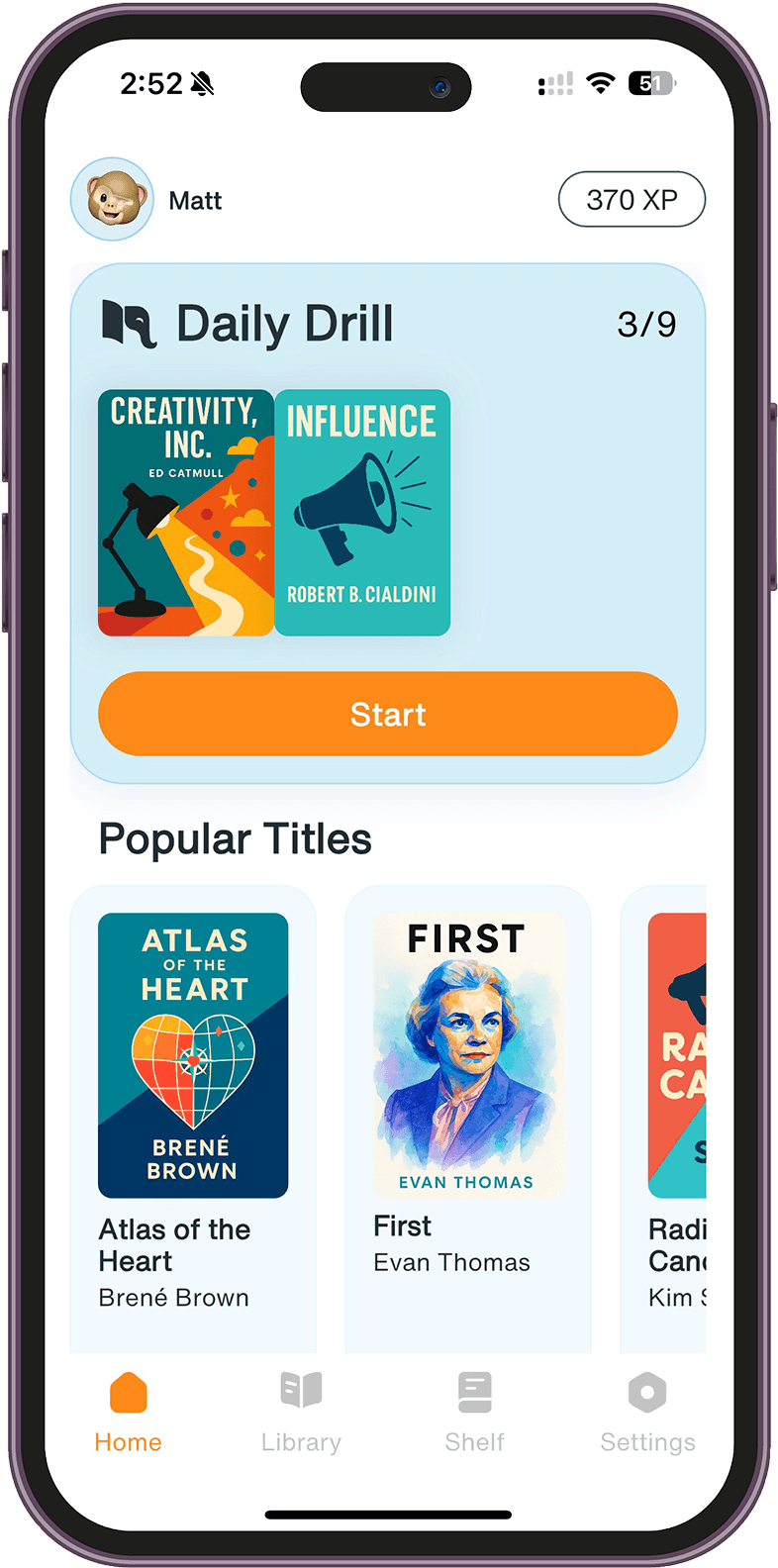
Loxie uses spaced repetition and active recall—the two most effective learning techniques science has discovered—to help you retain the ideas that matter. Instead of reading Start with Why once and watching the concepts fade, you practice for just 2 minutes a day with questions that resurface ideas right before you'd naturally forget them.
Active recall means you're not passively reviewing notes—you're actively retrieving concepts from memory, which strengthens the neural pathways that make knowledge accessible when you need it. Spaced repetition means the app intelligently schedules reviews based on how well you know each concept, focusing your limited time on ideas that need reinforcement.
Loxie includes Start with Why in its full topic library, so you can start internalizing the Golden Circle framework, the biology of decision-making, and the principles of purpose-driven leadership immediately. When you're crafting your next presentation, building your team's culture, or discovering your own why, these concepts will be available—not as vague memories but as actionable knowledge.
Frequently Asked Questions
What is the main idea of Start with Why?
The core idea is that inspirational leaders and organizations communicate from the inside out, starting with their purpose (why) rather than their products (what). People don't buy what you do; they buy why you do it. This pattern of purpose-first communication creates loyalty and builds movements rather than just customer bases.
What is the Golden Circle framework?
The Golden Circle is a three-layered model with Why at the center (your purpose), How in the middle (your process), and What on the outside (your products). Most organizations communicate from outside in, starting with what they do. Inspirational leaders reverse this, starting with why they believe what they believe.
Why does starting with why work on a biological level?
The Golden Circle maps directly onto brain structure. The limbic brain, which controls feelings, behavior, and decision-making, has no capacity for language and corresponds to why and how. The neocortex processes rational thought and language, corresponding to what. Starting with why speaks to the part of the brain that actually drives decisions.
What happens when organizations forget their why?
Organizations that lose sight of their original purpose experience cultural fragmentation, declining employee engagement, and eroding customer loyalty. They shift from inspiring based on shared beliefs to competing on features and price—a race to the bottom where manipulation replaces inspiration.
How do you discover your authentic why?
Your why isn't invented through brainstorming—it's discovered by examining life experiences, values, and decisions that have consistently shaped your worldview. Look at patterns: what causes naturally attract you, what work feels inherently meaningful, and what beliefs you've held regardless of circumstances.
How can Loxie help me remember what I learned from Start with Why?
Loxie uses spaced repetition and active recall to help you retain the key concepts from Start with Why. Instead of reading the book once and forgetting most of it, you practice for 2 minutes a day with questions that resurface ideas right before you'd naturally forget them. Loxie includes Start with Why in its full topic library.
We're an Amazon Associate. If you buy a book through our links, we earn a small commission at no extra cost to you.
Stop forgetting what you learn.
Start learning for good with your 7-day FREE trial.