Switch: Key Insights & Takeaways from Chip & Dan Heath
Master the Heath brothers' proven framework for creating lasting change by aligning your rational mind, emotions, and environment.
by The Loxie Learning Team
Why do some changes stick while others fizzle out within weeks? Chip and Dan Heath's Switch answers this question with a deceptively simple framework: successful change requires aligning three forces—your rational mind, your emotions, and your environment. When these elements work together, transformations that once seemed impossible become almost inevitable.
This guide breaks down the Heath brothers' complete system for making change happen. Whether you're trying to transform your own habits, lead organizational change, or help others break free from stuck patterns, you'll learn the specific techniques that turn resistance into momentum. The framework works because it addresses the real reasons change fails—not lack of information, but lack of emotional engagement and environmental support.
 Start practicing Switch free for 7 days ▸
What is the Rider-Elephant-Path framework and how does it work?
The Rider-Elephant-Path framework is a model for understanding how change happens by recognizing that our minds operate on two systems—a rational, analytical side (the Rider) and an emotional, instinctive side (the Elephant)—while both navigate an environment (the Path) that can either help or hinder progress. Successful change requires addressing all three: directing the Rider with crystal-clear instructions, motivating the Elephant through emotional engagement, and shaping the Path by modifying the environment.
The metaphor illuminates a critical insight: when the Rider and Elephant disagree, the Elephant almost always wins. This explains why knowing what to do rarely translates into actually doing it. Your rational mind can analyze the benefits of exercise for hours, but if your emotional side doesn't feel motivated or the gym is inconvenient, you'll stay on the couch. Understanding this dynamic is the first step toward designing change efforts that actually work.
The framework also reveals why most change initiatives fail. They focus almost exclusively on the Rider—presenting data, making arguments, creating plans—while ignoring the Elephant's need for emotional fuel and the Path's influence on behavior. When you learn to work with all three elements, changes that once required exhausting willpower become natural and self-sustaining. Loxie helps reinforce this framework through regular practice, ensuring you remember when and how to apply each element when facing real change challenges.
Why does emotional engagement drive change more effectively than logical arguments?
Emotional engagement drives change more effectively than logical arguments because feelings inspire action while analysis often creates paralysis. The Elephant—our emotional, instinctive side—provides the energy and motivation needed to push through obstacles and sustain effort over time. Without emotional buy-in, even the most compelling rational case for change will fail to produce lasting results.
Consider a powerful example from the book: a company's procurement team knew from spreadsheets that they were overpaying for supplies, but nothing changed until someone created a "glove shrine"—a display showing 424 different types of work gloves the company was purchasing at wildly different prices. The visual, tangible experience of seeing all those gloves in one place created an emotional response that spreadsheets never could. Executives who saw the display immediately felt the absurdity of the situation and took action.
This principle has profound implications for how you approach change. Instead of building better arguments, focus on creating experiences that make people feel the need for change. Show them the problem rather than describing it. Connect change to values they care about. Create visceral moments that bypass intellectual resistance and speak directly to the Elephant. When you understand this dynamic deeply—something Loxie's spaced repetition helps cement—you'll approach change efforts with fundamentally different strategies.
Practice these concepts in Loxie ▸
What are bright spots and how do you use them to create change?
Bright spots are instances where the desired change is already happening successfully, and cloning their specific behaviors creates faster progress than analyzing what's broken. Instead of obsessing over problems, the bright spots approach asks: "What's working, and how can we do more of it?" This question shifts focus from deficit-based thinking to solution-focused action.
The power of bright spots lies in their proof of concept. When you find someone or something that's already succeeding despite the same constraints everyone else faces, you've discovered a blueprint that works in the real world—not just in theory. These solutions are typically more practical, more culturally appropriate, and easier to implement because they've already been tested in context.
To use bright spots effectively, start by identifying where success already exists, even in small pockets. Study what's different about those situations. What specific behaviors, conditions, or approaches are present? Then work to replicate those exact elements more broadly. This approach sidesteps the paralysis that comes from trying to design perfect solutions from scratch. The answers often already exist—they just need to be found and scaled.
How does scripting critical moves eliminate decision paralysis?
Scripting critical moves eliminates decision paralysis by replacing vague goals with specific behavioral instructions that leave no room for interpretation. When the Rider faces too many choices or ambiguous directions, it burns energy deliberating instead of acting—a phenomenon the Heaths call "decision paralysis." Concrete, scripted behaviors bypass this trap entirely.
The difference between "eat healthier" and "buy 1% milk instead of whole milk" illustrates the power of scripting. The first instruction requires constant interpretation: What counts as healthy? How much healthier? In what situations? The second instruction requires zero thought—you simply grab the different carton. This specificity isn't condescending; it's liberating. It frees mental energy for execution rather than deliberation.
When designing change, identify the handful of specific behaviors that matter most and script them explicitly. What exactly should people do differently? When should they do it? How should they handle common obstacles? The more precise your instructions, the less the Rider has to figure out, and the more likely action becomes. These scripted moves become even more powerful when you've internalized them through regular practice—exactly what Loxie's active recall system helps you achieve.
What are implementation intentions and why do they dramatically increase follow-through?
Implementation intentions are simple "if-then" plans that specify exactly when and where you'll perform a behavior, and research shows they double or triple the likelihood of follow-through by creating automatic response mechanisms that bypass decision fatigue. The format is straightforward: "If [situation X occurs], then I will [perform behavior Y]."
Studies demonstrate the remarkable power of this technique. In one experiment, people who formed implementation intentions about when and where they would exercise showed 91% follow-through rates compared to just 34% for those who simply intended to exercise. The pre-decision eliminates the moment of choice where resistance typically wins. When the situation arises, the response is already determined.
Implementation intentions work because they shift behavior from deliberative to automatic. Instead of facing a fresh decision each time—"Should I go to the gym now? Maybe later would be better..."—the choice was already made in advance. Your brain simply executes the pre-programmed response. This technique is particularly powerful for behaviors you want to become habitual, creating the consistency needed for lasting change.
Knowing about implementation intentions isn't the same as using them
Most people who read Switch learn about powerful techniques like implementation intentions, but few remember to apply them when opportunities arise. Loxie helps you internalize these concepts so they're available when you need them—not just facts you once read.
Try Loxie free for 7 days ▸How do small environmental tweaks produce disproportionate behavioral shifts?
Small environmental tweaks produce disproportionate behavioral shifts by making desired actions easier and undesired actions harder, reducing the friction that determines which behaviors actually happen. The Path—your environment—exerts enormous influence on behavior, often more than motivation or knowledge. When you shape the Path, you make change nearly automatic.
Consider how Amazon's one-click ordering revolutionized online shopping by removing friction. Each step eliminated between "I want this" and "I bought this" represented an opportunity for second thoughts. By reducing the process to a single click, Amazon made purchasing so frictionless that millions of dollars in additional sales followed. The same principle applies to any behavior: reduce friction for desired actions, increase friction for undesired ones.
This insight transforms how you approach change. Instead of trying to strengthen willpower, modify the environment. Want to eat healthier? Redesign your kitchen so healthy options are visible and convenient while unhealthy options require effort to access. Want to exercise more? Sleep in your workout clothes and place your running shoes by the bed. These changes may seem trivial, but they leverage a fundamental truth: behavior follows the path of least resistance.
Why does shrinking the change and celebrating small wins generate momentum?
Shrinking the change and celebrating small wins generates momentum because breaking change into small, concrete steps makes progress feel achievable and immediate, while each victory provides evidence that success is possible. Large changes overwhelm the Elephant, triggering fear and resistance. Small changes feel safe enough to attempt.
Research on motivation reveals a surprising finding: the perception of progress matters as much as actual progress. In one study, car wash customers given loyalty cards pre-stamped with two bonus punches (requiring eight more for a reward) were twice as likely to complete the card as customers requiring the same total of eight punches from zero. The head start created the feeling of momentum, even though the actual requirement was identical.
Apply this by breaking ambitious changes into laughably small first steps. Instead of "reorganize your entire filing system," start with "organize one drawer." Instead of "get in shape," start with "walk for five minutes." Each small win proves change is possible, builds confidence, and energizes the next step. Over time, these small victories accumulate into the large transformation you originally envisioned—but without the paralyzing overwhelm that kills most change efforts at the start.
Start retaining what you learn ▸
What is a destination postcard and how does it sustain long-term change?
A destination postcard is a vivid, concrete vision of the future that aligns everyone's efforts and provides emotional pull that sustains long-term change. Unlike vague mission statements or abstract goals, a destination postcard paints a specific picture of what success looks like—something you can see, describe, and feel drawn toward.
The power of destination postcards lies in their ability to motivate the Elephant while directing the Rider. A school that declares "we will be a top-rated institution where every student reads at grade level" creates a different emotional response than "we will improve educational outcomes." The first is concrete enough to visualize and compelling enough to inspire; the second is forgettable corporate speak.
Effective destination postcards are both ambitious and achievable. They stretch people beyond their comfort zones while remaining believable. They're specific enough that you'd recognize success when you see it, yet inspiring enough to sustain effort through inevitable setbacks. When creating change, invest time in crafting a destination postcard that captures both what will be different and why it matters emotionally.
How do identity shifts enable sustainable behavioral change?
Identity shifts enable sustainable behavioral change because people act consistently with who they believe they are, making identity-based change more durable than behavior-based change. When you see yourself as a certain type of person, behaviors aligned with that identity feel natural, while contradictory behaviors create psychological tension.
Research demonstrates the remarkable power of identity labels. In one study, students who were told "you are scholars" dramatically outperformed peers who didn't receive that identity framing—even though their actual abilities were equivalent. The label created an expectation that shaped behavior. Once someone adopts an identity, they tend to act in ways that confirm it.
This principle suggests a powerful change strategy: focus on cultivating new identities rather than just new behaviors. Instead of trying to get someone to recycle more, help them see themselves as "an environmentally conscious person." Instead of pushing exercise habits, help them adopt the identity of "someone who takes care of their body." The specific behaviors then flow naturally from the identity, requiring less ongoing effort and supervision.
Why is social proof such a powerful lever for change?
Social proof is a powerful lever for change because people look to others' behavior to determine appropriate action, especially in uncertain situations. When we're unsure what to do, we take cues from those around us. If "people like me" are doing something, it must be the right thing to do.
The statistics are striking: hotel guests are 33% more likely to reuse towels when told that "most guests who stayed in this room" reused their towels, compared to standard environmental appeals. The specific framing matters—"guests in this room" was more powerful than "guests at this hotel" because it increased perceived similarity. We're most influenced by the behavior of people we identify with.
To leverage social proof in change efforts, make the desired behavior visible and highlight that "people like you" are already doing it. Publicize early adopters. Share success stories from relatable individuals. Create opportunities for people to see others engaging in the new behavior. When change becomes socially normal rather than exceptional, resistance drops dramatically.
How do you create tangible experiences that make abstract problems real?
Creating tangible, visceral experiences transforms abstract problems into felt needs by making issues impossible to ignore. Data and arguments speak to the Rider, but concrete experiences speak to the Elephant. When people can see, touch, or feel a problem, they're moved to action in ways that charts and reports never achieve.
The "glove shrine" example perfectly illustrates this principle. A company's procurement inefficiency was well-documented in spreadsheets, but no one acted until someone displayed 424 different types of work gloves the company was purchasing—each with a different price tag attached. Executives who had ignored years of data were stunned into action by the visual reality of the waste. The experience was undeniable in a way the numbers never were.
When you need to motivate change, ask: "How can I make this problem tangible?" Show people the actual consequences. Create demonstrations that engage multiple senses. Make the abstract concrete and the distant immediate. The goal is to generate an emotional response that rational arguments alone cannot produce.
The real challenge with Switch
Here's the uncomfortable truth about reading Switch: understanding these concepts doesn't guarantee you'll use them. The Rider-Elephant-Path framework makes perfect sense when you're reading it. Implementation intentions seem obviously useful. You fully believe that scripting critical moves and finding bright spots will transform how you approach change. But when you're actually facing a stuck situation weeks later, how much will you remember?
Research on the forgetting curve suggests you'll retain less than 20% of what you read after just one week. Those powerful techniques that felt so clear while reading become vague impressions you can't quite articulate. The irony is painful: a book about making change stick suffers from the same retention problems as everything else you read.
How many books have you read that felt transformative in the moment but left barely a trace months later? Switch's insights are genuinely valuable—but only if you can access them when you actually need to create change.
How Loxie helps you actually remember what you learn
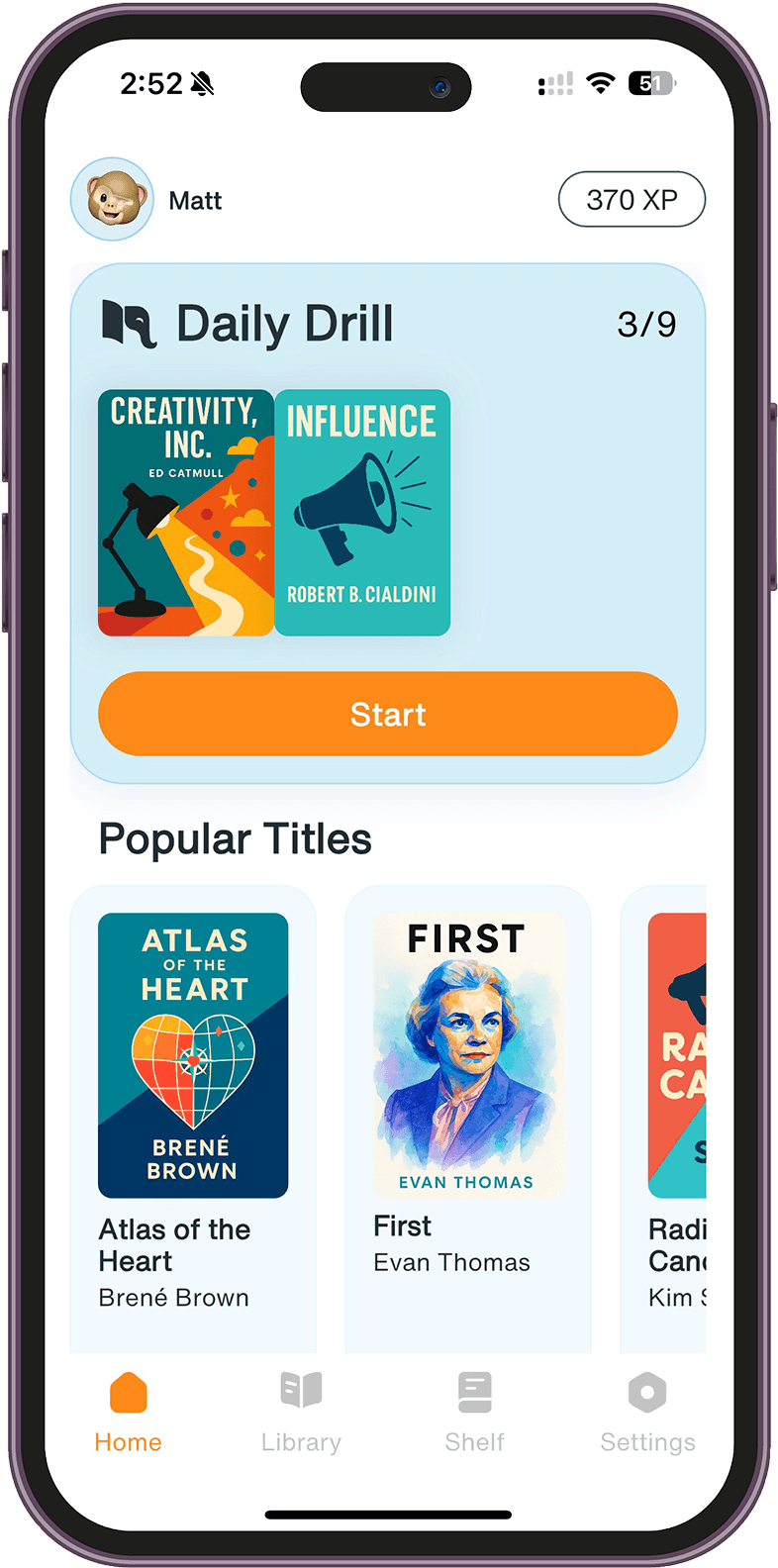
Loxie uses spaced repetition and active recall—the two most scientifically validated learning techniques—to help you actually retain what you learn from Switch. Instead of reading the book once and hoping the ideas stick, you practice retrieving key concepts at scientifically optimized intervals, right before you'd naturally forget them.
The process is simple: spend just 2 minutes a day answering questions about concepts like the Rider-Elephant-Path framework, implementation intentions, and bright spots. Each time you successfully recall an idea, the interval before your next review extends. Over time, these concepts move from short-term memory into durable long-term knowledge that's available when you actually face change challenges.
Loxie includes Switch in its complete topic library, so you can start reinforcing these concepts immediately. No more reading great books only to forget them. No more knowing that implementation intentions work but failing to remember the technique when you need it. With Loxie, the insights from Switch become permanent tools you can deploy whenever change is needed.
Frequently Asked Questions
What is the main idea of Switch?
Switch argues that successful change requires aligning three forces: the rational mind (the Rider), the emotional mind (the Elephant), and the environment (the Path). When these elements work together—with clear direction, emotional motivation, and a supportive environment—changes that once seemed impossible become almost automatic.
What is the Rider-Elephant-Path framework?
The Rider represents your rational, analytical side that plans and directs. The Elephant represents your emotional, instinctive side that provides energy and motivation. The Path represents your environment and situation. Effective change directs the Rider with specific instructions, motivates the Elephant through emotional engagement, and shapes the Path to make desired behaviors easier.
What are implementation intentions and how do they work?
Implementation intentions are "if-then" plans that specify when and where you'll perform a behavior. For example: "If it's 7 AM, then I will go for a run." Research shows they double or triple follow-through rates by pre-deciding responses to specific situations, creating automatic behaviors that bypass decision fatigue.
What are bright spots in the context of change?
Bright spots are instances where the desired change is already working successfully. Instead of analyzing problems, the bright spots approach studies what's already working and clones those specific behaviors. This strategy provides proven solutions that work in real-world conditions rather than theoretical ideals.
Why does shrinking the change help create momentum?
Shrinking the change works because large changes overwhelm the emotional mind, triggering resistance. Small, concrete first steps feel achievable and safe. Each small win provides evidence that success is possible, builds confidence, and generates momentum for tackling bigger challenges.
How can Loxie help me remember what I learned from Switch?
Loxie uses spaced repetition and active recall to help you retain key concepts from Switch. Instead of reading the book once and forgetting most of it, you practice for 2 minutes a day with questions that resurface ideas right before you'd naturally forget them. Loxie includes Switch in its complete topic library.
We're an Amazon Associate. If you buy a book through our links, we earn a small commission at no extra cost to you.
Stop forgetting what you learn.
Start learning for good with your 7-day FREE trial.