The 4-Hour Workweek: Key Insights & Takeaways from Tim Ferriss
Master Tim Ferriss's complete framework for escaping the 9-5 grind through automation, outsourcing, and lifestyle design.
by The Loxie Learning Team
What if you could earn more while working less—not someday after retirement, but right now? Timothy Ferriss's The 4-Hour Workweek challenges everything you've been taught about work, wealth, and the good life. The book introduces a radical premise: the traditional model of working 40+ years to finally enjoy life in retirement is fundamentally broken, and there's a better way.
This guide breaks down Ferriss's complete framework for joining what he calls the "New Rich"—people who prioritize time and mobility over accumulating wealth for a distant future. You'll learn the DEAL framework, the mathematics of relative income, and practical systems for automation and liberation. Whether you want to build a location-independent business or simply reclaim your time, these principles provide the blueprint.
 Start practicing The 4-Hour Workweek free for 7 days ▸
What is the DEAL framework and how does it work?
The DEAL framework is Ferriss's four-step system for escaping traditional work: Definition, Elimination, Automation, and Liberation. Each step builds on the previous one, creating a systematic path from overworked employee to lifestyle-free entrepreneur. Unlike traditional career advice that optimizes within the existing system, DEAL challenges the system itself.
Definition means redefining what you actually want from life and work. Most people chase money without asking what they'd do with it. The New Rich define specific lifestyle goals—adventures, experiences, and freedoms—then calculate the actual cost. Often, the dream life costs far less than imagined.
Elimination applies ruthless efficiency principles to cut out everything that doesn't serve your goals. This isn't about doing more faster; it's about doing less, better. The 80/20 rule and Parkinson's Law become your primary tools here.
Automation involves creating systems and delegating tasks so income flows without your constant attention. Virtual assistants, automated businesses, and outsourced operations handle the work that remains after elimination.
Liberation is the final step: achieving the mobility to work from anywhere—or not work at all. For employees, this means negotiating remote arrangements. For entrepreneurs, it means building businesses that don't require your presence.
Understanding DEAL intellectually is one thing; internalizing it so you actually apply each step is another. Loxie helps you retain these frameworks through spaced repetition, so when you're ready to negotiate remote work or audit your time, the principles are fresh and actionable.
Why does relative income matter more than absolute income?
Relative income measures your earnings per hour of work, not your annual total—and this distinction changes everything about how you evaluate success. Someone earning $40,000 while working 10 hours per week has a relative income of $400/hour. Someone earning $80,000 while working 60 hours per week has a relative income of just $22/hour. By any meaningful measure, the first person is wealthier.
This reframing exposes the hidden poverty of many high earners. Lawyers billing 80 hours per week, executives constantly on-call, entrepreneurs chained to their businesses—they've traded their only non-renewable resource (time) for money they have no time to enjoy. The math is brutal: if you can't spend it or experience life with it, higher income doesn't make you richer.
The New Rich optimize for relative income by asking two questions: How can I earn more per hour? And how can I need fewer hours to support my lifestyle? Geographic arbitrage (living in lower-cost locations), automated income streams, and aggressive elimination of time-wasting activities all improve your relative income ratio.
Practice these concepts in Loxie ▸
What is fear-setting and how does it overcome paralysis?
Fear-setting is a systematic exercise for analyzing the fears that prevent action, revealing that most paralyzing anxieties have reversible consequences and low probability. Instead of vaguely worrying about what could go wrong, you write down specific worst-case scenarios, prevention strategies, and repair plans. The exercise transforms fog into clarity.
The process has three columns. First, define your nightmare: What's the absolute worst that could happen if you take the action you're considering? Be specific—job loss, financial ruin, relationship damage. Second, list what you could do to prevent each outcome or decrease its likelihood. Third, if the worst happened anyway, what would you do to repair the damage? Most fears, once examined, reveal surprisingly manageable downsides.
Fear-setting also includes a critical comparison: What is the cost of inaction? Staying in a soul-crushing job for another 5 years, never starting the business, remaining in the wrong city—these guaranteed costs often exceed the potential costs of trying and failing. Inaction has its own price tag, and it's usually higher than we admit.
This framework is particularly powerful because it surfaces the asymmetry between upside and downside. Taking a calculated risk might have a 90% chance of working and a 10% chance of a setback you can recover from in months. Not taking the risk guarantees continued stagnation. The math favors action.
Why are unrealistic goals easier to achieve than realistic ones?
Unreasonable and unrealistic goals are paradoxically easier to achieve because fierce competition clusters around conventional targets while ambitious goals have less competition and inspire greater effort. Everyone wants the same "realistic" outcomes—a 10% raise, gradual promotion, modest side income—creating saturated markets for mediocrity.
When you aim for something audacious—becoming location-independent in six months, building a business that runs without you, taking a year-long sabbatical—you enter territory where most people never compete. The perceived impossibility keeps the crowd away. Meanwhile, the audacity of the goal triggers your peak performance and creative problem-solving.
There's also a psychological dimension. Modest goals produce modest effort because the stakes feel low. If you're trying to save an extra $200 per month, you won't restructure your entire life to achieve it. But if you're trying to fund a year abroad, suddenly every expense and every income stream becomes worth examining. Big goals mobilize resources that small goals don't.
Ferriss applies this to entrepreneurship: instead of trying to improve on existing products by 10%, he looks for opportunities to be 10x better or completely different. The 10% improvement faces every competitor in the market. The 10x improvement might face none.
Big ideas require big retention
The DEAL framework, fear-setting, relative income—these concepts can transform how you approach work and life. But reading about them once doesn't make them stick. Loxie reinforces these frameworks through daily practice, so they're available when you need to make decisions.
Try Loxie free for 7 days ▸How does the 80/20 rule apply to productivity and lifestyle design?
The Pareto Principle states that 80% of results come from 20% of efforts—but Ferriss takes this further with recursive application. If 80% of results come from 20% of inputs, then 80% of that 80% (64% of total results) comes from 20% of that 20% (4% of inputs). This means 64% of your outcomes may come from just 4% of your activities.
Applied to work, this insight is revolutionary. Most people optimize the wrong 96%—tweaking processes, attending meetings, responding to emails—while neglecting the vital 4% that actually drives results. Ferriss argues you should identify your highest-leverage activities and ruthlessly protect time for them while eliminating or delegating everything else.
The same principle applies to customers, products, and relationships. Often, 20% of customers generate 80% of revenue (and 20% generate 80% of complaints—usually different groups). A small subset of products drives most profit. A handful of relationships provide most value. Identifying these concentrations enables radical simplification.
The 80/20 audit
Ferriss recommends regularly asking two diagnostic questions: Which 20% of sources cause 80% of my problems and unhappiness? And which 20% of sources result in 80% of my desired outcomes and happiness? The first question identifies what to eliminate; the second identifies what to amplify. Most people never perform this audit, continuing to invest equally across all activities regardless of return.
What is Parkinson's Law and how does it boost productivity?
Parkinson's Law states that work expands to fill the time available for its completion—a task that could take two hours will somehow consume an entire day if that's how long you allocate. This isn't laziness; it's how the human mind naturally calibrates effort. Give yourself a week, and you'll use the week. Give yourself two hours, and you'll find a way to finish in two hours.
The tactical application is counterintuitive: shorter deadlines increase productivity by eliminating perfectionism and procrastination. When you have three hours to write a report, you can't spend an hour deciding on the perfect opening sentence. Constraints force efficient decisions. Ferriss recommends cutting normal time estimates by 50-80% to trigger this effect.
Combined with the 80/20 rule, Parkinson's Law becomes even more powerful. First, identify the 20% of tasks that produce 80% of results. Then, give yourself impossibly short deadlines for those tasks. The constraints force focus on what matters most while preventing the perfectionist tinkering that consumes unlimited time.
This principle also explains why people who work fewer hours often accomplish more. Working 60 hours per week allows endless procrastination disguised as diligence. Working 10 hours per week forces ruthless prioritization. The constraint becomes the source of productivity, not the enemy of it.
Start retaining what you learn ▸
What is a low-information diet and why does it matter?
A low-information diet means eliminating news, gossip, and non-actionable information from your life—freeing mental bandwidth for decisions and activities that actually matter. Ferriss argues that most "staying informed" is actually "staying distracted," consuming attention and producing anxiety without improving your life or enabling better decisions.
The logic is simple: if information isn't immediately actionable, consuming it costs more than it's worth. Reading about a political crisis you can't influence, a market fluctuation you won't trade on, or a celebrity scandal that doesn't affect you—all of this has carrying costs in attention and emotional energy. The mind treats information as urgent even when it's irrelevant.
Ferriss proposes a radical experiment: for one week, consume no news, no non-fiction books (unless directly related to a current project), no websites except for essential work. Instead, ask colleagues and friends to mention anything truly critical. The surprising discovery: almost nothing important is missed, and the reclaimed mental space transforms productivity and well-being.
This isn't anti-intellectual—it's strategic. The goal is just-in-time information (learning what you need when you need it) rather than just-in-case information (stockpiling knowledge that might someday be useful). The former is efficient; the latter creates cognitive burden without corresponding benefit.
How does batching increase productivity?
Batching means grouping similar tasks—checking email twice daily, returning calls once daily, doing errands weekly—to reduce the startup costs and context-switching penalties that fragment attention. Every time you shift between different types of work, your brain pays a "switching tax" that compounds across dozens of daily transitions.
Email is the clearest example. Checking messages constantly throughout the day means entering and exiting "email mode" dozens of times. Each transition costs focus and creates anxiety about incomplete tasks. Batching email into two 30-minute blocks (e.g., 11am and 4pm) consolidates these transitions, handles the same volume of communication, and preserves uninterrupted blocks for deep work.
The same principle applies to phone calls, administrative tasks, shopping, cooking, and any other recurring activity. Cooking all meals for the week on Sunday ("meal prep") is batching. Scheduling all appointments on Tuesday afternoons is batching. Paying all bills on the first of the month is batching. Each grouping reduces overhead and mental load.
Ferriss takes batching further with "task quarantine"—designating specific times and places for different activities to create environmental cues. Email only at the desk. Calls only during commute. Creative work only in the morning. These boundaries prevent activities from bleeding into each other and train your brain to engage the right mode automatically.
How can virtual assistants transform your productivity?
Virtual assistants in countries like India and the Philippines can handle 80% of personal and professional tasks for $4-15 per hour, making delegation accessible to ordinary professionals rather than just executives. This geographic arbitrage democratizes personal assistance, allowing middle-class earners to outsource work that would be prohibitively expensive locally.
The tasks virtual assistants can handle surprise most people: research, scheduling, email management, travel booking, data entry, customer service, social media management, and dozens of specialized functions. Ferriss started by delegating personal tasks—comparison shopping, appointment scheduling, bill paying—before moving to professional delegation.
The delegation ladder
Ferriss recommends starting with personal tasks before professional ones. Outsourcing research, appointments, and purchases teaches delegation skills with lower stakes than business-critical functions. This graduated approach builds trust in the process through reversible experiments, overcoming the psychological barrier of releasing control. Once you've experienced successful delegation on small tasks, expanding to professional functions becomes natural.
A critical principle: never delegate something you haven't first eliminated or automated. Outsourcing inefficient processes just multiplies waste—you end up paying someone to perform unnecessary work. Optimize your systems, then scale them through delegation.
Learn these frameworks for good ▸
What is a muse business and how do you build one?
A muse is an automated income stream requiring minimal maintenance—a business designed from the start to run without constant owner involvement. Unlike traditional businesses that trade time for money, a muse generates cash flow whether you're working, traveling, or sleeping. This isn't about building the biggest company; it's about building the most efficient one for your lifestyle goals.
The ideal muse targets niche markets with specific problems rather than trying to serve everyone. Focused positioning reduces competition and marketing costs while enabling premium pricing. A product solving a specific problem for left-handed golfers, for example, faces less competition and can charge more than a generic golf product fighting for shelf space.
Information products as ideal muses
Information products—courses, ebooks, software, membership sites—scale infinitely with near-zero marginal cost. Creating a video course takes significant upfront effort, but once built, selling 100 copies costs the same as selling 10,000. There's no inventory, minimal fulfillment complexity, and revenue can grow without proportional increases in time investment.
Ferriss also emphasizes that expert status can be manufactured faster than most people realize. Joining trade organizations, reading the top books in a field, giving free seminars, and writing articles can establish credibility within weeks rather than years. You don't need decades of experience to create valuable information products—you need to know more than your target audience and present it effectively.
How do you test a business idea with $500 or less?
Micro-testing uses Google Ads, landing pages, and pre-orders to validate demand before product creation—eliminating the risk of building something nobody wants. Instead of spending months developing a product and hoping people buy it, you spend days testing whether people will actually pay before you build anything.
The process is straightforward: create a simple landing page describing your product as if it exists, drive traffic through small paid advertising campaigns, and measure how many visitors attempt to purchase. If the conversion rate is strong, build the product. If it's weak, test a different positioning or move on to another idea. This compresses months of traditional market research into days of actual buyer behavior data.
The key insight is testing actual purchase behavior, not stated interest. Surveys and focus groups reveal what people say they'd buy; landing pages with "buy now" buttons reveal what they'll actually pay for. Only the latter matters. People are polite in surveys and optimistic about hypothetical purchases—but credit cards reveal true intent.
Ferriss also notes that competition is a good sign, not a warning. Existing competitors prove market demand—people are already spending money on solutions. An empty market usually indicates no demand rather than untapped opportunity. The goal isn't to find markets without competition but to differentiate through positioning, guarantees, and superior targeting.
What is management by absence and why does it work?
Management by absence means deliberately becoming unavailable to force systems and delegation—revealing which functions truly need you versus those that run better without micromanagement. By removing yourself from day-to-day operations, you create a stress test that exposes dependencies while training both staff and systems to function autonomously.
This sounds terrifying to most business owners, but the reality is often liberating. Many discover that their constant involvement was actually slowing things down. Employees who couldn't make decisions without approval become capable decision-makers when approval isn't available. Systems that seemed to require constant monitoring reveal themselves as self-correcting.
The implementation is gradual: start with short periods of unavailability (a day), measure what actually breaks (usually less than feared), fix the gaps with better systems or empowered staff, then extend the periods. Each cycle reveals problems to solve and capabilities to develop. Within months, week-long absences become routine.
Ferriss emphasizes empowerment without permission: give employees authority to solve problems up to a specific dollar amount without seeking approval. This trust-based system transforms order-takers into decision-makers while freeing owners from constant intervention. Most problems cost less than the management overhead of solving them "correctly."
How do you negotiate remote work successfully?
Remote work negotiations succeed through demonstrated value rather than theoretical arguments—proving productivity gains during trial periods makes approval a validation of results, not permission for an experiment. Instead of asking for remote work privileges, you create undeniable evidence that remote work improves your performance.
The strategy is incremental. Start by requesting one remote day per week, citing a specific productivity goal ("I want to complete the Henderson report without interruptions"). Track your output meticulously. When results exceed in-office performance, use that evidence to request a second day. Each success builds the case for the next expansion.
Strategic inconvenience
Ferriss suggests creating strategic inconvenience: schedule important meetings during proposed remote days, then demonstrate superior participation via video. This forces direct comparison between remote and in-office effectiveness under high-stakes conditions. Managers who witnessed excellent remote performance during a crucial meeting struggle to argue that physical presence is necessary.
Throughout this process, the principle is "ask for forgiveness, not permission." Most corporate policies exist to prevent disasters but aren't enforced for small experiments that succeed. Testing boundaries often reveals surprising flexibility—organizations are more tolerant of successful rule-breaking than failed rule-following.
Why take mini-retirements throughout life instead of one retirement at 65?
Mini-retirements throughout life beat one retirement at 65 because distributing adventures across decades ensures you have the physical capability to enjoy them and provides rejuvenation when you most need it. The traditional model gambles that you'll be healthy and motivated at 65 to do what you postponed at 35—a bet that often fails.
Adventure requires health more than wealth. Climbing mountains, exploring cities on foot, learning new skills—these activities have physical prerequisites that diminish with age. A month in Thailand at 30 differs fundamentally from the same trip at 70. Mini-retirements capture experiences in their optimal window rather than deferring everything to uncertain future capacity.
There's also the burnout prevention angle. Periodic resets—three months abroad, a summer of learning, a season of exploration—prevent the accumulated exhaustion that makes traditional workers desperate for retirement. Instead of grinding toward a distant finish line, you intersperse work with genuine recovery. This rhythm often makes work more sustainable and productive.
Fear of quitting or pausing often exceeds actual consequences. Most careers can be resumed; skills don't atrophy in months; experience gained from lifestyle experiments often enhances rather than damages marketability. Employers increasingly value diverse experience and demonstrated independence. The gap year that felt risky becomes a resume highlight.
The real challenge with The 4-Hour Workweek
Ferriss provides an extraordinary framework—the DEAL system, fear-setting, 80/20 productivity, muse businesses, liberation tactics—but here's the uncomfortable truth: most readers will forget 90% of these concepts within weeks. The forgetting curve is merciless. By next month, the DEAL acronym might feel vague, the fear-setting process fuzzy, the negotiation tactics distant.
This is the paradox of transformational books. They feel life-changing while you're reading them. You highlight passages, take notes, feel motivated. But without reinforcement, the knowledge fades. A year later, you might remember that you liked the book without being able to explain its core frameworks. The insights that could have changed your approach to work and life become pleasant but useless memories.
How many books have you read that felt significant but you can't recall three key points from? How many productivity systems have you forgotten? The problem isn't reading—it's retention.
How Loxie helps you actually remember what you learn
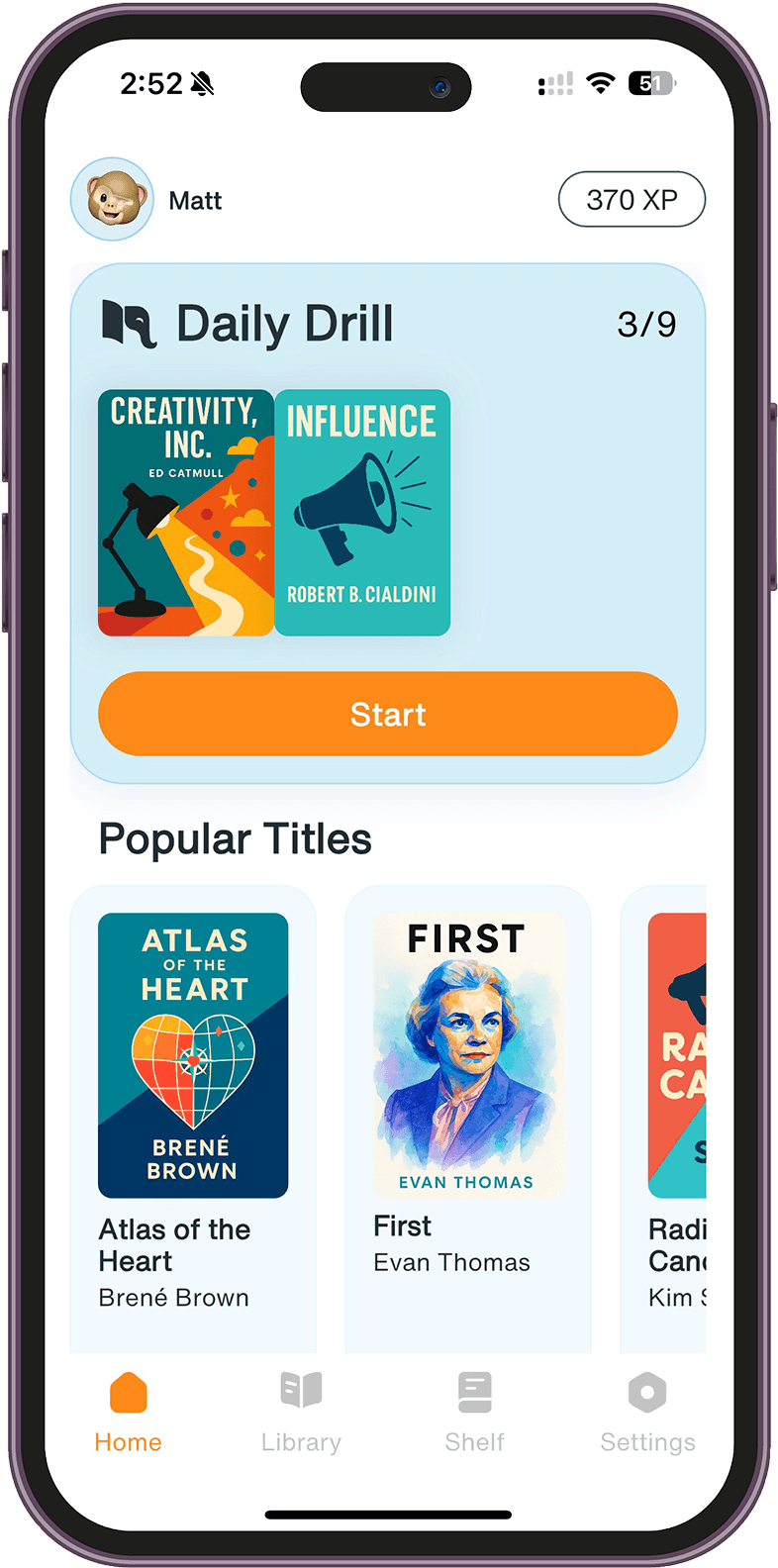
Loxie uses spaced repetition and active recall—the same techniques that make medical students retain thousands of facts—to help you internalize the concepts from books like The 4-Hour Workweek. Instead of reading once and hoping it sticks, you practice for 2 minutes a day with questions that resurface ideas right before you'd naturally forget them.
The science is proven: active recall (retrieving information rather than passively re-reading) strengthens memory far more than review. Spaced repetition (reviewing at expanding intervals) optimizes the timing. Together, they transform fragile knowledge into permanent understanding.
The 4-Hour Workweek is available in Loxie's free topic library. You can start reinforcing the DEAL framework, Parkinson's Law, the 80/20 principle, and every other concept immediately. When you're ready to negotiate remote work or audit your time or build a muse business, the frameworks will be accessible—not buried in a forgotten book on your shelf.
Frequently Asked Questions
What is the main idea of The 4-Hour Workweek?
The core idea is that you can escape the traditional 9-5 grind through systematic automation, outsourcing, and lifestyle design. Ferriss introduces the DEAL framework (Definition, Elimination, Automation, Liberation) to help readers join the "New Rich"—people who prioritize time and mobility over deferring life until retirement.
What does DEAL stand for in The 4-Hour Workweek?
DEAL stands for Definition (clarifying what you actually want), Elimination (using 80/20 and Parkinson's Law to cut waste), Automation (using systems and virtual assistants to handle work), and Liberation (achieving location independence). Each step builds toward a lifestyle where income isn't tied to constant effort.
What is the concept of relative income?
Relative income measures earnings per hour of work rather than annual totals. Someone earning $40,000 working 10 hours weekly ($400/hour) is wealthier than someone earning $80,000 working 60 hours ($22/hour). Time is non-renewable, so hourly freedom rate matters more than gross income.
What is fear-setting and how do you do it?
Fear-setting is an exercise for analyzing fears that prevent action. You write down specific worst-case scenarios, what you could do to prevent them, and how you'd recover if they happened. The exercise typically reveals that feared outcomes are reversible and that inaction costs more than taking calculated risks.
What are muse businesses in The 4-Hour Workweek?
A muse is an automated income stream requiring minimal maintenance—typically an information product or niche physical product designed to run without constant owner involvement. Muses target specific markets, use micro-testing to validate demand, and leverage automation and outsourcing to minimize time investment.
How can Loxie help me remember what I learned from The 4-Hour Workweek?
Loxie uses spaced repetition and active recall to help you retain the key concepts from The 4-Hour Workweek. Instead of reading the book once and forgetting most of it, you practice for 2 minutes a day with questions that resurface ideas right before you'd naturally forget them. Loxie includes The 4-Hour Workweek in its full topic library.
We're an Amazon Associate. If you buy a book through our links, we earn a small commission at no extra cost to you.
Stop forgetting what you learn.
Start learning for good with your 7-day FREE trial.