The 5 Second Rule: Key Insights & Takeaways from Mel Robbins
Master Mel Robbins' science-backed technique for beating procrastination, building courage, and taking action before your brain talks you out of it.
by The Loxie Learning Team
What if the gap between who you are and who you want to be could be closed in just five seconds? Mel Robbins' The 5 Second Rule presents a deceptively simple technique—counting backward 5-4-3-2-1 and then moving—that interrupts your brain's natural tendency to overthink, hesitate, and avoid discomfort. This isn't motivational fluff; it's a science-backed method for outsmarting the mental machinery that keeps you stuck.
This guide breaks down Robbins' complete framework for transforming intention into action. Whether you're battling procrastination, struggling to speak up, or waiting to feel confident before making a change, you'll understand how the countdown works, why it's effective, and how to apply it across every area of your life where hesitation holds you back.
 Start practicing The 5 Second Rule free for 7 days ▸
What is The 5 Second Rule and how does it work?
The 5 Second Rule is a metacognitive technique where you count backward 5-4-3-2-1 and immediately take physical action toward a goal before your brain can generate fear, doubt, or excuses. The countdown activates your prefrontal cortex—the brain's decision-making center—and interrupts the automatic patterns controlled by your basal ganglia that keep you in your comfort zone.
Here's why counting backward matters: it requires concentration. Your brain can't simultaneously focus on a reverse countdown and manufacture reasons to avoid action. By the time you reach "1" and move, you've bypassed the mental window where hesitation typically kills your impulses. Robbins discovered this technique during a period of personal crisis and has since seen it help millions overcome everything from hitting the snooze button to speaking up in high-stakes situations.
The rule works because hesitation follows a predictable pattern. Within approximately five seconds of having an instinct to act, your brain begins magnifying risks and generating rationalizations for inaction. The countdown creates a forcing function—a commitment device that propels you past that danger zone before self-sabotage can take hold.
Why does one technique work across so many different challenges?
The 5 Second Rule addresses multiple life challenges because the root problem—the gap between intention and action—remains constant regardless of the domain. Whether you're procrastinating on a work project, avoiding a difficult conversation, or struggling to maintain an exercise routine, the underlying mechanism is identical: your brain detects potential discomfort and manufactures resistance.
This universality explains why the same countdown that gets you out of bed can also help you speak up in meetings, start a creative project, or resist an unhealthy craving. The specific situation changes, but the hesitation pattern doesn't. Your brain's threat-detection system doesn't distinguish between the discomfort of a cold gym floor and the discomfort of vulnerable communication—it just flags both as experiences to avoid.
Robbins' insight is that you don't need different tools for different problems. You need one reliable method for bridging the intention-action gap wherever it appears in your life. The countdown serves as that universal bridge, applicable whether the stakes are mundane or life-changing.
Try Loxie free and retain what you learn ▸
How does the 5 Second Rule break procrastination?
The 5 Second Rule breaks procrastination by forcing immediate action before your brain can manufacture excuses, worries, or rationalizations for delay. Procrastination isn't a time management problem—it's a stress-avoidance mechanism. When you delay a task, you temporarily relieve the anxiety associated with it, but this relief reinforces the avoidance pattern and ultimately increases your stress.
The countdown interrupts this cycle at its origin point. Instead of allowing your brain to build a case for "later," you count 5-4-3-2-1 and take the smallest possible first step. This immediate initiation bypasses the mental resistance that magnifies difficulty. Tasks that seemed insurmountable when you were thinking about them become manageable once you're actually doing them.
Importantly, the rule doesn't require you to complete the entire task—just to start it. Robbins emphasizes that the first physical movement is what matters. Once you're in motion, momentum takes over. The psychological power that avoided tasks hold over you dissolves the moment you engage with them, because action dissolves the anticipatory anxiety that made them seem insurmountable.
How does action create confidence instead of the other way around?
Action creates confidence—not the other way around—because by using the 5 Second Rule to act despite fear or doubt, you generate real-world evidence of your capability. Most people believe they need to feel confident before taking action, but Robbins argues this gets the causation backward. Confidence is the result of taking action, not the prerequisite for it.
Each time you count 5-4-3-2-1 and move despite feeling uncertain, you create proof that you can handle discomfort. This evidence accumulates. After repeatedly seeing yourself act in moments of hesitation, your brain's prediction model updates: "I guess I am someone who takes action." This is identity-level change, not just behavioral modification.
The mechanism is self-trust. Confidence fundamentally comes from keeping promises to yourself. Every time you honor an intention—getting up when you said you would, speaking up when you wanted to, starting the project you've been avoiding—you deposit into a psychological trust account. The 5 Second Rule creates a daily track record of follow-through, which compounds into genuine self-belief.
How does The 5 Second Rule transform your relationship with fear?
Fear transforms from a paralyzing force into a growth signal when you recognize it as your brain's alert that you're about to do something that matters—and then use the 5 Second Rule to act anyway. Robbins reframes fear not as a stop sign but as a green light indicating you're at the edge of your comfort zone, exactly where growth happens.
The countdown prevents fear from escalating. When you hesitate, your amygdala (the brain's fear center) has time to amplify threat signals, creating worst-case scenarios and physical anxiety symptoms. By acting within five seconds, you bypass this escalation process. You feel the initial fear but don't give it the runway it needs to become paralyzing.
Over time, consistent practice rewires your neural response to fear. Instead of the automatic pattern of feel-fear-then-freeze, you develop a new automatic pattern: feel-fear-then-count-then-act. Scary moments become breakthrough opportunities because you've trained yourself to move through them rather than away from them.
Understanding the 5 Second Rule intellectually won't change your behavior
The countdown only works when you actually use it in moments of hesitation. Loxie helps you internalize these concepts through spaced repetition, so the technique comes to mind automatically when you need it most.
Practice The 5 Second Rule with Loxie ▸How does the 5 Second Rule help break psychological patterns of being stuck?
The 5 Second Rule breaks psychological patterns of being stuck by interrupting the habitual thought sequences that maintain procrastination, worry, and self-doubt. When you're stuck in a mental loop—ruminating about a problem, replaying a mistake, catastrophizing about the future—your brain is running on autopilot through well-worn neural pathways.
The countdown disrupts this autopilot. Counting backward 5-4-3-2-1 requires the prefrontal cortex's deliberate attention, which pulls cognitive resources away from the basal ganglia's automatic loops. You can't simultaneously focus on a reverse countdown and continue ruminating. The act of counting creates a pattern interrupt that breaks the mental cycle.
This mechanism also works for breaking destructive habits. Every habit follows a loop: trigger, routine, reward. The 5 Second Rule inserts conscious choice between the trigger and the routine. When you notice the urge to engage in an unhealthy behavior—reaching for your phone, grabbing an unhealthy snack, snapping at a family member—you have approximately five seconds to count down and choose a different response before the automatic habit loop completes.
How do small acts of courage compound into life transformation?
Small acts of courage compound into life transformation because each 5-second decision builds momentum, rewires neural pathways, and creates evidence that you can change. Robbins emphasizes that courage isn't a grand gesture reserved for heroes—it's a muscle built through small daily acts of pushing yourself.
The compounding works on multiple levels. Behaviorally, each small action creates momentum for the next. Getting out of bed on time makes starting your workout easier. Starting your workout makes tackling that dreaded email easier. The pattern of action-taking becomes self-reinforcing.
Neurologically, repeated use of the countdown strengthens the prefrontal cortex's ability to override automatic avoidance responses. What initially requires significant effort becomes progressively easier as the neural pathway for deliberate action gets reinforced. Over time, you develop a trained habit of decisive action that replaces your previous pattern of hesitation.
Psychologically, each kept promise to yourself deposits into your confidence account. The compound effect of hundreds of small courageous acts—speaking up in meetings, starting difficult conversations, trying something new—accumulates into a fundamentally changed self-concept.
How does the 5 Second Rule bypass perfectionism and creative blocks?
Creative exploration stalls when perfectionism creates analysis paralysis, but counting 5-4-3-2-1 bypasses the critic brain and launches you into messy, productive action. Perfectionism is procrastination in disguise—it's your brain using impossibly high standards as justification for never starting.
The countdown works for creative blocks because it targets the moment of initiation, not the quality of output. You're not committing to writing a perfect paragraph; you're committing to typing one sentence. You're not committing to painting a masterpiece; you're committing to putting brush to canvas. By focusing on the physical act of starting, you sidestep the perfectionist's impossible evaluation of whether the result will be good enough.
Robbins' approach aligns with research on creative flow: the path to quality work runs through quantity. The writer who produces ten rough drafts generates better final material than the perfectionist who agonizes over getting the first draft perfect. The 5 Second Rule gets you producing, which is the only path to eventually producing something excellent.
How does the 5 Second Rule improve communication and relationships?
Vulnerable communication requires activating courage in the moment of hesitation—using 5-4-3-2-1 to speak your truth before fear silences you. Most relationship problems aren't caused by people who communicate too much, but by people who swallow their words to avoid temporary discomfort, allowing resentment to build and relationships to stagnate.
The countdown prevents the escalation of mental resistance that stops difficult conversations before they start. In the seconds after you think "I should tell them how I feel," your brain begins generating reasons not to: "They'll react badly," "It's not the right time," "Maybe I'm overreacting." By counting and speaking within five seconds, you bypass this excuse-manufacturing process.
This applies to both difficult truths and expressions of appreciation. Many people struggle to share positive feelings as much as negative ones. The 5 Second Rule works for saying "I love you," "I'm proud of you," or "I appreciate what you did" just as effectively as it works for addressing conflicts. In all cases, you're overriding hesitation to share what truly matters.
How can the 5 Second Rule help with anxiety and panic?
Panic attacks lose their power when you use the 5-4-3-2-1 countdown to anchor yourself in the present moment, interrupting the escalation of physical symptoms before they reach peak intensity. Anxiety spirals depend on a feedback loop where worried thoughts trigger physical symptoms, which trigger more worried thoughts. The countdown breaks this loop.
The mechanism involves the prefrontal cortex. Counting backward requires deliberate cognitive focus, which shifts brain activity from the amygdala (emotional reaction center) to the prefrontal cortex (executive function center). You can't simultaneously count backward and fully engage in panic. The countdown creates cognitive separation from the spiral.
For chronic anxiety, consistent Rule practice rewires neural pathways over time. Each time you use the countdown to interrupt anxious thoughts and redirect toward productive action, you weaken the automatic worry response and strengthen the pattern of deliberate intervention. The goal isn't to eliminate anxiety—it's to train your brain to respond to anxiety with action rather than rumination.
Start retaining what you learn ▸
Why does the morning alarm set the tone for your entire day?
The first decision of the day—getting up immediately versus hitting snooze—sets a psychological pattern of either action or hesitation that influences every subsequent choice. When you hit snooze, you're telling your brain that your intentions don't matter, that comfort trumps commitment. This message echoes through the rest of your day.
Robbins emphasizes that conquering the snooze button isn't about the extra minutes of sleep—it's about the psychological cascade that follows. When you count 5-4-3-2-1 and get up immediately, you create a win first thing in the morning. You prove to yourself that you can act despite not feeling like it. This evidence of self-discipline makes subsequent hard choices easier throughout the day.
The morning moment is particularly powerful because your prefrontal cortex is at its weakest when you first wake up, while your basal ganglia's automatic responses are at their strongest. Overriding the snooze impulse in this disadvantaged state creates disproportionate evidence that you can overcome hesitation. If you can do it when your willpower is depleted, you can do it anytime.
How does the 5 Second Rule help with health and wellness habits?
Exercise consistency improves when you count 5-4-3-2-1 and start moving before waiting for motivation, because action generates motivation rather than the reverse. The common belief that you need to feel motivated before exercising has it backward. Motivation is the result of action, not the cause of it.
The same principle applies to nutritional choices. At decision points—the moment your hand reaches for the cookie jar, the moment you're choosing between salad and pizza—you have a five-second window to count down and choose the option aligned with your goals before your brain can justify the unhealthy one. The countdown prevents the rationalization process that typically overrides good intentions.
For breaking unhealthy habits specifically, Robbins emphasizes the importance of acting within five seconds of recognizing a trigger. This window precedes the feelings and rationalizations that typically sabotage behavior change. Whether you're trying to stop smoking, reduce drinking, or end an unhealthy eating pattern, the countdown gives you a tool for inserting conscious choice before the automatic habit loop completes.
The real challenge with The 5 Second Rule
Here's an uncomfortable truth: reading about the 5 Second Rule won't help you use it. The technique is simple enough to explain in one sentence, but that simplicity is deceptive. The challenge isn't understanding the countdown—it's remembering to use it in the exact moments when hesitation has already begun hijacking your brain.
Consider how many times you've learned a productivity technique, felt inspired for a few days, and then forgotten about it entirely. Or how many self-help concepts you could explain to a friend but don't actually apply to your own life. The problem isn't knowledge—it's the gap between knowing and doing, which is exactly what the 5 Second Rule is supposed to address.
This creates an ironic challenge: you need to remember the tool designed to help you take action, but memory itself fades without reinforcement. Studies show we forget 70% of new information within 24 hours and 90% within a week. Without active practice, the 5 Second Rule becomes another concept that sounded great but never made it into your actual behavior.
How Loxie helps you actually remember and use The 5 Second Rule
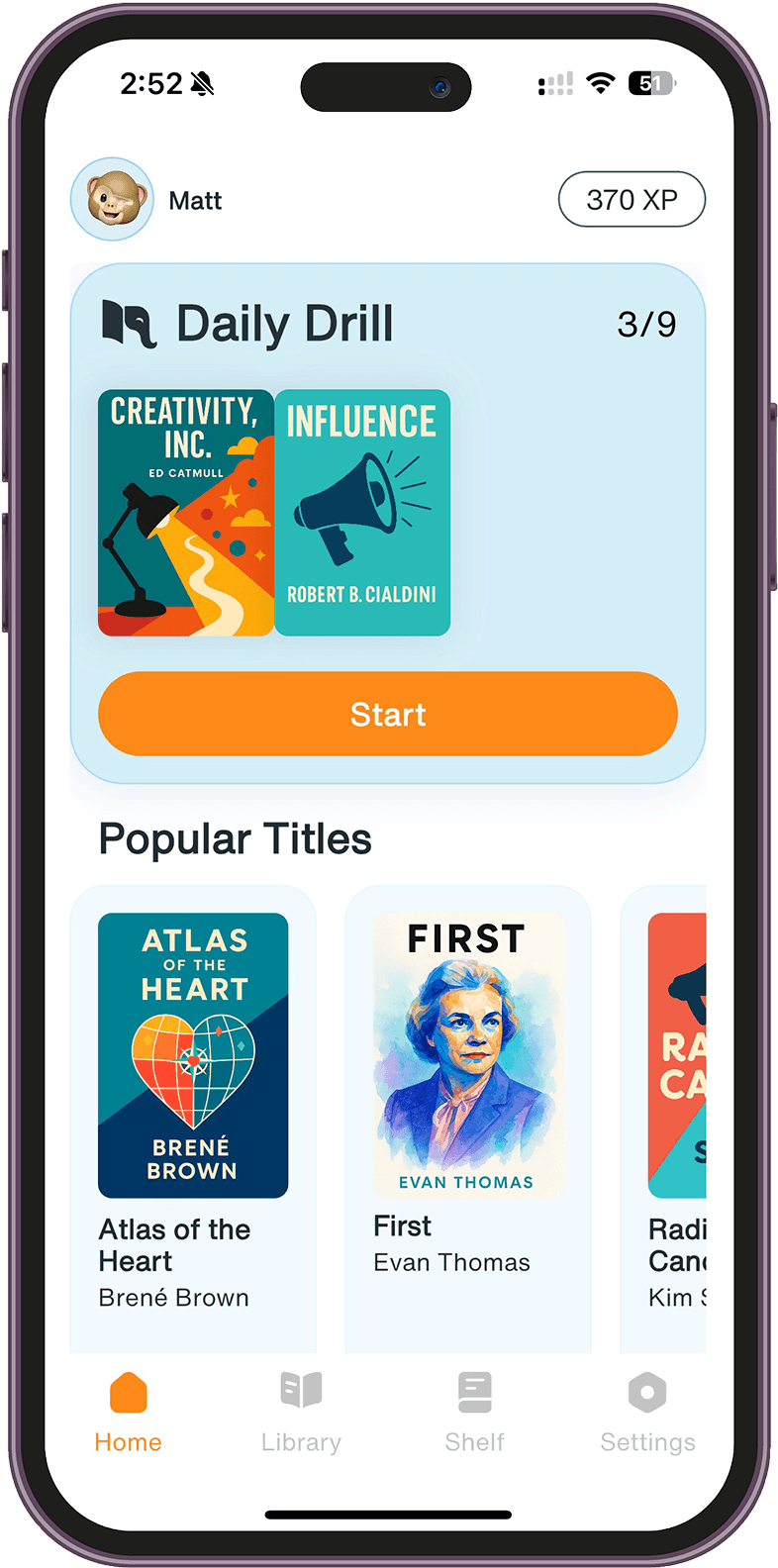
Loxie uses spaced repetition and active recall to move the 5 Second Rule from intellectual understanding to automatic behavior. Instead of reading Robbins' book once and hoping the concepts stick, you practice with questions that resurface ideas right before you'd naturally forget them—the same 5-4-3-2-1 pattern, applied to learning itself.
The app presents you with scenarios and asks what you'd do, reinforcing the connection between hesitation moments and the countdown response. Over time, your brain builds the neural pathway that makes reaching for the 5 Second Rule automatic when you feel resistance. You're training yourself to remember the technique in the exact situations where you need it.
This takes about two minutes a day. Loxie includes The 5 Second Rule in its full topic library, so you can start immediately. Each session strengthens your ability to bridge the intention-action gap—which is fitting, since that's exactly what Robbins' technique is designed to do.
Frequently Asked Questions
What is the main idea of The 5 Second Rule?
The core idea is that counting backward 5-4-3-2-1 and immediately taking action interrupts your brain's tendency to hesitate, overthink, and avoid discomfort. This simple technique works because you have approximately five seconds before your brain begins manufacturing excuses, fears, and rationalizations that kill your impulse to act.
What are the key takeaways from The 5 Second Rule?
The key takeaways are: (1) hesitation is the enemy of action—act within five seconds of an impulse, (2) confidence comes from action, not the other way around, (3) small acts of courage compound into transformation, (4) one technique works across multiple life challenges because the intention-action gap is universal, and (5) fear is a signal you're about to grow, not a reason to stop.
Why does counting backward work better than counting forward?
Counting backward requires more concentration than counting forward because it's not an automatic sequence your brain has memorized. This deliberate focus activates your prefrontal cortex and prevents your mind from wandering into excuse-making. By the time you reach "1," you've used your cognitive resources for the countdown rather than for manufacturing reasons to hesitate.
Can The 5 Second Rule help with anxiety?
Yes. The countdown interrupts anxiety spirals by shifting brain activity from the amygdala (emotional reaction center) to the prefrontal cortex (executive function). Counting requires deliberate focus that's incompatible with full engagement in panic. For chronic anxiety, consistent practice rewires neural pathways, training your brain to respond to anxious feelings with action rather than rumination.
How is The 5 Second Rule different from other motivation techniques?
Most motivation techniques try to change how you feel before you act. The 5 Second Rule bypasses feelings entirely—you act despite not feeling motivated, and motivation follows. It's also universal: the same countdown works for getting out of bed, speaking up in meetings, or starting difficult projects, because the hesitation mechanism is identical across all situations.
How can Loxie help me remember what I learned from The 5 Second Rule?
Loxie uses spaced repetition and active recall to help you retain the key concepts from The 5 Second Rule. Instead of reading the book once and forgetting most of it, you practice for 2 minutes a day with questions that resurface ideas right before you'd naturally forget them. Loxie includes The 5 Second Rule in its full topic library, so you can start reinforcing these concepts immediately.
We're an Amazon Associate. If you buy a book through our links, we earn a small commission at no extra cost to you.
Stop forgetting what you learn.
Start learning for good with your 7-day FREE trial.