The 5AM Club: Key Insights & Takeaways from Robin Sharma
Master Robin Sharma's complete morning routine framework and discover how the world's most successful people use their first hour to build extraordinary lives.
by The Loxie Learning Team
What if the difference between an average life and an extraordinary one came down to a single hour? Robin Sharma's The 5AM Club argues that waking at 5 AM and following a specific morning protocol creates a compounding advantage so powerful that it separates the world's highest achievers from everyone else. The math is compelling: rising an hour earlier gives you 365 additional hours per year—the equivalent of nine extra 40-hour work weeks devoted entirely to self-improvement.
This guide breaks down Sharma's complete framework for morning mastery, including the 20/20/20 Formula, the neuroscience behind why early rising works, and the 66-day protocol for making any habit automatic. Whether you've read the book and want to cement these ideas, or you're discovering them for the first time, you'll understand not just what to do at 5 AM, but why this single habit transforms every other area of your life.
 Start practicing The 5AM Club free for 7 days ▸
What is the 20/20/20 Formula and how does it work?
The 20/20/20 Formula is Sharma's precise blueprint for spending the first hour after waking. It divides the "victory hour" into three equal segments: 20 minutes of intense exercise (Move), 20 minutes of reflection and meditation (Reflect), and 20 minutes of learning (Grow). Each segment targets a different dimension of human performance, creating a comprehensive daily upgrade system that addresses body, emotions, and mind systematically.
The sequence matters. Exercise comes first because physical movement floods the brain with BDNF (brain-derived neurotrophic factor), which Sharma describes as fertilizer for neural growth. This biological response literally prepares your brain for optimal functioning during the reflection and learning segments that follow. Intense movement also flushes cortisol—the stress hormone—from your system, creating a calm, focused state for the rest of your morning.
The reflection segment uses journaling, meditation, or contemplation to process emotions and clarify thinking. This daily emotional maintenance prevents the accumulation of psychological debris that clouds judgment and depletes energy throughout the day. The growth segment then compounds knowledge through reading, podcasts, or study—just 20 minutes daily equals approximately 12 books per year, transforming you into an expert in any field within five years.
Why these specific 20-minute intervals?
The 20-minute duration balances effectiveness with sustainability. Longer segments would exhaust willpower and make the routine feel like a burden. Shorter ones wouldn't create sufficient impact for meaningful transformation. Twenty minutes is enough time to achieve depth in each area while maintaining the energy and enthusiasm that keeps you coming back day after day. The structure prevents cognitive fatigue while ensuring each dimension of performance gets dedicated attention.
Practice the 20/20/20 Formula in Loxie ▸
Why does owning your morning mean winning your day?
The first hour after waking sets a chain reaction of focus, energy, and momentum that determines your productivity for the remaining 23 hours. This principle leverages the psychological phenomenon of behavioral momentum—early victories create a cascade of positive outcomes that carry you through challenges that would otherwise derail an undisciplined day. When you've already exercised, reflected, and learned before most people wake up, you approach your work with confidence and clarity that compounds with each task you complete.
Sharma frames the morning as the highest-leverage habit for life transformation. While evening routines help you wind down, morning routines build you up. The discipline required to rise early and complete a structured protocol creates a self-image of someone who follows through on commitments. This identity shift influences every other decision you make throughout the day. You become someone who does hard things, who prioritizes growth, who doesn't let circumstances dictate outcomes.
The mathematics reinforce this principle. While others sleep, 5 AM Club members gain 365 extra hours annually for learning, creating, and advancing their goals. Over a decade, this adds up to nearly 4,000 hours of additional self-development—the equivalent of two full years of 40-hour work weeks. This explains how early risers achieve seemingly impossible productivity: they're literally operating with more time than their competitors.
What makes the 5-6 AM hour neurologically special?
The daybreak period from 5-6 AM offers what Sharma calls a "Tranquility Base"—a sanctuary free from digital interruptions, social obligations, and mental noise. This quiet hour before the world awakens provides uninterrupted time for deep work when willpower is at its peak and distractions are at their minimum. The absence of incoming demands creates optimal conditions for the focused attention that drives breakthrough thinking.
Neurologically, the morning hours align with your body's natural cortisol rhythm. Cortisol levels peak shortly after waking, providing natural energy and alertness without the need for caffeine or stimulants. This biological timing makes the first hour ideal for challenging activities that require concentration and discipline. By working with your circadian rhythm rather than against it, you leverage your body's built-in systems for peak cognitive performance.
The brain's prefrontal cortex—responsible for decision-making, planning, and impulse control—is freshest in the morning before it becomes depleted by the day's countless small choices. This is why morning routines work: they capture your best mental resources before they get scattered across emails, meetings, and reactive tasks. The first hour represents the most valuable real estate in your daily schedule.
Understanding the 5 AM Club is one thing. Remembering it when your alarm goes off is another.
Loxie uses spaced repetition to help you internalize these concepts so they're available when you need them—not just while you're reading about them.
Try Loxie free for 7 days ▸What does it mean to release 95% behaviors to join the top 5%?
Joining the top 5% of performers requires releasing the behaviors that 95% of people engage in. Most people fail not because they lack talent or intelligence, but because they cling to average habits that guarantee mediocre results. This mathematical framing reveals that excellence is largely about subtraction rather than addition—success comes more from what you stop doing than what you start.
The 95% behaviors Sharma identifies include hitting snooze, checking phones immediately upon waking, skipping exercise, consuming negative news, and starting the day reactively rather than proactively. These common habits feel harmless in isolation but compound into a trajectory of declining energy, focus, and achievement. What the majority calls "normal" is actually a recipe for underperformance.
The uncomfortable truth is that conventional behavior produces conventional results. To achieve extraordinary outcomes, you must be willing to appear unusual or extreme to those committed to mediocrity. What most people call "balance" often means accepting average performance in every area. The 5 AM Club methodology requires trading social conformity for personal excellence—a trade that feels difficult initially but becomes liberating as results accumulate.
How does the 66-day habit installation protocol work?
New habits follow a predictable 66-day timeline divided into three distinct phases: Destruction (days 1-22), Installation (days 23-44), and Integration (days 45-66). Understanding this progression transforms habit formation from a mysterious process into a manageable journey with clear milestones and expected challenges.
The Destruction Phase (Days 1-22)
The first phase feels terrible because your brain is literally rewiring. Old neural pathways are breaking down while new ones haven't yet formed. This biological reality explains the intense resistance, discomfort, and temptation to quit that characterize early habit change. The destruction phase requires the most willpower, which is why it's strategically placed when motivation from your initial commitment is highest.
The Installation Phase (Days 23-44)
During installation, new neural pathways begin forming and strengthening. The behavior starts feeling less foreign, though it still requires conscious effort. This middle phase is often where people plateau—the initial excitement has faded but automaticity hasn't yet arrived. Understanding that this valley is a necessary part of the process helps you persist through the discomfort rather than interpreting it as evidence the habit "isn't working."
The Integration Phase (Days 45-66)
In the final phase, the behavior becomes increasingly automatic as neural pathways solidify. By day 66, the habit requires minimal willpower—your nervous system executes the routine without conscious decision-making. This automaticity frees mental energy for the next level of growth. What seemed impossible at day one becomes effortless through systematic conditioning.
What are the four interior empires and why do they matter?
Sharma identifies four interior empires that history-makers develop: Mindset (psychology), Heartset (emotionality), Healthset (physicality), and Soulset (spirituality). Sustainable success requires strengthening all four dimensions simultaneously. Focusing on just one while neglecting others creates imbalance that eventually undermines achievement—like building a mansion on an unstable foundation.
Mindset encompasses your beliefs, thoughts, and mental programming. It determines what you believe is possible and shapes how you interpret events. Upgrading mindset means exposing yourself to world-class ideas and challenging limiting beliefs that keep you playing small.
Heartset addresses your emotional life—the feelings that drive behavior and influence relationships. Many high achievers neglect emotional health while pursuing professional success, only to find their accomplishments feel hollow. The reflection segment of the 20/20/20 Formula specifically develops emotional intelligence and processing capacity.
Healthset recognizes that physical vitality underlies all other performance. Energy, focus, and resilience depend on how you treat your body. The movement segment of the morning routine ensures daily physical investment, while sleep optimization supports recovery and cognitive function.
Soulset connects you to meaning, purpose, and contribution beyond personal gain. This spiritual dimension provides the deeper motivation that sustains discipline when surface-level motivation fades. Morning reflection creates space for connecting with values and purpose.
The morning routine is uniquely powerful because it develops all four empires simultaneously. The 20/20/20 Formula addresses body (exercise), emotions (reflection), mind (learning), and spirit (the intentionality of rising early for self-development). This integrated approach explains why the habit produces transformations that single-focus interventions cannot match.
Why is Capitalization IQ more important than raw intelligence?
Capitalization IQ—the ability to execute on your intelligence—matters more than raw cognitive ability. The world is full of brilliant people who achieve little and moderately intelligent people who achieve enormously. The difference lies in execution capacity: the discipline to transform knowledge into action consistently over time.
Morning routines specifically develop this execution capacity through daily implementation practice. Every time you rise at 5 AM despite wanting to sleep, you strengthen the neural pathways associated with following through on commitments. Every completed 20/20/20 session reinforces your identity as someone who does what they say they'll do. This execution muscle, like physical muscles, grows stronger with use.
The concept redefines intelligence from knowing to doing. Understanding the principles in this book intellectually is easy—most people can grasp them in an hour. But understanding doesn't change lives; implementation does. The gap between knowledge and results is bridged only through consistent practice. Loxie helps close this gap by transforming passive reading into active recall, ensuring the concepts stay accessible when execution matters most.
How does the habit loop apply to building a morning routine?
Every habit follows a three-step pattern: Trigger (environmental cue), Routine (the behavior itself), and Reward (the immediate benefit that reinforces the behavior). Understanding this loop provides a practical blueprint for behavior design. Habits aren't built through willpower alone but through systematic environmental and psychological engineering.
For the 5 AM habit, the trigger might be your alarm combined with strategic placement of workout clothes beside your bed. The routine is the 20/20/20 Formula. The reward is the flood of endorphins from exercise, the clarity from reflection, and the satisfaction of personal growth. Over time, the reward becomes the feeling of being the kind of person who honors commitments to themselves.
Manipulating these elements makes any habit more likely to stick. Making triggers obvious (alarm across the room), making routines easy (clothes laid out), and making rewards immediate (tracking streaks, noting energy levels) all increase the probability that the behavior becomes automatic. The 66-day protocol works in conjunction with this loop—you're not just waiting for time to pass, but actively engineering your environment and psychology to support the change.
Start retaining what you learn ▸
What is the 90/90/1 Rule and how does it protect your best work?
The 90/90/1 Rule dedicates the first 90 minutes of your workday, for 90 consecutive days, to your single most important project. This focus protocol ensures your highest-priority work receives your best cognitive energy immediately after the morning routine, rather than getting lost in the urgent trivialities that fill most people's days.
The timing is intentional. After completing the 20/20/20 Formula, your mind is clear, your energy is high, and your willpower reserves are full. These peak cognitive hours represent your most valuable professional asset. The 90/90/1 Rule protects them from being squandered on emails, meetings, and reactive tasks that feel urgent but rarely matter.
By guaranteeing progress on what matters most, this rule prevents the common trap of busyness without productivity. Many people work hard all day yet make no progress on their most important goals. The 90/90/1 Rule reverses this pattern by front-loading significance. After 90 days of focused morning work, you'll have made more progress on your key project than most people make in a year of scattered effort.
How does sleep optimization support early rising?
Elite performers sleep 7.5-9 hours by going to bed early rather than waking late. The 5 AM Club requires becoming a member of the "10 PM Sleep Club." Early rising isn't about sleeping less—it's about shifting your sleep window to align with natural circadian rhythms and protect the rest that makes morning excellence possible.
Deep sleep cycles consolidate learning and clear metabolic waste from the brain through the glymphatic system. Sacrificing sleep for productivity actually reduces performance by impairing these critical restoration processes. The "sleep when you're dead" mentality ironically accelerates that outcome while undermining the cognitive function needed for meaningful achievement.
Creating a sleep sanctuary
Sharma recommends specific environmental modifications for sleep optimization: eliminate electronic devices from the bedroom, maintain a temperature around 67°F (19°C), and use blackout curtains to ensure complete darkness. These conditions dramatically improve sleep quality, showing that how you sleep matters as much as how long you sleep for supporting early rising and peak performance.
What productivity systems complement the morning routine?
The 5 AM Club methodology extends beyond the morning hour with several complementary systems designed to maintain peak performance throughout the day.
The 60/10 Method structures work in 60-minute focused sprints followed by 10-minute recovery breaks. This rhythm aligns with ultradian cycles—the natural 90-120 minute oscillations in human energy and attention. By working with these biological patterns rather than against them, you maintain consistently high output while preventing the mental fatigue that comes from marathon work sessions.
The Daily 5 Concept limits focus to five small daily targets rather than overwhelming to-do lists. This constraint forces prioritization and ensures completion over perpetual partial progress. By limiting daily ambitions to what's actually achievable, you build momentum through consistent wins rather than the demoralization of never-finished task lists.
The Second Wind Workout at 5-6 PM creates a second peak performance window. Counterintuitively, exercise after work doesn't drain energy but multiplies it for evening activities. This leverages exercise's energizing effects to create two high-performance periods daily, effectively doubling productive capacity.
How do Twin Cycles enable sustainable excellence?
Twin Cycles of Elite Performance alternate periods of intense output (High Excellence Cycles) with deep recovery (Deep Refueling Cycles). Sustainable success requires both, not just relentless effort. This oscillation principle reveals that recovery isn't lost productivity but an investment in future performance—similar to how fields left fallow produce better harvests.
The Renewal Cycle includes weekly "Sabbath" days of complete rest, quarterly mini-retreats for deeper restoration, and annual lengthy vacations for comprehensive renewal. These aren't rewards for hard work but requirements for sustained excellence. They ensure you never deplete your reserves completely, maintaining the energy and creativity needed for long-term high performance.
This approach redefines balance. Balance isn't about equal time for all activities but about matching energy expenditure with energy renewal. The morning routine creates this equilibrium daily, while the broader renewal cycles ensure you maintain capacity across weeks, months, and years. Without systematic recovery, even the most disciplined morning practice eventually leads to burnout.
Practice these concepts in Loxie ▸
The real challenge with The 5AM Club
Reading The 5AM Club feels energizing. The concepts make intuitive sense. The promise of transformation is compelling. But here's the uncomfortable truth: most people who read this book will wake up at 5 AM for a few days, maybe a couple weeks, then gradually drift back to their old patterns. The knowledge fades. The motivation evaporates. The morning routine becomes another abandoned self-improvement project.
This isn't a character flaw—it's how human memory works. Research on the forgetting curve shows we lose approximately 70% of new information within 24 hours and up to 90% within a week if we don't actively reinforce it. You could understand the 20/20/20 Formula perfectly right now, but three weeks from now, will you remember the specific sequence? The biological reasons exercise comes first? The three phases of habit installation?
The gap between knowing and doing is bridged by remembering. You can't execute concepts you've forgotten. You can't reference frameworks that have faded from memory. The irony is that The 5AM Club itself teaches about neuroplasticity and the importance of repetition—yet most readers experience these insights once and wonder why transformation doesn't stick.
How Loxie helps you actually remember what you learn
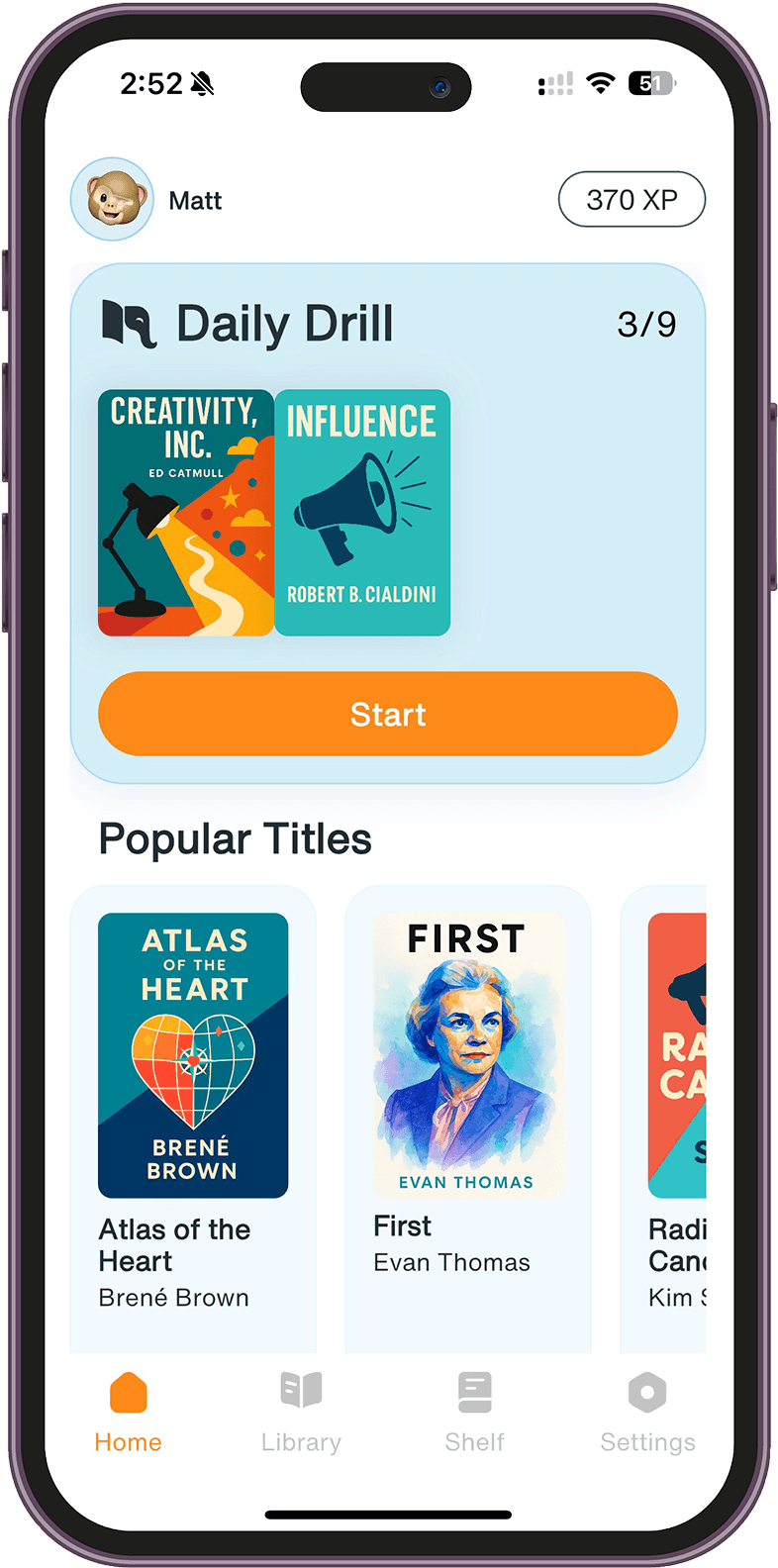
Loxie uses spaced repetition and active recall—the same learning science Sharma references—to help you retain the key concepts from The 5AM Club. Instead of reading the book once and watching the ideas fade, you practice for just 2 minutes a day with questions that resurface concepts right before you'd naturally forget them.
Active recall forces your brain to retrieve information rather than passively recognize it. This retrieval practice strengthens neural pathways far more effectively than re-reading or highlighting. Spaced repetition optimizes the timing of these practice sessions, ensuring you review ideas at the precise intervals that maximize long-term retention while minimizing study time.
The result: the 20/20/20 Formula stays accessible months after you've read the book. The 66-day protocol timeline remains clear when you're in the difficult destruction phase. The four interior empires framework is available when you're designing your personal development plan. The concepts aren't just understood—they're remembered, ready for application when you need them most.
Loxie includes The 5AM Club in its full topic library, so you can start reinforcing these morning routine concepts immediately. Your first hour of the day changes your life—but only if you remember how to use it.
Frequently Asked Questions
What is the main idea of The 5AM Club?
The central idea is that waking at 5 AM and following the 20/20/20 Formula—20 minutes of exercise, 20 minutes of reflection, and 20 minutes of learning—creates a compounding advantage that transforms productivity, health, and happiness over time. How you start your day determines your entire trajectory.
What is the 20/20/20 Formula in The 5AM Club?
The 20/20/20 Formula divides the first hour after waking into three segments: Move (20 minutes of intense exercise to activate BDNF and clear cortisol), Reflect (20 minutes of meditation or journaling for emotional processing), and Grow (20 minutes of learning to compound knowledge daily).
How long does it take to build the 5 AM habit?
According to Sharma's 66-day protocol, habit installation takes approximately 66 days divided into three phases: Destruction (days 1-22, when old patterns break down), Installation (days 23-44, when new pathways form), and Integration (days 45-66, when the behavior becomes automatic).
What are the four interior empires in The 5AM Club?
The four interior empires are Mindset (psychology and beliefs), Heartset (emotional health and processing), Healthset (physical vitality and energy), and Soulset (spiritual meaning and purpose). Sustainable success requires developing all four dimensions simultaneously.
Why is 5 AM specifically the recommended wake time?
Five AM provides a full hour of self-development before typical 6 AM obligations begin, while aligning with natural circadian rhythms when cortisol levels peak and the prefrontal cortex is freshest. This creates a protected window that's both neurologically optimal and practically feasible.
How can Loxie help me remember what I learned from The 5AM Club?
Loxie uses spaced repetition and active recall to help you retain key concepts from The 5AM Club. Instead of reading the book once and forgetting most of it, you practice for 2 minutes a day with questions that resurface ideas right before you'd naturally forget them. Loxie includes The 5AM Club in its full topic library.
We're an Amazon Associate. If you buy a book through our links, we earn a small commission at no extra cost to you.
Stop forgetting what you learn.
Start learning for good with your 7-day FREE trial.