The Culture Code: Key Insights & Takeaways from Daniel Coyle
Master Daniel Coyle's research-backed framework for building high-performing teams through safety, vulnerability, and purpose.
by The Loxie Learning Team
Why do some teams consistently outperform others with far more talent and resources? Daniel Coyle spent four years studying the world's most successful groups—from Navy SEAL Team Six to Pixar to championship basketball teams—and discovered that great culture isn't mysterious or innate. It's built through three specific, learnable skills that anyone can practice.
This guide breaks down Coyle's complete framework for creating high-performing team cultures. You'll learn why belonging cues matter more than mission statements, how vulnerability loops build trust faster than years of working together, and why simple purpose narratives outperform complex strategic plans. Whether you lead a Fortune 500 division or a small project team, these principles apply.
 Start practicing The Culture Code free for 7 days ▸
What are the three skills that build successful group cultures?
Successful group cultures are built on three learnable skills: creating psychological safety through belonging cues, building trust through shared vulnerability, and establishing clear purpose through simple narratives. These aren't abstract values—they're specific, observable behaviors that transform how groups function. The framework explains a counterintuitive finding: groups of average individuals often outperform collections of stars because culture acts as a force multiplier for individual contributions.
What makes this insight powerful is its practicality. Culture isn't something mystical that some groups possess and others lack. It's something you actively create through repeated micro-behaviors. Every interaction either reinforces or erodes the three foundational skills. Understanding this transforms culture-building from hoping for the right chemistry to deliberately practicing the right actions.
Coyle's research across Navy SEALs, Pixar, and elite restaurants reveals remarkably consistent patterns. Despite operating in completely different domains, these groups all invest heavily in the same three areas. They obsess over signals that make people feel safe. They create structures that normalize vulnerability. They repeat simple narratives that connect daily work to larger meaning. The consistency across contexts suggests these aren't industry-specific tactics but fundamental principles of human group dynamics.
Why is culture something you do rather than something you are?
Culture is not a static identity—it's a continuous process of micro-behaviors that signal safety, shared risk, and shared purpose. This behavioral view shifts focus from abstract values hanging on walls to concrete actions happening in meetings, hallways, and daily interactions. Every moment where someone signals "you are safe here," "we share risk together," or "this is why we exist" adds to the cultural fabric.
This perspective makes culture measurable and improvable. Instead of vaguely hoping your team "has good culture," you can observe specific behaviors: Are people making eye contact? Is speaking time distributed equally? Do leaders admit mistakes first? Are purpose narratives repeated consistently? These observable patterns predict group performance with remarkable accuracy—MIT researchers could predict team success with 90% accuracy just by measuring interaction dynamics.
The behavioral view also explains why culture change feels so difficult. You can't just announce new values and expect transformation. You have to change thousands of tiny daily behaviors. But this same insight offers hope: you don't need dramatic interventions. Small, consistent changes in how people interact compound into cultural transformation. Loxie helps leaders internalize these behavioral patterns so they become automatic rather than forced—because culture-building skills only work when they're genuinely reflexive.
How does one bad apple actually affect team performance?
A single toxic team member reduces group performance by 30-40% because humans unconsciously mirror negativity more strongly than positivity. Research shows that negative behaviors are five times more impactful than positive ones in group settings. This asymmetry means one consistently negative person can overwhelm the positive contributions of an entire team.
The mechanism is neurological: our brains evolved to prioritize threats over opportunities for survival. When someone displays contempt, cynicism, or hostility, team members unconsciously shift into self-protection mode. Cognitive resources that would otherwise fuel collaboration and creativity get redirected to vigilance and defense. The whole group becomes less creative, less trusting, and less willing to take risks.
This explains why successful cultures actively screen out "brilliant jerks" regardless of individual talent. Google's Project Aristotle found that psychological safety mattered more than collective IQ for team performance. A highly skilled person who damages group safety isn't a net positive—they're actively destroying the conditions that enable everyone else's best work. Cultural protection becomes as important as cultural creation.
Practice these team dynamics in Loxie ▸
What are belonging cues and why do they matter so much?
Belonging cues are micro-behaviors that signal "you are part of this group and we have a shared future." They trigger primitive brain circuits that shift individuals from self-protection mode to group-contribution mode—often within minutes. These signals work below conscious awareness, answering the fundamental question our brains constantly ask: "Are we safe here?"
When the answer is yes, cognitive resources shift from vigilance to collaboration. People become willing to take creative risks, offer honest feedback, and contribute their best thinking. When the answer is no, people hold back, play it safe, and prioritize self-protection over group success. The difference between high-performing and struggling teams often comes down to the density and consistency of belonging cues in everyday interactions.
The three patterns of effective belonging cues
Effective belonging cues follow three consistent patterns: energy (investing visible effort in the exchange), individualization (treating people as unique individuals rather than interchangeable roles), and future orientation (signaling that the relationship will continue). Together, these create psychological safety.
Leaders who master these three elements create environments where people feel safe enough to take risks. Gregg Popovich, the legendary San Antonio Spurs coach, exemplifies this through intense eye contact, personalized questions about players' families and interests, and constant references to shared future goals. These aren't management techniques—they're relationship behaviors that happen to work in professional settings.
How do high-performing teams generate collective intelligence?
High-performing cultures generate collective intelligence through specific interaction patterns: equal speaking time, high social sensitivity, and frequent eye contact. These measurable behaviors predict group performance better than individual IQ scores—a finding that challenges conventional assumptions about talent and team composition.
MIT research found these patterns so consistent that researchers could predict team performance with 90% accuracy just by observing communication dynamics, without knowing anything about the actual content of discussions or the credentials of participants. How groups interact matters more than who is in them.
This insight has profound implications for team building and leadership. Traditional approaches focus on assembling the most talented individuals. But if interaction patterns matter more than individual capability, leaders should invest at least as much energy in shaping communication norms as in recruiting stars. The goal isn't just getting smart people together—it's creating conditions where collective intelligence can emerge from their interactions.
Knowing these patterns intellectually isn't the same as applying them automatically
Loxie uses spaced repetition to help you internalize the specific behaviors that build collective intelligence—so they become reflexive when you're actually leading a meeting or joining a conversation.
Try Loxie free for 7 days ▸What are vulnerability loops and how do they build trust?
Vulnerability loops are a specific pattern of interaction where Person A admits a weakness, Person B acknowledges and reciprocates with their own vulnerability, creating escalating mutual disclosure. These loops build trust faster than years of conventional interaction because they signal "we can be weak together"—a profound message of safety and acceptance.
The mechanism explains why intense shared experiences create lifelong bonds. Boot camp, startup struggles, crisis situations—these contexts force mutual vulnerability in high-stakes environments, creating trust that transcends the original setting. The vulnerability wasn't incidental to the bonding; it was the primary mechanism.
This insight can be deliberately applied. Rather than waiting for crises to create bonding opportunities, leaders can design structures that invite safe vulnerability. After Action Reviews, peer coaching programs, and failure-sharing forums all create conditions for vulnerability loops to occur naturally. The key is making vulnerability expected rather than exceptional.
Why does vulnerability signal trust at a biological level?
Vulnerability signals trust because exposing weakness is evolutionarily dangerous. Our brains interpret voluntary vulnerability as the ultimate signal that someone considers us part of their survival group. When someone risks showing incompetence, ignorance, or emotional struggle, they're essentially betting their safety on your response.
This biological programming explains a counterintuitive finding: admitting ignorance or asking for help builds relationships faster than displaying competence. Competence displays can actually inhibit trust formation because they don't trigger the reciprocal circuits that vulnerability activates. Showing strength signals status; showing weakness signals connection.
Understanding this mechanism helps leaders recognize why their attempts to appear confident and capable might backfire. The leader who admits "I don't know" or "I made a mistake" isn't displaying weakness—they're building the foundation for trust that no amount of impressive credentials can create.
Why must leaders go first in showing vulnerability?
Leaders must go first in vulnerability because hierarchy creates asymmetric risk. Subordinates revealing weakness face potential career consequences—being seen as incompetent, passed over for promotion, or viewed as liabilities. Leaders demonstrating fallibility face primarily reputational gains from appearing humble and human.
This power dynamic explains why leader vulnerability has disproportionate impact on culture. When those with the least to lose take the first risk, it signals safety for everyone else to follow. The message is clear: if the person with the most status can admit mistakes, it must be safe for the rest of us.
Navy SEAL Team Six's After Action Reviews institutionalize this principle. Rank is removed during reviews, leaders go first in admitting errors, and the focus stays on process rather than blame. By creating structured protocols where leader vulnerability is expected, they transform what might feel like weakness into obvious strength.
What makes the magical feedback formula so effective?
The magical feedback formula—"I'm giving you these comments because I have very high expectations and I know that you can reach them"—increases effort by 40% because it combines challenge with belonging in a single statement. Research shows this 19-word sentence dramatically improves how people receive and act on criticism.
The formula works by addressing both fundamental psychological needs simultaneously. The challenge ("very high expectations") signals respect for the recipient's capability—you wouldn't push someone hard unless you believed in their potential. The belonging cue ("I know you can reach them") ensures psychological safety, communicating that the feedback comes from investment in success rather than desire to criticize.
This combination creates optimal conditions for growth. Without challenge, people plateau. Without safety, people become defensive. The formula threads this needle by making high standards feel supportive rather than threatening. It transforms feedback from something people endure to something they genuinely welcome.
How did Johnson & Johnson's Credo guide them through crisis?
Johnson & Johnson's Credo—a simple 300-word statement placing customers first, employees second, community third, and shareholders last—provided clear decision-making priorities during the 1982 Tylenol crisis when every option seemed wrong. Seven people died from cyanide-laced capsules, and the company had to decide whether to recall all products at massive cost or take a more measured approach.
The Credo's power came not from its content but from its simplicity and years of constant reinforcement. When crisis hit, employees didn't need to deliberate about priorities—customers came first, period. This enabled rapid, unified response: a nationwide recall that ultimately saved the brand by demonstrating genuine commitment to the stated values.
Most organizations have values statements that fail in crisis because they're either too complex to remember or too rarely reinforced to be automatic. The lesson isn't the specific content of Johnson & Johnson's Credo but the principle: purpose statements only guide decisions when they're simple enough to be memorable and repeated enough to be reflexive.
How does Pixar's Braintrust enable honest creative feedback?
Pixar's Braintrust separates creative feedback from power dynamics by having directors present work-in-progress to peers who offer candid notes without any authority to mandate changes. This structure enables brutal honesty without triggering the defensiveness that typically accompanies criticism, because creators maintain complete autonomy over their work.
The key insight is that most feedback fails not because it's wrong but because it threatens the recipient's sense of control. When someone has power over your work, honest criticism feels dangerous regardless of how it's delivered. By removing the ability to impose changes while maintaining the expectation of honest assessment, Braintrust creates a unique dynamic where creators genuinely want feedback.
This principle applies beyond creative contexts. Any situation where you want honest input requires separating the roles of "evaluator" and "decision-maker." When the person giving feedback can't force implementation, defensiveness drops and genuine learning becomes possible.
Why should you name and rank your priorities explicitly?
If everything is important, nothing is. Clear priority hierarchies enable rapid decision-making while ambiguous priorities create paralysis and politics. When employees must guess which value matters most in a given situation, they either freeze or make inconsistent choices that erode trust in the organization's stated principles.
Organizations that rank their values explicitly—customer first, employee second, shareholder last—make faster, more consistent decisions. The ranking eliminates deliberation when values conflict. Should we inconvenience shareholders to better serve customers? The hierarchy answers instantly. Should we invest in employee development even when it hurts short-term profits? The ranking decides.
This principle explains why simple, ranked purpose statements outperform elaborate strategic documents. The goal isn't comprehensiveness—it's clarity that enables action without consultation. When Danny Meyer's restaurant team faces a choice between operational efficiency and guest experience, "hospitality first" provides immediate guidance. No meeting required.
Start retaining what you learn ▸
The real challenge with The Culture Code
The Culture Code delivers a comprehensive framework for building great teams—belonging cues, vulnerability loops, purpose narratives, and dozens of specific tactics. Reading it feels illuminating. You understand why certain teams thrive and see clear actions you could take. But here's the problem: understanding isn't the same as remembering, and remembering isn't the same as doing.
Research on the "forgetting curve" shows we lose 70% of new information within 24 hours without reinforcement. How many books have you read that felt transformative in the moment but now you struggle to recall three key points? The Culture Code's insights are only valuable if they're available when you're actually leading a meeting, giving feedback, or navigating team conflict.
The gap between knowing and doing is especially wide for behavioral skills. It's one thing to remember that "leaders should go first in vulnerability." It's another to actually do it in the moment when you feel pressure to appear competent. Cultural leadership requires reflexive application of principles—and that only comes from repeated practice, not one-time reading.
How Loxie helps you actually remember what you learn
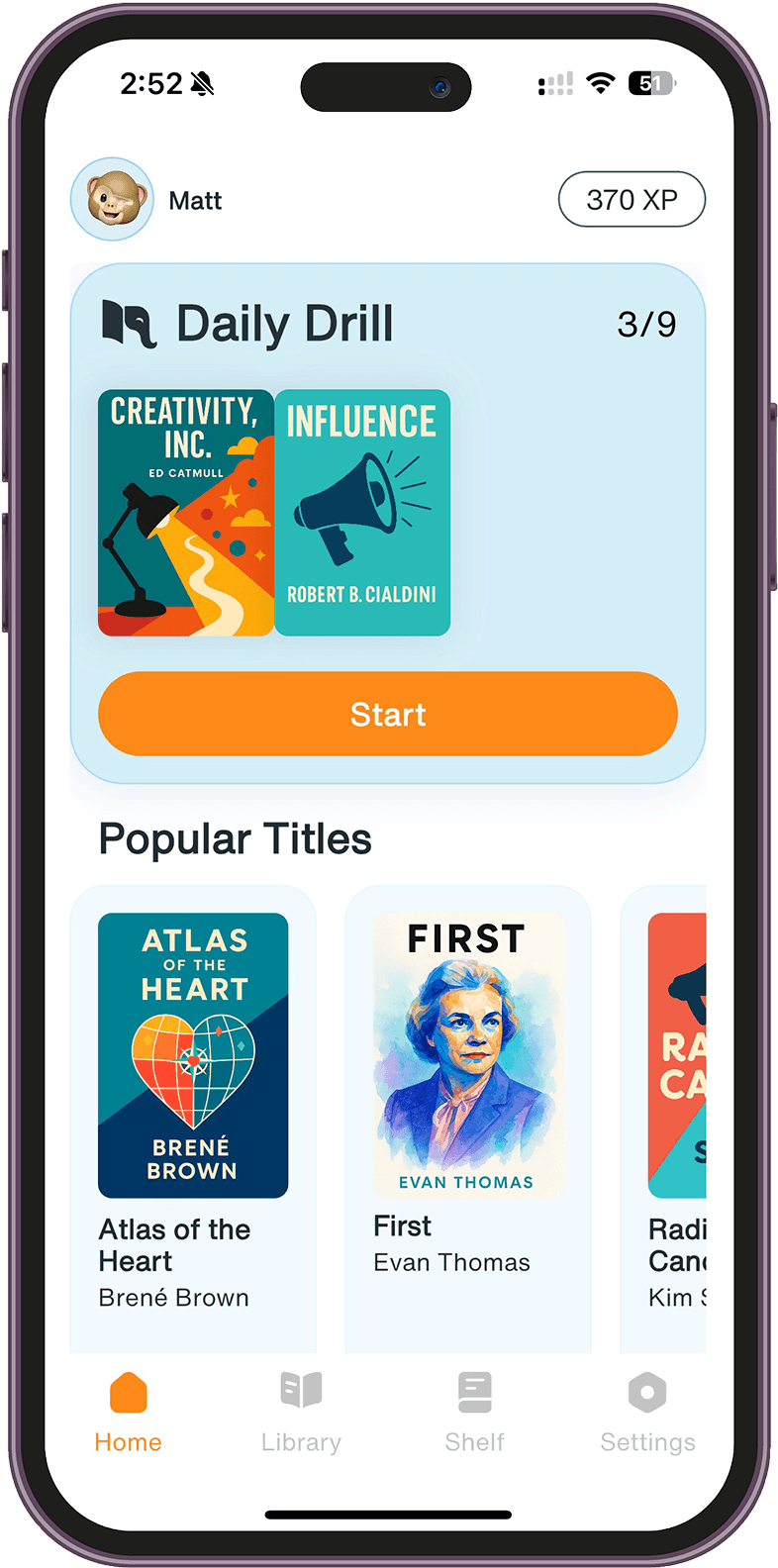
Loxie uses spaced repetition and active recall—the two most scientifically validated learning techniques—to help you actually retain The Culture Code's insights. Instead of reading once and hoping the ideas stick, you practice for just 2 minutes a day with questions that resurface concepts right before you'd naturally forget them.
The approach transforms passive knowledge into active capability. When you repeatedly retrieve information about vulnerability loops or belonging cues, you're not just memorizing definitions—you're building neural pathways that make these concepts available when you actually need them. The goal isn't to recite Coyle's framework on command; it's to have these principles shape your leadership behavior automatically.
Loxie's free version includes The Culture Code in its topic library, so you can start reinforcing these culture-building skills immediately. Whether you're preparing to lead a new team or trying to transform an existing one, daily practice ensures the insights stay fresh and actionable.
Frequently Asked Questions
What is the main idea of The Culture Code?
The core idea is that successful group cultures are built on three learnable skills: creating psychological safety through belonging cues, building trust through shared vulnerability, and establishing clear purpose through simple narratives. These aren't innate qualities but specific, practiceable behaviors that transform how teams perform.
What are the key takeaways from The Culture Code?
The key takeaways include: culture is something you do through micro-behaviors, not something you are; one toxic person reduces team performance by 30-40%; belonging cues matter more than mission statements; vulnerability loops build trust faster than years of working together; and simple, ranked priorities enable better decisions than comprehensive strategic plans.
What are belonging cues and how do they work?
Belonging cues are micro-behaviors that signal "you are part of this group and we have a shared future." They follow three patterns: energy (investing effort in exchanges), individualization (treating people as unique), and future orientation (signaling ongoing relationship). These cues trigger brain circuits that shift people from self-protection to collaboration mode.
Why is vulnerability important for building team trust?
Vulnerability signals trust because exposing weakness is evolutionarily risky—our brains interpret voluntary vulnerability as proof someone considers us part of their survival group. This triggers reciprocal trust circuits that competence displays actually inhibit. Leaders must go first because hierarchy creates asymmetric risk for subordinates.
How can I apply The Culture Code principles to my team?
Start with belonging cues in every interaction: make eye contact, use names, reference shared future. Create structures for safe vulnerability like After Action Reviews where leaders admit mistakes first. Develop a simple, ranked purpose statement and repeat it constantly. Focus on interaction patterns—equal speaking time and active listening—over recruiting stars.
How can Loxie help me remember what I learned from The Culture Code?
Loxie uses spaced repetition and active recall to help you retain The Culture Code's key concepts. Instead of reading once and forgetting most of it, you practice for 2 minutes a day with questions that resurface ideas right before you'd naturally forget them. Loxie includes The Culture Code in its full topic library.
We're an Amazon Associate. If you buy a book through our links, we earn a small commission at no extra cost to you.
Stop forgetting what you learn.
Start learning for good with your 7-day FREE trial.