The Defining Decade: Key Insights & Takeaways from Meg Jay
Discover why your twenties matter more than any other decade—and the science-backed strategies to make them count.
by The Loxie Learning Team
What if the decade you're taught to "figure things out" is actually the one that determines everything? In The Defining Decade, clinical psychologist Meg Jay argues that your twenties aren't a throwaway period for exploration—they're the most consequential years of your adult life. The statistics are sobering: 80% of life's most defining moments happen before age 35, and two-thirds of lifetime wage growth occurs in the first ten years of a career.
This guide breaks down Jay's complete framework for making your twenties count. Drawing from neuroscience research and real client stories, you'll understand why the choices you make now have an outsized impact on your career, relationships, and identity—and what to do about it. Whether you're in your twenties now or advising someone who is, these insights reveal why urgency isn't pressure but opportunity.
 Start practicing The Defining Decade free for 7 days ▸
Why are your twenties called the defining decade?
Your twenties are called the defining decade because 80% of life's most significant events cluster during this period—and the consequences compound for decades afterward. The job you accept at 25 shapes your earning potential at 45. The partner you choose becomes the co-creator of your children's genetics and family environment. The habits you form become the neural pathways that govern adult behavior.
This isn't motivational rhetoric—it's developmental science. Two-thirds of lifetime wage growth happens in the first ten years of a career, not because employers reward youth, but because early career momentum creates opportunities that late starters never access. Personality changes more during the twenties than at any other adult stage. And the brain undergoes its final major rewiring before the frontal lobe fully connects around age 30.
Jay's core argument is that treating your twenties as a developmental playground—waiting for real life to begin at 30—means arriving at adulthood without the identity capital, relationship skills, or career foundation that earlier decades were meant to build. The defining decade defines precisely because it's the last chance for certain kinds of growth.
What is identity capital and why does it matter so much in your twenties?
Identity capital refers to the collection of personal assets—degrees, jobs, relationships, skills, and experiences—that you accumulate over time and that compound in value. Unlike financial capital, which can theoretically be built at any age, identity capital has a critical accumulation window because each piece builds on previous ones.
The internship leads to the job. The job leads to the expertise. The expertise opens doors that remain permanently closed to late starters. This isn't about prestige or resume padding—it's about creating options. A twentysomething who spends five years building identity capital in their field has exponentially more career flexibility at 30 than someone who spent those years "keeping options open" by never committing to anything.
Jay emphasizes that identity capital includes intangible assets too: the confidence that comes from completing hard things, the network built through professional relationships, the self-knowledge gained from actually doing work rather than imagining it. These compound just like skills do. The twentysomething who practiced handling workplace conflict, giving presentations, and navigating office politics arrives at 30 with capabilities their exploring peers never developed. Loxie helps you retain these frameworks about identity capital so you can apply them intentionally rather than realizing their importance only in retrospect.
How does present bias affect twentysomething decision-making?
Present bias is the neurological tendency to value immediate rewards over future benefits—and it's biologically stronger in twentysomethings because the frontal lobe responsible for considering long-term consequences isn't fully developed until around age 30. This isn't a character flaw or lack of discipline; it's brain architecture.
This developmental reality explains patterns that frustrate older generations: why a twentysomething chooses the fun job over the career-building one, the exciting partner over the compatible one, the immediate social event over the gym session. The brain literally discounts future rewards more heavily when the neural machinery for future-thinking is still under construction.
Jay's solution isn't willpower but systems. Because the future feels abstract to the twentysomething brain, you need to make future-oriented choices feel more immediate and tangible. Visualization exercises that create vivid images of your future self. Automatic savings that remove the daily decision. Explicit commitments that create social accountability. The goal is to override the bias by engineering an environment where the right choice is also the easy choice.
What is the paradox of choice and how does it trap twentysomethings?
The paradox of choice describes how having unlimited options actually decreases satisfaction and increases regret. Every choice means mourning the infinite paths not taken, and twentysomethings face this psychological burden more intensely than any previous generation—more career options, more potential partners, more cities to live in, more identities to try on.
This explains why commitment-phobic twentysomethings often feel more trapped by keeping all options open than they would by actually choosing a direction. The mental energy spent maintaining possibilities—researching other careers, keeping backup partners at arm's length, refusing to commit to a city—prevents deep investment in any actual path. You end up with many shallow experiments rather than one meaningful trajectory.
Jay argues that active decisions that close doors create more life satisfaction than perpetual optionality. Just as sonnets produce better poetry than free verse for most writers, life constraints force innovation and mastery that endless possibility actively undermines. Limitation becomes a tool for actualization rather than a form of settling. The twentysomething who chooses a career path and goes deep builds expertise their option-hoarding peers never develop.
Why is partner selection one of the most important decisions of your twenties?
Choosing a partner in your twenties isn't just choosing a person—you're selecting the co-creator of your future children's genetics, personality influences, and the extended family network that will shape decades of holidays, crises, and daily life. This multi-generational impact makes partner selection one of the highest-stakes decisions you'll ever make.
Yet it's often treated more casually than choosing a college or job despite having far greater long-term consequences. Studies show that spouse characteristics predict career success more accurately than education or early job choices: their geographic flexibility determines which opportunities you can pursue, their financial stability affects your risk tolerance, and their emotional support shapes which dreams require compromise.
What predicts relationship success better than chemistry?
Compatibility in core values—attitudes about money, family, ambition, and lifestyle—predicts relationship success five times better than chemistry or attraction. Yet twentysomethings consistently prioritize immediate spark over long-term alignment, committing based on the most visible but least predictive factor.
This misprioritization occurs because values compatibility reveals itself slowly through everyday decisions while chemistry is immediately felt. You know within seconds whether you're attracted to someone; you discover whether they share your financial philosophy only after months of observing their spending. Jay encourages twentysomethings to treat these slow-reveal characteristics as primary selection criteria rather than afterthoughts.
What does "dating up" actually mean?
Dating up means choosing partners who inspire growth rather than enable stagnation—someone whose ambitions, emotional maturity, and values pull you toward your best self rather than validating your current limitations. This isn't about status or perfection but about positive peer pressure.
The partner who makes you want to read more, communicate better, and pursue goals creates a different life trajectory than the one who makes Netflix and complaints feel like enough. Your closest relationship becomes your most powerful developmental environment, for better or worse.
Knowing what to look for in a partner isn't the same as remembering it when you're actually dating.
Loxie helps you internalize these relationship frameworks through spaced repetition, so Jay's insights about values compatibility and dating up become instincts rather than forgotten advice.
Practice these concepts in Loxie ▸What is relationship inertia and why is cohabitation risky?
Relationship inertia occurs when couples slide into living together for convenience—splitting rent, spending time together anyway—then find themselves locked in by shared leases, pets, furniture, and merged lives. The logistics of separation raise the bar for leaving far above the bar that was set for moving in.
Jay calls this "sliding versus deciding." Cohabitation as a test of compatibility actually obscures compatibility issues rather than revealing them, because the exit barriers accumulate before you've genuinely evaluated whether this person is a life partner. You end up trapped not by commitment but by convenience.
This incremental entanglement explains why so many unhappy couples stay together for years: not because of love, but because separating two merged lives feels more daunting than enduring dissatisfaction. Lock-in happens through small conveniences that individually seem minor but collectively create exit barriers higher than the entry standards. The solution isn't avoiding cohabitation but ensuring that moving in represents a deliberate decision about long-term compatibility rather than a drift toward shared Netflix accounts.
How does the twentysomething brain differ from older brains?
The twentysomething brain undergoes its final major rewiring, with the frontal lobe—responsible for planning, emotion regulation, and judgment—not fully connecting until nearly 30. This extended plasticity means that habits, thinking patterns, and emotional responses developed in your twenties literally become the hardwired defaults for adult life.
This is both opportunity and responsibility. The brain is still malleable enough for significant change, making this the last period for major neural reorganization. But that malleability cuts both ways: the patterns you practice become the patterns you're stuck with. The twentysomething who develops emotional regulation skills builds neural architecture that makes calm responses automatic at 40. The one who practices avoidance wires avoidance into their default operating system.
Jay emphasizes that forward thinking must be deliberately practiced in your twenties because prospective memory—the ability to imagine future consequences—is the last cognitive function to fully develop. Visualization exercises, explicit future-self conversations, and five-year plans aren't just helpful productivity tools; they're neurologically necessary for building the mental machinery that adult decision-making requires.
Start retaining what you learn ▸
Why does confidence come from action rather than waiting to feel ready?
Confidence is a byproduct of action, not a prerequisite for it. Waiting to feel ready before starting ensures you'll never begin, because genuine confidence comes from experiencing your own capability—and you can't experience capability without taking action. The assumed sequence of confidence-then-action is reversed: action creates the competence that creates confidence.
This means twentysomethings should pursue opportunities that feel slightly beyond their current capability. The stretch zone between comfort and panic is where both growth and confidence develop. Taking on projects you're not quite ready for, applying to jobs that feel like a reach, having conversations that feel awkward—these create the track record of success that builds authentic self-belief.
Jay describes this as "do good, be good"—acting confident creates actual confidence through a neurological feedback loop. Your brain interprets your bold behavior as evidence that you must be capable, updating your self-concept accordingly. Impostor syndrome isn't a permanent identity; it's a temporary state that behavioral courage dissolves. With Loxie, you can reinforce these mindset shifts through daily practice, transforming intellectual understanding into genuine psychological change.
What is the strength of weak ties and why does it matter for career building?
The strength of weak ties is a sociological principle showing that new opportunities come from acquaintances and distant connections six times more often than from close friends. Your best friend knows the same people and information you do; that random LinkedIn connection or conference contact bridges you to entirely different networks.
These weak ties serve as bridges between social clusters, providing access to opportunities, information, and perspectives that don't exist in your immediate circle. The insider knowledge and introductions that transform careers rarely come through job boards or formal applications—they come through peripheral contacts who happen to know about an opening in their company or industry.
How can you leverage weak ties without feeling awkward?
The Ben Franklin effect demonstrates that asking for small favors from influential weak ties actually makes them like you more, not less. This contradicts the fear that reaching out for help will be seen as imposing or bothersome. People justify their helpful behavior by concluding they must like you, creating a positive feedback loop.
This psychological principle means that requesting advice, asking for informational interviews, or seeking introductions transforms distant contacts into invested mentors. The key is specificity: asking for a clearly defined small favor ("Could you spare 15 minutes to tell me about your path into this industry?") rather than vague requests that feel like obligations.
How do family stories and childhood patterns affect adult life?
Unexamined family stories operate like invisible scripts, causing twentysomethings to unconsciously recreate their parents' limitations or rebel in equally limiting ways. Someone raised by a workaholic father might choose poverty to avoid repeating his mistakes—trading one extreme for another rather than finding balance.
The "working model" of relationships formed in childhood continues to dictate professional dynamics. Those who learned that love requires constant performance become workaholics. Those who experienced inconsistent care develop imposter syndrome, expecting rejection despite evidence of competence. These aren't personality traits—they're transferred survival strategies from environments that no longer apply.
Breaking these patterns requires explicitly identifying the family narrative you've inherited, then consciously choosing which elements to keep and which to rewrite. This isn't about blaming parents but about gaining awareness. The twentysomething who recognizes that her perfectionism traces to childhood performance demands can separate that survival strategy from adult professional choices, preventing self-sabotage disguised as "just how I am."
What does Jay say about fertility and timing decisions?
Female fertility declines sharply after 35, while reproductive technology success rates are widely overestimated. IVF works 20-35% of the time for women over 35—not the near-guarantee many twentysomethings assume when indefinitely postponing childbearing decisions.
This mismatch between biological reality and cultural assumptions means women who want children need to factor fertility windows into career and relationship timing. The narrative that you can focus on career now and have children whenever technology has solved—treating reproduction as infinitely postponable—doesn't align with actual medical outcomes.
Jay isn't arguing that everyone should have children young, but that those who want children should make that a conscious part of life planning rather than something that will "work out later." The career sprints of your late twenties and early thirties coincide with peak fertility, creating tradeoffs that deserve explicit consideration rather than default assumptions about future options.
How do health habits in your twenties affect long-term wellbeing?
Health habits in your twenties set biological age more than chronological age does. A 30-year-old who exercised and ate well throughout their twenties has younger cellular markers than a sedentary 25-year-old. This biological banking means the health investments of your twenties pay compound interest across your entire lifespan.
Muscle mass built now prevents frailty at 70. Bone density accumulated now prevents fractures at 60. Cardiovascular fitness gained now extends both lifespan and healthspan—the years of life spent in good health rather than merely alive. The twenties aren't just for enjoying youthful metabolism; they're for building the biological reserves you'll draw on for decades.
This compounds with the neural patterns discussed earlier. Exercise habits established in your twenties become hardwired defaults. The person who builds a consistent workout routine now doesn't need willpower to exercise at 45—it's simply what they do. The person who never establishes that pattern faces an uphill rewiring battle when health consequences finally become undeniable.
How can you manage anxiety and distinguish it from intuition?
Twentysomething anxiety often stems from intrusive thoughts that feel like intuition but are actually the amygdala's false alarms. Learning to distinguish fear from wisdom requires checking anxious thoughts against evidence rather than treating every worry as meaningful truth.
This confusion leads twentysomethings to either avoid important risks (mistaking fear for a "sign" that something is wrong) or ignore genuine warnings (dismissing intuition as "just anxiety"). Emotional calibration—developing accurate internal signals—becomes essential for good judgment in an uncertain decade.
What calming techniques actually work?
Calming techniques work backward from body to brain. Slowing your breathing activates the vagus nerve, which signals safety to the amygdala, making physiological intervention more effective than trying to think your way out of anxiety. This biological override explains why meditation, exercise, and breathing exercises work when rational self-talk fails: they bypass anxious thoughts to directly calm the nervous system generating them.
The practical implication is that twentysomethings should build physical anxiety management tools rather than relying on cognitive reframing alone. The brain that won't respond to "calm down" will respond to ten deep breaths, a short walk, or progressive muscle relaxation. These aren't alternatives to addressing anxiety's causes—they're prerequisites for thinking clearly enough to do so.
What does managing up mean and why does it accelerate careers?
Managing up means actively helping your boss succeed rather than just completing assigned tasks. Promotions come from people, not performance metrics, and your boss's success determines their ability to advocate for you. The employee who makes their supervisor look good becomes an ally worth advancing.
This strategic focus transforms you from an employee to an invested partner. Understanding your boss's goals, anticipating problems before they ask, making their job easier—these create reciprocal investment that turns managers into career sponsors. Perfect task execution alone doesn't build the relationship capital that promotions require.
Twentysomethings often mistake professional boundaries for unfriendliness, expecting workplace relationships to mirror college friendships. When colleagues maintain appropriate distance despite good working relationships, it can feel like rejection. But friendly professionalism is the workplace norm; expecting personal intimacy from professional contexts causes unnecessary anxiety and can lead to oversharing that damages career prospects.
The real challenge with The Defining Decade
The Defining Decade delivers urgent, research-backed insights about the most consequential years of your life. But here's the uncomfortable truth: reading these insights once isn't enough. Within a week, you'll forget most of what you learned. Within a month, the urgency fades. Within a year, you're back to the default behaviors the book warned against.
How many books have you read that felt life-changing in the moment but left no lasting trace? The defining decade passes whether or not you remember the frameworks for making it count. The insights about identity capital compound only if they guide actual decisions; the warnings about relationship inertia help only if you recall them while dating.
How Loxie helps you actually remember what you learn
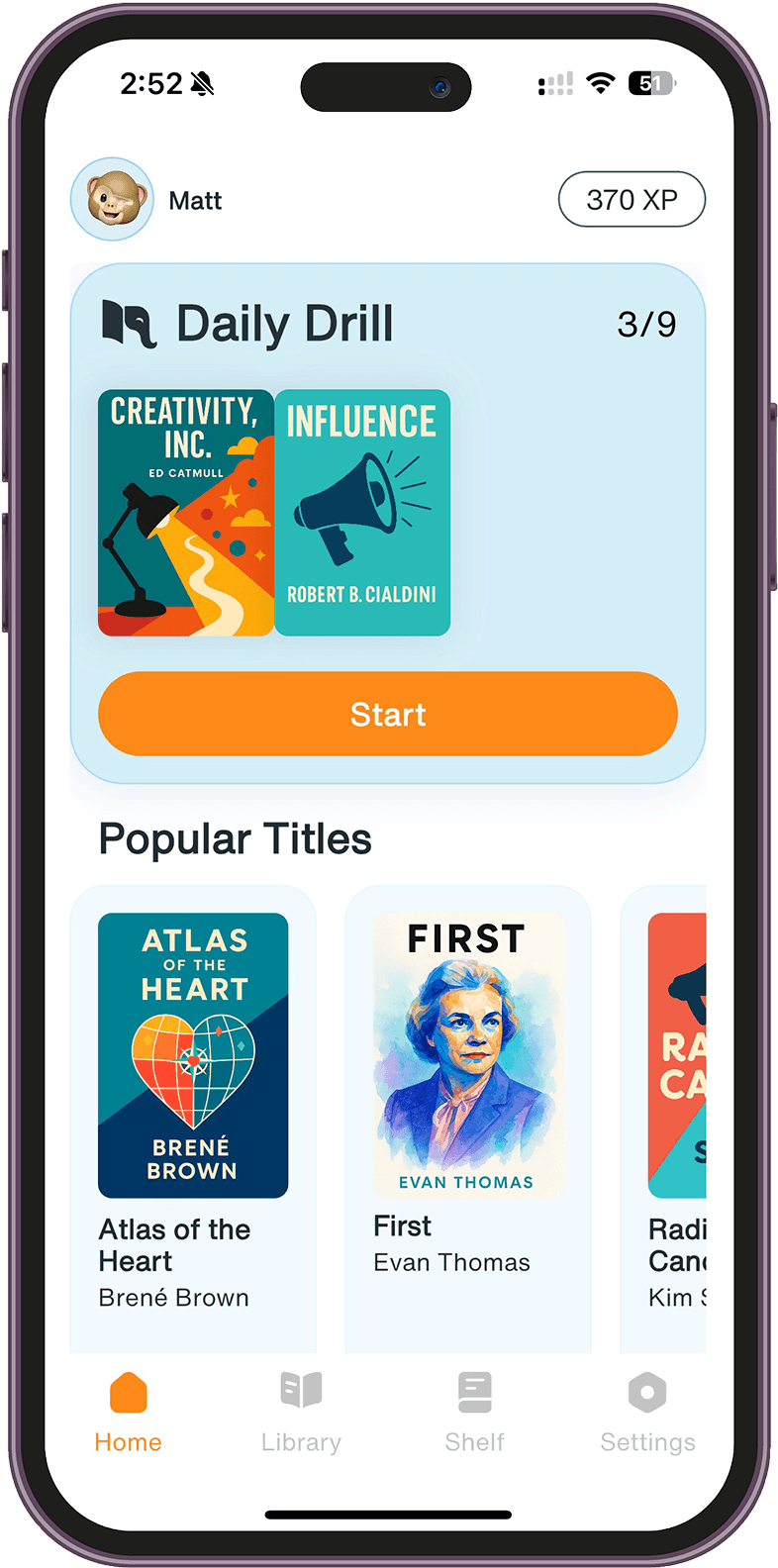
Loxie uses spaced repetition and active recall—the two most effective learning techniques known to cognitive science—to help you retain what you read. Instead of highlighting passages and hoping they stick, you practice for 2 minutes a day with questions that resurface ideas right before you'd naturally forget them.
The timing is precise: Loxie's algorithm tracks what you're about to forget and prompts you to recall it at the optimal moment for memory consolidation. Over weeks, concepts that would have faded become permanently accessible—available when you're actually making career decisions, evaluating partners, or choosing where to invest your twenties.
Loxie includes The Defining Decade in the full topic library, so you can start reinforcing these concepts immediately. Your defining decade is happening now; make sure the insights that could shape it don't disappear by next month.
Frequently Asked Questions
What is the main idea of The Defining Decade?
The core idea is that your twenties are the most transformative and consequential years of adult life—not a throwaway period for exploration. Eighty percent of life's most defining moments happen before 35, and the choices made during this decade about career, relationships, and identity compound into dramatically different life outcomes.
What is identity capital according to Meg Jay?
Identity capital refers to the collection of personal assets you accumulate—degrees, jobs, relationships, skills, and experiences—that compound in value over time. Unlike financial capital, identity capital has a critical accumulation window because each piece builds on previous ones: the internship leads to the job, which leads to the expertise that opens doors closed to late starters.
Why does Meg Jay say cohabitation can be risky?
Jay warns about "sliding versus deciding"—when couples move in together for convenience rather than commitment, they accumulate exit barriers (shared leases, pets, merged finances) before genuinely evaluating long-term compatibility. This relationship inertia makes it harder to leave unsuitable partners than if they'd maintained separate spaces.
What is the paradox of choice and how does it affect twentysomethings?
The paradox of choice describes how unlimited options actually decrease satisfaction and increase regret. Twentysomethings keeping all options open often feel more trapped than those who commit, because the mental energy of maintaining possibilities prevents deep investment in any actual path.
What does Meg Jay say about confidence in your twenties?
Jay argues that confidence comes from action, not before it. Waiting to feel ready ensures you never begin. Taking action despite uncertainty generates the competence that creates genuine confidence—the assumed sequence is reversed. Impostor syndrome is a temporary state that behavioral courage dissolves.
How can Loxie help me remember what I learned from The Defining Decade?
Loxie uses spaced repetition and active recall to help you retain the key concepts from The Defining Decade. Instead of reading the book once and forgetting most of it, you practice for 2 minutes a day with questions that resurface ideas right before you'd naturally forget them. Loxie includes The Defining Decade in its full topic library.
We're an Amazon Associate. If you buy a book through our links, we earn a small commission at no extra cost to you.
Stop forgetting what you learn.
Start learning for good with your 7-day FREE trial.