The End of Burnout: Key Insights & Takeaways from Jonathan Malesic
Discover why burnout is a systemic failure—not a personal one—and learn how to reclaim meaning beyond productivity.
by The Loxie Learning Team
If you've ever felt completely depleted by work—not just tired, but emptied of purpose—you're not alone, and more importantly, it's not your fault. Jonathan Malesic's The End of Burnout makes a compelling case that the exhaustion epidemic plaguing modern workers stems from structural failures in how we've organized work, not from individual weakness or poor self-care habits.
This guide breaks down Malesic's analysis of why burnout has become so pervasive and what genuine solutions look like. You'll understand the cultural forces that created this crisis, why individual resilience strategies fall short, and how we might restructure work to honor human dignity. Whether you're currently burned out, recovering, or trying to prevent it, these insights reveal the deeper dynamics at play.
 Start practicing The End of Burnout free for 7 days ▸
What actually causes burnout according to Malesic?
Burnout emerges from a mismatch between your values and your daily tasks—when work demands emotional investment but offers no authentic purpose in return. This isn't about working too many hours, though overwork certainly contributes. The deeper issue is that modern employment promises meaning, purpose, and fulfillment while delivering repetitive tasks, bureaucratic constraints, and dehumanizing metrics. This gap creates a spiritual crisis rather than mere fatigue.
Malesic argues that the cynicism and depersonalization characteristic of burnout are actually protective responses. When you've invested emotionally in work that promised self-realization but delivered only spreadsheets and performance reviews, pulling back emotionally becomes a survival mechanism. The problem isn't that you care too little—it's that you cared deeply about something that couldn't reciprocate.
Understanding burnout this way transforms how we approach solutions. If exhaustion came purely from overwork, the answer would be simple: work less. But when the core problem is a meaning gap, working fewer hours at a meaningless job still leaves you depleted. Real recovery requires addressing both the structural conditions that created the gap and finding authentic sources of purpose that don't depend on employment.
Why does the myth of work-as-meaning create so much pressure?
The idea that work should provide self-actualization creates crushing pressure because it promises transcendent meaning through employment while most jobs involve mundane tasks that cannot sustain such existential weight. We've culturally agreed that your job should simultaneously provide income, identity, community, purpose, and self-worth—burdens no single institution can realistically bear.
This ideology didn't emerge naturally. It evolved from industrial capitalism's shift from extracting physical labor to demanding emotional investment, passion, and total life commitment from workers. Employers discovered that workers who find meaning in their jobs accept lower wages, longer hours, and worse conditions. The cultural pressure to love your work serves economic interests far more than human flourishing.
The impossible expectations set by work-as-meaning ideology guarantee disappointment. When you're told that the right job will complete you, anything less feels like personal failure. You blame yourself for not finding passion in spreadsheets, for feeling drained by meetings, for wanting boundaries. The truth is that expecting employment to provide ultimate purpose inevitably fails because most jobs involve necessary but ordinary tasks that simply cannot carry that weight.
Practice these concepts in Loxie ▸
How does American work ethic contribute to burnout?
The American work ethic dangerously conflates personal worth with professional achievement, creating a culture where unemployment equals moral failure and overwork signals virtue. This cultural equation means that struggling at work feels like a character defect, and taking breaks triggers guilt rather than restoration.
This moral dimension explains why burnout feels so shameful. If work equals worth, then exhaustion suggests you're somehow deficient—not strong enough, not organized enough, not passionate enough. The logical response becomes working harder, which accelerates the spiral. Malesic traces how this ethic developed through Protestant theology, industrial capitalism, and contemporary hustle culture to create a uniquely American relationship with work that makes sustainable boundaries feel like moral weakness.
Breaking this equation requires recognizing that human dignity exists independently of productive output. Disability advocates have been making this argument for decades, challenging the ableist assumptions that fuel burnout for everyone. When we accept that people have inherent worth regardless of their economic contribution, the moral imperative to overwork dissolves. Work becomes something we do, not something we are.
Where should we actually find meaning if not through work?
Sustainable purpose comes from relationships, community involvement, creative pursuits, and spiritual practices—sources of meaning that exist beyond productivity metrics and workplace achievements. Malesic argues that diversifying your sources of meaning creates resilience that no job can provide or take away.
This doesn't mean work should be meaningless. Rather, it means work should be one source of satisfaction among many, not the exclusive domain of purpose. When your identity doesn't depend entirely on your job, you can set healthier boundaries, recover from setbacks more easily, and evaluate employment opportunities based on realistic criteria rather than hoping each new position will finally complete you.
Monastic communities offer an instructive model here. They structure work around prayer, rest, and communal life—demonstrating that productivity actually increases when work serves life rather than consuming it. The monks Malesic studied don't work less than secular workers, but their work fits within a larger framework of meaning that prevents it from becoming all-consuming. The lesson isn't to join a monastery but to recognize that work functions best when bounded by other priorities.
Understanding burnout intellectually is just the first step
The concepts in The End of Burnout can transform how you relate to work—but only if you remember them when you're deep in a project and tempted to skip lunch again. Loxie uses spaced repetition to keep these insights accessible when you actually need them.
Try Loxie free for 7 days ▸Why is burnout a systemic problem rather than a personal one?
Burnout is a systemic failure of work culture that requires restructuring employment practices, redefining success metrics, and rebuilding boundaries between work and life—not more individual resilience strategies or self-care apps. When millions of people across industries and professions experience the same syndrome, the common factor is clearly the system, not individual weakness.
The focus on personal solutions—meditation apps, time management techniques, yoga breaks—conveniently shifts responsibility from employers to employees. If burnout is your problem to solve, companies don't need to examine unsustainable workloads, toxic management, or impossible expectations. The self-care industrial complex profits from treating symptoms while leaving causes untouched.
This doesn't mean individual actions are pointless. Setting boundaries, diversifying your sources of meaning, and practicing self-compassion genuinely help. But personal strategies alone cannot fix structural problems. Preventing burnout requires simultaneous changes at both individual and systemic levels—personal boundaries alone cannot fix broken systems, while policy changes fail without individual buy-in and behavioral change.
How does the always-on economy eliminate recovery?
The always-on economy eliminates natural work-rest boundaries through smartphones, remote access, and the expectation of constant availability, making recovery impossible and burnout inevitable. When you can receive work emails at midnight and are implicitly expected to respond, the distinction between work time and personal time dissolves.
Technology isn't the root cause—it's the delivery mechanism for deeper cultural expectations. The smartphone didn't create the expectation that good workers are always available; it simply made constant availability technically possible. The problem is a work culture that interprets any boundary as lack of commitment and rewards those willing to sacrifice the most.
Remote work has intensified this dynamic. Without physical separation between office and home, work expands to fill available time. The commute, for all its frustrations, provided a transition that signaled the workday's end. Working from your kitchen table eliminates that natural boundary, requiring conscious effort to create separation that physical workplaces provided automatically.
What does work that honors human dignity look like?
Work should enhance human dignity by providing fair compensation, reasonable boundaries, and respect for workers' full humanity—not consume people's entire identity and leave them exhausted. This means evaluating jobs not just by salary or prestige but by whether they allow space for the rest of life.
Dignified work acknowledges that employees are complete human beings with families, health needs, creative interests, and community obligations. It provides sufficient compensation without demanding total devotion in return. It respects that sustainable productivity requires recovery time and that humans are not machines designed for constant output.
Care-centered organizations offer examples of this approach. They measure success through employee tenure, community relationships, and sustainable practices rather than quarterly profits and productivity metrics. Worker cooperatives demonstrate that shared ownership, democratic decision-making, and profit-sharing create resilient organizations where burnout rates drop because workers control their conditions. These models prove that profitable businesses can operate while honoring human limitations.
Why does accepting human limitations transform work?
Accepting human limitations—our need for rest, community, and boundaries—transforms work from an endless performance into a sustainable practice that honors our finite nature. When you stop pretending you can work indefinitely without consequence, you can structure work around reality rather than fantasy.
The productivity culture that drives burnout depends on denying limitations. The expectation of constant availability assumes humans can function without adequate rest. The demand for passionate engagement assumes emotional energy is infinite. The equation of worth with output assumes value comes only from production. Accepting that these assumptions are false liberates you from impossible standards.
This acceptance isn't resignation or laziness—it's realism. Humans genuinely need rest, connection, and meaning beyond work. Pretending otherwise doesn't eliminate these needs; it just forces them underground where they emerge as exhaustion, cynicism, and health problems. Acknowledging limitations actually improves productivity within sustainable bounds rather than maximizing short-term output at the cost of long-term collapse.
How should work be restructured to prevent burnout?
Work restructuring must prioritize human flourishing over efficiency metrics by implementing flexible schedules, meaningful autonomy, and clear boundaries between work and rest. Malesic advocates for systemic changes that address root causes rather than treating symptoms.
Concrete alternatives exist and work. Sabbaticals provide extended recovery that shorter breaks cannot offer. Job-sharing arrangements reduce individual workloads while maintaining coverage. Results-only work environments replace time-based productivity measures with trust-based systems that honor natural work rhythms. These approaches recognize that sustainable productivity requires designing work around human needs rather than forcing humans to adapt to inhuman demands.
Sustainable work cultures measure success differently. Rather than quarterly profits and productivity metrics alone, they track employee wellbeing, community contribution, and long-term sustainability. This shift requires employers to accept that maximizing short-term extraction creates long-term costs through turnover, disability, and diminished creativity. Organizations that invest in sustainable practices often find they outperform extractive competitors over time.
Start retaining what you learn ▸
What are the historical roots of modern burnout?
The modern burnout epidemic traces directly to industrial capitalism's evolution from extracting physical labor to demanding emotional investment, passion, and total life commitment from workers. Understanding this history reveals that our current crisis isn't inevitable—it's the result of specific choices that can be unmade.
Early industrial work was brutal but bounded. Factory owners wanted your physical labor for specific hours and didn't particularly care about your emotional engagement. The contemporary expectation that you should love your job and find meaning through employment is relatively recent, emerging from post-industrial economies where work shifted from physical production to knowledge and service roles.
This evolution served employer interests. Workers who find meaning in their jobs accept conditions that purely transactional employees would reject. The cultural pressure to be passionate about work effectively transfers compensation from wages to meaning—you're paying for the privilege of caring. Recognizing this dynamic helps explain why overwork feels so natural and boundaries feel so transgressive.
The real challenge with The End of Burnout
Understanding burnout intellectually is different from escaping it. You might finish Malesic's book feeling validated and informed—finally, someone explained why you've been struggling. But a month later, when you're deep in a project and your boss asks for extra hours, will you remember that overwork signals systemic problems, not personal virtue? Will you recall that your worth doesn't depend on your output?
This is the retention problem that undermines even the most transformative books. Research shows we forget roughly 70% of new information within 24 hours and up to 90% within a week. The insights that felt life-changing during reading fade before we can apply them. We return to old patterns not from lack of motivation but because the knowledge simply isn't accessible when we need it.
How Loxie helps you actually remember what you learn
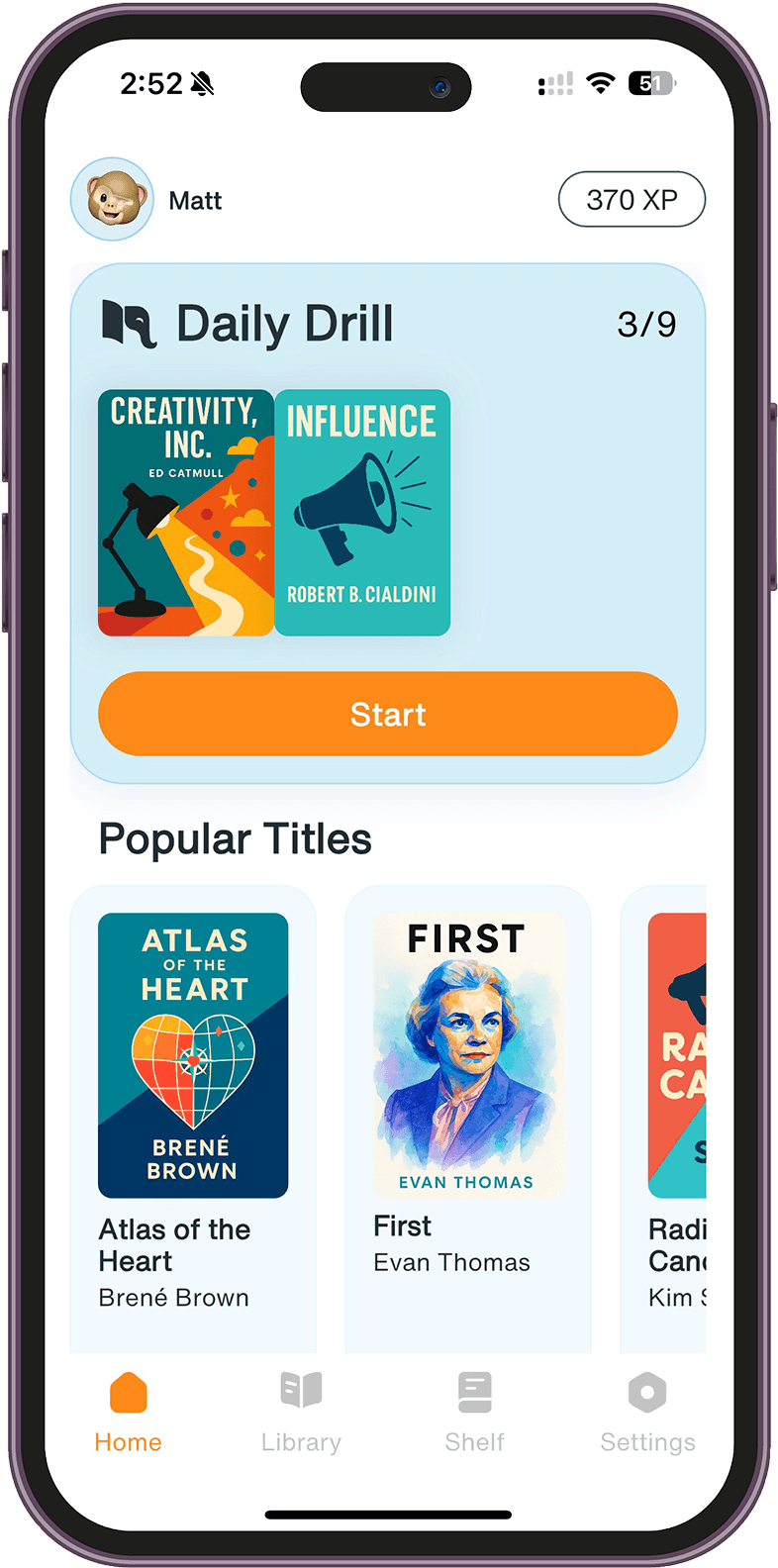
Loxie uses spaced repetition and active recall—the most effective learning techniques cognitive science has discovered—to help you genuinely retain the concepts from The End of Burnout. Instead of reading once and hoping the ideas stick, you practice for just 2 minutes a day with questions that resurface ideas right before you'd naturally forget them.
This approach transforms passive knowledge into available wisdom. When you've actively recalled the concept that burnout reflects systemic failure rather than personal weakness a dozen times over several weeks, that insight becomes genuinely accessible when you need it. You don't just understand that work shouldn't define your worth—you remember it in the moment when you're tempted to sacrifice another evening.
Loxie includes The End of Burnout in its full topic library, so you can start reinforcing these concepts immediately. The goal isn't to memorize the book but to internalize the insights that can actually change how you relate to work—and to have those insights available when facing the real-world pressures that create burnout.
Frequently Asked Questions
What is the main idea of The End of Burnout?
The central argument is that burnout is a systemic failure of work culture, not personal weakness. Modern work promises meaning and self-actualization but delivers repetitive tasks and dehumanizing metrics, creating a gap that exhausts workers emotionally and spiritually. Solutions require structural change, not just individual coping strategies.
What causes burnout according to Jonathan Malesic?
Burnout emerges from a mismatch between your values and daily tasks—when work demands emotional investment but offers no authentic purpose in return. It's not primarily about long hours but about the gap between what jobs promise (meaning, fulfillment, identity) and what they actually deliver (bureaucracy, metrics, precarity).
Why doesn't self-care fix burnout?
Self-care treats symptoms while leaving causes untouched. When millions of people across industries experience burnout, the common factor is clearly systemic—unsustainable workloads, toxic expectations, and work cultures that demand total devotion. Personal strategies help but cannot fix structural problems that require policy and organizational change.
Where should we find meaning if not through work?
Sustainable purpose comes from relationships, community involvement, creative pursuits, and spiritual practices—sources that exist beyond productivity metrics. Diversifying meaning sources creates resilience that no job can provide or take away, allowing work to be one satisfying part of life rather than its entire purpose.
What does dignified work look like?
Dignified work provides fair compensation, reasonable boundaries, and respects workers' full humanity—their families, health, creative interests, and community obligations. It acknowledges that sustainable productivity requires recovery time and that humans are not machines designed for constant output.
How can Loxie help me remember what I learned from The End of Burnout?
Loxie uses spaced repetition and active recall to help you retain key concepts from The End of Burnout. Instead of reading once and forgetting most of it, you practice for 2 minutes a day with questions that resurface ideas right before you'd naturally forget them. Loxie includes this book in its full topic library.
We're an Amazon Associate. If you buy a book through our links, we earn a small commission at no extra cost to you.
Stop forgetting what you learn.
Start learning for good with your 7-day FREE trial.