The Leadership Engine: Key Insights & Takeaways from Noel Tichy
Master Tichy's systematic approach to developing leaders at every level—and building the pipeline that creates sustainable competitive advantage.
by The Loxie Learning Team
Why do some companies consistently produce exceptional leaders while others scramble to fill every vacancy? Noel Tichy's The Leadership Engine reveals that winning organizations don't just hire great leaders—they systematically manufacture them at every level through deliberate processes that multiply leadership capacity exponentially.
This guide breaks down Tichy's complete framework for building a leadership engine that generates sustainable competitive advantage. You'll learn why leaders must teach other leaders directly, how to develop your own teachable point of view, and the specific mechanisms that companies like GE and PepsiCo use to create leadership depth that competitors can't replicate.
 Start practicing Leadership Engine free for 7 days ▸
What is a leadership engine and why do companies need one?
A leadership engine is a systematic process for developing leaders at every organizational level, not just at the top. Companies with functioning leadership engines generate significantly better financial returns because they create exponential leadership capacity rather than relying on a few heroic executives to drive results.
The multiplicative effect works like this: each leader develops multiple other leaders, creating a geometric progression of leadership capability throughout the organization. This distributed leadership enables faster decision-making closer to customers, better execution across all levels, and more innovation from people empowered to lead in their domains.
Traditional companies treat leadership as a scarce resource—something you compete for externally and hoard internally. Leadership engine companies treat it as a renewable resource they manufacture deliberately. The difference shows up in bench strength: while struggling organizations scramble to find one qualified candidate for key positions, leadership engine companies typically have ten ready candidates for every critical role.
Understanding this concept intellectually is one thing. Actually building the reflexes to identify leadership potential, structure development experiences, and teach effectively requires practice. Loxie helps you internalize these frameworks through spaced repetition, so the principles become second nature when you're designing your own leadership development approach.
What is a teachable point of view and how do you develop one?
A teachable point of view is a leader's integrated framework that combines three essential elements: business ideas about how to win, values that define acceptable behavior, and methods for generating emotional energy in others. This framework becomes the DNA of leadership development when leaders actively teach it rather than delegating training to HR departments.
Business ideas: How to succeed
Your business ideas articulate how your organization creates value and wins in the marketplace. These aren't abstract strategy statements—they're the specific insights about customers, competitors, and capabilities that drive your daily decisions. A leader without clear business ideas can't help others make good decisions because they haven't crystallized the logic themselves.
Values: Acceptable behaviors
Values define what behaviors are acceptable on the path to results. Without explicit values, leaders produce results through means that eventually destroy the organization—cutting corners on safety, deceiving customers, or burning out employees. Values create the boundaries within which business ideas get executed sustainably.
Emotional energy: Motivation methods
Emotional energy methods explain how you inspire people to pursue challenging goals. Even brilliant strategy and strong values accomplish nothing without the ability to mobilize human effort. Leaders must articulate not just what they want people to do, but how they generate the enthusiasm and commitment to make it happen.
The test of a developed teachable point of view is simple: can you articulate it in under two minutes? Complexity in explanation reveals confusion in understanding. Leaders who hide behind jargon and lengthy explanations haven't clarified their thinking enough to lead effectively—or to teach others how to lead.
Practice these frameworks in Loxie ▸
Why must leaders teach directly instead of delegating to HR?
Leaders must teach directly because teachable points of view transmit through personal engagement, not standardized programs. When senior leaders actively teach emerging leaders, they transfer hard-won insights and decision frameworks that can't be captured in training materials. The act of teaching forces clarity in the teacher while building capability in the learner.
CEOs who spend substantial time teaching and developing leaders generate significantly better returns compared to those who delegate development entirely to HR functions. This dual benefit emerges because teaching requires leaders to translate abstract strategy into concrete actions while directly shaping the thinking of those who will execute it. The result is tighter alignment between strategic intent and operational implementation.
There's also a virtuous cycle: teaching others forces leaders to crystallize their own thinking, making them better leaders who then create even more effective teaching experiences. The act of teaching requires articulating tacit knowledge, confronting gaps in logic, and responding to challenging questions—all of which sharpen the teacher's own capabilities.
Winning leaders treat their teachable point of view as a living document, updating it regularly based on new experiences and market changes. This continuous revision prevents the ossification that makes many leadership frameworks obsolete within a few years of being developed.
How do teaching chains multiply leadership capacity?
Teaching chains work through geometric multiplication: each leader teaches a cohort of emerging leaders, who each teach their own cohorts, reaching thousands of leaders in just a few levels rather than relying on centralized training programs. This cascade ensures consistent leadership practices across the organization while adapting teachings to local contexts.
The math is compelling: if each leader teaches ten others, who each teach ten more, you reach a thousand leaders in just three levels. Centralized training can never achieve this scale with the same depth of engagement. More importantly, each level translates core principles into relevant applications for their specific challenges, making the teachings immediately actionable.
Teaching chains also solve the adaptation problem. Senior executives can articulate principles, but frontline supervisors know how those principles apply to daily operations with customers and production challenges. When supervisors teach their teams, they translate strategy into the language and examples their people understand.
Teaching chains require remembering core frameworks
You can't teach what you don't remember. Loxie helps you internalize the Leadership Engine principles so deeply that you can teach them fluently to others—without checking your notes.
Build your teaching fluency ▸Why are failure stories more powerful than success stories in leadership teaching?
The most powerful leadership lessons come from teaching failure stories with vulnerability—sharing not just what went wrong but the faulty thinking patterns that led to poor decisions. This approach accelerates learning because it reveals the invisible decision-making process behind mistakes, helping emerging leaders recognize similar patterns in their own thinking before making costly errors.
Success stories inspire but often mislead. They highlight what worked without revealing the doubts, alternatives considered, and near-misses along the way. Success also benefits from luck and timing in ways that are hard to replicate. Failure stories, by contrast, expose the reasoning errors and blind spots that reliably produce bad outcomes regardless of circumstances.
Vulnerability matters because leaders who admit failures signal that learning from mistakes is acceptable. This psychological safety enables emerging leaders to share their own errors rather than hiding them—which means problems surface while they're still small enough to fix. Organizations where leaders hide failures are organizations where small mistakes compound into catastrophes.
The stories leaders tell about their failures become organizational teaching currency, transmitted and retold across levels and years. These narratives embed lessons into cultural memory more durably than any policy manual or training program.
What makes action learning more effective than classroom training?
Action learning projects—where emerging leaders solve real business problems with significant stakes while being coached—develop leadership capabilities far faster than traditional classroom training because the consequences are genuine. The combination of real business impact, time pressure, and expert coaching creates optimal conditions for growth.
When millions of dollars or critical outcomes depend on a project team's recommendations, participants engage differently than they do in simulated exercises. They apply genuine judgment under uncertainty, navigate real organizational politics, and experience the emotional weight of consequential decisions. This felt experience builds leadership instincts that lectures cannot.
Coaching during action learning makes implicit lessons explicit. Without skilled coaches to help participants reflect on what they're learning, action learning degenerates into mere work. Coaches help emerging leaders connect their immediate experiences to broader principles, building pattern recognition they can apply to future challenges.
Compressed experiences—simulations that recreate the emotional intensity and complexity of major decisions in hours rather than years—complement action learning by building pattern recognition rapidly. These high-fidelity simulations activate the same mental pathways as real experiences, allowing leaders to develop intuition about complex situations without waiting decades to encounter them naturally.
Start retaining what you learn ▸
How do values actually embed in organizational culture?
Values stick when leaders publicly fire high performers who violate them, sending an unmistakable signal that principles trump results. This is the ultimate test of values: are you willing to sacrifice revenue and results to enforce them? Organizations that flinch from this test have policies, not values.
These visible consequences create organizational stories that transmit values more powerfully than any training program. Employees remember and retell moments when leadership chose principles over profits, embedding values into cultural memory that persists across years and leadership transitions. The story becomes the lesson.
Values also embed through daily rituals—regular practices that make value-aligned behaviors automatic rather than requiring conscious effort. When leadership behaviors become habitual through repeated rituals, they persist even under stress when conscious decision-making degrades. Toyota's morning huddles and similar practices ritualize behaviors until they become organizational reflexes.
The asymmetry matters: it takes dozens of consistent actions to build values credibility and a single visible contradiction to destroy it. This is why values enforcement must be immediate and unambiguous. Delayed or qualified consequences signal that values are negotiable, which means they're not really values at all.
What role does emotional energy play in leadership effectiveness?
Emotional energy multiplies through contagion—one energized leader can lift an entire team's performance, while one energy vampire can drag down a whole division. The asymmetry is stark: negative emotions trigger stronger survival responses than positive ones, making it crucial to identify and address energy drainers quickly.
This isn't about being perpetually cheerful. Productive energy comes from alternating intense challenges with complete recovery periods. Leaders who sprint and recover outperform those who maintain steady moderate effort because this oscillation matches human biological rhythms and prevents burnout while maintaining peak performance.
Energy generation is a teachable skill, not an innate personality trait. Leaders can learn to energize others through how they frame challenges, celebrate progress, and connect daily work to meaningful purpose. These methods should be explicit components of every leader's teachable point of view.
Senior leaders teaching in the trenches—working directly with frontline teams rather than just teaching executives—builds energizing credibility that cascade presentations never achieve. Ground-level engagement demonstrates commitment in visible ways and creates psychological safety for honest feedback that improves both energy and execution.
What is edge and why does it determine leadership effectiveness?
Edge is the courage to make tough people decisions quickly. It determines a disproportionate share of leadership effectiveness because delayed decisions on underperformers poison team morale and signal that standards are negotiable. Team members constantly evaluate whether leaders will enforce standards, and hesitation undermines all other messages about excellence.
The most common edge failure is keeping underperformers too long. Leaders rationalize delays with stories about potential improvement, past contributions, or disruption costs. But every week of delay sends a message to high performers that excellence isn't required—and eventually, the best people leave for organizations where standards are maintained.
Edge develops through practice, not intention. Leaders build this capability through graduated consequences—starting with small-stakes decisions and progressively increasing impact. Each successful tough decision builds confidence and emotional resilience for the next one. Starting with high-stakes decisions often produces either paralysis or reckless action.
Edge also applies to strategic decisions, not just people decisions. Leaders need courage to kill projects that aren't working, exit markets that aren't profitable, and make resource allocation choices that disappoint some stakeholders. The same muscle that enables tough people decisions enables tough strategic decisions.
Why do leadership promotion failures happen and how can they be prevented?
The majority of leadership failures stem from promoting people before they've made the mental transition to thinking at the next level, not from lack of skills. Leaders fail when they continue doing their previous job well rather than embracing their new level's different success criteria.
This insight shifts development focus from skill training to mindset transformation. Someone promoted from individual contributor to manager often fails not because they lack management skills, but because they keep trying to be the best individual contributor on the team rather than making their team members successful. The work is fundamentally different.
Each leadership level requires different time horizons, success metrics, and relationship patterns. Managers succeed through their direct reports; directors succeed through their managers; executives succeed through organizational systems. Failure to make these mental transitions produces leaders who are working hard at the wrong things.
Prevention requires making these transitions explicit through coaching, peer learning, and graduated responsibility. Emerging leaders need to understand—before promotion—that their new role requires abandoning competencies that made them successful and developing new ones. This psychological preparation is as important as skill development.
How often must leadership engines be rebuilt?
Leadership engines must destroy and rebuild themselves every five to seven years because the half-life of leadership competencies shrinks as business cycles accelerate. What created effective leaders in one era won't develop them for the next. Leadership development practices naturally ossify around past challenges unless deliberately disrupted.
This creative destruction prevents leadership development from becoming a historical artifact. Regular examination forces uncomfortable questions: Are we developing capabilities for future challenges or past successes? Do our leadership models reflect the business environment emerging leaders will actually face?
Transformation readiness increases when leaders pre-experience future disruption through scenario planning exercises that make abstract threats visceral. Simulating future crises creates the psychological conditions for proactive transformation, converting intellectual understanding of change into emotional urgency that drives action.
360-degree teaching—where leaders learn from subordinates and peers, not just superiors—accelerates this adaptation by surfacing frontline insights that often contain solutions senior leaders' distance obscures. Customer-facing employees frequently understand market changes before executives who rely on filtered reports.
Where should organizations focus leadership development investment?
Frontline supervisor development yields dramatically better returns compared to executive training because supervisors directly influence the vast majority of employees and make thousands of daily decisions that compound into organizational culture. These leaders shape the actual work experience, translating strategy into daily actions.
This multiplier effect occurs because frontline supervisors make decisions continuously throughout the day—how to handle customer complaints, which tasks to prioritize, how to give feedback, when to escalate problems. Each decision either reinforces or undermines organizational values and strategic direction.
Starting a leadership engine doesn't require company-wide transformation. Begin with a pilot group of twelve to fifteen high-potential leaders who become teaching evangelists, spreading the practice through peer influence rather than top-down mandate. This viral approach succeeds because peer influence drives adoption more effectively than executive decree.
Early successes create demand pull rather than requiring compliance push. When pilot participants visibly develop faster and achieve better results, others seek inclusion. This organic growth builds sustainable momentum that survives leadership transitions and competing priorities.
The real challenge with The Leadership Engine
You've just absorbed a sophisticated framework for building leadership capacity at scale. The teachable point of view model, the mechanics of teaching chains, the importance of edge in people decisions—these ideas could transform how you develop leaders in your organization.
But here's the uncomfortable truth: within a week, you'll remember perhaps three of these concepts. Within a month, you might recall that the book was about leadership development but struggle to articulate the specific mechanisms. The forgetting curve is relentless—we lose 70% of new information within 24 hours without reinforcement.
How many leadership books have you read that felt transformative in the moment but left no lasting imprint on how you actually lead? The gap between reading and retention is where most leadership development investments disappear.
How Loxie helps you actually remember what you learn
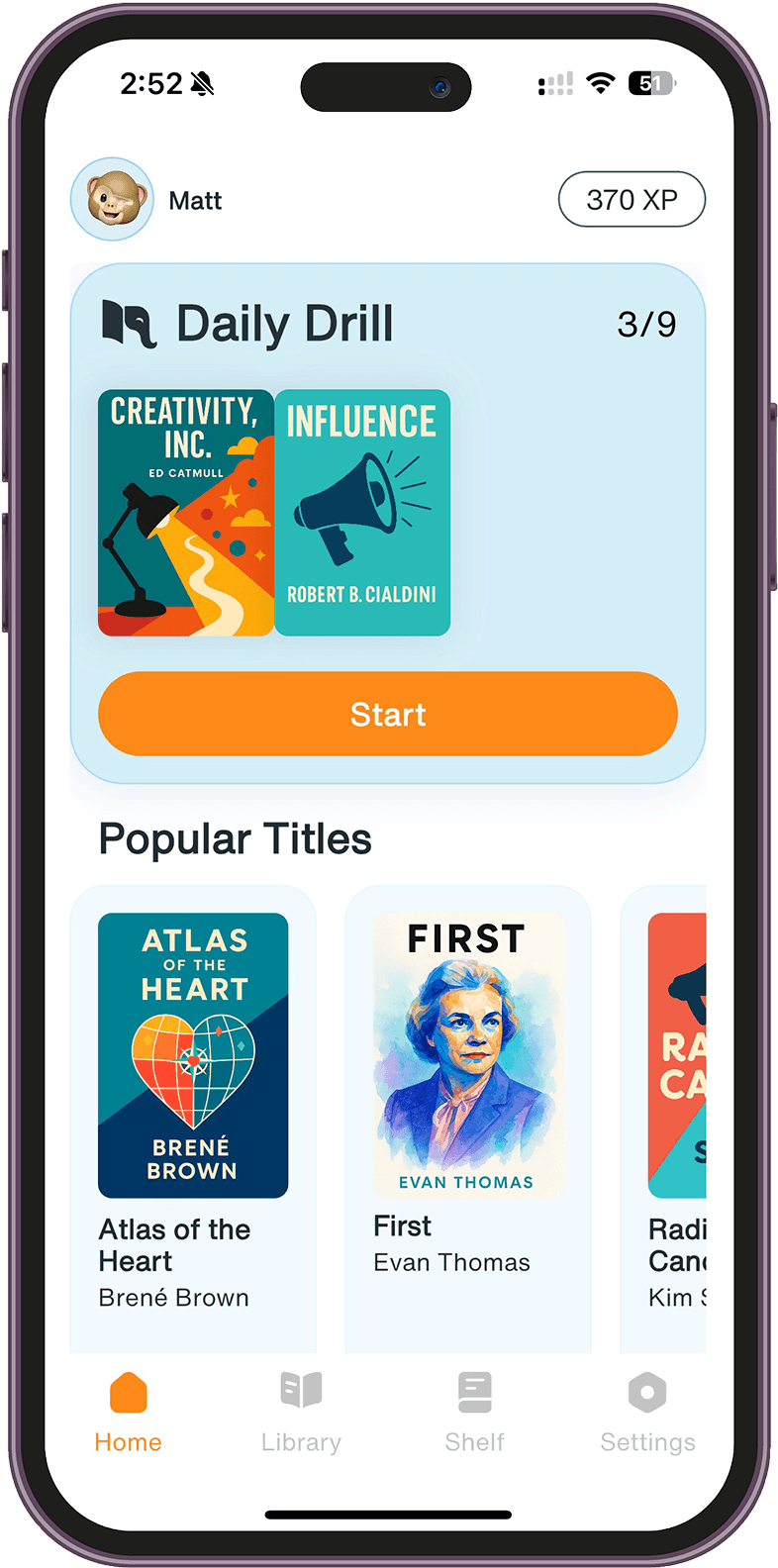
Loxie uses spaced repetition and active recall—the same cognitive science that makes the Leadership Engine's action learning work—to help you retain what you read. Instead of passively reviewing highlights, you practice with questions that surface concepts right before you'd naturally forget them.
Two minutes a day is enough to maintain and deepen your grasp of these frameworks. Over time, concepts like the teachable point of view and teaching chains become mental reflexes you can access instantly when designing development programs or coaching emerging leaders.
Loxie includes The Leadership Engine in its full topic library. You can start reinforcing these concepts immediately—building the kind of durable knowledge that lets you teach others fluently, without checking your notes.
Frequently Asked Questions
What is the main idea of The Leadership Engine?
The central argument is that winning companies systematically develop leaders at every level through teachable points of view, where leaders actively teach other leaders. This creates exponential leadership capacity and solves succession challenges before they become crises, generating significantly better financial returns than companies relying on heroic executives at the top.
What is a teachable point of view?
A teachable point of view is a leader's integrated framework combining three elements: business ideas about how to succeed, values defining acceptable behaviors, and methods for generating emotional energy in others. Leaders must be able to articulate this framework in under two minutes and actively teach it to develop other leaders.
What are the key takeaways from The Leadership Engine?
Key takeaways include: leaders must teach directly rather than delegate to HR; teaching chains multiply capacity geometrically; failure stories teach more powerfully than success stories; action learning with real stakes develops leaders faster than classroom training; and leadership engines must rebuild themselves every five to seven years.
What is edge in leadership?
Edge is the courage to make tough people decisions quickly. It determines a disproportionate share of leadership effectiveness because delayed decisions on underperformers poison team morale and signal that standards don't matter. Edge develops through practice with progressively higher-stakes decisions.
How do you start building a leadership engine?
Begin with a pilot group of twelve to fifteen high-potential leaders who become teaching evangelists. Focus on frontline supervisor development for maximum return on investment, since these leaders directly influence most employees and make thousands of daily decisions that shape organizational culture.
How can Loxie help me remember what I learned from The Leadership Engine?
Loxie uses spaced repetition and active recall to help you retain the key concepts from The Leadership Engine. Instead of reading the book once and forgetting most of it, you practice for 2 minutes a day with questions that resurface ideas right before you'd naturally forget them. Loxie includes The Leadership Engine in its full topic library.
We're an Amazon Associate. If you buy a book through our links, we earn a small commission at no extra cost to you.
Stop forgetting what you learn.
Start learning for good with your 7-day FREE trial.