The Lean Startup: Key Insights & Takeaways from Eric Ries
Master Eric Ries's framework for building products customers actually want through rapid experimentation and validated learning.
by The Loxie Learning Team
Most startups fail not because they can't build products, but because they build products nobody wants. Eric Ries's The Lean Startup offers a radically different approach: instead of spending months or years perfecting a product in isolation, test your assumptions early and often through rapid experimentation. The goal isn't to launch faster—it's to learn faster.
This guide breaks down Ries's complete framework for entrepreneurship under uncertainty. You'll understand the Build-Measure-Learn feedback loop, how to create minimum viable products, when to pivot versus persevere, and why validated learning—not revenue or features—is the true measure of startup progress. Whether you're founding a company, launching a product within an established organization, or simply want to think more scientifically about building things, these principles apply.
 Start practicing The Lean Startup free for 7 days ▸
What exactly is a startup, and why does it require different management?
A startup is a human institution designed to create new products and services under conditions of extreme uncertainty. This definition matters because it explains why traditional management fails in startup environments. Established businesses operate with known customers, proven products, and predictable markets. Startups have none of these advantages.
When uncertainty is extreme, five-year business plans become fiction. Traditional metrics like revenue growth can be misleading when you're not sure you're building the right thing. The management techniques developed for execution—optimizing known processes—simply don't work when the fundamental question is "should this product exist at all?"
This is why Ries argues for entrepreneurial management: a discipline designed specifically for navigating uncertainty. It treats business decisions as hypotheses to test rather than plans to execute, measures progress through validated learning rather than output, and uses customer data rather than intuition to guide pivotal decisions. Understanding this distinction is foundational—everything else in lean startup methodology builds on recognizing that startups require different rules.
What is the Build-Measure-Learn feedback loop?
The Build-Measure-Learn feedback loop is the core engine of lean startup methodology. It works like this: turn your ideas into products (Build), measure how customers respond to those products (Measure), and then learn whether to pivot or persevere based on what you discover (Learn). The goal is to complete this cycle as quickly as possible.
What makes this framework powerful is its emphasis on speed. Every day spent building features that don't matter is waste. Every week spent measuring the wrong metrics delays crucial insights. The companies that learn fastest—not the ones that launch fastest or raise the most money—tend to win. This is because validated insights compound. Each cycle teaches you something real about your customers that informs the next cycle.
Critically, the loop works in reverse when planning. You start with what you want to learn, then determine what you need to measure to learn it, then figure out what to build to generate those measurements. This prevents the common trap of building impressive products that teach you nothing useful about whether customers will actually pay for your solution.
Why learning velocity matters more than feature velocity
Many teams celebrate shipping features. But Ries argues this is the wrong metric. Learning velocity—how quickly you can complete Build-Measure-Learn cycles—matters more because validated insights compound while unused features create waste. A team that ships slowly but learns quickly will eventually outpace a team that ships quickly but learns nothing.
This reframe changes how you prioritize work. Instead of asking "what features can we ship this sprint?" you ask "what can we learn this sprint?" The answer might involve building something, but it might also involve customer interviews, landing page tests, or prototype demos. The output isn't code—it's validated learning about what customers actually want.
Practice these concepts in Loxie ▸
What is validated learning and why is it the fundamental unit of startup progress?
Validated learning is demonstrated progress through experiments that test whether customers will engage with and pay for a product. It's "validated" because it's backed by real customer data, not assumptions or projections. And it's the fundamental unit of progress because everything else—features shipped, code written, meetings held—only matters if it produces insights about what customers actually want.
This concept directly challenges how most people think about productivity. Traditional business measures output: how many features shipped, how many lines of code written, how many hours worked. But in a startup, you can be incredibly productive while accomplishing nothing. Building features nobody wants is waste, no matter how efficiently you built them.
Validated learning redefines success. A team that runs ten experiments and learns their core assumption is wrong has made more progress than a team that builds a beautiful product based on untested beliefs. The first team can now pivot to something that might work. The second team has invested months into something that will likely fail—they just don't know it yet.
What is a minimum viable product (MVP)?
A minimum viable product is the simplest version of a product that enables a full turn of the Build-Measure-Learn feedback loop with minimum effort and development time. The key word is "minimum"—an MVP contains only what's necessary to test your most critical assumptions, nothing more.
This concept is widely misunderstood. An MVP isn't a crappy version of your product. It's not version 1.0 with fewer features. It's a learning vehicle designed to answer specific questions about your customers. The goal isn't to launch something impressive—it's to learn something important as quickly and cheaply as possible.
MVPs can take many forms. A landing page that describes your product and measures how many people sign up tests demand before you build anything. A concierge MVP delivers your service manually to test whether customers value it before you automate. A Wizard of Oz MVP creates the illusion of automation while humans do the work behind the scenes. The right form depends on what you need to learn.
MVPs test assumptions before full commitment
Every startup is built on assumptions. You assume customers have a problem worth solving. You assume they'll pay for your solution. You assume you can deliver that solution profitably. These leap-of-faith assumptions form the foundation of your entire business model—if any of them are wrong, nothing else matters.
MVPs let you test these assumptions before committing significant resources. Instead of spending a year building a product based on what you think customers want, you spend a week building something that lets you observe what customers actually do. This is fundamentally different from asking customers what they want—people are notoriously bad at predicting their own behavior. MVPs measure real actions, not stated intentions.
Understanding MVPs intellectually isn't the same as remembering to apply them
Loxie uses spaced repetition to help you internalize these concepts so they're available when you're actually making product decisions—not just when you're reading about them.
Try Loxie free for 7 days ▸What are leap-of-faith assumptions and how do you identify them?
Leap-of-faith assumptions are the fundamental beliefs about customers and value creation that your entire business model depends on. They're called "leap-of-faith" because they require belief without evidence—at least initially. Identifying and testing these assumptions is the most important work a startup can do.
Ries breaks leap-of-faith assumptions into two categories. The value hypothesis tests whether your product delivers value to customers when they use it. Do they actually find it useful? Do they come back? Would they miss it if it disappeared? The growth hypothesis tests how new customers will discover your product. Will existing customers tell their friends? Will you be able to acquire customers profitably?
The danger is assuming you already know the answers. Most failed startups were founded by smart people who were convinced they understood their customers. The lean startup approach requires humility: treating your beliefs as hypotheses to test rather than truths to execute. This is harder than it sounds because our assumptions feel like facts.
Why does traditional business planning fail under extreme uncertainty?
Traditional business planning assumes predictable customer behavior and stable market conditions. You analyze the market, forecast demand, create financial projections, and execute the plan. This works well for established businesses expanding into known territories—but it fails catastrophically for innovative products where customer behavior is unknown.
The problem is that traditional planning treats assumptions as facts. A five-year financial projection for a startup is fiction dressed up as analysis. Nobody knows if customers will pay for a product that doesn't exist yet. Nobody can accurately forecast the growth of a market that's just emerging. Yet these projections often determine funding decisions and strategic direction.
Lean startup methodology replaces prediction with experimentation. Instead of spending months creating detailed plans based on guesses, you spend weeks testing whether your guesses are correct. The plans get better as you learn. This doesn't mean planning is worthless—it means planning should be informed by validated learning rather than wishful thinking.
How does applying the scientific method to entrepreneurship create competitive advantage?
Applying the scientific method to entrepreneurship means treating each business decision as a hypothesis to test rather than an assumption to execute. You make predictions, design experiments, gather data, and update your beliefs based on results. This creates sustainable competitive advantage because it systematically eliminates wrong directions faster than intuition-based approaches.
Most entrepreneurs rely on vision and instinct. Sometimes they're right, but often they're not—and they don't find out until they've invested significant time and resources. The scientific approach accelerates this feedback. You learn you're wrong in weeks rather than years, preserving resources to try something else.
This methodology also compounds over time. Each experiment teaches you something real about your customers. These insights inform better hypotheses, which lead to better experiments, which generate better insights. Organizations that adopt this approach become learning machines, continuously improving their understanding of what customers want while competitors remain trapped in assumption-based planning.
What is a pivot, and when should you pivot versus persevere?
A pivot is a structured course correction designed to test a new fundamental hypothesis about your product, business model, or growth engine. It's not abandoning your vision—it's changing your strategy while keeping your vision intact. Pivoting requires courage because it means admitting that your current approach isn't working.
The pivot-or-persevere decision is one of the hardest in entrepreneurship. Teams become emotionally invested in their original vision. Sunk costs create psychological pressure to continue. Nobody wants to admit they were wrong. But continuing down a failing path wastes resources that could be deployed on something more promising.
Validated learning provides objective criteria for this decision. If your experiments consistently show that customers don't want what you're building, that's data—not failure. It means you've learned something valuable that should inform your next move. The opposite is also true: if experiments show you're on the right track, that's evidence to persevere. The key is basing the decision on customer data rather than hope or sunk costs.
Why do small batch sizes accelerate learning and reduce waste?
Small batch sizes in product development accelerate learning cycles by enabling faster feedback loops, earlier problem detection, and lower inventory costs. Instead of spending months building a complete product before testing anything, you build and test in small increments. Each batch teaches you something that informs the next batch.
This concept comes from lean manufacturing, where Toyota discovered that producing in small batches—rather than large ones—actually increased efficiency. The same principle applies to software and products. When you ship smaller batches more frequently, you get feedback sooner, detect problems earlier, and can adjust course with less waste.
The counterintuitive insight is that small batches feel less efficient but are actually more efficient. Building everything at once seems faster because you're not "wasting time" on repeated testing and deployment. But large batches hide problems until the end, when they're expensive to fix. Small batches surface problems early, when they're cheap to address.
What are growth engines and why do they determine business viability?
Sustainable growth engines create mechanisms where new customers come from the actions of past customers, not from unsustainable paid acquisition. If every new customer requires you to spend more money on advertising, your business will eventually hit a ceiling. True growth engines become more efficient over time as they compound.
Ries identifies three primary growth engines. Sticky growth relies on high retention rates—customers stay so long that their lifetime value exceeds acquisition cost even with modest new customer growth. Viral growth happens when customers naturally refer others, creating a viral coefficient greater than one where each customer brings in more than one new customer. Paid growth works when customer lifetime value exceeds acquisition cost by enough to generate profit and fund further acquisition.
Understanding your growth engine matters because each requires different product features, metrics, and optimization strategies. A product designed for viral growth looks different from one designed for sticky retention. Trying to optimize for all three simultaneously usually means optimizing for none. The lean approach involves testing which growth engine fits your product, then focusing your efforts accordingly.
Start retaining what you learn ▸
How does innovation accounting differ from traditional metrics?
Innovation accounting uses actionable metrics tied to customer behavior and business drivers instead of vanity metrics like total users or downloads that don't indicate real progress. Vanity metrics make you feel good but don't tell you whether you're building something customers want. Actionable metrics inform decisions.
The distinction matters because vanity metrics can hide failure. Total registered users might grow while active usage declines. Revenue might increase while customer satisfaction plummets. Traditional dashboards optimized for making executives feel confident often obscure the signals that matter most for learning.
Actionable metrics have three characteristics: they're tied to specific, repeatable actions; they're comparative (showing change over time or between cohorts); and they're auditable (you can trace them to real customer behavior). Cohort analysis—tracking how groups of users acquired at the same time behave over time—is particularly powerful because it reveals trends that aggregate metrics hide.
What is the Five Whys technique and how does it build adaptive organizations?
The Five Whys is a technique for tracing problems to their root human causes by asking "why" repeatedly until you reach the fundamental issue. When something goes wrong, asking why five times typically reveals that technical failures stem from human systems failures—inadequate training, unclear processes, insufficient resources—rather than individual mistakes.
This matters because fixing symptoms doesn't prevent recurrence. If a bug makes it to production, the immediate cause might be that testing missed it. But why did testing miss it? Perhaps the test suite was incomplete. Why? Perhaps there wasn't time to write tests. Why? Perhaps deadlines were unrealistic. Why? Perhaps there's no process for estimating accurately. Now you're addressing root causes.
Adaptive organizations use Five Whys to make proportional investments in prevention. Small problems get small investments. Repeated problems or large failures warrant larger systemic changes. This prevents both under-reacting (letting root causes fester) and over-reacting (implementing heavy processes after minor incidents). The result is an organization that learns from mistakes without becoming paralyzed by bureaucracy.
What are innovation sandboxes and why do large organizations need them?
Innovation sandboxes protect lean experiments from corporate antibodies by creating bounded environments with clear metrics, time limits, and authority to test radical approaches without risking the core business. Large organizations naturally resist innovation because their systems are optimized for execution of known business models, not experimentation with unknown ones.
The sandbox concept allows entrepreneurs within large organizations to operate with startup-like speed while limiting risk to the parent company. Within the sandbox, teams can break normal rules: ship imperfect products, talk to customers directly, make decisions without approval chains. Outside the sandbox, the core business continues operating normally.
Successful sandboxes have clear boundaries. They define what experiments can and cannot affect. They specify metrics that will determine success or failure. They set time limits after which experiments either graduate to broader rollout or get terminated. This structure provides enough freedom for real experimentation while containing the potential damage of failed experiments.
How does lean startup methodology reduce economic waste?
Lean startup methodology reduces economic waste by killing failed ideas early through minimum viable products and pivoting before significant resources are invested. The waste in most startups isn't failed experiments—it's the months or years spent building the wrong things based on untested assumptions.
Ries argues this waste is enormous at a societal level. Billions of dollars flow into startups each year, and most of that money funds products that will fail. Much of this failure is preventable—not through better prediction, but through faster learning. If startups discovered they were wrong in weeks rather than years, the same capital could fund more attempts, increasing the odds of finding things that work.
This perspective reframes what failure means. A startup that runs ten experiments and learns its core assumption is wrong hasn't failed—it's made efficient progress. The real failure is spending years building something nobody wants. Lean methodology treats early failure as success: you've learned something important while preserving resources to try something else.
The real challenge with The Lean Startup
Here's the uncomfortable truth about reading The Lean Startup: understanding these concepts intellectually is easy; remembering to apply them when you're under pressure to ship features is hard. Research shows we forget 70% of new information within 24 hours. Within a week, most of what you've just read about MVPs, validated learning, and pivot decisions will have faded.
This creates a painful gap. You know lean startup principles would help you make better product decisions. But when you're in a meeting arguing about features, you can't recall the specific frameworks. When you're writing a business plan, you default to traditional approaches because that's what your brain can access. The book sits on your shelf while you repeat the mistakes it warned against.
How many business books have you read that felt transformative but you can't recall three key concepts from? The problem isn't the books—it's that reading alone doesn't create lasting knowledge. Your brain needs active retrieval practice to move information into long-term memory.
How Loxie helps you actually remember what you learn
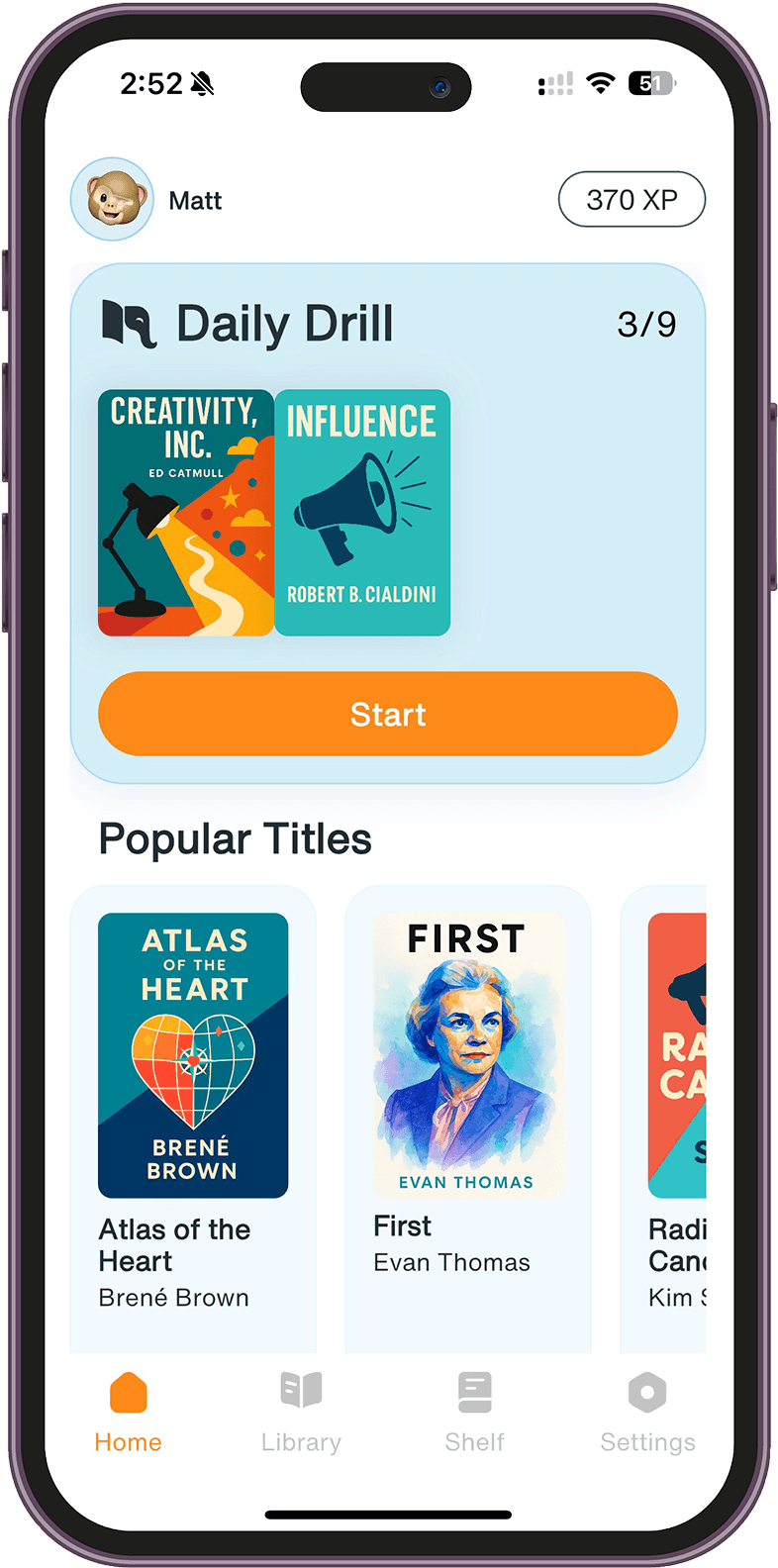
Loxie uses spaced repetition and active recall—the two most scientifically validated learning techniques—to help you retain the key concepts from The Lean Startup. Instead of reading once and forgetting, you practice for just 2 minutes a day with questions that resurface ideas right before you'd naturally forget them.
The approach is simple: Loxie asks you questions about concepts like the Build-Measure-Learn loop, MVP design, and pivot criteria. When you actively retrieve an answer, you strengthen the neural pathways that make that knowledge accessible. When questions resurface at scientifically optimized intervals, you interrupt the forgetting curve before the information fades.
Loxie includes The Lean Startup in its complete topic library, so you can start reinforcing these concepts immediately. Two minutes a day is all it takes to transform this reading session from a momentary experience into lasting knowledge you can actually apply.
Frequently Asked Questions
What is the main idea of The Lean Startup?
The central idea is that startups should treat business decisions as hypotheses to test rather than plans to execute. Through rapid experimentation using minimum viable products, measuring real customer behavior, and learning whether to pivot or persevere, entrepreneurs can build products customers actually want while minimizing wasted time and resources.
What is the Build-Measure-Learn feedback loop?
The Build-Measure-Learn loop is lean startup's core engine: turn ideas into products (Build), measure how customers respond (Measure), and learn whether to pivot or persevere (Learn). The goal is completing this cycle as quickly as possible because learning velocity—not feature velocity—determines startup success.
What is a minimum viable product (MVP)?
An MVP is the simplest version of a product that enables a full turn of the Build-Measure-Learn feedback loop with minimum effort. It's not a low-quality product—it's a learning vehicle designed to test specific assumptions about customers as quickly and cheaply as possible before committing major resources.
When should a startup pivot versus persevere?
Pivot when validated learning consistently shows customers don't want what you're building. Persevere when experiments indicate you're on the right track. The key is basing this decision on customer data rather than hope, sunk costs, or emotional investment in the original vision.
What's the difference between vanity metrics and actionable metrics?
Vanity metrics like total users or downloads make you feel good but don't indicate real progress. Actionable metrics tie to specific customer behaviors, show change over time, and inform decisions. Cohort analysis—tracking how user groups behave over time—is particularly valuable for revealing trends aggregate metrics hide.
How can Loxie help me remember what I learned from The Lean Startup?
Loxie uses spaced repetition and active recall to help you retain key concepts from The Lean Startup. Instead of reading the book once and forgetting most of it, you practice for 2 minutes a day with questions that resurface ideas right before you'd naturally forget them. Loxie includes The Lean Startup in its full topic library.
We're an Amazon Associate. If you buy a book through our links, we earn a small commission at no extra cost to you.
Stop forgetting what you learn.
Start learning for good with your 7-day FREE trial.