The Let Them Theory: Key Insights & Takeaways from Mel Robbins
Master Mel Robbins' two-word mindset shift that frees you from controlling others and transforms your relationships.
by The Loxie Learning Team
How much of your mental energy do you spend trying to change other people? Mel Robbins' The Let Them Theory introduces a deceptively simple two-word phrase that can liberate you from the exhausting cycle of attempting to control others' thoughts, actions, and opinions. By saying "Let them," you reclaim your emotional bandwidth and redirect it toward the only thing you can actually control—yourself.
This guide breaks down Robbins' complete framework for emotional freedom. You'll learn why we instinctively try to control others, how the "Let Them" and "Let Me" components work together, and practical techniques for implementing this mindset shift in your daily life. Whether you're struggling with a difficult family member, a frustrating coworker, or a romantic partner who won't change, these insights will transform how you approach every relationship.
 Start practicing The Let Them Theory free for 7 days ▸
What is the Let Them Theory and how does it work?
The Let Them Theory is a two-part mindset system for emotional freedom. The first part—"Let them"—releases your grip on others' behavior. The second part—"Let me"—empowers you to focus on your own actions and responses. Together, they create a complete framework for reclaiming your energy and peace of mind.
When someone does something that frustrates you, the instinct is to try changing their behavior through persuasion, argument, or manipulation. The Let Them Theory interrupts this pattern with a simple acknowledgment: Let them do what they're going to do. This isn't passive acceptance or giving up—it's recognizing that you control 100% of your reactions but 0% of their behavior. By releasing your grip on the uncontrollable, you free up enormous mental resources.
The "Let me" component prevents passivity by immediately redirecting your focus to what you can control. Instead of spinning in frustration about what they did, you ask yourself: "What can I do now? How do I want to show up?" This shift from victimhood to agency transforms your experience of difficult situations.
Why do we try to control others in the first place?
Humans naturally attempt to control others due to psychological survival instincts that evolved to protect us but now create unnecessary stress in modern relationships. In ancestral environments, being rejected by the group could mean death, so we developed an intense sensitivity to others' opinions and behaviors. Our brains learned to predict and influence others' actions as a survival strategy.
In modern life, these same instincts fire constantly but inappropriately. When a friend cancels plans, your brain treats it like a tribal rejection. When a partner disagrees with you, ancient circuits interpret it as a threat to group cohesion. The result is an exhausting internal monologue: How can I make them understand? Why won't they listen? What can I say to change their mind?
Understanding this evolutionary backdrop helps you recognize control impulses when they arise. You're not broken or unreasonable—you're running ancient software in a modern world. This awareness creates the first crack of space between trigger and reaction, allowing you to consciously choose the Let Them response instead of automatically escalating.
Practice these concepts in Loxie ▸
How does trying to control others damage your relationships?
Control attempts damage relationships by communicating a lack of trust and respect, pushing people away rather than bringing them closer. When you repeatedly try to change someone's behavior, opinions, or choices, you send an implicit message: "I don't accept you as you are. My way is better than yours." Even when your intentions are loving, the impact feels suffocating.
Consider the mental energy you spend rehearsing arguments, defending positions, and trying to convince others to see things your way. This creates an adversarial dynamic where interactions become debates to be won rather than connections to be enjoyed. The other person feels judged and defensive, which typically makes them dig in harder—the opposite of what you wanted.
Releasing control paradoxically often produces the change you were hoping for. When people feel genuinely accepted, they're more open to influence. When they don't feel pressured, they're free to reconsider their positions on their own terms. The Let Them approach creates space for authentic connection instead of power struggles.
How can you consciously choose your reactions instead of reacting automatically?
You can consciously choose your reactions by creating space between trigger and response through specific practices: breathing, naming your emotions, and asking yourself "How do I want to show up right now?" instead of automatically reacting. This pause—even a few seconds—breaks the stimulus-response chain that normally operates on autopilot.
The first step is developing awareness of your triggers. Notice when your body tenses, your heart rate increases, or your jaw clenches. These physical signals indicate your control impulses are activating. Simply noticing "I'm being triggered right now" creates distance from the automatic reaction.
Next, take a deliberate breath and name what you're feeling: "I'm feeling frustrated. I'm feeling dismissed. I'm feeling afraid." This emotional labeling activates your prefrontal cortex, shifting brain activity away from the reactive amygdala. Then ask yourself: "What can I control here? How do I want to respond?" This question redirects your focus from the other person's behavior to your own choices.
The power of simple phrases to interrupt reactivity
Simple phrases like "Let them" work by creating a verbal interrupt that breaks cycles of emotional reactivity. When you say these words—either out loud or silently—you pause the automatic mental loop of frustration, argument, and attempted control. The phrase acts as a mental pattern interrupt, giving your rational mind a chance to engage before your emotional brain takes over.
This is why the theory uses just two words. Complexity would fail in moments of stress when cognitive resources are depleted. "Let them" is memorable, repeatable, and simple enough to access even when you're flooded with emotion. With practice, the phrase becomes a trained response that automatically surfaces when you need it. Loxie's spaced repetition approach helps cement this mental tool so it's available precisely when your emotional brain wants to take control.
Understanding "Let Them" isn't the same as remembering it when triggered
The Let Them Theory sounds simple, but applying it in heated moments requires the phrase to surface automatically. Loxie uses spaced repetition to train your brain to recall these concepts exactly when you need them—not just when you're calm and reading about them.
Build automatic recall with Loxie ▸Why don't you need external validation to feel worthy?
You don't need external validation to feel worthy because your value comes from your own actions and choices, not from others' approval or disapproval. When you tie your self-worth to others' opinions, you create a fragile foundation that shifts with every interaction—praised one moment, devastated the next.
Seeking external validation keeps you emotionally dependent on factors you can't control. Your self-worth fluctuates based on whether people approve of your choices, creating an exhausting cycle of people-pleasing and anxiety. You end up making decisions based on anticipated reactions rather than your own values, living a life designed by others' expectations.
The Let Them approach extends to others' opinions of you. Let them think what they want. Let them misunderstand your choices. Let them disapprove. Their opinions don't diminish your truth or change your inherent worth. This doesn't mean you become indifferent to feedback—it means you evaluate feedback from a position of security rather than desperation.
How do you set boundaries without guilt?
Healthy boundaries can be maintained without guilt by recognizing that setting limits is an act of self-respect, not selfishness. Others' discomfort with your boundaries is their responsibility to manage, not yours. A boundary isn't a demand that others change—it's a clear statement of what you will and won't accept, and what you'll do in response.
The key insight is that you don't need to control others' reactions to your boundaries. Their response reveals their priorities and respect for you, giving you valuable information about the relationship. If someone repeatedly violates your boundaries despite clear communication, that tells you something important. Let them show you who they are.
Guilt around boundaries often comes from confusing your responsibility with theirs. You're responsible for communicating your needs clearly and compassionately. You're not responsible for managing their emotional response to those needs. When you internalize this distinction, setting boundaries becomes an expression of self-care rather than a selfish act requiring justification.
Start retaining what you learn ▸
How does "Let Me" empower you to take action?
"Let me" statements empower you by shifting from passive victimhood to active choice. Instead of asking "Why won't they..." you declare "Let me decide what I'll do." This linguistic shift moves you from complaint to agency, from waiting for others to change to taking responsibility for your own experience.
The "Let me" component prevents the Let Them approach from becoming passive resignation. Releasing control over others doesn't mean accepting situations that harm you—it means redirecting your energy from futile attempts to change them toward productive action you can take. Let them behave however they want. Let me decide how I'll respond, what boundaries I'll set, and whether I'll remain in this situation.
This shift is particularly powerful when facing circumstances you can't change. Let them hold their political opinions. Let me choose whether to engage in that conversation. Let them make their choices about their health. Let me focus on my own well-being. The combination of release and empowerment creates complete emotional freedom.
How does the Let Them Theory transform romantic relationships?
Romantic partnerships thrive when both partners release control by expressing needs without ultimatums, allowing space for individual growth, and choosing connection over being right. The Let Them approach transforms the most common relationship conflicts—from arguments about household tasks to deeper disagreements about life direction.
Consider how many relationship arguments stem from trying to change your partner. You want them to load the dishwasher differently, spend money more carefully, communicate more openly, or prioritize the relationship differently. Each attempt to change them communicates: "I need you to be different for me to be happy." This creates pressure that often produces resistance rather than change.
The Let Them approach in romance means letting your partner be who they are while clearly expressing your own needs and boundaries. Let them have their preferences. Let me communicate what I need. Let them respond however they will. Let me decide what that response means for me and the relationship. This creates space for authentic connection rather than power struggles.
How can you apply Let Them to family relationships?
Family relationships transform when you apply Let Them by accepting relatives as they are, communicating your needs without demanding change, and protecting your peace through selective engagement rather than trying to fix family dynamics. Family often triggers our strongest control impulses because the relationships feel permanent and the stakes feel high.
The family context is challenging because you often can't simply walk away. You'll see these people at holidays, family events, and emergencies. The Let Them approach allows you to maintain these relationships without being destroyed by them. Let them hold their opinions about your career, your parenting, or your life choices. Let me decide how much energy I'll give to defending myself.
Releasing family members also means accepting that their choices are not your responsibility. Each person has their own path, lessons to learn, and timing that you cannot control no matter how much you care. Let them make decisions you disagree with. Let them face the consequences of those decisions. Let me offer support without trying to rescue or fix.
Why is letting people be wrong so liberating?
Letting people be wrong creates inner peace by eliminating the exhausting mental battles where you rehearse arguments and defend positions that ultimately don't matter. You don't need to correct everyone's mistakes or opinions because their understanding doesn't diminish your truth, and the energy spent arguing could be used for your own growth.
Consider how much mental energy you spend on being right. Someone says something incorrect at dinner, and hours later you're still composing the perfect rebuttal in your head. A colleague misattributes credit for a project, and you spend days feeling wronged and planning how to set the record straight. All this energy is spent on things you can't control and that often don't matter.
The Let Them approach to being wrong doesn't mean you never speak up or correct genuine misinformation that matters. It means you choose your battles consciously rather than reflexively defending every position. Let them misunderstand. Let them believe what they believe. Let me spend my limited energy on what actually matters to me.
How does daily practice create lasting emotional freedom?
Daily practice of "Let Them" creates lasting freedom and peace by training your brain to automatically release control over others' actions and redirect energy toward your own choices and responses. Like any skill, emotional regulation improves with repetition until new patterns become automatic.
Emotional regulation requires daily practice through mindfulness exercises, emotion labeling, and celebrating small wins when you choose response over reaction. Each time you notice a control impulse, pause, and choose the Let Them response, you strengthen neural pathways that make this choice easier next time. Over weeks and months, what once required enormous conscious effort becomes increasingly natural.
The goal is to move from conscious competence (deliberately applying the theory) to unconscious competence (automatically responding this way). This transition requires consistent practice in low-stakes situations so the skill is available in high-stakes moments. When your mother-in-law criticizes your parenting or your partner makes a decision you disagree with, you need "Let them" to surface automatically—not after you've already reacted.
Why is accepting when people leave so important?
Accepting when people choose to leave prevents prolonged suffering by allowing you to grieve cleanly rather than desperately trying to change someone's mind. When someone decides to exit a relationship—romantic, friendship, or professional—your control impulses want to fight, convince, and negotiate. The Let Them approach creates space for dignified acceptance.
Releasing relationships that no longer serve you requires courage because it means accepting that love alone isn't always enough to sustain a healthy connection. You can love someone and still recognize that the relationship isn't working. You can wish things were different while accepting they aren't. Let them leave. Let me grieve. Let me eventually move forward.
This acceptance isn't immediate or easy, but it's ultimately less painful than the alternative. Chasing someone who's leaving, bargaining for their return, or trying to manipulate the situation extends suffering indefinitely. The Let Them approach allows you to feel the pain of loss fully and move through it rather than around it.
The real challenge with The Let Them Theory
Here's what most readers of The Let Them Theory discover: understanding the concept intellectually is the easy part. Applying it in the heat of the moment—when your partner criticizes you, when your parent pushes your buttons, when a colleague takes credit for your work—is where the theory breaks down.
The forgetting curve is particularly brutal with emotional skills. You read the book, feel inspired, and genuinely intend to apply "Let them" next time you're triggered. But when that trigger arrives, your brain defaults to its well-worn pathways of control, defense, and reaction. The insight you had while reading is nowhere to be found when you actually need it.
How many personal development books have you read that felt life-changing in the moment but didn't change your actual behavior? The Let Them Theory only works if the phrase surfaces automatically when you're emotionally flooded. That requires a different kind of learning than simply reading and understanding.
How Loxie helps you actually remember the Let Them Theory when you need it
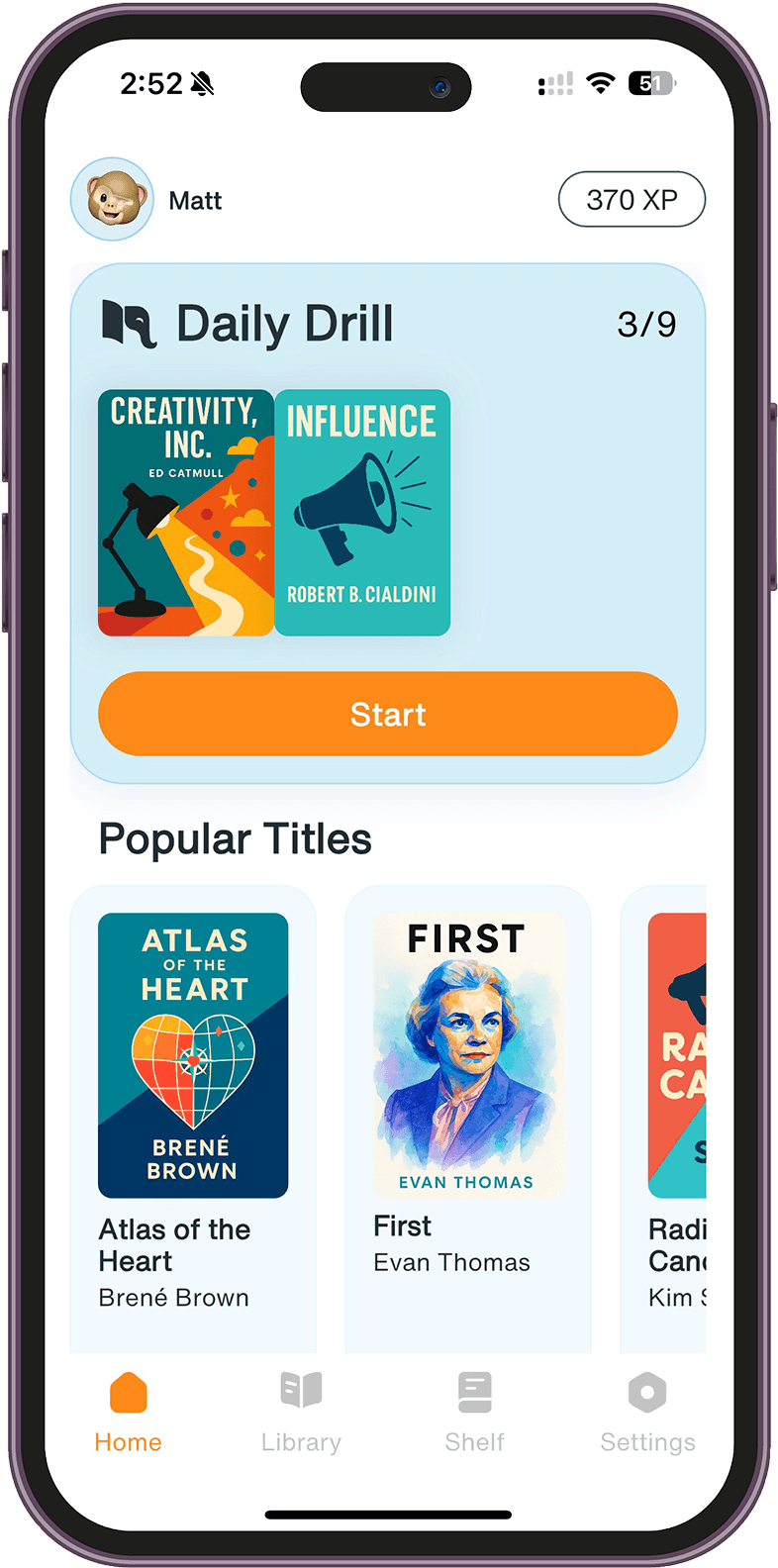
Loxie uses spaced repetition and active recall to help you internalize concepts from The Let Them Theory so they're available when you're triggered—not just when you're calm and reading about emotional freedom. Instead of reading the book once and hoping it sticks, you practice for 2 minutes a day with questions that resurface ideas right before you'd naturally forget them.
The science is clear: we forget roughly 70% of new information within 24 hours unless we actively retrieve it at strategic intervals. Loxie's algorithm times your practice sessions to catch concepts right before they fade, gradually extending intervals as memories strengthen. After a few weeks of practice, "Let them" becomes an automatic response rather than a forgotten insight.
Loxie includes The Let Them Theory in its full topic library, so you can start reinforcing these concepts immediately. Two minutes a day builds the mental muscle you need to actually apply this theory when your triggers fire—transforming the book from something you read into something you live.
Frequently Asked Questions
What is the main idea of The Let Them Theory?
The core idea is that you can achieve emotional freedom by releasing your attempts to control others' thoughts, actions, and opinions. By saying "Let them," you redirect your energy toward the only thing you can actually control—yourself and your responses. The theory has two parts: "Let them" releases others while "Let me" empowers you to take action.
What are the key takeaways from The Let Them Theory?
The key takeaways are: (1) trying to control others damages relationships and drains your energy, (2) you control 100% of your reactions but 0% of others' behavior, (3) healthy boundaries don't require managing others' reactions, (4) daily practice creates automatic responses, and (5) your self-worth comes from your choices, not others' approval.
How do I apply the Let Them Theory when someone upsets me?
When triggered, pause and take a breath. Say "Let them" to acknowledge you can't control their behavior. Then ask "What can I control? How do I want to show up?" This shifts focus from their actions to your response. With practice, this sequence becomes automatic, interrupting reactive patterns before they take over.
Does the Let Them Theory mean I should accept bad treatment?
No. The theory is about releasing control, not becoming passive. You still set boundaries and communicate needs clearly. The difference is you don't try to control how others respond to your boundaries. Their reaction is their responsibility. If someone repeatedly violates your boundaries, "Let them" might mean letting them experience the natural consequence of losing access to you.
Why is it so hard to apply the Let Them Theory in the moment?
Our brains evolved to monitor and influence others for survival. These ancient instincts fire automatically when triggered, before conscious thought can intervene. Applying "Let them" requires building new neural pathways through repeated practice, so the response becomes automatic. Reading about the concept isn't enough—you need active retrieval practice.
How can Loxie help me remember what I learned from The Let Them Theory?
Loxie uses spaced repetition and active recall to help you retain the key concepts from The Let Them Theory. Instead of reading the book once and forgetting most of it, you practice for 2 minutes a day with questions that resurface ideas right before you'd naturally forget them. Loxie includes The Let Them Theory in its full topic library, so you can start reinforcing these concepts immediately.
We're an Amazon Associate. If you buy a book through our links, we earn a small commission at no extra cost to you.
Stop forgetting what you learn.
Start learning for good with your 7-day FREE trial.