The ONE Thing: Key Insights & Takeaways from Gary Keller
Master Gary Keller's framework for cutting through distractions and achieving extraordinary results by focusing on what matters most.
by The Loxie Learning Team
What if the path to extraordinary success isn't doing more, but doing less? Gary Keller's The ONE Thing makes a compelling case that remarkable results come from ruthlessly narrowing your focus to the single most important priority at any given time. In a world that celebrates busyness and multitasking, this book argues that going small—doing fewer things better—is the counterintuitive key to achieving more than you ever thought possible.
This guide breaks down Keller's complete framework for identifying and pursuing your ONE Thing. You'll learn the Focusing Question that cuts through complexity, why multitasking is a productivity lie, how to time block for deep work, and the mindset shifts required for extraordinary results. Whether you've read the book and need a refresher or you're encountering these ideas for the first time, you'll walk away with actionable strategies for transforming how you work and live.
 Start practicing The ONE Thing free for 7 days ▸
What is the Focusing Question and how does it work?
The Focusing Question is the cornerstone of Keller's entire framework: "What's the ONE Thing I can do such that by doing it everything else will be easier or unnecessary?" This deceptively simple question systematically identifies your highest-leverage activity by forcing you to find the domino that will knock down all the others.
The question works because of its precise construction. It asks for one thing, not several. It demands action ("I can do") rather than passive analysis. And the crucial qualifier—"such that by doing it everything else will be easier or unnecessary"—ensures you're not just picking something important, but identifying the activity with the greatest downstream impact.
Making the Focusing Question a habit transforms decision-making from reactive to strategic. When you train your mind to automatically seek the highest-leverage action in any situation, you stop getting pulled in a dozen directions and start making progress on what truly matters. Loxie helps you internalize this question so it becomes second nature—not just something you read about once, but a mental tool you actually use when facing your next important decision.
Why does narrowing your focus lead to extraordinary results?
Top performers consistently narrow their focus rather than diversify their efforts because extraordinary success demands going small—doing fewer things better rather than more things adequately. This principle contradicts our instinct to hedge bets and keep options open, but the evidence is clear: success is sequential, not simultaneous.
Think of it like dominoes. A single domino can knock down another domino that's 50% larger than itself. Line them up correctly, and a two-inch domino can eventually topple a domino the size of the Empire State Building through geometric progression. Your focused efforts work the same way—small actions compound over time into results that seem impossible when viewed from the starting point.
Knocking down the right domino—your lead domino—sets off a chain reaction that makes subsequent achievements progressively easier and more impactful. The key insight is that you don't need to do everything; you need to identify the one thing that makes everything else easier or unnecessary. This is fundamentally different from prioritization, which still implies multiple priorities. Keller argues you should have only one priority by definition.
Why is multitasking a lie that destroys productivity?
Multitasking costs up to 28% of an average workday through inefficiency because the brain cannot effectively process multiple cognitive tasks simultaneously. What we call "multitasking" is actually task-switching—rapidly moving attention between activities—and each switch carries a significant cost.
Research shows task-switching increases cortisol production, doubles error rates, and reduces IQ by up to 15 points—equivalent to losing a night's sleep. Every time you check email while writing a report or take a call while reviewing data, you're not doing two things at once; you're doing two things poorly while exhausting your mental resources faster.
The implications for achieving your ONE Thing are profound. If you want extraordinary results, you need uninterrupted focus on your highest-priority task. Loxie reinforces this principle by helping you remember the specific costs of multitasking so you're more likely to protect your focused work time when distractions inevitably arise.
Practice these concepts in Loxie ▸
How does willpower work and why does timing matter?
Willpower operates like a battery that depletes with use throughout the day, making it crucial to tackle your ONE Thing when this resource is fullest. Every decision you make, every temptation you resist, every email you process drains from the same limited pool of mental energy.
This is why scheduling your ONE Thing for early morning produces dramatically better results than tackling it in the afternoon. Before decision fatigue from emails, meetings, and minor choices depletes your mental resources, you have access to your full willpower reserves. Successful people don't have more willpower—they're simply strategic about when they use it.
The practical implication is clear: protect your mornings for your most important work. Don't check email first thing. Don't schedule meetings before noon if you can avoid it. Your ONE Thing deserves your best cognitive resources, not the depleted reserves left over after a day of minor decisions.
What is time blocking and how do you implement it?
Time blocking your ONE Thing means scheduling a non-negotiable appointment with yourself for at least four hours daily, treating this time as sacred as any meeting with your most important client. This isn't about finding time for focused work—it's about making time by blocking it on your calendar before anything else.
The four-hour minimum might seem extreme, but extraordinary results require extraordinary commitment. Most people's calendars are filled with other people's priorities. Time blocking reverses this by claiming your most productive hours for your most important work first, then fitting everything else around it.
Implementation requires three things: block the time on your calendar (make it visible and recurring), protect the time ruthlessly (say no to conflicts, turn off notifications), and honor the time consistently (showing up is non-negotiable regardless of how you feel). Loxie helps you remember these implementation details so when Monday morning arrives, you know exactly how to protect your focused work time.
Why do not all tasks have equal importance?
The Pareto Principle reveals that 20% of your efforts produce 80% of your results, making priority identification crucial for success. But Keller takes this further—he argues you should keep applying the 80/20 rule until you arrive at the single most important thing. The vital few matter more than the trivial many.
This insight demolishes the to-do list mentality that treats all tasks as roughly equivalent. When you understand that a small fraction of your activities drive the majority of your results, the question shifts from "What should I do today?" to "What's the one thing I must do today?"
The practical application requires honest assessment of where your results actually come from. Track your activities and outcomes for a week. You'll likely find that most of your meaningful progress came from a handful of focused efforts, while the bulk of your busyness produced little lasting value. This awareness makes it easier to say no to low-leverage activities and yes to your ONE Thing.
What is goal-setting to the now and how does it connect your priorities?
Goal-setting to the now means working backward from your someday goals through five-year, one-year, monthly, and weekly goals to identify the ONE Thing you must do today that makes everything else easier or unnecessary. This creates a connected chain where each shorter timeframe's priority directly enables the next level's achievement.
Start with your someday goal—the big, audacious vision for your life or career. Then ask: "Based on my someday goal, what's the ONE Thing I can do in the next five years to be on track?" Continue this process through one year, this month, this week, and finally today. Each answer should logically connect to the level above it.
This approach solves the common problem of daily tasks feeling disconnected from larger ambitions. When your today-goal clearly connects to your someday-goal through a logical chain, you experience both urgency and meaning. You know why this particular task matters and how it fits into your bigger picture. Loxie helps you retain this framework so you can actually implement it rather than just understanding it conceptually.
Why is the inability to say no so dangerous to your success?
The inability to say "no" dilutes your effectiveness because saying yes to one thing always means saying no to something else, and without conscious choice, you'll say no to your ONE Thing by default. Every commitment you make claims time and energy that could go toward your highest priority.
This is one of the four thieves that steal productivity and derail your ONE Thing. The others are fear of chaos (handling everything instead of focusing), poor health habits that drain energy, and an environment that doesn't support your goals. But the inability to say no is particularly insidious because it masquerades as helpfulness, collaboration, or keeping options open.
Keller's solution is to recognize that "no" is not negative—it's the guardian of your "yes." When you understand that every yes costs a potential no to something else, you become more selective. The question shifts from "Can I do this?" to "Should I do this, given what it will cost my ONE Thing?" Protecting your priority requires disappointing some people some of the time.
Is work-life balance achievable, or is counterbalance the real goal?
Work-life balance is a myth; counterbalance is the truth. Extraordinary results require going long on your professional priorities while keeping personal priorities from falling too far behind. Perfect equilibrium isn't possible when you're pursuing something exceptional—the question is how to manage imbalance intentionally.
Counterbalance means you will spend extended periods focused intensely on work during critical phases, then consciously rebalance by giving concentrated attention to family, health, and relationships. You're never perfectly balanced, but you're aware of what's being neglected and you don't let anything fall so far that it can't recover.
The key distinction is between work and personal life. At work, going long means going as long as necessary—sometimes extremely long—to achieve your ONE Thing. In personal life, going long is dangerous. Relationships and health suffer permanent damage from prolonged neglect. So counterbalance looks different in each domain: go extremely out of balance professionally when needed, but keep personal imbalance short and conscious.
Knowing these concepts isn't the same as living them
The Focusing Question, time blocking, counterbalance—these frameworks only work if you remember them when you need them. Loxie uses spaced repetition to move these principles from intellectual understanding to automatic application.
Try Loxie free for 7 days ▸What three commitments do extraordinary results require?
Extraordinary results require three commitments: following the path of mastery by continually improving your skills, moving from entrepreneurial to purposeful thinking to find better models, and taking accountability for outcomes regardless of circumstances. These aren't optional for anyone pursuing exceptional achievement.
The path of mastery means accepting that your current skill level is never sufficient. Whatever your ONE Thing is, you must commit to getting better at it continuously. This requires deliberate practice, seeking feedback, and pushing beyond your comfort zone—not just putting in hours, but putting in hours of intentional improvement.
Moving from "E" (entrepreneurial) to "P" (purposeful) thinking shifts your approach from "think big, act big" to "think big, act small." This means finding the best models and systems that create leverage through focused action, rather than trying to brute-force results through sheer effort. And taking accountability means owning your outcomes completely—not blaming circumstances, competitors, or bad luck for falling short.
How do you move from good answers to great answers?
Moving from good to great answers requires pushing beyond obvious solutions by benchmarking against what's possible rather than what's probable, and seeking answers outside your current knowledge and comfort zone. A good answer is one you already know how to achieve; a great answer requires becoming someone new.
Your thinking determines your ceiling. Small questions lead to small answers and small results, while big questions lead to big answers and breakthrough outcomes. When you ask the Focusing Question, don't settle for the first reasonable answer. Ask: "What's possible here? What would a world-class result look like? What would have to be true for that to happen?"
Great answers often require research, mentorship, and modeling successful examples. If your ONE Thing has been achieved at a high level by others, study their methods. If it's novel, find adjacent examples you can learn from. The Focusing Question framework improves answer quality over time through this deliberate practice, turning initial good answers into great ones through iteration.
Why does discipline work differently than most people think?
Success requires selective discipline applied to forming one powerful habit at a time, not maintaining discipline in all areas simultaneously. The popular image of disciplined people as having superhuman self-control everywhere is a myth. In reality, they've channeled limited discipline into building habits that run on autopilot.
Research suggests habits take an average of 66 days to form with focused daily repetition. This means discipline is a sprint, not a marathon—you need intense focus for a defined period until the behavior becomes automatic, then you can redirect that discipline to the next habit. The right habit acts as a lever that makes everything else easier or unnecessary.
This has profound implications for how you approach change. Instead of trying to overhaul your entire life simultaneously (which exhausts your limited discipline reserves), identify the one habit that would make the biggest difference and focus exclusively on that until it's automatic. Then move to the next one. Success is built one habit at a time.
Start retaining what you learn ▸
How does purpose provide direction for your ONE Thing?
Clarity of purpose provides direction for determining your ONE Thing by serving as a compass that ensures your highest-priority actions align with your deeper values and long-term vision. Without purpose, you might focus intensely on the wrong thing—achieving a goal that doesn't actually matter to you.
Purpose answers the question "Why?" before you answer "What?" When you know your purpose, the Focusing Question becomes more powerful because you're not just identifying high-leverage activities in a vacuum—you're identifying activities that drive toward something meaningful. This creates both motivation and criteria for decision-making.
Regular application of the Focusing Question should cover every area of life systematically—from career and finances to relationships and health—ensuring no important domain is neglected while maintaining singular focus within each. Purpose helps you allocate attention across domains and recognize when counterbalancing is needed.
How does your environment support or sabotage your ONE Thing?
Your environment must actively support your goals by removing distractions, providing necessary tools within reach, and surrounding you with visual reminders and people who reinforce your ONE Thing. Environment is one of the four thieves of productivity—when it works against you, even strong intentions fail.
Environmental design means engineering your surroundings to make your ONE Thing easier and distractions harder. Put your phone in another room during time blocks. Keep the tools for your most important work visible and accessible. Create visual cues that remind you of your goals and priorities.
People are part of your environment too. Surround yourself with others who support your focus and ambitions. Minimize time with people who constantly pull you into their priorities or dismiss your goals. The people around you shape your normal—make sure their normal supports your extraordinary.
What does living the ONE Thing actually look like in practice?
Living the ONE Thing means continuously asking the Focusing Question and reorganizing your life around that answer through daily time-blocking, habit formation, and saying no to distractions. It's not a one-time insight but an ongoing practice that shapes how you approach every day.
The daily rhythm looks something like this: protect your morning for time-blocked work on your ONE Thing. Ask the Focusing Question to ensure you're working on the right priority. Say no to anything that threatens your time block. Counterbalance by giving focused attention to personal priorities. Repeat.
Extraordinary results demand accepting short-term imbalance in pursuit of goals while maintaining non-negotiable minimums in health, relationships, and personal integrity. You won't be balanced. You won't have time for everything. But you'll make progress on what matters most, and that progress compounds into results that seemed impossible when you started.
The real challenge with The ONE Thing
Here's the uncomfortable truth about The ONE Thing: understanding these concepts intellectually is the easy part. The hard part is remembering them when you're staring at your inbox Monday morning, when someone asks for a "quick favor," or when you're tempted to check your phone during a time block.
Research on memory shows we forget approximately 70% of new information within 24 hours and up to 90% within a week. How many books have you read that felt transformative in the moment but left almost no lasting trace in how you actually work and live? The Focusing Question only works if you actually ask it. Time blocking only works if you remember to protect it.
This is the gap between knowing and doing—and it's where most readers of The ONE Thing fall short. Not because they don't understand the ideas, but because understanding fades while habits persist. The question isn't whether these concepts can transform your results; it's whether you'll remember them long enough for transformation to happen.
How Loxie helps you actually remember what you learn
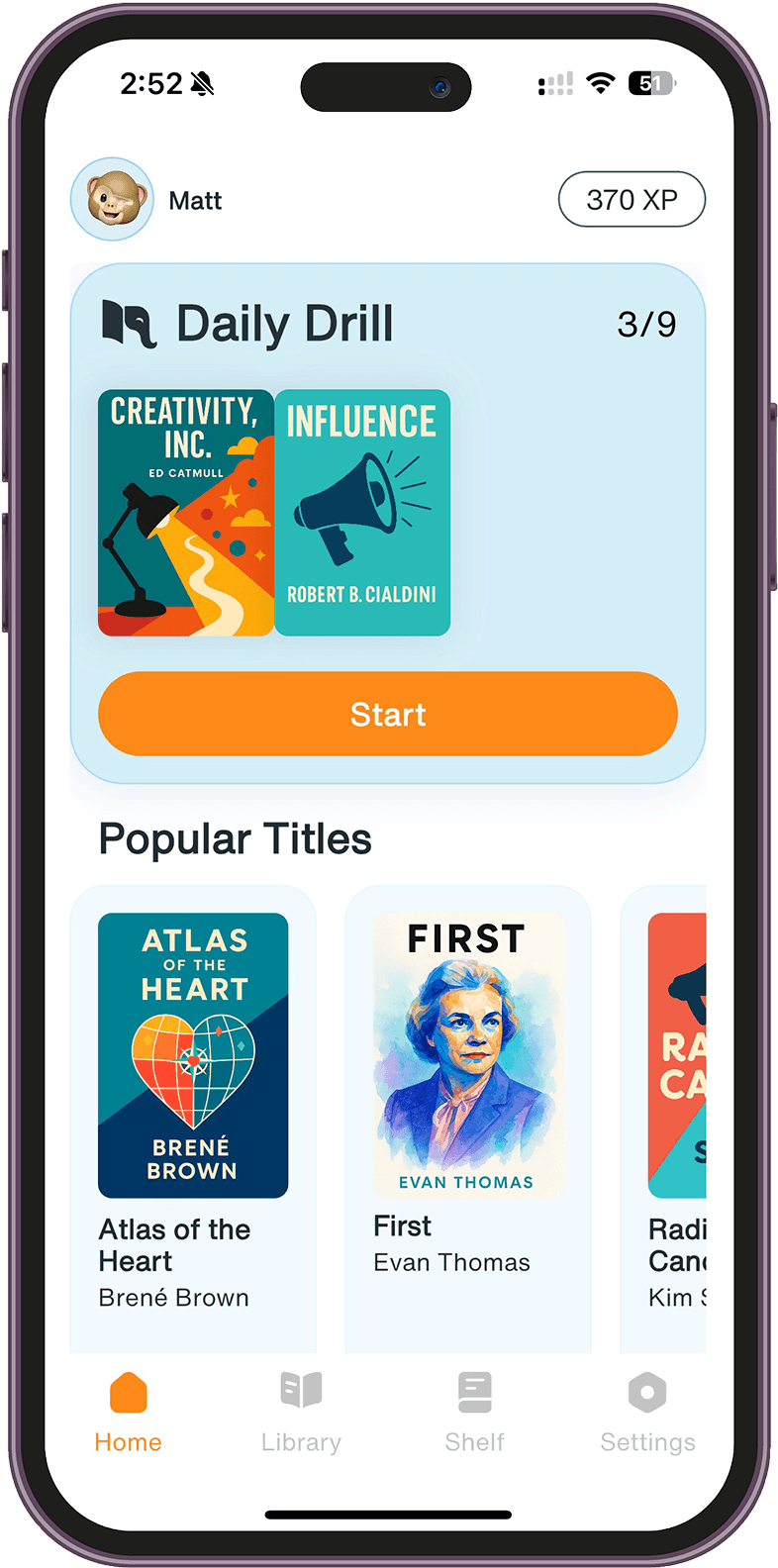
Loxie solves the forgetting problem by using spaced repetition and active recall—the same evidence-based techniques that help medical students remember thousands of facts and language learners achieve fluency. Instead of reading The ONE Thing once and hoping it sticks, you practice retrieving the key concepts at scientifically optimized intervals.
Here's how it works: Loxie presents you with questions about the Focusing Question, time blocking, willpower management, and other concepts from the book. When you successfully recall an idea, the interval before you see it again increases. When you struggle, you see it sooner. This personalized review schedule ensures concepts resurface right before you'd naturally forget them.
The entire process takes about 2 minutes a day. That's it. In less time than it takes to check social media, you reinforce the principles that can genuinely change how you work and live. The ONE Thing is included in Loxie's free topic library, so you can start immediately without any commitment.
Frequently Asked Questions
What is the main idea of The ONE Thing?
The central idea is that extraordinary success comes from narrowing your focus to your single most important priority rather than spreading effort across many tasks. By identifying and pursuing your ONE Thing—the activity that makes everything else easier or unnecessary—you can achieve remarkable results through focused, sequential action.
What is the Focusing Question in The ONE Thing?
The Focusing Question is: "What's the ONE Thing I can do such that by doing it everything else will be easier or unnecessary?" This question systematically identifies your highest-leverage activity by forcing you to find the domino that will knock down all the others, cutting through complexity to reveal your true priority.
What are the key takeaways from The ONE Thing?
The key takeaways include: multitasking is a myth that costs productivity; willpower depletes throughout the day so tackle priorities early; time blocking at least four hours for your ONE Thing is essential; success requires saying no to protect your yes; and discipline should be applied to forming one powerful habit at a time.
How does time blocking work according to The ONE Thing?
Time blocking means scheduling a non-negotiable appointment with yourself for at least four hours daily dedicated to your ONE Thing. This time should be protected like a meeting with your most important client—no interruptions, notifications off, and treated as sacred regardless of other demands.
What does The ONE Thing say about work-life balance?
Keller argues that work-life balance is a myth and counterbalance is the truth. Extraordinary results require going out of balance—spending extended periods focused intensely on priorities—while ensuring you don't let important areas of life fall so far behind that they can't recover.
How can Loxie help me remember what I learned from The ONE Thing?
Loxie uses spaced repetition and active recall to help you retain the key concepts from The ONE Thing. Instead of reading the book once and forgetting most of it, you practice for 2 minutes a day with questions that resurface ideas right before you'd naturally forget them. Loxie includes The ONE Thing in its full topic library.
We're an Amazon Associate. If you buy a book through our links, we earn a small commission at no extra cost to you.
Stop forgetting what you learn.
Start learning for good with your 7-day FREE trial.