The Power of Less: Key Insights & Takeaways from Leo Babauta
Master Leo Babauta's complete framework for achieving more by doing less through strategic limits and ruthless focus on the essential.
by The Loxie Learning Team
What if the secret to getting more done isn't adding more hours, tools, or systems—but deliberately doing less? Leo Babauta's The Power of Less makes a counterintuitive case: by setting strict limits on your tasks, projects, and commitments, you actually increase your impact. Constraints force you to focus only on what delivers the highest value, channeling your finite attention and energy into fewer, more meaningful actions.
This guide breaks down Babauta's complete framework for simplicity-driven productivity. You'll learn how to identify the vital few tasks that actually move the needle, install lasting habits through focused 30-day challenges, and design systems that protect your time from the endless demands competing for it. Whether you're drowning in commitments or simply seeking a more intentional approach to work and life, these principles provide a clear path forward.
 Start practicing The Power of Less free for 7 days ▸
Why do limits actually increase productivity?
Setting strict limits on tasks, projects, and commitments actually increases your impact because constraints force you to focus only on what delivers the highest value. This counterintuitive principle works because human attention and energy are finite resources that get diluted across too many activities. When you artificially constrain your options, you channel all available resources into fewer, more impactful actions rather than spreading yourself thin across dozens of half-finished projects.
Think of it like a river. Without banks, a river spreads into a swamp—shallow, stagnant, going nowhere. But contained within boundaries, that same water becomes a powerful force that carves through rock. Your work operates the same way. Unlimited time and options often produce worse results than thoughtful constraints because limits create the pressure that forces innovation, prevents scope creep, and channels effort into concentrated bursts of focused productivity.
Boundaries aren't restrictions—they're containers for excellence. By predetermining that you'll only check email twice daily, take on three projects maximum, or attend a limited number of meetings weekly, you stop wasting mental energy on constant micro-decisions. Each decision depletes willpower and cognitive resources, so unlimited options actually paralyze productivity. Establishing firm limits upfront automates thousands of daily choices and preserves mental energy for creative problem-solving and deep work.
How does simplicity lead to greater results?
Simplicity isn't about doing less work—it's about eliminating the 80% of activities that produce only 20% of results, then channeling all saved energy into the vital few tasks that actually move the needle. This application of the Pareto Principle to personal productivity reveals that most people waste enormous amounts of energy on low-impact busywork. By ruthlessly cutting non-essential tasks, you don't reduce output but rather amplify it by concentrating effort where it matters most.
The key insight here is that not all tasks are created equal. Most people fill their days with activities that feel productive but contribute nothing to their meaningful goals. Answering every email immediately, attending every meeting, responding to every request—these create the illusion of productivity while the truly important work never happens. Babauta's framework flips this by starting with what truly matters, then building protective boundaries around that essential work.
Before adding any new task, project, or commitment to your life, apply the subtraction principle: first remove two existing obligations. This rule prevents the gradual buildup of commitments that slowly overwhelms most people. By requiring elimination before addition, you maintain a sustainable workload while naturally evolving toward higher-value activities over time. The result is a progressively simpler life focused on increasingly meaningful work.
Practice these concepts in Loxie ▸
What is the Essential Question Test and how does it filter your priorities?
The Essential Question Test is a single filter that can eliminate 90% of urgent but unimportant activities that hijack your day: ask yourself, "Will this matter in 5 years?" If the answer is no, the task is probably not essential. This 5-year perspective instantly reveals the difference between truly important work and mere busywork disguised as urgency.
Why does temporal distance work so well? It strips away artificial deadlines and social pressures, exposing what actually contributes to long-term success and fulfillment. That "urgent" email reply, that meeting you feel obligated to attend, that project you took on to avoid saying no—most of these dissolve under the 5-year test. What remains are the activities that genuinely build toward your goals, relationships, and the person you want to become.
Create "not-to-do" lists that are longer than your to-do lists. Explicitly defining what you won't do protects your time more effectively than planning what you will do. Most productivity failures come from saying yes to non-essential requests rather than failing to complete planned tasks. By proactively listing activities, meetings, and commitments you'll refuse, you create a defensive perimeter around your time and attention that keeps the essential work protected.
Why does single-tasking outperform multitasking?
Single-tasking increases speed by approximately 40% compared to multitasking because eliminating context-switching overhead more than compensates for the perceived efficiency of parallel processing. Neuroscience research shows the brain cannot truly multitask but instead rapidly switches between tasks, incurring a cognitive penalty each time. Single-tasking eliminates these switching costs while enabling flow states that dramatically accelerate completion.
The optimal number of concurrent projects is one to three. Beyond that, context-switching costs obliterate productivity gains, with each additional project reducing overall effectiveness by roughly 25%. Research on cognitive load shows that juggling multiple projects creates mental overhead that compounds exponentially. By limiting active projects to three or fewer, you maintain momentum on each while avoiding the productivity death spiral of excessive context-switching.
The focus ritual—clearing your desk, closing browsers, setting a timer, and declaring your single task aloud—creates a psychological container that makes sustained attention far more likely. These deliberate transition behaviors signal to your brain that deep work is beginning, similar to how athletes use pre-performance routines. The ritual creates mental boundaries that protect against distraction and reinforce your commitment to single-tasking. Understanding why single-tasking works is one thing, but actually implementing it when distractions beckon requires practice. Loxie helps you internalize these focus principles through spaced repetition, so choosing single-tasking becomes your default response rather than an effortful decision.
How does the 30-Day Habit Installation Protocol work?
The 30-Day Habit Installation Protocol works because it's long enough to rewire neural pathways (research suggests habits solidify in 21-66 days) but short enough to maintain motivation—and focusing on just one habit prevents willpower dilution. Most habit attempts fail from trying to change too much simultaneously, depleting limited willpower reserves. The 30-day single-habit focus concentrates all available self-control on one change, dramatically increasing success rates while building momentum for future habits.
The secret to habit success is starting "stupidly small"—2 pushups instead of 20, 1 page instead of a chapter, 1 minute of meditation instead of 20. Consistency matters more than intensity, and micro-habits bypass the resistance that defeats ambitious beginnings. The brain's resistance to change is proportional to the change's size. Tiny habits slip under the psychological radar, establishing the neural pathway and identity shift ("I'm someone who exercises daily") that enables natural expansion over time.
Public accountability increases habit success rates by approximately 65%. Announcing your 30-day challenge on social media or to friends creates external pressure that supplements internal motivation when willpower wanes. Social commitment leverages our deep psychological need to maintain consistency with public declarations. This external accountability becomes especially crucial during days 10-20 when initial enthusiasm fades but the habit isn't yet automatic.
Habits fade without reinforcement
You might remember the 30-day protocol right now, but will you recall the micro-habit principle when you're setting your next goal? Loxie uses spaced repetition to surface these concepts exactly when you'd otherwise forget them, turning book knowledge into lasting behavioral change.
Try Loxie free for 7 days ▸What is the One Goal System and why is it so effective?
The One Goal System means pursuing a single goal for 3-12 months rather than juggling multiple goals simultaneously. This produces better results because undivided focus creates momentum that compounds exponentially, while split attention creates friction that multiplies. Goal interference research shows that multiple simultaneous goals compete for cognitive resources and create decision conflicts. Single-goal focus eliminates this interference, enabling deeper strategy, faster learning cycles, and the compound benefits of sustained momentum.
Break your One Goal into a maximum of three concurrent projects, each with no more than five next actions. This 1-3-5 hierarchy prevents overwhelm while maintaining clear forward progress. The constraint forces prioritization at every level, preventing the project sprawl and task proliferation that typically derails goal achievement. Each project should connect directly to advancing your One Goal, creating a clear line from daily tasks to long-term vision.
At least one of your Most Important Tasks each day should advance your One Goal. This creates an unbreakable chain of progress that transforms ambitious goals into inevitable outcomes through consistent daily action. The daily MIT-to-goal connection ensures that long-term objectives don't get lost in daily urgencies. This systematic linking of daily tasks to larger purposes creates compound progress that makes goal achievement nearly automatic rather than requiring heroic effort.
How does the MIT system protect your most important work?
The MIT (Most Important Tasks) system means completing your three most critical tasks before noon each day, ensuring that essential work happens before urgency, meetings, and fatigue erode your best energy. By front-loading high-value work when willpower and focus peak, you guarantee daily progress on what matters most. This temporal prioritization prevents the common trap of being busy all day while accomplishing nothing significant.
Schedule "focus blocks" as unmovable appointments with yourself. Treating deep work time as sacred as client meetings protects your most valuable hours from being fragmented by interruptions. Most people treat their own productive time as infinitely interruptible while respecting external commitments religiously. By calendar-blocking focus time with the same reverence as meetings, you guarantee that strategic work actually happens instead of being perpetually postponed.
Batch processing similar tasks—all emails, all calls, all administrative work—in designated time blocks reduces task-switching overhead by approximately 40% and creates efficiency through rhythm and momentum. Grouping similar cognitive tasks allows your brain to maintain the same processing mode, eliminating the startup costs of switching between different types of thinking. This creates a flow state within each batch that dramatically accelerates completion compared to handling tasks as they arise.
Start retaining what you learn ▸
What is the Email Triage System and how does it reclaim your time?
The Email Triage System involves checking email only twice daily, processing to zero using 2-minute/delegate/defer decisions, and keeping responses under 5 sentences. This systematic approach can reclaim approximately 2 hours daily while actually improving response quality. Constant email monitoring fragments attention and creates false urgency, while this approach concentrates email handling into focused sessions, eliminates re-reading, and forces concise communication that respects everyone's time.
Set up an email autoresponder explaining your twice-daily check schedule. This manages expectations, reduces follow-up messages, and trains others to respect your boundaries. Proactive expectation-setting eliminates the anxiety of delayed responses while educating your network about sustainable communication practices. This boundary-setting often inspires others to adopt similar limits, creating a culture of focused work rather than instant availability.
The Three-Folder System—Inbox, Action, and Archive—eliminates 90% of filing complexity while maintaining perfect retrievability through search. This proves that elaborate categorization wastes more time than it saves. Modern search capabilities make detailed folder hierarchies obsolete. This minimal structure provides just enough organization for active work while relying on search for retrieval, eliminating hours of filing overhead without sacrificing accessibility.
How do you say no without damaging relationships?
The "Graceful No" formula has three parts: acknowledge the request's value, explain your current focus, and suggest alternatives. This approach maintains relationships while protecting boundaries, proving you can decline without burning bridges. Most people say yes to avoid conflict, not because they genuinely want to help. This structured approach honors the requester while firmly protecting your priorities, often strengthening relationships through demonstrated integrity and clear communication.
The commitment inventory exercise reveals the true cost of accumulated obligations. List every recurring commitment and score each on impact versus time required. This audit typically reveals that 50% of commitments can be eliminated with zero negative consequences. Most people never systematically evaluate their accumulated commitments, leading to obligation creep. This process exposes low-value activities that persist through momentum alone, freeing massive amounts of time when eliminated.
Conduct quarterly "commitment audits" where you list all obligations and eliminate the bottom 20%. This regular pruning prevents the gradual accumulation of commitments that slowly strangle productivity. Commitments accumulate like possessions, gradually filling available time until you're overwhelmed. Regular systematic reviews force conscious decisions about what deserves your finite time, maintaining sustainable capacity for high-value activities.
How do morning and evening routines amplify productivity?
Design morning routines that require zero decisions—same wake time, same sequence, same breakfast—preserving willpower for important choices while creating automatic momentum that carries into productive work. Decision fatigue begins immediately upon waking. By automating morning activities through consistent routines, you preserve cognitive resources for creative work while building positive momentum through accomplished micro-habits before your day even officially begins.
Evening routines should focus on closure and preparation: review the day's MITs, set tomorrow's three priorities, and clear physical and digital workspaces. This creates psychological completion that enables true rest. Open loops and unfinished business create cognitive drag that prevents restoration. This structured wind-down process provides closure while pre-loading the next day's priorities, enabling both better sleep and faster morning startup.
Build "mindful transitions" between activities—30 seconds of conscious breathing when switching tasks resets attention and prevents residual processing from contaminating the next activity. Task residue from previous activities degrades performance on subsequent tasks, meaning your mind keeps processing the last problem while you're trying to focus on the new one. These micro-meditations clear mental RAM, enabling full engagement with each new activity rather than partial attention split across multiple concerns.
Why does deliberately slowing down improve both quality and speed?
Deliberately slowing down improves quality and speed paradoxically because rushed work creates errors requiring rework, while mindful pacing produces clean results that move faster through the total workflow. The anxiety of speed creates tunnel vision and poor decisions that multiply downstream problems. Intentional slowness enables systems thinking and root-cause solutions that prevent future issues, ultimately saving more time than rushing ever could.
A clear desk policy—nothing but current task materials visible—reduces cognitive load by approximately 23% because visual clutter competes for attention even when you're not consciously aware of it. Neuroscience shows that our brains continuously process visual stimuli, depleting focus even on items we're actively ignoring. A minimalist workspace eliminates this unconscious processing drain, freeing cognitive resources for the task at hand.
Install website blockers during focus hours and use a "distraction list" to capture urges to browse. Acknowledging the impulse without acting on it preserves focus while satisfying the psychological need for capture. The internet's infinite novelty triggers dopamine-seeking behavior that sabotages deep work. By combining technical barriers with psychological relief valves, you maintain focus without the anxiety of potentially missing something important—you know you can check your distraction list later.
How do you apply minimalism to health and motivation?
Apply minimalism to fitness through "minimum effective dose"—the smallest amount of exercise that produces desired results, typically around 20 minutes, three times weekly. This approach removes the all-or-nothing mentality that causes most people to quit. Perfectionist fitness goals create unsustainable commitments that lead to failure and guilt. Finding the minimum viable routine that you'll actually maintain produces better long-term results than ambitious programs you'll abandon within weeks.
Focus on "keystone health habits" like sleep and walking that cascade into other improvements. Better sleep improves food choices; walking reduces stress. These create positive spirals without overwhelming change. Some habits naturally trigger additional positive behaviors. By identifying and focusing on these high-leverage practices, you achieve comprehensive health improvements through minimal direct effort, leveraging natural behavioral chains rather than trying to change everything at once.
Replace external motivation with "intrinsic pull" by connecting every task to personal values. When work aligns with identity rather than obligation, motivation becomes automatic rather than forced. External rewards create dependency and resistance, while value-aligned actions feel effortless. By explicitly linking daily tasks to core values and long-term vision, you transform obligation into opportunity and discipline into desire. Celebrate "small wins" daily by acknowledging MIT completions—this dopamine reinforcement makes productivity self-sustaining rather than requiring constant willpower.
Where should you start implementing The Power of Less?
Start implementation with the "Power of Less Assessment"—tracking your time for one week without changing anything. This audit typically reveals that 60-80% of activities contribute nothing to your meaningful goals. Most people vastly overestimate time spent on important work. This reality check creates the emotional leverage needed for change by exposing the gap between intended priorities and actual time allocation.
Implement "conscious consumption" online by writing down your specific purpose and setting a timer before opening any browser. This prevents purposeful research from devolving into mindless browsing. The internet's design encourages endless exploration through recommendation algorithms and infinite scroll. Pre-declaring intentions and time limits creates conscious boundaries that preserve the internet's utility while preventing its addictive patterns from stealing your focused time.
The complete system creates a "simplicity spiral"—each successful limitation makes the next easier, as reduced complexity frees mental resources that enable better decisions about further simplification. Simplification is self-reinforcing because cognitive clarity improves with each reduction. As mental clutter decreases, you gain the perspective and energy to identify additional areas for streamlining, creating accelerating returns to minimalism rather than diminishing ones.
The real challenge with The Power of Less
Here's the uncomfortable truth about productivity books: reading them doesn't change behavior. Research on memory shows that we forget approximately 70% of new information within 24 hours and roughly 90% within a week. You might feel inspired right now by the MIT system or the 30-day habit protocol, but how much of this will you actually remember when you're planning tomorrow's work?
The forgetting curve doesn't care how profound the insight was. The Essential Question Test, the Graceful No formula, the subtraction-before-addition principle—these concepts will fade like everything else you've read unless you actively work to retain them. How many books have you read that felt transformative in the moment but left no lasting mark on how you actually work?
This isn't a willpower problem—it's a memory problem. Your brain evolved to forget. Without systematic reinforcement, the best ideas from The Power of Less will become vague impressions rather than actionable frameworks you can deploy when you need them.
How Loxie helps you actually remember what you learn
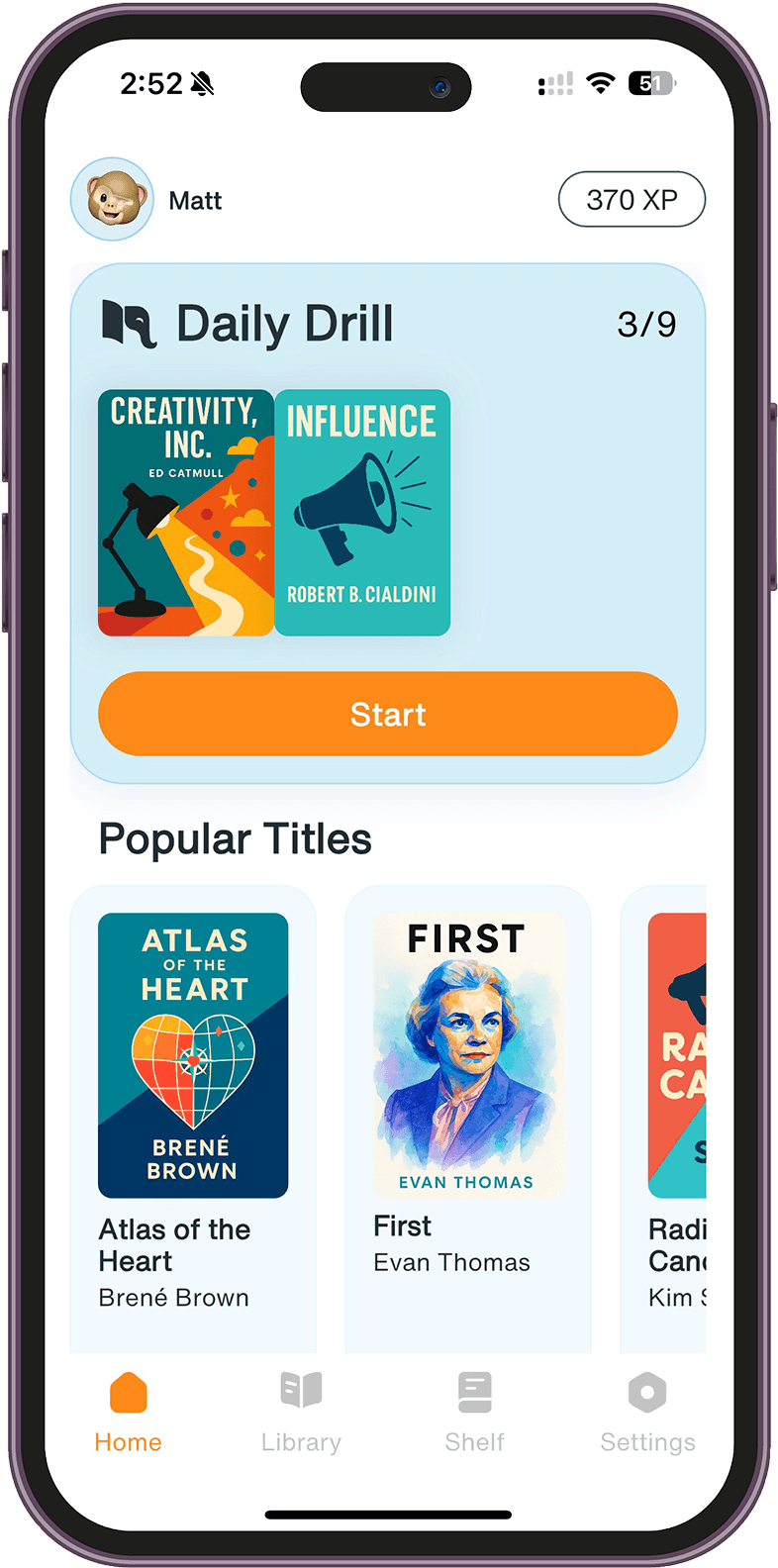
Loxie uses spaced repetition and active recall—the two most scientifically validated learning techniques—to help you retain the key concepts from The Power of Less. Instead of reading the book once and watching the ideas fade, you practice for just 2 minutes a day with questions that resurface concepts right before you'd naturally forget them.
Active recall means retrieving information from memory rather than passively re-reading it. Spaced repetition means reviewing at optimal intervals—right at the edge of forgetting—which strengthens memory traces far more effectively than massed practice. Together, these techniques can increase long-term retention by 200-400% compared to traditional reading.
Loxie includes The Power of Less in its full topic library. So the MIT system, the One Goal framework, the Essential Question Test, the 30-day habit protocol—all of these concepts get reinforced automatically, transforming what you learned into permanent knowledge you can actually use.
Frequently Asked Questions
What is the main idea of The Power of Less?
The core idea is that setting strict limits on tasks, projects, and commitments actually increases your impact rather than limiting it. By constraining your options, you channel all available attention and energy into fewer, more impactful actions. This counterintuitive principle works because human attention is finite and gets diluted across too many activities.
What are the key takeaways from The Power of Less?
The key takeaways include: focus on one goal for 3-12 months, complete your three Most Important Tasks before noon, apply the 5-year test to filter non-essential tasks, start habits "stupidly small" for 30 days, limit concurrent projects to three maximum, and create systems that automate decisions to preserve willpower.
What is the MIT system in The Power of Less?
MIT stands for Most Important Tasks. The system involves identifying your three most critical tasks each day and completing them before noon, when your energy and willpower are highest. This ensures essential work happens before meetings, urgency, and fatigue erode your productive capacity.
How does the 30-day habit protocol work?
The 30-day habit protocol focuses on installing one habit at a time over 30 days. Start with a "stupidly small" version of the habit to bypass psychological resistance. This concentrated approach prevents willpower dilution that occurs when attempting multiple habit changes simultaneously.
What is the Essential Question Test?
The Essential Question Test is a filter for prioritization: ask "Will this matter in 5 years?" for any task demanding your time. If the answer is no, the task is probably not essential. This temporal perspective strips away false urgency to reveal what truly contributes to long-term success.
How can Loxie help me remember what I learned from The Power of Less?
Loxie uses spaced repetition and active recall to help you retain the key concepts from The Power of Less. Instead of reading the book once and forgetting most of it, you practice for 2 minutes a day with questions that resurface ideas right before you'd naturally forget them. Loxie includes The Power of Less in its full topic library.
We're an Amazon Associate. If you buy a book through our links, we earn a small commission at no extra cost to you.
Stop forgetting what you learn.
Start learning for good with your 7-day FREE trial.