The Psychology of Money: Key Insights & Takeaways
Master Morgan Housel's framework for understanding why behavior matters more than brilliance when building lasting wealth.
by The Loxie Learning Team
What if the secret to building wealth has nothing to do with picking the right stocks or timing the market? Morgan Housel's The Psychology of Money makes a compelling case that your financial outcomes depend far more on how you behave than how smart you are. Through 19 stories about money, Housel reveals the psychological forces—from personal history to cognitive biases—that shape every financial decision you make.
This guide breaks down Housel's complete framework for understanding your relationship with money. Whether you've read the book and want to reinforce its lessons, or you're encountering these ideas for the first time, you'll walk away understanding not just what to do with your money, but why your behavior matters more than any spreadsheet or market analysis.
 Start practicing Psychology of Money free for 7 days ▸
Why does behavior matter more than intelligence for financial success?
Financial success depends more on behavior than intelligence because how you act with money—your patience, humility, and long-term perspective—matters more than your IQ or technical knowledge of markets. You can be a brilliant analyst who understands every financial ratio and still make terrible decisions when fear or greed takes over. Meanwhile, someone with average intelligence who consistently saves and avoids panic selling will likely build more wealth over time.
Housel points out that managing money well isn't primarily about what you know—it's about how you behave. And behavior is hard to teach, even to very smart people. The finance industry is full of highly educated professionals who blow up their portfolios through overconfidence or emotional reactions. The skills that matter most—patience during market downturns, humility about what you don't know, and the discipline to stick with a boring strategy—have nothing to do with intelligence.
This is why Loxie focuses on helping you internalize these behavioral principles rather than just reading about them once. Understanding that behavior beats brains is one thing; actually remembering it when markets crash takes repeated practice and reinforcement.
How do personal experiences shape your financial worldview?
Personal experiences shape your financial worldview more than data because the economic conditions you experienced in your formative years create lasting beliefs about risk, opportunity, and how money works. Someone who grew up during the Great Depression will have a fundamentally different relationship with money than someone who came of age during the bull market of the 1990s—even if both are looking at the same historical data.
Housel illustrates this with a striking observation: your personal experiences with money make up maybe 0.00000001% of what's happened in the world economically, but they account for maybe 80% of how you think the world works. A person born in 1970 experienced the S&P 500 increasing almost tenfold during their teenage years. Someone born in 1950 experienced the market going nowhere during the same developmental period. Both form their baseline expectations of investing from these radically different experiences.
This insight explains why financial advice often falls flat. When an older advisor tells a younger client to be more conservative, or a younger one urges more risk-taking, they're not just disagreeing about strategy—they're operating from entirely different mental models shaped by when they happened to be born. Recognizing this bias in yourself is the first step toward making more objective decisions.
Practice these concepts in Loxie ▸
What is true wealth and why isn't it about expensive things?
True wealth is the financial flexibility to do what you want, when you want, with who you want—not the expensive things you can buy. The highest form of wealth is waking up every morning and saying "I can do whatever I want today." Control over your time matters more for life satisfaction than your income level or the possessions you accumulate.
Housel draws a crucial distinction between being rich and being wealthy. Being rich means having a high income and buying nice things. Being wealthy means having money you don't spend—the cars not purchased, the jewelry not bought, and the upgrades declined that compound invisibly into financial security and freedom. Wealth is hidden. It's the option to take a lower-paying job that's more fulfilling. It's the ability to retire early or handle an emergency without panic.
This reframing matters because our culture celebrates visible consumption. When you see someone in a Ferrari, you don't actually admire the driver—you imagine yourself in that car. Expensive possessions rarely deliver the respect and admiration their owners seek. Meanwhile, true wealth—financial independence and flexibility—is invisible but infinitely more valuable for actual life satisfaction.
Why spending to impress others backfires
Spending money to show people how much money you have is the fastest way to have less money. Every dollar spent signaling wealth is a dollar that can't compound for your future. The irony is that the admiration you're seeking rarely materializes anyway—people are too busy thinking about themselves to be impressed by your car or watch.
Why are time and compounding the most powerful wealth-building forces?
Time and compounding are the most powerful wealth-building forces because small, consistent investments grow exponentially over decades, turning ordinary savings into extraordinary wealth through patient accumulation. The math is staggering: Warren Buffett accumulated $81.5 billion of his $84.5 billion net worth after his 65th birthday. His real secret isn't superior investing genius—it's that he's been investing consistently for three-quarters of a century.
Compounding creates wealth exponentially over decades rather than years. This is counterintuitive because our brains think linearly. We expect that if you double the time, you double the result. But compound growth doesn't work that way. The majority of gains come at the very end, which is why most people underestimate the power of starting early and staying invested.
This is also why survival matters so much. Staying in the game long enough to benefit from compounding requires avoiding catastrophic losses that force you out permanently. It's not about maximizing returns in any given year—it's about ensuring you're still around to collect the exponential gains that come decades later.
The compounding insight is easy to understand but hard to feel
Most people nod along when they hear about compound growth, then continue making short-term decisions. Loxie helps you internalize these concepts through spaced repetition, so the power of patience becomes part of how you actually think about money.
Start retaining what you learn ▸Why does your savings rate matter more than your income or investment returns?
Building wealth depends far more on your savings rate than on your income level or investment returns because you can control spending immediately while income and returns remain largely outside your control. A high earner who spends everything builds no wealth, while a moderate earner who consistently saves 20% will steadily accumulate financial freedom.
Housel emphasizes that savings is the gap between your ego and your income. You can grow this gap by earning more, which is hard and often outside your control. Or you can grow it by desiring less, which is always within your control. Past a certain level of income that covers basic needs, what you "need" is largely determined by ego and social comparison rather than actual requirements for happiness or security.
The beauty of focusing on savings rate is that it works at any income level. Whether you earn $50,000 or $500,000, the percentage you save is what determines your trajectory toward financial independence. And unlike chasing higher returns through clever investing, increasing your savings rate is something you can implement today.
What is margin of safety and why is it essential?
Margin of safety—through emergency funds, conservative assumptions, and avoiding leverage—is the only effective way to navigate a world governed by uncertainty and randomness. The most important part of every financial plan is planning on your plan not going according to plan by building in buffer for the inevitable surprises life throws at you.
This principle recognizes a fundamental truth: the future is unpredictable. History is the study of change and surprises, not a map of what's coming. The most impactful financial events in your life will likely be ones that have never happened before. Planning as if you know what will happen is a recipe for disaster when reality inevitably diverges from your assumptions.
Practical margin of safety means avoiding extreme financial commitments like oversized mortgages or illiquid investments that could trap you when circumstances change. It means maintaining emergency funds even when it feels inefficient. It means using conservative assumptions in your planning and avoiding leverage that could amplify losses into catastrophe.
Learn Psychology of Money for good ▸
Why do sustainable strategies beat optimal strategies?
Sustainable financial strategies that you can maintain through market cycles and life changes matter more than mathematically optimal decisions that you'll abandon when tested. The best investment strategy isn't the one with the highest theoretical return—it's the one you can actually stick with when markets plunge or life gets complicated.
This is why aiming to be reasonable rather than coldly rational with money leads to better outcomes. Reasonable strategies that account for emotions and real-life pressures are the ones you'll actually maintain long-term. A theoretically suboptimal portfolio that lets you sleep at night will outperform an optimal one that you panic-sell during a downturn.
Housel shares his own approach: he and his wife save a substantial percentage of their income, avoid debt, and invest in low-cost index funds they plan to hold for decades. Is this mathematically optimal? Probably not. But it's sustainable, low-stress, and accounts for the reality that they're human beings with emotions, not spreadsheet-calculating machines.
Why is survival the prerequisite for financial success?
Survival is the prerequisite for financial success because staying in the game long enough to benefit from compounding requires avoiding catastrophic losses that force you out permanently. Getting money requires risk-taking and optimism, while keeping money demands humility, fear of loss, and frugality—two opposing skill sets that explain why many who get rich don't stay rich.
The game of building wealth isn't won by the person with the highest single-year return. It's won by the person who stays invested through multiple decades, collecting the exponential gains that come later. One catastrophic loss—from leverage, concentration, or simply panic-selling at the bottom—can erase years of careful accumulation.
This requires what Housel calls the barbell personality: optimistic enough to believe in long-term growth, but paranoid enough to build defenses against ruin. You need confidence that things will work out combined with the humility to acknowledge that you could be wrong about timing and specifics.
What are the only two behaviors needed to build wealth?
Building wealth requires just two behaviors: maintaining a high savings rate regardless of income level and investing consistently in diversified, low-cost index funds over decades. Everything else is commentary. These two habits, maintained over sufficient time, will make most people wealthy—no stock picking, market timing, or complex strategies required.
The simplicity is the point. Most financial complexity exists to make advisors money or to satisfy the human craving for action. But the evidence overwhelmingly shows that boring, consistent behavior beats clever tactics. Save a meaningful percentage of your income. Put it in diversified, low-cost funds. Wait decades. That's it.
The challenge isn't understanding this strategy—it's maintaining it. When markets crash 40%, your emotions scream to sell. When a hot stock is soaring, you want to chase it. When your neighbor seems to be getting rich quick, your strategy feels painfully boring. Internalizing why this simple approach works is what helps you stick with it when tested.
Why should you save money without needing a specific goal?
Save money without needing a specific goal because life's most important financial needs—from opportunities to emergencies—are impossible to predict but certain to arise. The flexibility that comes from having savings exceeds any specific thing you might be saving for.
Most financial advice focuses on goal-based saving: retirement, a house, college for the kids. These are valid, but Housel argues they miss the bigger picture. The most valuable thing money buys is control over your time and options you can't currently imagine. You don't know what opportunities will appear or what emergencies will strike, but having savings means you can respond to both.
Saving without a defined purpose also removes the psychological barrier of needing to justify each dollar saved. You're not saving for something—you're saving for anything. This mindset shift makes consistent saving easier because you don't need to calculate whether you've "saved enough" for any particular goal.
Why does pessimism sound smarter than optimism?
Pessimism sounds smarter and more thoughtful than optimism, but optimism has the better track record because progress happens slowly while setbacks happen suddenly and capture more attention. A slow, steady rise in living standards over decades doesn't make headlines. A market crash makes front-page news instantly.
This asymmetry creates a bias toward pessimistic thinking. The pessimist always sounds more sophisticated and cautious. The optimist sounds naive or like they're trying to sell something. But humanity has become better at nearly everything over time—life expectancy, literacy, wealth, technology—even though pessimistic voices always sound more compelling in the moment.
For investors, this matters because pessimism can justify avoiding markets entirely, missing out on the long-term gains that have historically rewarded patience. Acknowledging that things generally improve over long periods—while preparing for inevitable setbacks—is a more accurate and useful worldview than constant doom-saying.
What role do luck and humility play in financial outcomes?
Go out of your way to find humility when things are going well and forgiveness when they go wrong, because the world is too complex to allow 100% of your actions to dictate 100% of your outcomes. Luck and risk are siblings in every outcome—they're just different sides of the same coin of randomness.
Housel illustrates this with Bill Gates, who happened to attend one of the only high schools in the world with a computer terminal in the late 1960s. His equally talented friend Kent Evans was on track for the same success until he died in a mountaineering accident. Both were brilliant. One got lucky, one got unlucky. Both outcomes had little to do with their individual decisions.
Recognizing the role of luck doesn't mean denying the importance of effort or skill. It means understanding that success is normal failure punctuated by moments of spectacular luck. This perspective helps maintain humility during wins and forgiveness during losses—for yourself and others. Someone who failed might have done everything right and gotten unlucky. Someone who succeeded might have done many things wrong but gotten lucky anyway.
The real challenge with The Psychology of Money
Here's the uncomfortable truth about reading The Psychology of Money: understanding these concepts intellectually is easy, but actually applying them when it matters is extraordinarily hard. You can nod along with every chapter about the importance of patience and long-term thinking, then panic-sell your portfolio the next time markets drop 20%.
This gap between knowing and doing is the central challenge of personal finance. How many books have you read that felt life-changing in the moment but left no lasting impact on your behavior? The forgetting curve is brutal—we lose about 70% of new information within 24 hours without active reinforcement. And when it comes to money, forgetting the lessons usually costs you exactly when markets test your resolve.
The insights in this book aren't complex. They're behavioral. And behavioral change requires repetition, not just reading. You need these principles to become instinctual responses, not just ideas you once encountered in a book.
How Loxie helps you actually remember what you learn
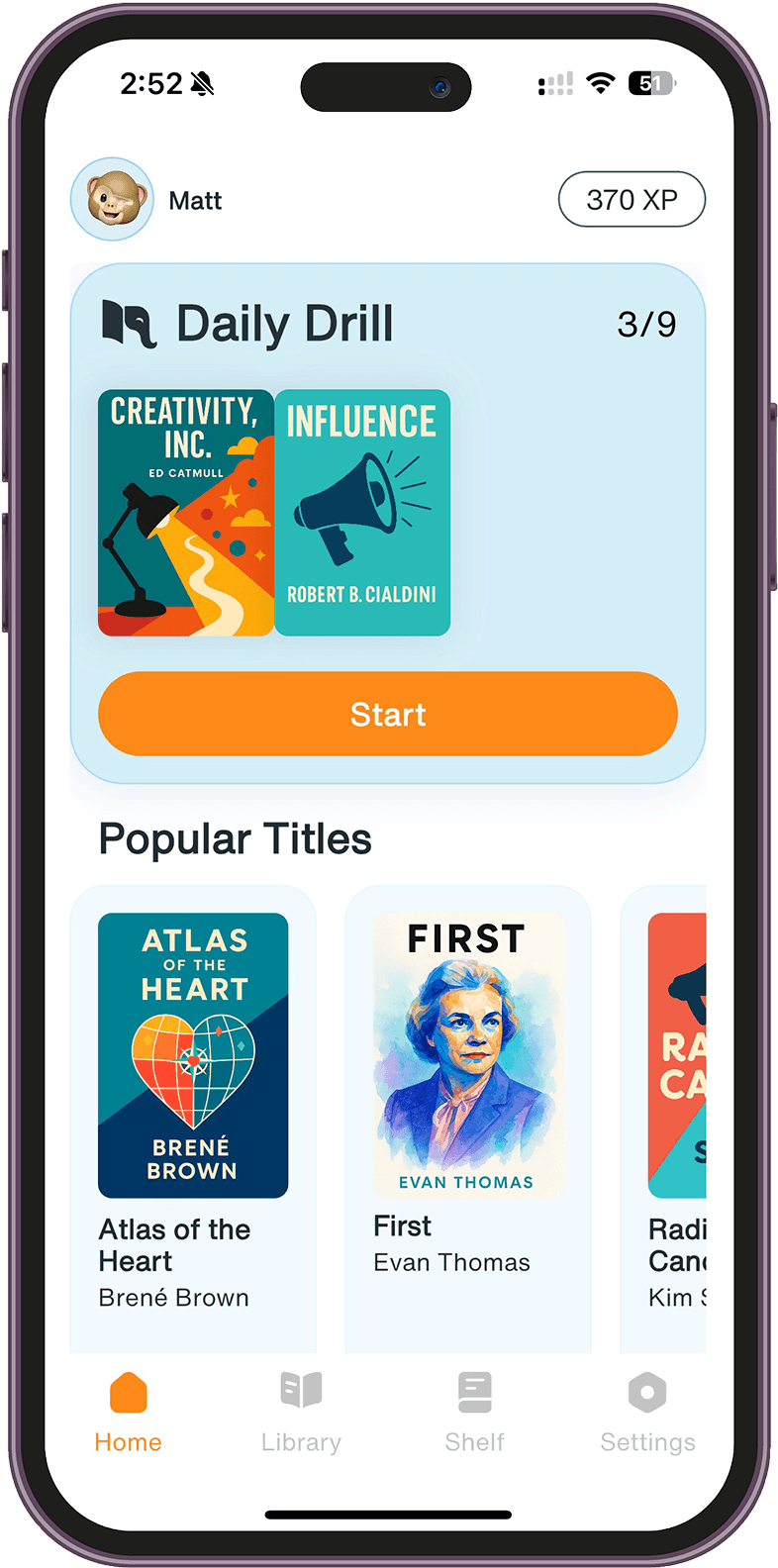
Loxie uses spaced repetition and active recall—the two most scientifically validated learning techniques—to help you internalize concepts from The Psychology of Money so they're available when you need them. Instead of reading once and forgetting, you practice for just 2 minutes a day with questions that resurface ideas right before you'd naturally forget them.
The key is that Loxie doesn't just quiz you on facts. It helps you internalize the behavioral principles that actually matter: why behavior beats brains, why patience pays off, why you should stay humble about luck and risk. These become part of how you think about money, not just things you once read.
Loxie includes The Psychology of Money in its full topic library, so you can start reinforcing these concepts immediately. Because the best financial advice isn't the cleverest—it's the advice you actually remember and follow.
Financial Disclaimer: This content is for educational purposes only and is not financial, investment, or tax advice. Always consult a qualified financial professional before making decisions about your money.
Frequently Asked Questions
What is the main idea of The Psychology of Money?
The central argument is that financial success depends more on behavior than intelligence. How you act with money—your patience, humility, and long-term perspective—matters more than your IQ or technical knowledge of markets. Personal experiences, emotions, and biases shape financial decisions far more than spreadsheets or analysis.
What are the key takeaways from The Psychology of Money?
The most important lessons are: save consistently regardless of income, invest in diversified low-cost index funds, stay in the game long enough for compounding to work, build margin of safety for uncertainty, and recognize that true wealth is freedom and flexibility—not expensive possessions.
What does Morgan Housel say about saving money?
Housel argues that your savings rate matters more than your income or investment returns because you can control spending immediately. He recommends saving without needing a specific goal, because life's most important financial needs are impossible to predict. Savings equals the gap between your ego and your income.
Why does Housel say behavior beats intelligence for investing?
Smart people often make terrible financial decisions when emotions take over. The skills that build wealth—patience, humility, discipline, long-term thinking—have nothing to do with IQ. A person of average intelligence who saves consistently and avoids panic will likely build more wealth than a brilliant analyst who can't control their emotions.
What is the role of luck in financial success according to The Psychology of Money?
Luck and risk are siblings in every outcome. Bill Gates happened to attend one of the only high schools with a computer; his equally talented friend died in an accident. Success is often normal failure punctuated by spectacular luck. This demands humility when things go well and forgiveness when they don't.
How can Loxie help me remember what I learned from The Psychology of Money?
Loxie uses spaced repetition and active recall to help you retain the key concepts from The Psychology of Money. Instead of reading the book once and forgetting most of it, you practice for 2 minutes a day with questions that resurface ideas right before you'd naturally forget them. Loxie includes this book in its full topic library.
We're an Amazon Associate. If you buy a book through our links, we earn a small commission at no extra cost to you.
Stop forgetting what you learn.
Start learning for good with your 7-day FREE trial.