The Rosie Effect: Key Insights & Takeaways from Graeme Simsion
Discover how an unconventional mind navigates pregnancy, partnership, and the beautiful chaos of preparing for parenthood.
by The Loxie Learning Team
What happens when a man who thrives on schedules, data, and scientific precision faces the most unpredictable experience of all—becoming a father? In The Rosie Effect, Graeme Simsion continues Don Tillman's story as he navigates pregnancy alongside his wife Rosie in New York City. The result is a humorous yet deeply moving exploration of how love, partnership, and impending parenthood can transform even the most systematic mind.
This guide unpacks the essential lessons woven throughout Don's journey. Whether you've read the book and want to internalize its wisdom, or you're discovering these themes for the first time, you'll find insights about flexibility, emotional connection, and the beautiful chaos that comes with preparing for a child.
 Start practicing The Rosie Effect free for 7 days ▸
Why do rigid schedules fail when preparing for a baby?
Rigid schedules fail in newborn care because babies operate on their own unpredictable timelines that resist even the most meticulous planning. Don discovers that his carefully constructed routines—the very systems that help him function effectively in daily life—become liabilities when facing a tiny human who has no regard for spreadsheets or optimization protocols.
The lesson extends beyond infant care schedules. Throughout Rosie's pregnancy, Don confronts repeated evidence that natural biological processes like childbirth resist scheduling attempts entirely. Labor doesn't wait for the optimal time slot. Contractions don't follow predictable intervals. The baby arrives when ready, not when the calendar dictates.
This forces a fundamental shift in Don's approach: moving from fixed routines to constant adaptation. For anyone who finds comfort in structure and predictability, this insight reveals that life's most significant transitions require developing what might be called "flexible structure"—maintaining helpful frameworks while remaining open to moment-by-moment adjustment.
Why does community support become essential during major life changes?
Community support becomes essential during overwhelming challenges because even the most capable individuals cannot anticipate or manage every aspect of major life transitions alone. Don, despite his impressive intellectual capabilities and exhaustive preparation, discovers that parenthood requires a network of relationships he hadn't prioritized building.
The book illustrates how long-term friends serve as interpreters between different communication styles, helping partners understand each other's fundamentally different processing approaches. Friends who know both Don and Rosie can translate between logic-driven and emotion-driven perspectives, smoothing conflicts that would otherwise escalate.
This insight challenges the self-sufficiency that many high-achievers prize. Don learns that his preference for independence becomes a liability when facing parenthood's unpredictable demands. Accepting help from others isn't weakness—it's wisdom about human limitations and the social nature of raising children.
Practice these insights with Loxie ▸
Why do optimization projects fail in relationships?
Optimization projects fail when they prioritize efficiency over emotional connection because focusing solely on nutrition plans, exercise regimens, and data tracking can miss the fundamental need for empathy, presence, and emotional support. Don's elaborate pregnancy protocols—while scientifically sound—create distance rather than closeness with Rosie.
The problem isn't the systematic thinking itself. Don's research skills and attention to detail are genuine strengths. The failure comes from applying these tools without integrating emotional awareness. A perfectly optimized prenatal vitamin schedule means nothing if your partner feels unseen and unsupported.
When systematic approaches become relationship assets
The book reveals that systematic approaches can become relationship assets when adapted to emotional contexts. The key is using structured thinking to support rather than replace emotional connection. Don's detailed pregnancy schedules work best when they leave room for spontaneous support—when the system serves the relationship rather than dominating it.
This balance requires recognizing that exhaustive research must be filtered through collaborative decision-making. Information overload can paralyze rather than empower couples facing important choices. The goal isn't maximum data—it's wisdom about which data matters and how to apply it together.
How do partnership roles evolve during pregnancy?
Partnership roles evolve significantly during pregnancy, requiring conscious adaptation as both partners navigate new responsibilities, emotional needs, and shifting dynamics in their relationship. What worked before pregnancy may not work during it. The balance of support, decision-making authority, and emotional labor all require renegotiation.
Don learns that supporting a pregnant partner requires prioritizing relationship needs over personal routines. This means recognizing emotional cues, adapting schedules spontaneously, and accepting that predictability must sometimes yield to presence. When Rosie needs connection, the workout schedule can wait.
Schedule flexibility transforms from a personal inconvenience into a relationship skill during pregnancy. Partners must develop new metrics for productivity that include emotional availability—a challenging shift for anyone whose identity is built around efficiency and optimization.
Understanding these dynamics is one thing—remembering them when you need them is another.
The Rosie Effect offers profound insights about partnership and flexibility, but insights fade without reinforcement. Loxie helps you internalize these lessons through spaced repetition, so they're available when you're actually navigating relationship challenges.
Try Loxie free for 7 days ▸What does effective labor support actually require?
Effective labor support requires emotional presence and intuitive responsiveness beyond technical knowledge—partners need reassurance and connection more than perfectly executed protocols. Don's extensive preparation for labor, while admirable in its thoroughness, misses this essential truth.
Being a supportive partner during childbirth demands learning new communication skills like reading non-verbal cues and offering comfort without solving. This challenges logic-based interaction styles that default to problem-solving mode. Sometimes the answer isn't fixing anything—it's simply being there.
The limits of preparation
Real emergencies like active labor require balancing advance preparation with moment-to-moment adaptation, using plans as flexible guides rather than rigid scripts. Systematic approaches simultaneously help and hinder during chaotic moments by providing useful structure while potentially blocking spontaneous responses to rapidly changing needs.
Over-preparation through multiple rehearsals and contingency planning often reveals deeper anxiety about loss of control during unpredictable life events. Don's elaborate emergency drills and contingency planning reveal his deep fear of being unprepared for fatherhood's inherent uncertainties. The preparation provides psychological comfort by creating an illusion of control—but the illusion must eventually yield to reality.
How does preparing for parenthood transform a person?
The journey of preparing for parenthood transforms Don fundamentally by forcing him to develop emotional intelligence, flexibility, and empathy beyond what his scientific mindset initially allowed. This isn't about abandoning who he is—it's about expanding his capacity for connection while retaining his analytical strengths.
People who identify primarily with logic and analysis can surprise themselves with unexpected depths of emotional capacity when experiencing profound life events. Don discovers feelings he didn't know he could access, responses that bypass his usual analytical frameworks entirely.
Even highly analytical minds experience surprising emotional responses to pregnancy milestones like ultrasounds and baby movements. These moments reveal that parenthood awakens feelings that bypass logical processing—and that this isn't a bug but a feature of human experience.
Start retaining what you learn ▸
Why does meeting your child transcend logic?
Meeting your child for the first time transcends all logic and data processing, creating an immediate emotional bond that bypasses analytical thinking and transforms even the most systematic person. Don experiences overwhelming emotions that completely bypass his usual logical frameworks when he meets his baby.
This moment reveals that fatherhood operates on instinctive and emotional levels that data analysis cannot capture. All the preparation, research, and optimization become secondary to the raw experience of holding your child. The spreadsheets don't matter anymore—only the connection does.
For readers who share Don's analytical tendencies, this insight offers both reassurance and challenge. The reassurance: you will feel things you couldn't predict or prepare for, and that's okay. The challenge: accepting that some of life's most meaningful experiences can't be optimized or controlled.
How does growth in social awareness actually happen?
Growth in social awareness comes from navigating unfamiliar customs by observing others' reactions, asking clarifying questions without shame, and accepting that social logic differs from scientific logic. Don's journey through pregnancy involves countless encounters with social traditions he doesn't intuitively understand.
Social traditions like baby showers contain unwritten rules about gift-giving, games, and gender dynamics that require cultural decoding rather than logical analysis. Literal interpretation of instructions and excessive questioning—while revealing genuine commitment to learning—can create social discomfort in group settings.
Group educational environments like prenatal classes expose communication style differences between partners when one processes information literally while the other grasps social context intuitively. These moments become opportunities for growth rather than sources of embarrassment when approached with curiosity rather than judgment.
Why must personal growth include accepting uncertainty?
Personal growth emerges from accepting uncertainty and embracing chaos because life's most meaningful experiences—like pregnancy and parenthood—cannot be fully controlled or optimized through planning alone. Don's transformation hinges on this fundamental acceptance.
Accepting chaos becomes essential for functioning as a parent. Attempting to impose order on infant care creates more stress than embracing the inherent unpredictability. The goal shifts from eliminating uncertainty to developing comfort with it.
Balancing systematic thinking with emotional flexibility
Successful relationships require balancing systematic thinking with emotional flexibility by creating structured approaches to life while remaining open to spontaneous emotional needs and unexpected changes. Neither pure logic nor pure emotion serves relationships well—the integration of both creates strength.
Neurodivergent minds contribute unique strengths to relationships and parenting through systematic problem-solving, unwavering dedication to research, and fresh perspectives on conventional challenges. Don's differences aren't deficits—they're assets when properly integrated with emotional awareness.
Learn The Rosie Effect for good ▸
How do you express feelings without data?
Expressing feelings without data requires developing new communication skills through practice with emotional vocabulary, body language awareness, and accepting the imprecision of subjective experience. For Don, this represents one of his greatest challenges—and greatest areas of growth.
Vulnerability strengthens intimate connections when shared appropriately. Don discovers that admitting uncertainty and fear draws Rosie closer rather than pushing her away. The precision he typically demands must yield to the messiness of emotional expression.
Focusing on technical details during emotionally significant moments creates disconnection because it prioritizes intellectual curiosity over shared emotional experience. Learning when to analyze and when to simply feel becomes a crucial relationship skill.
How should couples balance research with intuition in medical decisions?
Medical decisions during pregnancy require balancing exhaustive research with a partner's intuition and preferences, creating a synthesis between data-driven analysis and emotional wisdom. Neither approach alone produces optimal outcomes—the integration matters.
Creating exhaustive databases of expert advice can paralyze decision-making by presenting contradictory recommendations that increase anxiety rather than provide clarity. Conflicting expert opinions about pregnancy and parenting create anxiety because they undermine confidence in making choices that have no objectively correct answer.
Partner disagreements about pregnancy decisions often represent fundamentally different coping strategies for uncertainty—one partner seeking control through information while the other embraces the unknown. Understanding this dynamic helps couples navigate conflicts with compassion rather than frustration.
The real challenge with The Rosie Effect
Reading about Don's transformation is one thing. Actually internalizing these insights about flexibility, emotional presence, and accepting uncertainty is another entirely. Research on memory reveals that we forget approximately 70% of what we learn within 24 hours, and up to 90% within a week without reinforcement.
Consider how many books you've read that felt genuinely life-changing in the moment—insights about relationships, personal growth, or parenting that seemed unforgettable—yet you'd struggle to recall three key points today. The problem isn't the quality of the ideas. It's how human memory works.
Don's journey teaches us that growth requires repeated practice and reinforcement. The same principle applies to retaining what we learn from his story. Understanding that emotional presence matters more than perfect protocols won't help you in the moment unless that understanding is deeply encoded and readily accessible.
How Loxie helps you actually remember what you learn
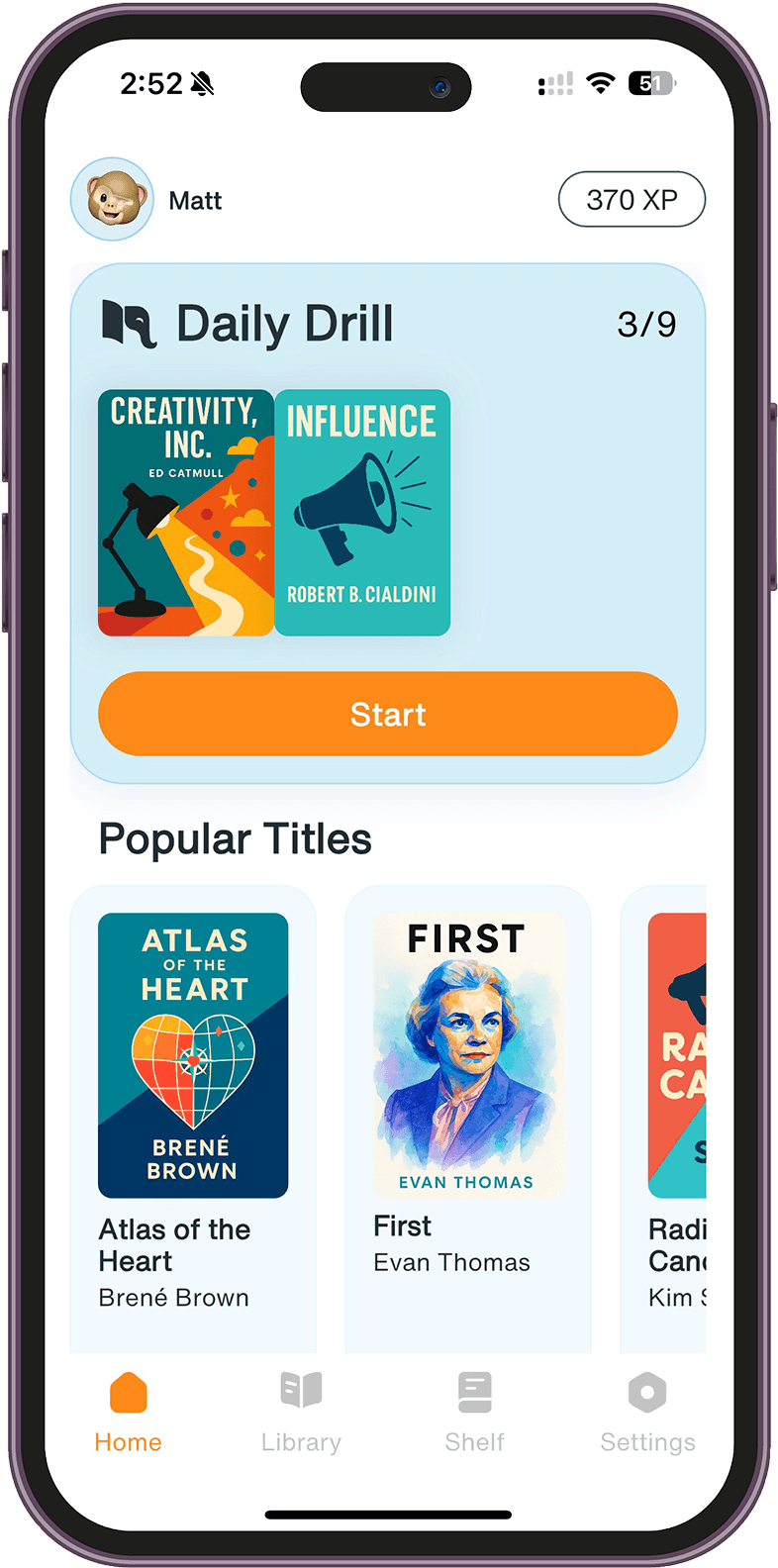
Loxie uses spaced repetition and active recall—the same evidence-based learning techniques that help medical students retain vast amounts of information—to help you internalize the key concepts from The Rosie Effect. Instead of reading once and watching the insights fade, you practice for just 2 minutes a day with questions that resurface ideas right before you'd naturally forget them.
Loxie includes The Rosie Effect in its complete topic library, so you can start reinforcing these concepts about flexibility, partnership, and emotional growth immediately. When you actually need to practice emotional presence over protocol-following, the lesson will be there—not buried in a book you read months ago.
Frequently Asked Questions
What is the main idea of The Rosie Effect?
The Rosie Effect explores how a highly systematic, logic-driven person must develop emotional flexibility and presence when facing impending fatherhood. The core message is that life's most meaningful experiences—like pregnancy and parenthood—cannot be controlled or optimized through planning alone, requiring growth in areas like empathy, adaptability, and accepting uncertainty.
What are the key takeaways from The Rosie Effect?
The essential lessons include: rigid schedules must yield to flexibility when caring for children; emotional presence matters more than perfect protocols; community support is essential during major life transitions; systematic thinking becomes a strength only when integrated with emotional awareness; and personal transformation comes from accepting what cannot be controlled.
How does Don Tillman change throughout The Rosie Effect?
Don transforms from someone who approaches pregnancy as an optimization project—creating elaborate schedules, protocols, and data systems—into a person capable of emotional presence and spontaneous adaptation. He develops the ability to express feelings without data, prioritize connection over efficiency, and accept the inherent chaos of parenthood.
What does The Rosie Effect teach about relationships?
The book illustrates that successful partnerships require balancing systematic thinking with emotional flexibility. Supporting a partner through major life changes means prioritizing their emotional needs over personal routines, learning to read non-verbal cues, and accepting that vulnerability strengthens rather than weakens intimate connections.
Is The Rosie Effect about autism or neurodivergence?
While Don's character exhibits traits consistent with autism spectrum conditions, the book focuses on universal themes about adaptation, growth, and connection rather than diagnosis. The story shows how neurodivergent minds contribute unique strengths to relationships while highlighting the growth possible when systematic thinking integrates with emotional awareness.
How can Loxie help me remember what I learned from The Rosie Effect?
Loxie uses spaced repetition and active recall to help you retain the key concepts from The Rosie Effect. Instead of reading the book once and forgetting most of it, you practice for 2 minutes a day with questions that resurface ideas right before you'd naturally forget them. Loxie includes The Rosie Effect in its full topic library, so you can start reinforcing these concepts immediately.
We're an Amazon Associate. If you buy a book through our links, we earn a small commission at no extra cost to you.
Stop forgetting what you learn.
Start learning for good with your 7-day FREE trial.