The Second Mountain: Key Insights & Takeaways from David Brooks
Discover why true fulfillment comes not from personal success but from commitments to family, vocation, faith, and community.
by The Loxie Learning Team
What if everything you've been taught to chase—career success, wealth, status—is merely preparation for discovering your true purpose? David Brooks argues in The Second Mountain that the deepest fulfillment doesn't come from climbing higher on the mountain of personal achievement. It comes from descending through suffering into a valley, then ascending a second mountain dedicated entirely to commitments beyond yourself.
This guide unpacks Brooks's complete framework for understanding why so many accomplished people feel empty, what transforms suffering into growth, and how sacred commitments to spouse, vocation, faith, and community create what he calls "moral joy"—a satisfaction that transcends circumstances and transforms both individuals and society.
 Start practicing The Second Mountain free for 7 days ▸
What is the first mountain and why isn't it enough?
The first mountain represents the conventional path to success that modern culture celebrates: building a career, accumulating wealth, achieving status, and cultivating an impressive public identity. This mountain is organized around what Brooks calls résumé virtues—the achievements, titles, and accomplishments that look impressive on paper and earn external validation.
The problem isn't that first mountain pursuits are bad. Career success and financial security genuinely matter. The problem is treating them as ultimate goals rather than means to something deeper. First mountain climbers often discover, sometimes at the summit itself, that the view doesn't satisfy. They've won the game everyone told them to play, yet feel strangely empty.
Brooks describes a personality type he calls the "insecure overachiever"—someone who appears successful but remains inwardly anxious because their entire sense of self depends on the next accomplishment. Peace and satisfaction become structurally impossible when identity rests entirely on external validation. There's always another peak to climb, another competitor to outpace, another metric to optimize.
The first mountain's individualist ethos promises self-sufficiency and freedom but often delivers isolation and exhaustion. Constructing an identity entirely alone is like trying to build a house while living inside it—you need external relationships and commitments to provide the scaffolding for genuine transformation.
What is the valley experience and why is suffering necessary?
The valley represents periods of suffering, loss, or moral failure that shatter first mountain illusions. This might be a divorce, the death of someone close, a career collapse, a health crisis, or a profound moral failure. Whatever form it takes, the valley strips away the ego's protective armor of competence and control.
Brooks argues that the valley isn't an unfortunate detour to be avoided or quickly escaped. It's the essential crucible that burns away ego and opens people to transformation. Like controlled burns in forests that clear dead growth to enable new life, valley experiences create the conditions for genuine rebirth when approached with openness rather than resistance.
This challenges the modern tendency to avoid or medicate away pain. Our culture treats suffering as a problem to solve rather than a necessary phase of transformation. But many people describe their worst experiences as ultimately their most valuable. Loss creates space for transformation that success and comfort never could—what mystics call "blessed subtraction," the painful grace of losing what you thought you needed to discover what you actually need.
The wilderness period after the valley
After a valley experience comes a wilderness period when old certainties have died but new purpose hasn't emerged. This requires learning to sit in the anxiety rather than rushing to premature answers or numbing the discomfort. Our solution-oriented culture treats uncertainty as a problem to solve, but the capacity to tolerate ambiguity enables genuine rebirth rather than mere recovery.
Post-valley transformation happens not through thinking your way to new beliefs but through small acts of service that gradually reshape identity. You become what you do before you become what you believe. Committed action in service of others naturally transforms consciousness over time.
Practice these concepts in Loxie ▸
What is the second mountain and what makes it different?
The second mountain is organized around eulogy virtues—the qualities people remember at funerals: kindness, bravery, honesty, the capacity for deep love. While first mountain people organize life around what looks impressive on paper, second mountain people pursue the character traits that create lasting impact on others.
The fundamental shift is from self-centeredness to other-centeredness. First mountain climbers ask "What do I want from life?" Second mountain people ask "What is life asking of me?" and "What do my commitments require?" The organizing principle moves from personal achievement to sacred obligation.
Second mountain people find what Brooks calls moral joy—not ordinary happiness but the deep satisfaction of living aligned with your deepest values even when it involves sacrifice and struggle. This explains why second mountain people often appear more content despite having "less" in conventional terms. They've found a joy that transcends circumstances.
Distinguishing ego from soul
Brooks offers a practical framework for understanding these different orientations: The ego wants to be admired, but the soul wants to be connected. The ego fears humiliation, but the soul fears separation. By distinguishing these voices, you can identify whether your choices serve ego-protection or soul-expansion.
The soul speaks in whispers while the ego shouts. This is why silence, solitude, and contemplative practices are essential for hearing your deepest callings rather than your loudest fears. Constant stimulation drowns out the quiet voice that might question whether you're climbing the right mountain at all.
Understanding these concepts intellectually is just the beginning
The distinction between résumé virtues and eulogy virtues can reshape how you make decisions—but only if you remember it when facing an actual choice. Loxie helps you internalize these frameworks through spaced repetition so they're available when you need them most.
Try Loxie free for 7 days ▸Why do sacred commitments matter more than keeping options open?
Sacred commitments differ fundamentally from contracts. Contracts are entered for mutual benefit—you give something to get something. Sacred commitments are entered for the sake of the commitment itself. You commit to children not because they'll care for you in old age but because the commitment transforms you. The unconditional nature of sacred commitments creates a different quality of love and obligation than cost-benefit calculations ever could.
This challenges the modern obsession with flexibility and keeping options open. Brooks argues that making commitments in an age that celebrates choice is a radical act. It declares that some things matter more than personal freedom and that limitation can be liberation. The modern fear of commitment actually imprisons us in perpetual FOMO, while commitment—though it closes doors—opens depths of experience unavailable to those who won't choose.
Brooks identifies four domains of commitment that structure second mountain life: vocation (your life's work), marriage and family (intimate relationships), philosophy or faith (your ultimate framework for meaning), and community (the place and people you serve). Each domain requires moving from consumer to giver, from spectator to participant.
The four stages of commitment
All deep commitments move through predictable stages: initial enchantment, inevitable disillusionment, testing through crisis, and finally fusion. Understanding these phases helps people persist through the difficult middle stages when enchantment fades and fusion seems impossible. Disillusionment isn't proof of a poor choice—it's part of the process.
Doubt isn't commitment's enemy but its companion. The person who never doubts their marriage, vocation, or faith hasn't truly chosen it but merely inherited or assumed it. Wrestling with uncertainty deepens rather than threatens real commitment.
How does relationalism differ from individualism?
Brooks contrasts two fundamental philosophies: individualism starts from "I think therefore I am"—the isolated self constructing meaning alone. Relationalism starts from "I am embedded"—recognizing that we exist first in relationships and only secondarily as individuals. Connection precedes consciousness; isolation is the aberration, not the natural state.
Hyper-individualism doesn't free people but orphans them, cutting them off from the traditions, communities, and commitments that provide identity, meaning, and moral formation. Extreme individualism creates not liberated individuals but anxious, isolated people forced to construct meaning alone without the cultural inheritance that previous generations took for granted.
The quality of your life is determined by the quality of your relationships—not just intimate ones but the entire web of connections from family to strangers. Even casual interactions and community bonds shape wellbeing. The modern focus on a few intense relationships while neglecting the broader social fabric misses how human flourishing actually works.
What does second mountain marriage look like?
Marriage as moral commitment means choosing to see your spouse's growth as equally important as your own. Brooks describes this as a "covenant of mutual transformation" where both people become more than either could alone. The relationship itself becomes a vehicle for moral growth, elevating marriage beyond companionship or romance to a spiritual discipline.
The maximal commitment of marriage—promising your whole future to another person—creates maximal freedom by eliminating the endless energy drain of keeping options open and evaluating alternatives. Total commitment liberates rather than constrains, freeing mental and emotional resources for depth rather than wasting them on perpetual choice-making.
Deepening intimacy through attention
Brooks describes a progression in how we see another person: from "glimpsing" (noticing surface), to "gazing" (perceiving patterns), to "beholding" (witnessing their essence). Love deepens not through time alone but through increasingly penetrating ways of seeing, requiring the discipline to move beyond projection to actual perception.
Intimate relationships develop through three-part harmony: heart (emotional connection), mind (intellectual engagement), and soul (shared transcendence). Problems arise when any dimension dominates or disappears. Overemphasis on passion without friendship, or companionship without mystery, creates imbalance that undermines lasting intimacy.
Conflict and forgiveness as growth practices
Conflict in committed relationships serves like pruning in vineyards—painful cutting back that enables stronger growth. But this only works when partners approach disagreements as shared problem-solving rather than winner-take-all combat. The key is fighting for the relationship rather than against each other.
Forgiveness isn't a one-time act but a daily practice—less like paying off a debt than tending a garden where weeds of resentment continuously sprout and require patient removal. Lasting relationships require constant small acts of grace rather than occasional grand pardons.
Start retaining what you learn ▸
How do you find your vocation?
Finding vocation requires distinguishing between three related but different concepts: a career (what you're paid for), a calling (what you're made for), and a profession (the community and standards that shape your practice). This three-part framework helps navigate work decisions by separating economic necessity from life purpose while recognizing how professional communities provide structure and accountability.
Brooks draws on theologian Frederick Buechner's principle: vocation emerges at the intersection of your deep gladness and the world's deep need. This dissolves the false choice between personal satisfaction and altruism. Authentic service flows from doing what you're genuinely called to do—where fulfillment and contribution align rather than conflict.
How calling announces itself
The inner genius or "daemon" doesn't tell you what to do but what you cannot not do. Vocation announces itself through persistent interests and recurring themes that won't leave you alone. Paying attention to what repeatedly calls to you reveals purpose more reliably than aptitude tests and market analysis.
Vocation rarely arrives as a voice from the sky. Instead, it emerges as a growing inability to imagine doing anything else. What was once a possibility becomes first a probability, then an inevitability. Most people discover purpose through accumulated experiences and deepening conviction rather than sudden revelation.
"Annunciation moments"—when calling arrives unbidden—can't be manufactured but can be prepared for through practices of attention, availability, and response-ability. You can cultivate readiness to recognize and respond when purpose presents itself, often in unexpected forms.
What distinguishes thick communities from thin ones?
Thick communities create dense networks of mutual obligation, shared practices, and accumulated trust—what sociologists call "social capital." Thin communities offer only weak ties and optional participation. The difference matters because thick communities provide the moral ecology in which both individuals and genuine transformation can flourish.
Rebuilding thickness requires accepting a trade-off: you gain deeper support and belonging, but you sacrifice some individual autonomy. This explains why many people simultaneously long for deeper connection yet resist the mutual obligations that create it. You can't have community without giving up some freedom.
Covenant communities versus consumer communities
Brooks distinguishes the "covenant community" from the "consumer community" by the question each asks. Consumer communities ask "What can I get?" Covenant communities ask "What can I give?" When everyone approaches community as consumers seeking benefits, no one provides the gift-giving and sacrifice that creates actual communal bonds.
Community builders must be "weavers" who connect people across difference rather than "dividers" who mobilize tribes. Creating bonds through shared projects rather than shared enemies builds sustainable community without requiring uniformity.
Communities of commitment—whether religious congregations, twelve-step groups, or professional guilds—provide the "moral ecology" that makes individual transformation sustainable. Individual willpower usually fails at sustaining change; it requires the reinforcement of shared practices, mutual accountability, and collective wisdom that only communities provide.
What role does faith play on the second mountain?
Second mountain wisdom appears across traditions—from Christian kenosis (self-emptying) to Jewish tikkun olam (repairing the world) to Confucian ren (benevolence). This cross-cultural convergence suggests that second mountain values aren't culturally specific but reflect deep human truths about meaning and flourishing that transcend particular systems.
Faith traditions provide "moral vocabularies" and "rituals of transformation" that secular culture lacks. They offer tested practices for moving from ego to soul rather than having to invent them alone. Ancient traditions provide proven technologies for moral development that purely rational or therapeutic approaches struggle to replicate.
Rituals and practices sustain commitments through dry periods when feeling fails. The daily kiss, weekly sabbath, or annual pilgrimage creates structure that carries relationship when emotion cannot. Commitment requires scaffolding beyond good intentions, using repeated actions to maintain connection during inevitable periods when passion or purpose feels absent.
Practice these concepts in Loxie ▸
What is moral joy and how is it different from happiness?
Moral joy isn't ordinary happiness—it's the deep satisfaction of living aligned with your deepest values even when it involves sacrifice and struggle. This distinction between hedonic happiness (pleasure and comfort) and eudaimonic fulfillment (meaning and purpose) explains why second mountain people often appear more content despite having "less" in conventional terms.
Second mountain people become "radiant"—not through self-improvement but through self-donation. They develop a quality of presence that comes from living for something beyond themselves. This magnetism attracts others not through charisma or achievement but through the depth and authenticity of their commitments.
The enchanted view of love and life sees relationships and experiences as sacred mysteries rather than biological transactions or economic exchanges. Treating existence as purely material phenomenon drains it of the very magic that makes it transformative. Re-enchanting life means acknowledging forces at work that neither science nor psychology fully captures.
The real challenge with The Second Mountain
Brooks's framework offers a profound reorientation of how to think about success, suffering, and meaning. The concepts—first and second mountains, résumé versus eulogy virtues, the four domains of commitment—provide a vocabulary for understanding why conventional success often feels hollow and what genuine fulfillment requires.
But here's the problem: insight without retention is entertainment, not transformation. How many books have offered you life-changing frameworks that you can barely recall three months later? The forgetting curve is brutal—within a week, most people lose 70-80% of what they've read. You might remember that there are "two mountains" but forget what distinguishes them when you're actually facing a career decision or relationship challenge.
Understanding the difference between ego and soul is valuable. Remembering that distinction when you're anxious about a presentation or tempted to prioritize image over intimacy—that's transformative. Knowledge that fades can't change behavior.
How Loxie helps you actually remember what you learn
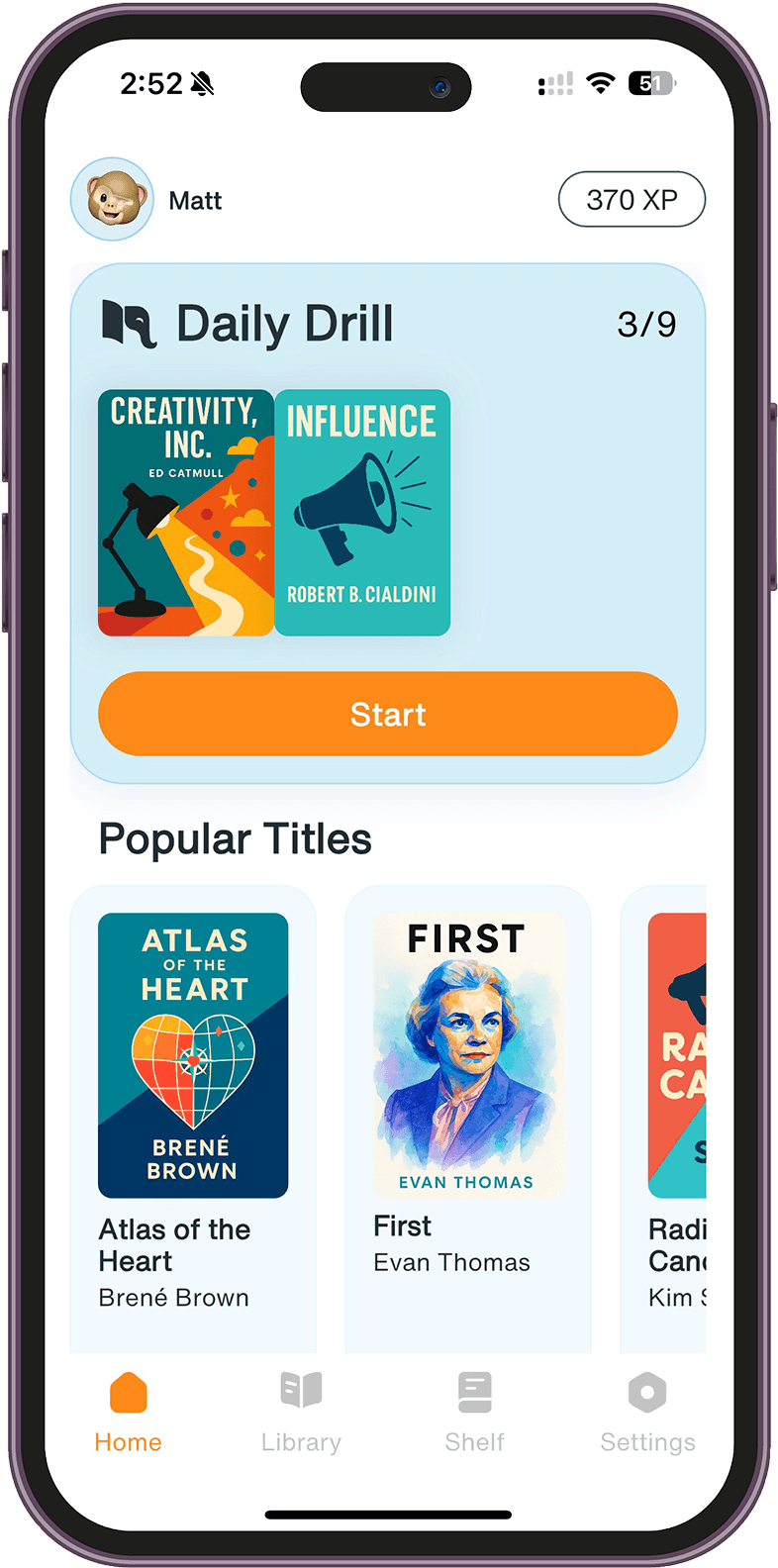
Loxie uses spaced repetition and active recall—the same techniques Brooks describes as essential for moral formation—to help you internalize concepts rather than just consume them. Instead of reading The Second Mountain once and watching its insights fade, you practice for 2 minutes a day with questions that resurface ideas right before you'd naturally forget them.
The distinction between résumé virtues and eulogy virtues becomes something you carry with you, available when you're weighing a promotion against family time. The framework for recognizing ego versus soul voices becomes a tool you actually use in moments of decision. Concepts move from interesting ideas you once read to lived wisdom that shapes how you navigate life.
Loxie includes The Second Mountain in its free topic library. You can start reinforcing these concepts immediately—turning Brooks's profound framework into durable knowledge that supports your own journey from the first mountain through the valley to the second.
Frequently Asked Questions
What is the main idea of The Second Mountain?
The central argument is that true fulfillment comes not from climbing the first mountain of personal success (career, wealth, status) but from descending through suffering into a valley and ascending a second mountain dedicated to commitments beyond yourself—to spouse, vocation, faith, and community. Only these sacred commitments create lasting moral joy.
What is the difference between the first and second mountain?
The first mountain is organized around résumé virtues—achievements, titles, and external success. The second mountain is organized around eulogy virtues—kindness, bravery, honesty, and deep commitment to others. First mountain people ask what they want from life; second mountain people ask what life is asking of them.
What are the four commitments on the second mountain?
Brooks identifies four domains of commitment that structure second mountain life: vocation (your life's work and calling), marriage and family (intimate relationships of mutual transformation), philosophy or faith (your ultimate framework for meaning), and community (the place and people you serve).
Why does Brooks say suffering is necessary?
Valley experiences—periods of loss, failure, or crisis—function as essential crucibles that burn away ego and create openness to transformation. Like controlled burns in forests, suffering clears dead growth to enable new life. It creates the humility and vulnerability required for genuine moral growth.
What is moral joy?
Moral joy is distinct from ordinary happiness. It's the deep satisfaction of living aligned with your deepest values even when it involves sacrifice and struggle. Second mountain people experience this joy not from circumstances but from the quality of their commitments and the meaning they create through self-donation.
How can Loxie help me remember what I learned from The Second Mountain?
Loxie uses spaced repetition and active recall to help you retain the key concepts from The Second Mountain. Instead of reading the book once and forgetting most of it, you practice for 2 minutes a day with questions that resurface ideas right before you'd naturally forget them. Loxie includes The Second Mountain in its full topic library.
We're an Amazon Associate. If you buy a book through our links, we earn a small commission at no extra cost to you.
Stop forgetting what you learn.
Start learning for good with your 7-day FREE trial.