The Tipping Point: Key Insights & Takeaways from Malcolm Gladwell
Discover how small changes trigger massive social epidemics—and learn the three rules that determine whether ideas spread or die.
by The Loxie Learning Team
Why do some ideas spread like wildfire while others fade into obscurity? Malcolm Gladwell's The Tipping Point reveals that social epidemics follow predictable patterns—and that small, targeted changes can trigger massive transformations when they reach a critical threshold. Understanding these patterns gives you a framework for spreading ideas, building movements, or stopping harmful behaviors in their tracks.
This guide breaks down Gladwell's complete framework for understanding how epidemics work. You'll learn about the three types of people who spark social contagion, the factors that make messages memorable, and why your environment shapes your behavior far more than you realize. Whether you're trying to launch a product, shift organizational culture, or simply understand why certain trends explode, these principles will change how you see the world.
 Start practicing The Tipping Point free for 7 days ▸
What is a tipping point and why does it matter?
A tipping point is the critical threshold where small changes accumulate until they trigger a dramatic, widespread transformation. Just as a single degree of temperature can turn water into steam, social phenomena can simmer at low levels for years before suddenly exploding into epidemics. This concept fundamentally challenges the assumption that big results require big causes—in reality, the right small change at the right moment can reshape entire industries, communities, or societies.
Gladwell draws on epidemiology to explain how ideas, products, and behaviors spread through populations the same way viruses do. An epidemic requires three things working together: an infectious agent, a susceptible population, and conditions favorable to transmission. Social epidemics work identically—the agent is your idea or behavior, the population is your target audience, and the conditions are the context in which people encounter your message. Understanding this parallel allows you to engineer contagion deliberately rather than hoping for lucky breaks.
The practical implication is profound: if you can identify which small changes will push a situation past its tipping point, you can create disproportionate impact with limited resources. This applies whether you're launching a startup, designing a public health campaign, or trying to change behavior within your own family. The key is recognizing that social epidemics are sensitive to initial conditions—the right intervention at the right moment matters more than massive efforts applied indiscriminately.
What are the three rules of epidemics?
The three rules that govern whether something tips into an epidemic are the Law of the Few, the Stickiness Factor, and the Power of Context. Each rule addresses a different dimension of contagion: who spreads the message, what makes it memorable, and where transmission occurs. Mastering all three gives you a complete toolkit for engineering social change—or understanding why certain phenomena spread while others don't.
The Law of the Few
The Law of the Few states that a small number of exceptional people are responsible for the vast majority of social contagion. Not everyone has equal influence in spreading ideas—a tiny fraction of highly connected, knowledgeable, or persuasive individuals act as super-spreaders who can ignite epidemics that ordinary people cannot. Identifying and recruiting these key individuals is often more effective than broadcasting your message to thousands of average people.
The Stickiness Factor
The Stickiness Factor addresses what makes a message memorable enough to spread. An idea might reach millions of people but fail to tip if nobody remembers it or acts on it. Stickiness often comes from small, seemingly trivial changes in presentation—the way information is structured, the emotional hooks it contains, or the specific words used to frame it. The most contagious messages aren't necessarily the cleverest; they're the ones that lodge in memory and compel action.
The Power of Context
The Power of Context reveals that human behavior is far more sensitive to environment than most people realize. The same person will act completely differently depending on the physical and social context they find themselves in. This means that changing circumstances—even in minor ways—can dramatically alter how people respond to messages and whether epidemics spread or stall. Context is as powerful as character in determining what people actually do.
Practice these concepts in Loxie ▸
Who are Connectors, Mavens, and Salesmen?
Connectors, Mavens, and Salesmen are the three types of exceptional people who spark social epidemics by spreading information through their unique gifts. Each type plays a distinct role in the contagion process, and understanding these roles helps you identify who to recruit when you want an idea to spread. Most successful epidemics involve all three types working in concert, with each contributing what the others lack.
What makes Connectors so powerful?
Connectors are people with an extraordinary ability to make friends and maintain relationships across diverse social worlds. Where most people cluster within tight-knit groups of similar others, Connectors bridge gaps between communities—linking together circles that would otherwise never interact. This bridging function is what makes them so valuable for spreading ideas: they create pathways for information to jump from one social cluster to another, reaching populations that would be inaccessible through normal channels.
The key to Connector power lies in their mastery of what sociologists call "weak ties." These are casual acquaintances rather than close friends—people you might see occasionally at parties or through mutual connections. While weak ties feel less important than close relationships, they're actually more valuable for spreading information because they reach into social circles you don't normally access. Connectors accumulate hundreds of these weak ties across different industries, neighborhoods, age groups, and subcultures, making them information superhighways.
What role do Mavens play in epidemics?
Mavens are people who accumulate specialized knowledge and share it enthusiastically to help others make better decisions. The word "maven" comes from Yiddish and means "one who accumulates knowledge." Unlike Connectors who spread information through their social reach, Mavens spread it through their credibility—they're the trusted experts that people consult before making purchases, trying new restaurants, or adopting new behaviors.
What distinguishes Mavens from ordinary experts is their motivation: they share information altruistically because helping others is intrinsically satisfying to them. They're not trying to sell anything or gain status—they genuinely want you to benefit from what they've learned. This selfless orientation is what makes them so trusted and influential. When a Maven recommends something, people listen because they know the recommendation isn't driven by ulterior motives.
How do Salesmen convert skeptics into believers?
Salesmen are individuals with natural persuasive abilities that allow them to convert skeptics into believers through subtle influence. While Connectors provide reach and Mavens provide credibility, Salesmen provide the final push that moves people from awareness to action. Their gift lies not in logical argument but in emotional contagion—the ability to transmit their own enthusiasm and conviction to others.
The secret of Salesman influence often operates below conscious awareness. Research on nonverbal synchrony shows that persuasive people naturally mirror and harmonize with those they're talking to, creating rapport through body language, facial expressions, and vocal patterns. This synchronization makes their targets feel understood and connected, which increases receptivity to their message. Salesmen don't manipulate through tricks; they influence through genuine emotional resonance that makes their convictions feel contagious.
What makes a message sticky and memorable?
Message stickiness comes from small changes in presentation and structure that align content with how human attention and memory actually work. A sticky message doesn't just reach people—it lodges in their minds and compels them to act. The difference between a message that fades immediately and one that changes behavior often comes down to seemingly trivial adjustments in wording, format, or delivery.
The counterintuitive insight about stickiness is that more information often reduces impact. Human attention is limited, and memory works by creating strong associations rather than storing raw data. Sticky messages succeed by being simple enough to remember, concrete enough to visualize, and emotionally resonant enough to care about. They often use stories, repetition, and interactive elements that force the audience to engage rather than passively receive.
Understanding stickiness has profound implications for anyone trying to teach, persuade, or create change. The natural instinct is to pack in more facts, more arguments, more evidence—but this often backfires by overwhelming the audience. The most effective communicators strip their message down to its sticky core and then present that core in ways that align with human cognitive architecture. This is why simple slogans often outperform sophisticated arguments, and why emotional stories often beat statistical evidence.
Understanding stickiness is one thing—making it stick is another
You might grasp why some messages are memorable, but will you remember these principles next time you're crafting a presentation or pitch? Loxie uses spaced repetition to turn your understanding of stickiness into lasting knowledge you can apply when it matters.
Start retaining what you learn ▸How does context shape behavior and spread epidemics?
Context shapes behavior because humans are far more sensitive to their surroundings than they realize, making environmental factors as powerful as personal character in determining actions. This insight, known as the Power of Context, challenges the common assumption that behavior flows primarily from personality traits or conscious decisions. In reality, subtle features of the immediate environment can dramatically increase or decrease the likelihood of specific behaviors.
The famous Broken Windows theory illustrates this principle: minor signs of disorder like graffiti, litter, and vandalism signal that nobody is watching and nobody cares, which invites more serious transgressions. When New York City aggressively addressed these "broken windows"—cleaning graffiti from subway cars, cracking down on fare-beating, fixing vandalism quickly—crime rates plummeted. The environment itself had been creating a context favorable to criminal behavior, and changing that context changed what people did.
The practical application is that if you want to change behavior, changing context is often more effective than trying to change people directly. Rather than lecturing people about why they should act differently, redesign the environment so the desired behavior becomes natural and the undesired behavior becomes difficult. This principle applies at every scale, from arranging your home to reduce bad habits to designing organizational systems that make ethical behavior the path of least resistance.
Why does group size affect behavior and social cohesion?
Group size fundamentally affects behavior because humans have cognitive limits on how many meaningful relationships they can maintain, creating natural thresholds for social cohesion. Beyond a certain size—roughly 150 people—groups lose the intimate knowledge and peer pressure that regulate behavior in smaller communities. This "Rule of 150" explains why companies, military units, and communities often become dysfunctional as they grow, and why successful organizations often deliberately limit group size.
The number 150 emerges from anthropological research on human brain capacity for social relationships. Maintaining genuine relationships requires remembering who people are, how they relate to others, and the history of your interactions. This requires significant cognitive resources, and there appears to be a hard limit around 150 people beyond which relationships become superficial. In groups smaller than 150, everyone knows everyone else well enough for reputation and peer pressure to regulate behavior. In larger groups, anonymity allows deviance to flourish.
Organizations that understand this principle structure themselves to preserve the benefits of small-group dynamics even as they scale. They might organize into autonomous units of 150 or fewer, create systems for maintaining personal connections across larger organizations, or accept that certain behaviors will change as groups grow past critical thresholds. Ignoring group size effects leads to predictable failures: the startup culture that disappears at scale, the community that becomes hostile to newcomers, the movement that loses cohesion as it gains followers.
How must ideas be translated to spread across different groups?
Ideas must be translated to spread across different groups because each social context has its own language, values, and communication styles that determine whether a message will be accepted or rejected. An idea that spreads virally within one community may fall completely flat in another—not because the idea is bad, but because it's expressed in ways that don't resonate with the new audience. Successful epidemic-starters understand that translation is as important as creation.
This translation function is often performed by people who straddle multiple social worlds—individuals fluent in the languages and values of different communities. They can take an idea from its origin context, understand its essence, and reframe it in terms that will resonate with new audiences. Without these translators, ideas remain trapped in their original communities no matter how compelling they are. This is why Connectors are so valuable: their diverse social networks give them practice in translation, making them natural bridges for ideas crossing community boundaries.
The implication for anyone trying to spread an idea is that a one-size-fits-all approach rarely works. You need to understand the specific communities you're targeting and either craft different versions of your message for each or recruit translators who can do this naturally. What feels like obvious truth to one group may need significant reframing before another group will even give it a hearing. Effective idea-spreaders are constantly adapting their message to their audience rather than assuming the right message will sell itself.
How can negative tipping points be reversed?
Negative tipping points can be reversed by identifying and disrupting the specific factors that make harmful behaviors contagious—whether it's changing the messenger, altering the message, or transforming the environment where transmission occurs. The same principles that allow positive epidemics to spread also govern negative ones, which means the three rules of epidemics become tools for intervention rather than just explanation.
The key insight is that negative epidemics are rarely driven by inevitable forces—they depend on specific conditions that can be changed. A drug epidemic might spread through particular Connectors who could be reached with alternative messages. Teen smoking might be sustained by specific contextual cues that could be redesigned. Crime might flourish because environmental signals suggest that disorder is acceptable. In each case, identifying the precise mechanism of contagion reveals intervention points that can halt or reverse the epidemic.
Reversing negative tipping points often requires counterintuitive thinking. The obvious response to a crime epidemic is more police and harsher sentences, but this addresses symptoms rather than contagion mechanisms. The Broken Windows approach worked in New York because it addressed the environmental signals that were permitting crime to spread. Similarly, addressing teen smoking might require understanding which specific people and contexts make smoking contagious to adolescents, rather than simply broadcasting anti-smoking messages to everyone.
How do you create a tipping point deliberately?
Creating tipping points requires concentrating limited resources on finding the right Connectors, crafting sticky messages, and identifying the specific contexts where change can spread—while constantly testing assumptions about what actually drives contagion. The goal is not to push harder with the same tactics but to find the precise leverage points where small efforts produce outsized results.
The first step is identifying which of the three rules is most relevant to your situation. Sometimes the limiting factor is reach—you haven't found the Connectors who can spread your message to new communities. Sometimes it's stickiness—people hear your message but don't remember or act on it. Sometimes it's context—the environments where people encounter your message aren't conducive to the behavior you want. Diagnosis comes before prescription: you need to understand why your idea isn't tipping before you can fix it.
The second principle is relentless testing. The specific factors that drive epidemics are often surprising and counterintuitive—small changes in wording, messenger, or context can have dramatic effects that you'd never predict in advance. Successful epidemic-engineers treat their assumptions as hypotheses to be tested rather than truths to be implemented. They run experiments, measure results, and adjust their approach based on what actually works rather than what should theoretically work. This iterative process is how you discover the small changes that make the difference between fizzling out and achieving liftoff.
Learn The Tipping Point for good ▸
The real challenge with The Tipping Point
Gladwell's framework is elegantly simple: find the right people, craft the right message, and change the right context. But understanding these concepts intellectually is vastly different from applying them when it matters. When you're actually trying to launch a product, shift organizational culture, or design an intervention, will you remember the specific mechanisms of Connector power, the principles of stickiness, or the subtleties of contextual influence?
Research on memory and learning reveals an uncomfortable truth: we forget most of what we read within days. The forgetting curve shows that without active reinforcement, you'll lose up to 70% of new information within 24 hours and up to 90% within a month. That brilliant insight about Mavens that felt so clear while reading? It's probably already fading. The nuanced understanding of the Broken Windows theory? Dissolving into vague recollection.
This isn't a character flaw—it's how human memory works. The brain prioritizes recent, repeated, and emotionally significant information. A single reading, no matter how engaging, rarely creates the kind of durable memory traces that make knowledge available when you need it. You might remember that The Tipping Point was a good book about how things spread, but the specific, actionable frameworks that make the book valuable will blur into generic concepts.
How Loxie helps you actually remember what you learn
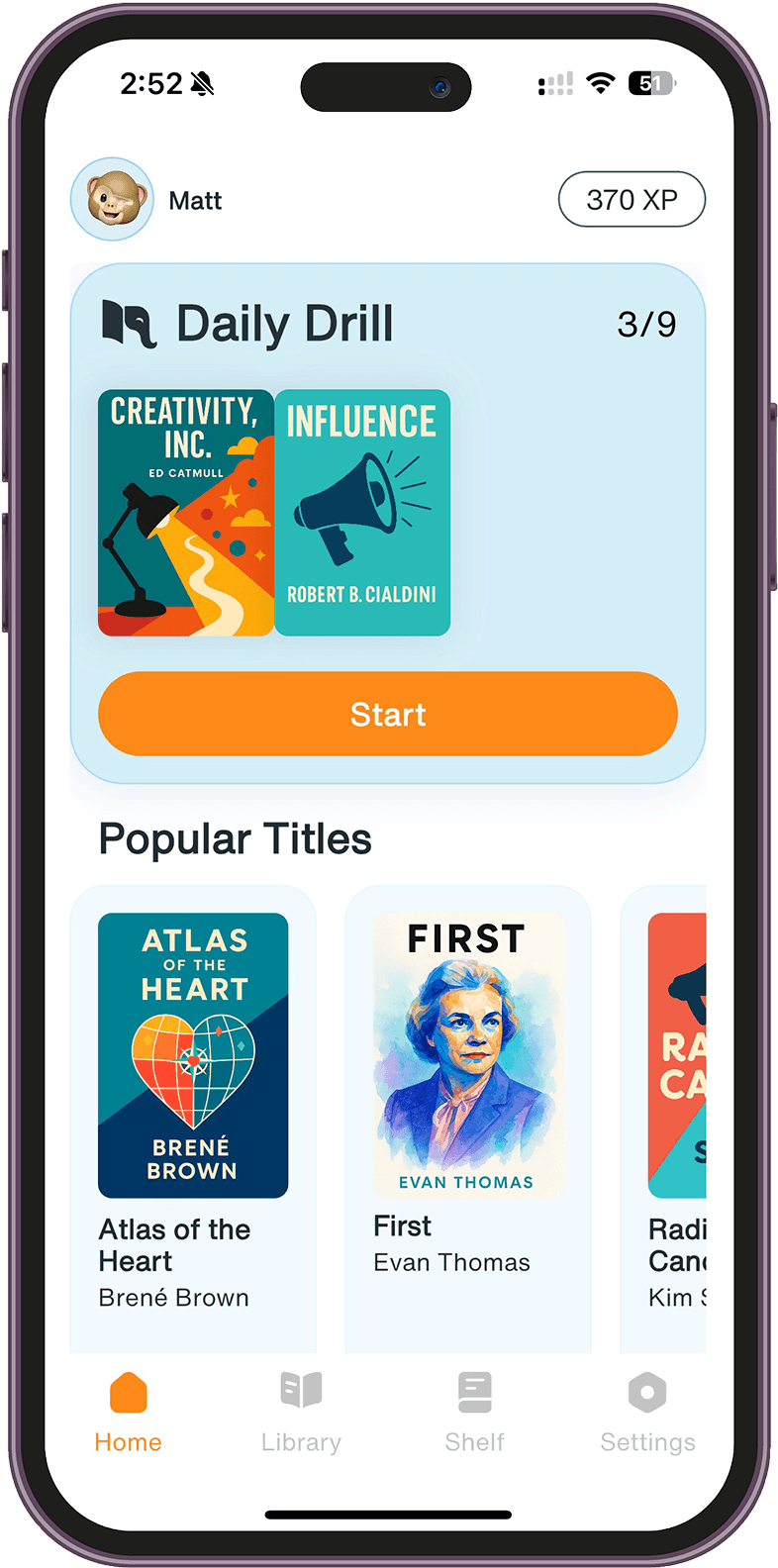
Loxie uses spaced repetition and active recall—the two most powerful learning techniques known to cognitive science—to help you retain the concepts from The Tipping Point and actually apply them in your work and life. Instead of reading the book once and watching your understanding fade, you practice for just 2 minutes a day with questions that resurface ideas right before you'd naturally forget them.
The science is simple: every time you successfully retrieve information from memory, that memory becomes stronger and more durable. Loxie's algorithm tracks what you know and what you're about to forget, then delivers precisely timed practice that maximizes retention with minimal time investment. You'll actually remember the difference between Connectors, Mavens, and Salesmen. You'll recall the three rules of epidemics when you're planning a campaign. The principles of stickiness will be available when you're crafting a message.
Loxie includes The Tipping Point in its full topic library, so you can start reinforcing these concepts immediately. Transform your reading from passive consumption into lasting knowledge that shapes how you think and act. Because understanding how epidemics work is only valuable if you remember it when you need to create one.
Frequently Asked Questions
What is the main idea of The Tipping Point?
The Tipping Point argues that ideas, products, and behaviors spread through society like epidemics, following predictable patterns that can be understood and leveraged. Malcolm Gladwell identifies three rules governing these social epidemics: the Law of the Few (exceptional people matter), the Stickiness Factor (memorable messages spread), and the Power of Context (environment shapes behavior).
What are the three types of people who spread epidemics?
Connectors are people with vast social networks who bridge different communities. Mavens accumulate specialized knowledge and share it to help others make decisions. Salesmen possess natural persuasive abilities that convert skeptics through emotional contagion. Together, these three types create the human infrastructure through which ideas spread.
What is the Stickiness Factor?
The Stickiness Factor refers to what makes a message memorable and compelling enough to spread. Sticky messages lodge in memory and prompt action. Stickiness often comes from small changes in presentation—the structure, emotional hooks, or specific wording—rather than the fundamental content. Simple, concrete, and emotionally resonant messages tend to stick best.
What is the Broken Windows theory?
The Broken Windows theory states that visible signs of disorder—like graffiti, vandalism, and broken windows—signal that nobody is watching, which invites more serious crimes. Addressing these minor issues can prevent larger problems by changing the contextual cues that permit antisocial behavior. New York City's crime reduction in the 1990s demonstrated this principle in action.
What is the Rule of 150?
The Rule of 150 states that groups larger than about 150 people cannot maintain the same level of personal connection and peer pressure that regulates behavior in smaller communities. This cognitive limit on meaningful relationships explains why organizations often become dysfunctional as they scale and why successful groups deliberately limit their size.
How can Loxie help me remember what I learned from The Tipping Point?
Loxie uses spaced repetition and active recall to help you retain the key concepts from The Tipping Point. Instead of reading the book once and forgetting most of it, you practice for 2 minutes a day with questions that resurface ideas right before you'd naturally forget them. Loxie includes The Tipping Point in its full topic library, so you can start reinforcing these concepts immediately.
We're an Amazon Associate. If you buy a book through our links, we earn a small commission at no extra cost to you.
Stop forgetting what you learn.
Start learning for good with your 7-day FREE trial.