The Whole-Brain Child: Key Insights & Takeaways
Master Daniel Siegel and Tina Payne Bryson's science-based strategies for raising emotionally intelligent, resilient children.
by The Loxie Learning Team
What if your child's next tantrum could actually build their brain? That's the revolutionary premise of The Whole-Brain Child by Daniel J. Siegel and Tina Payne Bryson. Rather than viewing meltdowns as problems to manage, the authors show how these challenging moments are opportunities to literally shape your child's developing neural architecture for better emotional regulation and lifelong resilience.
This guide breaks down the complete framework from The Whole-Brain Child, explaining the science behind why children behave the way they do and providing practical strategies you can use immediately. Whether you're dealing with toddler tantrums or teenage drama, understanding how different parts of the brain work together—or fail to—transforms how you respond to every difficult moment.
 Start practicing The Whole-Brain Child free for 7 days ▸
What is brain integration and why does it matter for children?
Brain integration is the coordination of different brain regions working together as a unified whole, and it's the key to mental health and emotional well-being according to Siegel and Bryson. When different parts of the brain aren't coordinating—a state called disintegration—children experience meltdowns, rigid thinking, and overwhelming emotions that seem irrational to adults but make perfect sense neurologically.
This framework gives parents a scientific lens for understanding behavior. A tantruming child isn't "being difficult" or "manipulating you"—they're experiencing temporary brain disintegration. Something has caused parts of their brain to stop communicating effectively, and specific parenting strategies can help reconnect those disconnected regions. This insight alone transforms how parents interpret and respond to challenging moments.
The power of this understanding is that it moves parents from reactive management to proactive brain-building. Every time you help a child's brain regions reconnect during a difficult moment, you're strengthening the neural pathways that make future integration easier. You're not just solving today's tantrum—you're building the architecture for tomorrow's emotional regulation.
How does neuroplasticity make everyday parenting moments matter?
The brain's neuroplasticity means that how parents respond to their children literally shapes the neural pathways being formed. Every interaction isn't just addressing an immediate problem—it's actively constructing the neural architecture that will determine how your child handles emotions, relationships, and challenges throughout their entire life.
This scientific insight is both empowering and sobering. It means that the small moments—how you respond when your child is frustrated, scared, or angry—have cumulative effects on brain development. Consistent patterns of response create consistent neural pathways. A parent who regularly helps a child calm down during emotional floods is building stronger connections between the emotional and logical brain regions.
The practical implication is that parenting becomes less about getting through difficult moments and more about using those moments strategically. Understanding neuroplasticity helps parents recognize that they're not just managing behavior—they're sculpting a brain. This reframe can help parents stay calmer during chaos, knowing that their patient response is having lasting developmental impact. Of course, remembering these principles in the heat of the moment is its own challenge—which is why practicing these concepts through spaced repetition with tools like Loxie ensures they're available when you need them most.
Practice these parenting strategies ▸
What is horizontal integration and how do you achieve it?
Horizontal integration refers to the coordination between the left and right hemispheres of the brain, and it's one of two primary types of integration Siegel and Bryson identify. The left brain handles logic, language, and linear thinking, while the right brain processes emotions, nonverbal cues, and the big picture. When these hemispheres aren't working together, children either get flooded with right-brain emotions they can't articulate or stuck in left-brain rigidity where everything must be a certain way.
Connect and redirect: The foundation strategy
The "connect and redirect" strategy is the cornerstone technique for horizontal integration. When a child is in emotional flood mode (right-brain hijacking), the logical left brain literally cannot engage. Attempting to reason with a child in this state—explaining why they shouldn't be upset, or what the logical consequences are—fails because the brain pathway to that logical processing is temporarily offline.
The solution is to first connect with the emotional right brain through empathy and validation. This means getting down to their level, using a calm voice, and acknowledging what they're feeling: "You're really upset. I can see how frustrated you are." This emotional attunement helps the right brain feel heard and understood, which naturally calms the emotional intensity. Only after this connection is established can you redirect with left-brain logic and problem-solving.
This sequence mirrors how the brain naturally processes intense emotions. Connection must come before correction. Empathy is the gateway to teaching. Parents who skip the connection step and jump straight to logic often find themselves in escalating power struggles because they're trying to engage a brain region that's currently inaccessible.
Name it to tame it: Using language to calm emotions
"Name it to tame it" is a powerful technique that leverages the brain's lateralization to transform overwhelming feelings into manageable experiences. When children verbally label their emotions—"I'm feeling angry" or "I'm scared"—they activate the left brain's language centers. This activation naturally calms the right brain's emotional intensity by engaging the integrative fibers that connect both hemispheres.
The technique works because putting feelings into words requires the logical left brain to engage with the emotional right brain, forcing a kind of collaboration that wouldn't happen otherwise. The act of articulating an emotion also creates distance from it—the child moves from being consumed by the feeling to observing and describing the feeling, which is inherently less overwhelming.
Parents can facilitate this by asking simple questions: "What's happening inside you right now?" or "Can you tell me what you're feeling?" Even for young children who lack vocabulary, parents can offer words: "It looks like you're feeling disappointed because we have to leave the park." Over time, children internalize this skill and begin spontaneously naming their emotions, building neural pathways for emotional regulation they'll use throughout life.
Addressing left-brain rigidity
Not all difficult behaviors stem from emotional overwhelm. Sometimes children get stuck in left-brain rigidity—demanding things be a certain way, unable to flex or adapt when plans change. In these moments, they need help accessing their right brain's flexibility through creativity, humor, or physical affection. This is the opposite of what's needed during right-brain emotional floods.
A child insisting their sandwich be cut in triangles, not squares, isn't necessarily having an emotional breakdown—they may be locked into rigid left-brain thinking. Rather than reasoning with them (which engages more left brain), parents can try playfulness: making the sandwich "talk," being silly about the shape situation, or offering a hug and physical connection. These interventions activate the right brain's creative, relational capacities and help break the rigid pattern.
Remember these strategies when you need them most
Knowing the difference between right-brain floods and left-brain rigidity is powerful—but only if you can recall it during a meltdown. Loxie uses spaced repetition to keep these distinctions fresh so you respond effectively when it matters.
Try Loxie free for 7 days ▸What is vertical integration and how does it explain meltdowns?
Vertical integration refers to the coordination between the "upstairs brain" (the prefrontal cortex, responsible for thinking, planning, and impulse control) and the "downstairs brain" (the brain stem and limbic regions, responsible for strong emotions and survival instincts like fight, flight, and freeze). When these regions aren't working together, the primitive downstairs brain can hijack behavior, overriding the thinking brain entirely.
The upstairs brain is under construction
A crucial biological reality that Siegel and Bryson emphasize is that the upstairs brain (prefrontal cortex) doesn't fully develop until the mid-twenties. This means children literally lack the brain architecture for consistent impulse control, emotional regulation, sound decision-making, and the ability to consider consequences. They're not choosing to be difficult—they're neurologically under construction.
This developmental reality reframes expectations and responses entirely. Instead of punishing children for lacking skills their brains haven't developed yet, parents can focus on building those neural connections through practice, patience, and scaffolding. A four-year-old who can't control their impulse to grab a toy isn't being defiant—their impulse control center is barely formed. A teenager who makes a poor decision in the heat of the moment isn't necessarily irresponsible—their prefrontal cortex is still under renovation.
Understanding this timeline helps parents hold appropriate expectations while still supporting development. The goal shifts from demanding mature behavior to creating opportunities for the upstairs brain to practice and strengthen—knowing that consistency and patience are building architecture that will eventually enable the self-regulation we're hoping to see.
Engage, don't enrage
When the downstairs brain hijacks a child, adding stress through punishment, yelling, or threats only intensifies the primitive response. The downstairs brain is designed for survival—when it perceives threat, it doubles down on fight, flight, or freeze. Traditional discipline approaches often backfire during these moments because they trigger more stress response rather than engaging the thinking brain needed for learning and behavior change.
The alternative is to engage the upstairs brain through calm presence. This doesn't mean permissiveness—it means recognizing that teaching can only happen when the upstairs brain is online. A calm voice, reduced stimulation, and patient waiting help the stress response settle so the prefrontal cortex can reengage. Only then can the child actually hear, process, and learn from what happened.
This approach requires parents to regulate their own stress response first. When a child is in full downstairs brain mode, the most powerful intervention is often a regulated adult nervous system. Children co-regulate with their caregivers—they borrow calm from adults who can provide it. This is why parental self-regulation isn't selfish; it's the foundation of effective intervention.
Exercise the upstairs brain
Just like a muscle, the upstairs brain gets stronger with exercise. Siegel and Bryson recommend giving children practice making decisions, considering consequences, and controlling impulses in low-stakes situations. This builds neural pathways through repetition, making the prefrontal cortex stronger and more accessible during challenging moments.
Practical exercises include letting children make age-appropriate choices ("Would you like to wear the blue shirt or the red shirt?"), discussing hypothetical scenarios ("What would you do if..."), and creating games that require impulse control (like Simon Says or freeze dance). The key is practicing when calm so the neural pathways are established before they're needed during stress.
This proactive approach treats executive function as a skill to be developed rather than a trait to be demanded. Children who have practiced decision-making and impulse control in playful contexts have stronger neural pathways to draw on when real challenges arise.
How do implicit memories affect children's behavior?
Implicit memories are unconscious emotional and sensory imprints from past experiences that can hijack behavior without the child—or parent—knowing why. Unlike explicit memories that we consciously recall ("I remember my fifth birthday party"), implicit memories operate below awareness, causing seemingly irrational fears, reactions, or behaviors that make perfect sense once the hidden memory is revealed.
A child who has an extreme reaction to a specific sound, smell, or situation is often responding to an implicit memory. Their brain is reacting as if a past experience is happening again in the present, triggering the same emotional and physical responses. Because the memory isn't conscious, the child can't explain why they're reacting this way—they just know something feels wrong or scary.
Understanding implicit memory helps parents respond with curiosity rather than frustration. Instead of dismissing a child's reaction as irrational, parents can gently explore what might be triggering the response. Often, making the connection between a current reaction and a past experience helps the child (and parent) make sense of what previously seemed inexplicable.
Tell and retell: Transforming memories through narrative
Helping children tell and retell the story of difficult experiences transforms implicit memories into explicit ones. This narrative process moves memories from the reactive amygdala to the hippocampus, where they can be processed, understood, and integrated rather than triggered unconsciously.
When children narrate a frightening or upsetting experience—what happened, how they felt, what they were thinking—they're literally reorganizing how that memory is stored in the brain. The process reduces the memory's emotional charge and gives children a sense of control over experiences that previously controlled them through unconscious activation.
Parents can facilitate this by asking gentle questions about past experiences, helping children fill in details, and revisiting the narrative over time. Each retelling integrates the memory more fully, reducing its power to hijack behavior. This is why children often want to hear the same story about a scary experience over and over—repetition is part of the integration process.
What is the wheel of awareness and how does it build resilience?
The wheel of awareness is a visual metaphor that teaches children their emotions are temporary states they experience, not permanent traits that define them. Imagine a bicycle wheel: the hub at the center represents the calm, observing part of the mind, while the rim contains all the different points of awareness—thoughts, feelings, sensations, memories. Children can visit different places on the rim but always return to the stable hub at the center.
This model gives children a concrete way to understand that they can feel angry without being an angry person, feel scared without being weak, feel sad without being broken. The separation of identity from emotional states creates psychological flexibility and resilience. Children learn that even the most intense feelings are visitors, not residents.
Parents can use the wheel of awareness during calm moments to help children understand the concept, then reference it during emotional experiences: "Right now you're visiting the angry part of the rim. Can you remember that you can always come back to the hub?" Over time, children internalize this framework and spontaneously use it to navigate difficult emotions.
Developing mindsight
Mindsight—the ability to see your own mind and understand others' minds—can be developed through simple exercises. Body scans, breathing awareness, and regular "feeling checks" build the metacognitive skills that underlie emotional intelligence. These practices strengthen the prefrontal cortex's ability to observe and regulate internal states.
A daily practice might be as simple as asking, "Where do you feel that emotion in your body?" or "Take three deep breaths and notice what happens inside." These micro-practices build neural pathways for self-awareness that compound over time. Children who regularly practice noticing their internal states become more skilled at recognizing, articulating, and managing emotions.
Importantly, mindsight isn't just about self-awareness—it extends to understanding others. Children who can observe their own minds develop the capacity to imagine what's happening in other minds. This is the foundation of empathy, perspective-taking, and healthy relationships throughout life.
Start retaining what you learn ▸
How does early attunement shape children's relationship abilities?
The "we map"—a child's understanding of relationships and social dynamics—develops through experiencing attunement with caregivers. When children's internal states are seen, shared, and soothed by another person, they learn that connection is possible and safe. This early experience forms the template for all future relationships.
Attunement means a caregiver accurately reads and responds to what the child is experiencing internally. When a parent notices a child is anxious and offers comfort, or recognizes excitement and shares in the joy, the child learns that their internal world can be understood by others. This creates the neural mapping for interpersonal connection that children will use throughout their lives—with friends, romantic partners, and eventually their own children.
Balancing "me" and "we"
Teaching children to maintain their own perspective while considering others' viewpoints builds differentiated relationships where connection and individuality coexist. Children need to learn they can be close to others without losing themselves, and maintain their identity without pushing others away.
This balance prevents both codependence (losing yourself in others' needs and perspectives) and isolation (dismissing others to protect yourself). Children who learn this balance can have meaningful disagreements without fear of abandonment, can support others without depleting themselves, and can be authentic while remaining connected.
Parents model this balance in how they relate to their children. Validating a child's perspective while also sharing your own shows that two different viewpoints can exist in the same relationship. Maintaining appropriate boundaries while staying warmly connected demonstrates that closeness doesn't require merging.
The real challenge with The Whole-Brain Child
The concepts in The Whole-Brain Child are genuinely transformative—when you can remember them. The challenge is that parenting happens in moments of stress, exhaustion, and emotional overwhelm. You're most likely to need "connect and redirect" or "engage, don't enrage" precisely when you're least likely to recall them.
Research on memory shows that we forget up to 70% of new information within 24 hours if we don't actively reinforce it. That means reading The Whole-Brain Child once—even taking notes—leaves most of these strategies unavailable when your toddler is screaming in the grocery store or your teenager slams their door for the third time today.
How many parenting books have you read that felt life-changing in the moment but faded into vague recollections? The gap between understanding a concept and having it available during a challenging moment is the gap between insight and actual behavior change.
How Loxie helps you actually remember what you learn
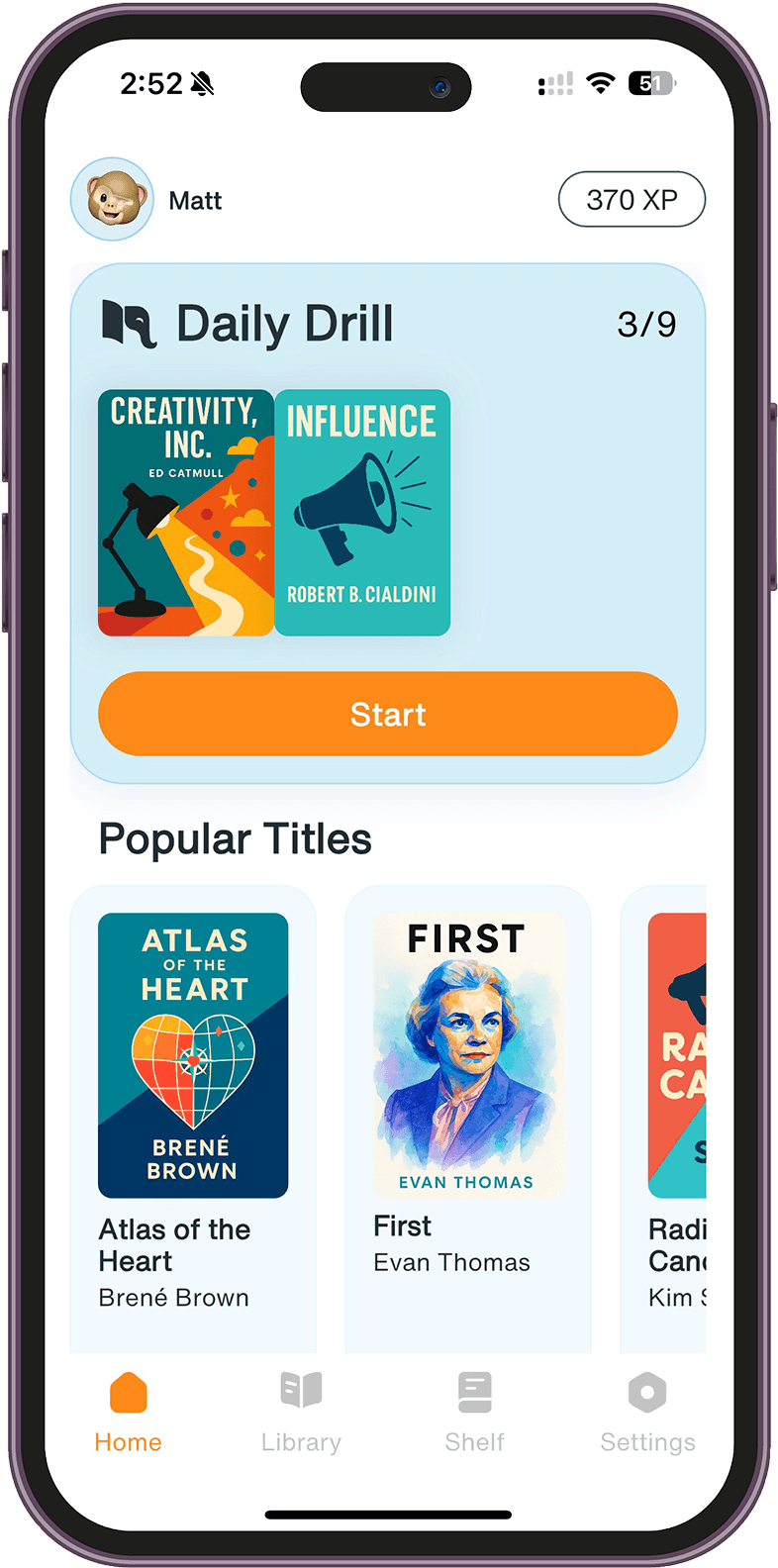
Loxie uses spaced repetition and active recall—the same techniques proven by cognitive science to transfer knowledge into long-term memory. Instead of reading these concepts once and hoping they stick, you practice for just 2 minutes a day with questions that resurface ideas right before you'd naturally forget them.
The result is that concepts like horizontal integration, vertical integration, "name it to tame it," and the wheel of awareness become genuinely available when you need them. You move from "I read something about this once" to "I know exactly what to do right now." That's the difference between consuming information and actually learning it.
Loxie includes The Whole-Brain Child in its full topic library, so you can start reinforcing these parenting strategies immediately. Build the neural pathways you need to help your child build theirs.
Frequently Asked Questions
What is the main idea of The Whole-Brain Child?
The central idea is that children's challenging behaviors like tantrums and meltdowns occur when different brain regions aren't working together (disintegration), and parents can use specific strategies to help these regions reconnect (integration). This transforms difficult moments from problems to manage into opportunities to build a child's emotional intelligence and resilience.
What are the key strategies from The Whole-Brain Child?
Key strategies include "connect and redirect" (first empathize, then teach), "name it to tame it" (verbally labeling emotions calms them), and "engage, don't enrage" (staying calm when a child is in fight-or-flight mode). The book provides 12 total strategies organized around horizontal integration (left-right brain) and vertical integration (upstairs-downstairs brain).
What is the difference between the upstairs brain and downstairs brain?
The upstairs brain is the prefrontal cortex, responsible for thinking, planning, impulse control, and emotional regulation. The downstairs brain includes the brain stem and limbic regions, handling strong emotions and survival responses like fight, flight, and freeze. The upstairs brain doesn't fully develop until the mid-twenties, which is why children struggle with consistent self-regulation.
What does "connect and redirect" mean in The Whole-Brain Child?
Connect and redirect means first connecting with a child's emotional right brain through empathy and validation before redirecting with left-brain logic and problem-solving. This sequence works because a child in emotional overwhelm can't access logical thinking until they feel heard and understood—empathy is the gateway to teaching.
What is the wheel of awareness?
The wheel of awareness is a metaphor for understanding emotions: the calm, observing part of the mind is the hub at the center, while thoughts, feelings, and sensations are points on the rim. Children learn that they visit different emotions on the rim but can always return to the stable hub—feelings are temporary states, not permanent identities.
How can Loxie help me remember what I learned from The Whole-Brain Child?
Loxie uses spaced repetition and active recall to help you retain the key concepts from The Whole-Brain Child. Instead of reading the book once and forgetting most of it during stressful parenting moments, you practice for 2 minutes a day with questions that resurface ideas right before you'd naturally forget them. Loxie includes The Whole-Brain Child in its full topic library.
We're an Amazon Associate. If you buy a book through our links, we earn a small commission at no extra cost to you.
Stop forgetting what you learn.
Start learning for good with your 7-day FREE trial.