The Willpower Instinct: Key Insights & Takeaways
Master Kelly McGonigal's science-backed strategies for strengthening self-control and achieving lasting behavioral change.
by The Loxie Learning Team
Why do we sabotage our own goals? Why does resisting one temptation make it harder to resist the next? Kelly McGonigal's The Willpower Instinct answers these questions by revealing the neuroscience and psychology behind self-control. The book's central insight is liberating: willpower isn't a fixed personality trait you're born with—it's a learnable skill that strengthens with understanding and practice.
This guide breaks down McGonigal's complete framework for mastering self-control. You'll learn why willpower fails, what triggers those failures, and specific strategies proven to work. Whether you're fighting procrastination, breaking bad habits, or pursuing ambitious goals, understanding how willpower actually operates in your brain transforms the struggle.
 Start practicing Willpower Instinct free for 7 days ▸
What are the three powers of willpower?
Willpower consists of three distinct capacities that work together: "I will" power (the ability to do difficult but necessary things), "I won't" power (the ability to resist temptation), and "I want" power (the ability to remember your long-term goals when short-term impulses strike). Most people think of willpower only as resisting temptation—the "I won't" power—but McGonigal shows that all three powers require attention and strengthening.
The "I want" power is often the most neglected and most powerful. When you clearly connect today's choices to what you genuinely want for your future, resisting temptation becomes less about deprivation and more about pursuing what matters most. This reframing shifts willpower from a battle against yourself to an alignment with your deeper values.
Understanding these three powers helps you diagnose where your willpower breaks down. Some people are strong at "I won't" but weak at "I will"—they can resist the cookie but can't make themselves exercise. Others struggle with "I want," losing sight of long-term goals when immediate rewards appear. Loxie helps you internalize these distinctions through spaced repetition, so when willpower challenges arise, you can identify which power needs strengthening.
Why is self-awareness the foundation of willpower?
Self-awareness is the prerequisite for all willpower improvements because you cannot change behaviors you don't notice happening. Most willpower failures occur on autopilot—you've eaten half the bag of chips before consciously realizing you started. McGonigal emphasizes that the moment of choice often passes without conscious awareness, making the decision feel like it happened to you rather than something you chose.
Building self-awareness means learning to catch yourself in the moments before automatic behaviors take over. This includes noticing what triggers your impulses, recognizing the physical sensations of craving, and observing the rationalizations your mind generates to justify indulgence. The goal isn't to judge these patterns but simply to see them clearly.
This is where many readers struggle after finishing the book. The concept of self-awareness sounds simple, but developing the habit of noticing requires consistent practice. Loxie reinforces these awareness-building strategies through regular review, helping you remember to apply them when you need them most—in the heat of a willpower challenge.
How does willpower work like a muscle?
Willpower operates like a muscle that becomes temporarily depleted after use but grows stronger with regular training and adequate recovery. This explains why you might resist unhealthy food all day but cave at night, or why a stressful workday leaves you vulnerable to impulse purchases. Each act of self-control draws from the same limited pool of mental energy.
The muscle model has practical implications. First, willpower depletion is temporary—sleep, relaxation, and positive emotions restore it. Second, you can train willpower through practice, gradually building capacity like building physical strength. Third, knowing your limits helps you structure your day strategically, tackling your hardest willpower challenges when your reserves are full.
Practice these concepts in Loxie ▸
What is the pause-and-plan response?
The pause-and-plan response is willpower's biological signature—the body's alternative to fight-or-flight that enables self-control. While fight-or-flight prepares you to react quickly to external threats, pause-and-plan prepares you to handle internal conflicts. Your heart rate slows, your breathing deepens, and brain activity shifts to the prefrontal cortex for better decision-making.
This response can be deliberately activated. Slowing your breathing to four to six breaths per minute triggers the pause-and-plan state, giving your prefrontal cortex time to override impulsive reactions. Physical exercise, adequate sleep, and stress reduction all enhance your capacity for this response by keeping your physiological baseline in a state ready for self-control rather than survival mode.
McGonigal's research shows that people with higher heart rate variability—a measure of the body's ability to shift between states—demonstrate stronger willpower across various challenges. This isn't fixed; practices like meditation and exercise increase heart rate variability over time, physically building your capacity for self-control.
How does stress undermine self-control?
Stress undermines self-control by triggering fight-or-flight responses that shut down the prefrontal cortex and prioritize immediate survival over long-term goals. When you're stressed, your brain shifts resources away from rational decision-making toward quick, instinctive reactions. This is why a difficult day at work leads to impulsive eating, drinking, or spending—your brain is seeking immediate relief.
The cruel irony is that the relief strategies stress triggers—comfort food, alcohol, shopping, procrastination—often create more stress, forming a vicious cycle. You feel stressed, so you indulge; you feel guilty about indulging, which creates more stress, which triggers more indulgence. Breaking this cycle requires recognizing stress as a willpower warning sign rather than a permission slip.
Effective stress management isn't about eliminating stress—it's about preventing stress from hijacking your self-control systems. Exercise, sleep, social connection, and relaxation practices all buffer the impact of stress on willpower. McGonigal emphasizes that what matters isn't avoiding stressful situations but having reliable stress-recovery strategies.
The stress-willpower connection is easy to forget in the moment
Loxie helps you internalize these patterns through spaced repetition, so you recognize stress triggers before they derail your self-control.
Try Loxie free for 7 days ▸What is delay discounting and why does it matter?
Delay discounting is the brain's tendency to value a smaller reward now more than a larger reward later—causing us to prefer $20 today over $100 next month, even though the math clearly favors waiting. This neurological quirk explains why we choose immediate gratification over future benefits, even when we know better intellectually.
The discounting is steep. Studies show that people often value a reward six months away at less than half its face value compared to the same reward available immediately. This means your brain is essentially running a different calculation than your rational mind. Future-you seems like a stranger whose interests matter less than present-you's desires.
Understanding delay discounting transforms how you approach willpower challenges. Rather than relying on raw resistance, you can use strategies that make future rewards feel more immediate: visualizing your future self in detail, connecting today's choices to tomorrow's consequences, and reducing the psychological distance between present and future.
How can you strengthen your connection to your future self?
Writing letters to your future self, visualizing specific future scenarios, and imagining how future-you will feel about today's choices makes delayed rewards feel more immediate and strengthens long-term motivation. Research shows that people who feel more connected to their future selves make better financial, health, and career decisions because future consequences feel real rather than abstract.
The key is specificity. Vague thoughts about "being healthier someday" don't activate the brain's motivation systems. But vividly imagining yourself at a specific future event—how you'll look, feel, and what you'll be doing—bridges the psychological gap between present and future. Your future self stops being a theoretical stranger and becomes someone you're actively helping.
McGonigal recommends thinking about your willpower challenges from your future self's perspective. Ask: "How will I feel tomorrow about what I do today?" This simple question shifts the frame from immediate desire to future consequence, engaging your "I want" power and reducing the pull of delay discounting.
What is the dopamine gap between wanting and liking?
Dopamine drives the wanting and craving for rewards but not the actual satisfaction or liking, creating a neurological gap between desire and fulfillment that fuels addictive behaviors. Your brain releases dopamine in anticipation of pleasure, not during the actual experience. This means you can crave something intensely that doesn't actually make you happy when you get it.
This distinction is crucial for understanding why willpower fails. The promise of reward—the anticipation of checking social media, eating junk food, or buying something new—triggers a powerful motivational state. But the actual experience rarely delivers the satisfaction the craving promised. You eat the cookie but don't feel fulfilled; you scroll for an hour but feel worse than before.
Recognizing the dopamine gap helps you respond differently to cravings. Instead of assuming the craving indicates genuine need or that satisfying it will bring real pleasure, you can observe the craving as a neurological event—your brain anticipating reward—without treating it as a command to act. This awareness creates space for choice.
What is moral licensing and how does progress become self-sabotage?
Moral licensing occurs when good behavior paradoxically creates permission to indulge because we feel we've earned it. Progress becomes an excuse for self-sabotage when we use past good behavior to justify present indulgences, creating a cycle where success undermines itself. You resist temptation all morning, so you "deserve" to indulge at lunch.
The problem is treating willpower challenges as moral tests where good behavior earns credits that can be cashed in for bad behavior. This transforms self-control into a bargaining system rather than a commitment to your goals. McGonigal found that people who felt proud of their progress were more likely to indulge than those who simply noted their progress without self-congratulation.
The antidote is remembering why you're pursuing your goal in the first place. When progress triggers thoughts of earned indulgence, reconnect with your "I want" power—your genuine motivation for change. Frame past success as evidence of who you're becoming, not as payment toward future misbehavior.
What is the what-the-hell effect?
The what-the-hell effect escalates single mistakes into complete failures when initial guilt triggers shame-based thinking that abandons all self-control rather than returning to the goal. You eat one cookie, feel guilty, think "I've already blown it," and proceed to eat the whole box. A small slip becomes a total collapse.
This effect is driven by negative emotions, not by the initial mistake itself. The guilt and self-criticism following a slip feel so uncomfortable that your brain seeks immediate relief through more indulgence. You're not eating the rest of the cookies because you want them—you're eating to escape the bad feelings about eating the first one.
Breaking the what-the-hell cycle requires changing how you respond to failure. The mistake has already happened; what matters is what you do next. Treating yourself with understanding rather than harsh criticism removes the emotional trigger that escalates small slips into major setbacks.
Why does self-compassion strengthen willpower more than self-criticism?
Self-compassion strengthens willpower more effectively than self-criticism because it reduces stress and shame that trigger impulsive behaviors. Contrary to the belief that being hard on yourself motivates change, research shows that self-criticism increases anxiety, depression, and—paradoxically—the very behaviors you're trying to change.
Self-compassion isn't self-indulgence or making excuses. It means treating your failures with the same understanding you'd offer a friend while still maintaining your commitment to your goals. This approach reduces the negative emotions that fuel the what-the-hell effect and emotional eating, spending, or other stress-driven behaviors.
McGonigal presents compelling evidence that people who practice self-compassion after setbacks recover faster, try again sooner, and are more likely to succeed long-term. They don't give up because they haven't layered shame on top of failure. A slip is just a slip—data to learn from, not evidence of permanent inadequacy.
Start retaining what you learn ▸
Why does thought suppression backfire?
Trying not to think about chocolate cake activates brain monitoring systems that paradoxically keep the forbidden thought active, creating ironic rebound effects that make cravings stronger and self-control failures more likely. The instruction "don't think about X" requires your brain to continuously check whether you're thinking about X—which keeps X in mind.
This ironic process theory explains why telling yourself not to think about food, not to worry, or not to crave a cigarette often intensifies those very thoughts. The harder you try to suppress, the stronger the rebound. Studies show that people who try to suppress thoughts about food eat more afterward than those who simply notice the thoughts without fighting them.
The alternative isn't giving in to every thought but rather observing thoughts without trying to control them. When a craving arises, notice it, name it ("I'm having a craving for cake"), and let it exist without either acting on it or fighting it. This acceptance-based approach removes the fuel that ironic rebound effects need.
How do acceptance-based strategies reduce cravings?
Acceptance-based strategies like acknowledging cravings without judgment, surfing the urge wave, and mindful observation reduce the power of unwanted thoughts and impulses more effectively than fighting them. Rather than trying to suppress or overcome cravings, you let them be present while choosing not to act on them.
Urge surfing is a particularly powerful technique. Cravings, like waves, rise, peak, and eventually fall—usually within fifteen minutes if you don't feed them. By observing the craving with curiosity rather than resistance, you can ride the wave until it subsides. Each time you surf an urge successfully, you build confidence that cravings aren't commands.
This approach requires a fundamental shift from seeing willpower as a battle to seeing it as an observation. You're not at war with your impulses; you're simply choosing not to act on them while accepting they exist. This reduces the stress and mental effort that fighting creates, preserving willpower resources for when you really need them.
How is self-control contagious?
Self-control is contagious through mirror neurons that automatically copy the goals, emotions, and behaviors we observe in others, making willpower challenges easier or harder depending on our social environment. When you see someone exercising self-control, your brain primes the same patterns. When you see someone indulging, your brain mirrors that too.
This social contagion extends beyond direct observation. Research shows that if your friend's friend's friend gains weight, your risk of gaining weight increases—even if you've never met them. Behaviors and norms ripple through social networks, shaping what feels normal and acceptable. Your willpower doesn't exist in isolation; it's embedded in your social context.
McGonigal recommends strategically managing your social environment for willpower challenges. Seek out people who embody the self-control you're working to develop. Think about your challenges in terms of group norms—"what would people like me do?"—rather than individual willpower. And recognize that your own self-control, or lack of it, affects the people around you.
How do negative emotions trigger willpower failure?
Negative emotions like stress, anxiety, and shame trigger impulse behaviors and poor decisions because the brain seeks immediate relief through reward-seeking, creating a vicious cycle. When you feel bad, your brain's reward system activates, promising that food, shopping, drinking, or other indulgences will make you feel better. This promise is largely false, but in the moment it feels compelling.
The false promise of relief is key. Dopamine responds to the anticipation of mood improvement, not actual mood improvement. After indulging, most people don't feel better—they feel guilty on top of whatever they were feeling before. But the brain doesn't update its prediction easily; next time you feel bad, it will offer the same failed solution.
Breaking this cycle requires developing alternative responses to negative emotions. Exercise, social connection, meditation, and creative activities genuinely improve mood without the guilt hangover. The challenge is remembering to use these strategies when you're in the grip of negative emotions—which is where consistent practice and reinforcement matter.
How can willpower challenges become opportunities for growth?
Willpower challenges become opportunities for self-awareness and growth when approached with curiosity rather than self-criticism, transforming failures into valuable data about triggers, patterns, and effective strategies. Every slip reveals something about your particular vulnerabilities—information you can use to design better approaches.
This experimental mindset changes your relationship with failure. Instead of seeing a willpower lapse as evidence of weakness, you see it as data: "I notice I always give in after stressful meetings" or "My willpower collapses when I haven't slept well." These observations become the foundation for targeted strategies—preparing for post-meeting temptation or prioritizing sleep before challenging days.
McGonigal emphasizes that sustainable change requires treating yourself as a scientist studying your own behavior, not a judge evaluating your worth. Each challenge is an experiment; each outcome provides feedback. This approach maintains motivation through setbacks and generates the self-knowledge that makes lasting change possible.
The real challenge with The Willpower Instinct
Here's the uncomfortable truth: reading The Willpower Instinct won't change your behavior any more than reading about exercise will make you fit. McGonigal's strategies are powerful, but only when you can access them in the moment of temptation. How many books have you read that felt transformative but whose insights faded within weeks?
The forgetting curve is real. Within a month, you'll forget 80% of what you learned—including the specific techniques for handling cravings, the warning signs of moral licensing, and the strategies for connecting with your future self. When the next willpower challenge hits, you'll be working from memory fragments rather than clear understanding.
This isn't a character flaw; it's how human memory works. The solution isn't to re-read the book every month. It's to practice retrieving these concepts regularly, strengthening the neural pathways that make them accessible when you need them.
How Loxie helps you actually remember what you learn
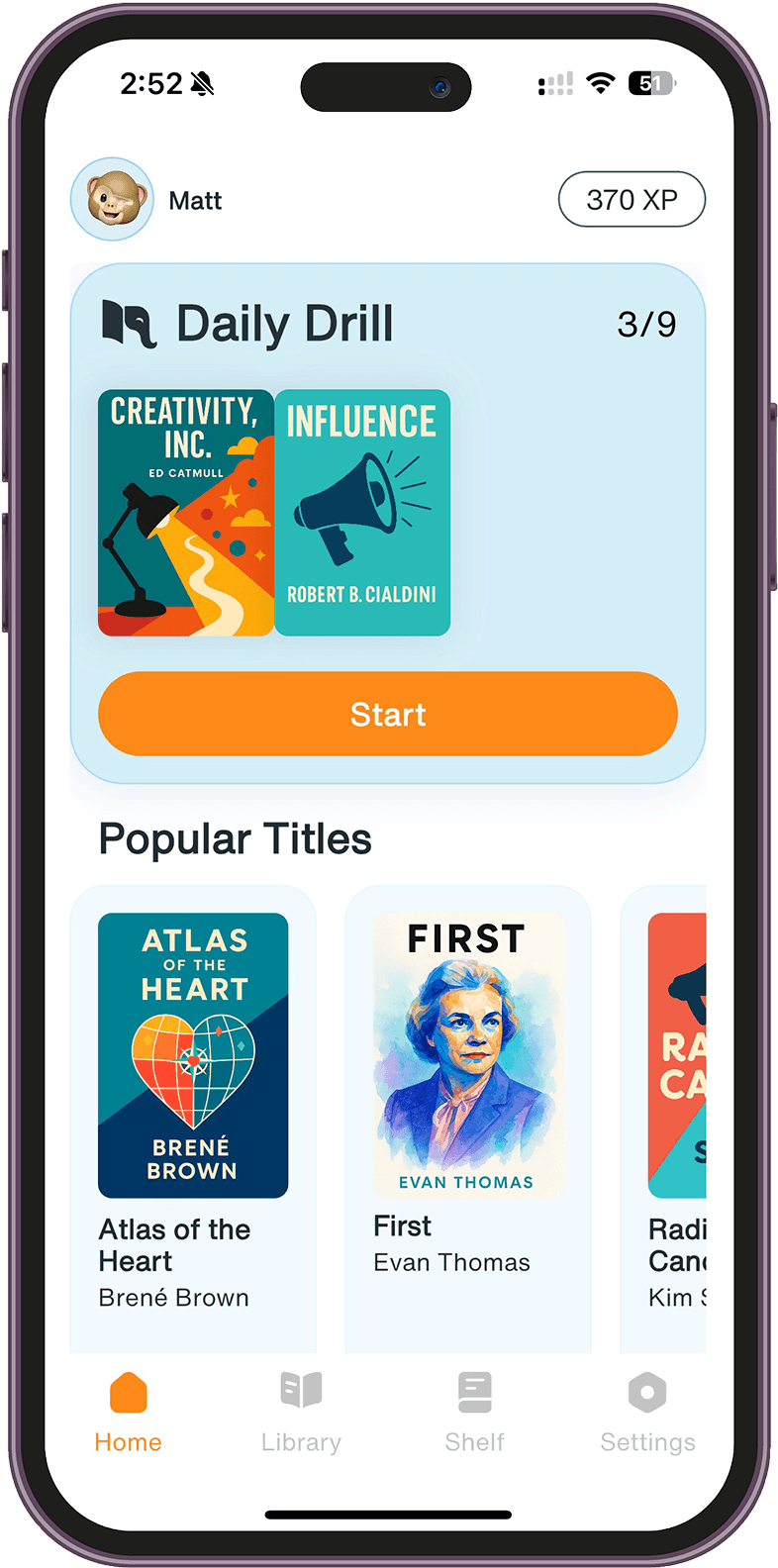
Loxie uses spaced repetition and active recall—the same science McGonigal applies to habit formation—to help you retain what you've learned. Instead of passively hoping you'll remember the three powers of willpower or the danger of moral licensing, you actively practice retrieving these concepts on a schedule optimized for long-term memory.
The practice takes just 2 minutes a day. Questions resurface right before you'd naturally forget them, strengthening retention with minimal time investment. Over time, concepts like urge surfing, the pause-and-plan response, and self-compassion strategies become genuinely accessible—not just ideas you once read about.
Loxie includes The Willpower Instinct in its full topic library. You can start reinforcing these concepts immediately, transforming a book you read into knowledge you actually use when willpower challenges arise.
Frequently Asked Questions
What is the main idea of The Willpower Instinct?
The central argument is that willpower is a learnable skill, not a fixed trait. Kelly McGonigal presents the three powers of willpower (I will, I won't, I want) and shows how understanding the neuroscience of self-control enables you to strengthen it through specific, evidence-based strategies like self-awareness, stress management, and self-compassion.
What are the three powers of willpower?
The three powers are "I will" (the ability to do difficult but necessary things), "I won't" (the ability to resist temptation), and "I want" (the ability to remember your long-term goals). All three require attention and strengthening, though most people focus only on "I won't" and neglect the others.
What is the what-the-hell effect?
The what-the-hell effect occurs when a single mistake escalates into complete abandonment of self-control. Initial guilt triggers shame-based thinking ("I've already blown it"), which causes you to give up entirely rather than recovering from a small slip. Self-compassion prevents this effect by removing the shame that fuels it.
Why does trying not to think about something make you think about it more?
Thought suppression activates brain monitoring systems that paradoxically keep the forbidden thought active. Your brain must constantly check whether you're thinking about X, which maintains X in awareness. Acceptance-based strategies—noticing thoughts without fighting them—work better than suppression.
How does stress affect willpower?
Stress triggers fight-or-flight responses that shut down the prefrontal cortex and prioritize immediate survival over long-term goals. This makes you vulnerable to impulse behaviors as your brain seeks quick relief. Managing stress through exercise, sleep, and relaxation practices protects your willpower capacity.
How can Loxie help me remember what I learned from The Willpower Instinct?
Loxie uses spaced repetition and active recall to help you retain the key concepts from The Willpower Instinct. Instead of reading the book once and forgetting most of it, you practice for 2 minutes a day with questions that resurface ideas right before you'd naturally forget them. Loxie includes The Willpower Instinct in its full topic library, so you can start reinforcing these concepts immediately.
We're an Amazon Associate. If you buy a book through our links, we earn a small commission at no extra cost to you.
Stop forgetting what you learn.
Start learning for good with your 7-day FREE trial.