The Wisdom of Your Body: Key Insights & Takeaways
Discover Hillary L. McBride's transformative framework for healing trauma and finding wholeness through embodied awareness.
by The Loxie Learning Team
What if your body knows things your mind has forgotten? Hillary L. McBride's The Wisdom of Your Body makes a radical claim: the path to healing trauma, developing authentic relationships, and finding wholeness runs not through thinking harder, but through befriending your physical self. In a culture that treats bodies as machines to optimize or obstacles to overcome, this represents a fundamental shift in how we approach wellbeing.
This guide breaks down McBride's complete framework for embodied healing—from understanding why we disconnect from our bodies to practical approaches for rebuilding that relationship with compassion. Whether you've experienced trauma, struggle with chronic disconnection, or simply want to live more fully in your own skin, you'll discover why the body holds wisdom the mind alone cannot access.
 Start practicing Body Wisdom free for 7 days ▸
What does it mean that the body holds wisdom the mind cannot access?
The body stores information that conscious thought cannot reach—trauma memories, emotional patterns, and intuitive knowledge that exists below the level of language. When you feel a "gut instinct" about someone or notice your shoulders tensing in a meeting, your body is communicating something your rational mind hasn't yet processed. This isn't mysticism; it's neuroscience. The body's nervous system constantly scans the environment for safety and threat, making split-second assessments that inform behavior long before conscious awareness catches up.
McBride argues that Western culture has spent centuries privileging rational thought over bodily knowing, treating the mind as master and the body as servant. This philosophical inheritance—traceable from Descartes through modern productivity culture—creates a fundamental problem: we're taught to override the very source of information we need for genuine healing and connection. Understanding trauma, processing emotions, and developing authentic relationships all require integrating embodied experience rather than transcending it.
For those working to heal from difficult experiences, this insight transforms the approach. Instead of trying to think your way to wholeness, you learn to listen to the language of sensation, emotion, and embodied memory. Loxie helps reinforce this paradigm shift through spaced repetition, ensuring that the conceptual framework for embodiment becomes second nature rather than a fleeting insight from reading.
Why does reconnecting with your body require gentleness rather than force?
Reconnecting with your body after trauma or cultural conditioning requires approaching yourself with the patience and gentleness you would offer a frightened child. The body remembers everything—not just explicit memories but the felt sense of danger, betrayal, or abandonment—and will only open when it feels safe. Aggressive attempts to "fix" the relationship often recreate the very patterns of violence or disconnection that caused the original rupture.
This principle has profound practical implications. If you've been taught to push through pain, ignore hunger, or suppress emotions, your body has learned that you're not a safe person to be vulnerable with. Rebuilding that trust happens through repeated small acts of listening and honoring—pausing when tired, eating when hungry, allowing tears when sad—rather than dramatic interventions or intensive retreats.
McBride emphasizes that this patient approach isn't weakness or self-indulgence. It's the only path that actually works. Just as you cannot force a frightened animal to trust you, you cannot bully your own nervous system into feeling safe. The body has its own timeline for opening, and respecting that timeline is the fastest route to genuine embodiment. Loxie's daily practice format aligns perfectly with this philosophy—small, consistent engagement rather than sporadic intensive effort.
Practice these concepts in Loxie ▸
How do cultural narratives that separate mind from body prevent healing?
Cultural narratives that divide us into separate minds and bodies don't just reflect poor philosophy—they actively prevent healing by severing us from the information we need to understand our trauma, emotions, and authentic needs. When society teaches that rational thought is superior and bodily sensations are unreliable or dangerous, it delegitimizes the primary channel through which we receive crucial data about our wellbeing.
This problem intensifies for marginalized communities. When embodied experiences of oppression—the hypervigilance of walking while Black, the tension of navigating spaces as a woman, the exhaustion of masking as a neurodivergent person—get dismissed as "irrational" or "oversensitive," real suffering becomes invisible. The mind-body split doesn't just harm individuals; it serves as a tool of social control, invalidating the lived experiences of those whose bodies register injustice the dominant culture wants to ignore.
Recognizing how deeply embedded these narratives are helps explain why body reconnection feels so countercultural. You're not just changing personal habits; you're swimming against centuries of cultural programming. This is why having frameworks and language for embodiment matters so much—they provide conceptual tools for resisting forces that constantly push toward disconnection. Loxie helps make these counter-narratives stick by reinforcing them through regular practice.
What's the difference between "having a body" and "being a body"?
The linguistic shift from "I have a body" to "I am a body" represents a fundamental reconceptualization of selfhood. Ownership language ("my body," "my legs," "my stomach") implies a hierarchical relationship where a separate "I" possesses and controls a physical object. Identity language recognizes that consciousness emerges from and through our physical being—there is no ghost in the machine, just one integrated self.
This isn't merely semantic. When you "have" a body, you can punish it for failing to meet standards, ignore its signals as inconvenient, or treat it as a vehicle for achieving mind-generated goals. When you "are" a body, these behaviors become forms of self-harm. The shift moves you from domination to partnership, from forcing to collaborating, from transcending the physical to honoring it as the ground of all experience.
McBride notes that this linguistic transformation changes everything from how we exercise (with the body rather than against it) to how we eat (according to internal signals rather than external rules) to how we rest (as genuine need rather than earned reward). Every moment of daily life offers opportunities to practice this reframe.
The challenge of embodiment isn't understanding—it's remembering
Reading about the shift from "having" to "being" a body creates an insight. But that insight fades within days unless actively reinforced. Loxie uses spaced repetition to resurface these concepts right before you'd forget them, turning intellectual understanding into embodied knowing.
Try Loxie free for 7 days ▸How does religious purity culture create comprehensive body distrust?
Religious purity culture doesn't just create shame about sexuality—it teaches fundamental distrust of all bodily sensations, framing the body as inherently dangerous, deceptive, and requiring constant vigilance. When the body is positioned as the source of sin, temptation, and moral failure, learning to override its signals becomes a spiritual practice. The "flesh" must be subdued by the "spirit."
This teaching extends far beyond sexual shame. Those raised in purity culture often struggle to identify hunger and fullness cues, recognize fatigue as a signal to rest, trust emotional responses, or set boundaries based on discomfort. If your body is fundamentally untrustworthy, every sensation becomes suspect. The result is comprehensive disconnection that undermines basic self-care and makes healthy relationships difficult—you cannot trust others' bodies if you cannot trust your own.
McBride, drawing on her own background in religious communities, emphasizes that healing from purity culture requires not just intellectual rejection of its theology but patient rewiring of nervous system patterns that developed over years. The body learned that its signals meant danger; it must now learn that its signals mean wisdom. This kind of deep reconditioning benefits enormously from repetition and reinforcement over time.
Why is body distrust in marginalized communities not just psychological but adaptive?
Systemic oppression specifically targets the body. Racism, sexism, ableism, and other forms of discrimination are enacted through physical violence, medical neglect, and environmental harm. When your body has been the site of violation, exploitation, or systematic disregard, disconnecting from it isn't pathology—it's protection. Body distrust in marginalized communities represents a rational response to real danger.
This reframe is crucial for healing work. Rather than treating disconnection as individual dysfunction to be corrected, we must recognize it as protective adaptation to ongoing threat. For someone whose body continues to face discrimination in healthcare settings, hypervigilance from police encounters, or exhaustion from code-switching, telling them to "just trust their body" ignores the context that makes distrust genuinely useful for survival.
Healing approaches for marginalized people must therefore address both personal trauma and systemic threats. It's not enough to regulate the individual nervous system when the environment remains dangerous. This dual focus—internal work alongside external awareness—represents a more honest and ultimately more effective path to embodiment that neither blames individuals for adaptive responses nor ignores the real possibility of reconnection.
Start retaining what you learn ▸
How does trauma reshape the nervous system's baseline?
Trauma isn't just remembered by the body—it fundamentally reshapes the nervous system's baseline, creating a new "normal" where hypervigilance, dissociation, or collapse feel safer than embodied presence. After overwhelming experiences, the nervous system recalibrates its threat detection settings, essentially lowering the bar for what triggers a survival response. What once felt like safety now feels like danger; what once felt like alertness now feels like calm.
This neurobiological understanding explains why cognitive approaches alone often fail to resolve trauma. You can understand intellectually that you're safe while your body continues operating from survival programming that bypasses conscious thought. The amygdala doesn't care what your prefrontal cortex believes—it will continue firing alarm signals based on patterns learned during traumatic experiences until the nervous system itself is recalibrated.
Effective trauma healing must therefore work at the level of the nervous system, not just the level of belief. This involves practices that directly engage the body: breathing exercises that shift physiological state, movement that completes interrupted survival responses, and safe relational connection that teaches the nervous system new patterns of regulation. Understanding this framework helps you approach trauma healing with appropriate tools rather than wondering why "just thinking differently" isn't working.
Why is dissociation during trauma brilliant rather than dysfunctional?
Dissociation from the body during trauma isn't weakness or dysfunction—it's a brilliant protective mechanism that allows survival when fight or flight aren't possible. When escape from overwhelming threat is blocked, the nervous system has one remaining option: leave the body while staying in it. Consciousness splits off, pain perception diminishes, and the psyche is preserved even as the body endures what it cannot flee.
Honoring dissociation as adaptive rather than pathological fundamentally changes the approach to trauma healing. Instead of forcing reconnection—which often recreates the violation of autonomy that caused disconnection in the first place—we begin by gratefully acknowledging the protection dissociation provided. This isn't enabling avoidance; it's creating the safety necessary for genuine return.
The healing journey involves gently inviting the nervous system to recognize current safety while respecting its right to disconnect when needed. Rushing this process or shaming dissociative responses only reinforces the message that the body is a dangerous place to be. For those who learned to leave their bodies to survive, every moment of safe embodied presence represents a victory—and building these moments gradually, with compassion, creates lasting change.
How are emotions embodied events rather than mental constructs?
Emotions are embodied events, not mental constructs. They begin as physical sensations—racing heart, tight chest, clenched jaw, churning stomach—that the brain interprets and labels based on context and past experience. The feeling we call "anxiety" starts as activation in the body; the feeling we call "sadness" starts as heaviness and slowing. Emotional labels come after, not before, physical sensation.
This somatic view of emotion has profound implications for emotional intelligence. If emotions live in the body first, then talking about feelings without attending to their physical components will often fail to resolve them. You can analyze your anxiety endlessly without ever addressing the chronic tension in your shoulders that both expresses and maintains it. Conversely, body-based practices—deep breathing, movement, physical release—can shift emotional states more effectively than cognitive reframing alone.
Learning to track the physical signatures of different emotions becomes a crucial skill. Where do you feel anger in your body? What does grief feel like in your chest? How does joy express itself in your posture and breath? These aren't abstract questions but practical inquiries that develop emotional fluency through embodied attention. Loxie can help reinforce the framework and vocabulary for this kind of somatic emotional awareness.
Why is pleasure a biological necessity rather than a luxury?
Pleasure is not a luxury, reward for good behavior, or indulgence to feel guilty about—it's a biological necessity that regulates the nervous system, promotes healing, and connects us to our aliveness and capacity for joy. The systematic denial of pleasure in productivity culture creates chronic stress states that actively undermine health, while regular experiences of sensory delight activate parasympathetic healing responses essential for wellbeing.
This represents a radical reframe for anyone raised to view pleasure with suspicion. When enjoyment is positioned as frivolous or dangerous, we cut ourselves off from one of the body's primary healing mechanisms. The relaxation response triggered by pleasure—whether through delicious food, beautiful surroundings, loving touch, or joyful movement—creates physiological conditions that support immune function, tissue repair, and nervous system regulation.
McBride emphasizes that reclaiming pleasure doesn't require dramatic lifestyle changes. Small moments of sensory delight—savoring tea, feeling sunlight, enjoying soft fabric against skin—can gradually rewire a nervous system trained for survival into one capable of experiencing safety and delight. These micro-practices create cumulative shifts, slowly building capacity for joy in bodies that have learned to expect only threat or numbness.
How does movement heal trauma beyond burning calories?
Movement is medicine not because of calories burned or muscles built, but because it literally moves trauma through and out of the body, completing stress cycles that otherwise remain frozen in tissues. When a threatening situation activates fight-or-flight responses, the body prepares for physical action. If that action is blocked or the threat continues without resolution, the mobilized energy gets stuck, creating patterns of chronic tension, numbness, or dysregulation.
This understanding transforms exercise from punishment or obligation into healing practice. Dancing, shaking, stretching, or any movement that feels good helps discharge accumulated stress and trauma that talking alone cannot release. The specific form matters less than whether it allows the body to complete its interrupted survival responses—running to escape, pushing to fight, trembling to discharge frozen energy.
Different emotional states may call for different movements. Anger might need vigorous punching or stomping to complete its action tendency. Grief might call for gentle rocking or swaying. Fear might release through shaking or running. Trauma-informed movement starts with agency—invitations rather than instructions, internal sensation over external form, always preserving the right to stop, modify, or rest. The goal is restoring the body's wisdom, not overriding it.
What is co-regulation and why does healing require connection?
Co-regulation is the process by which calm nervous systems help dysregulated ones find balance. Our nervous systems aren't isolated units but constantly influence each other—being near someone who is genuinely grounded and present can shift your own state more powerfully than any technique you might try alone. This biological reality of nervous system contagion means relationships are essential, not optional, for embodiment work.
This insight challenges the individualistic bias in much self-help literature. While personal practices matter, healing happens fundamentally through safe, attuned connection with other regulated bodies. A therapist's calm presence, a friend's steady breathing, a partner's regulated heartbeat—these aren't nice additions to healing but core mechanisms by which nervous systems learn new patterns of safety and connection.
The flip side is also true: dysregulated nervous systems affect others. Understanding co-regulation helps explain why certain relationships feel draining while others feel nourishing, why some environments create tension while others create ease. Building a life that supports embodiment means intentionally seeking connection with people whose nervous systems model the regulation you're working to develop.
How do you practice embodied self-compassion?
Self-compassion isn't just a mental attitude—it requires physically softening toward yourself through gentle touch, soothing voice tones, and the same comforting gestures you would offer a beloved friend in distress. The body doesn't distinguish between comfort from self or other, meaning we can activate our own caregiving system through self-touch, self-holding, and speaking to ourselves with genuine warmth.
This translates into concrete practices. Placing a hand on your heart when you're struggling. Wrapping your arms around yourself when you're sad. Speaking to yourself in the tone you'd use with someone you love. These aren't silly or self-indulgent—they literally trigger physiological responses that reduce stress hormones and activate calm. Your nervous system responds to caring touch regardless of its source.
McBride notes that the inner critic often speaks in voices of past caregivers or cultural messages. Recognizing these internalized external voices allows you to question whose standards you're enforcing on yourself. The harsh inner voice isn't your authentic self-awareness but adopted shame—and you can learn to respond to criticism with the same embodied compassion you'd offer any suffering person.
The real challenge with The Wisdom of Your Body
Reading about embodiment creates understanding. But the forgetting curve is merciless—within a week, you'll retain perhaps 20% of these insights. Within a month, even less. The detailed frameworks for nervous system healing, the precise distinctions between dissociation as adaptation versus pathology, the specific practices for embodied self-compassion—all fade back into vague impressions.
This creates a frustrating pattern many readers recognize. You finish the book feeling transformed, convinced your relationship with your body will never be the same. Three months later, you're back to old patterns, able to remember that you read something important about embodiment but unable to recall the specifics that made it actionable. How many books have you read that felt life-changing but now sit on shelves, their wisdom inaccessible?
How Loxie helps you actually remember what you learn
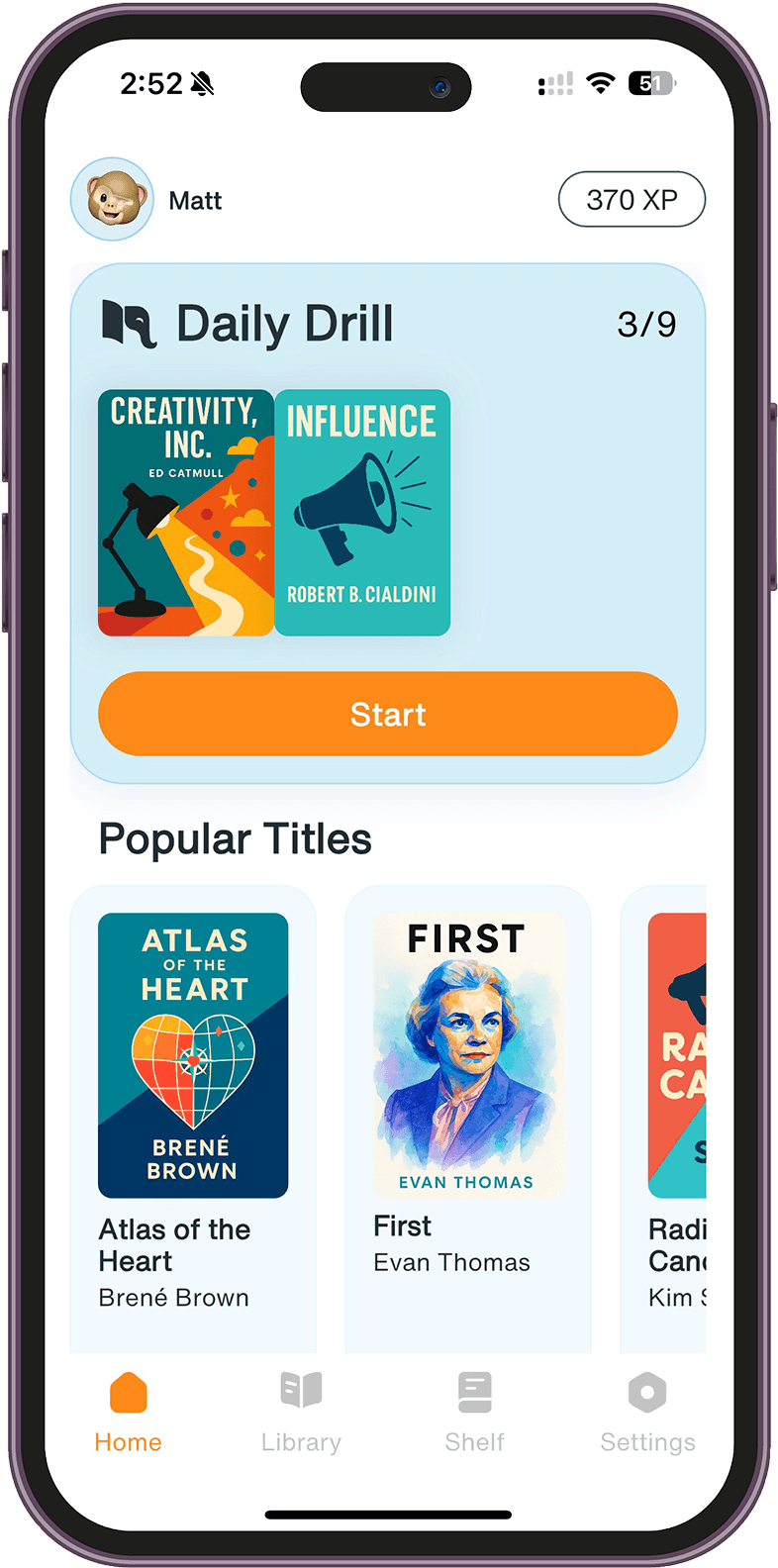
Loxie uses spaced repetition and active recall—the two most scientifically validated learning techniques—to help you genuinely retain what matters from The Wisdom of Your Body. Instead of reading once and hoping insights stick, you practice for just 2 minutes daily with questions that resurface concepts right before you'd naturally forget them.
The process is simple: Loxie presents a question about embodiment principles, you recall the answer, and the algorithm schedules your next review based on how well you remembered. Concepts you know well appear less frequently; concepts you struggle with appear more often. Over time, McBride's framework becomes genuinely yours—available when you need it, not locked in a book you can't quite remember reading.
Loxie includes full access to this book and hundreds of others in the topic library. No trial period, no credit card required. If embodied wisdom matters to you, why not actually remember it?
Frequently Asked Questions
What is the main idea of The Wisdom of Your Body?
The central argument is that the body holds wisdom the mind cannot access—healing from trauma and finding wholeness requires befriending your physical self rather than trying to think your way to wellbeing. McBride challenges the Western separation of mind and body, showing how reconnection with embodied experience is the path to genuine transformation.
What are the key takeaways from The Wisdom of Your Body?
Key takeaways include: you don't "have" a body, you "are" a body; trauma reshapes the nervous system's baseline and requires body-based healing; emotions are physical events before they're mental labels; pleasure is a biological necessity for healing; and co-regulation with other calm nervous systems is essential for embodiment work.
How does trauma affect the body according to Hillary McBride?
Trauma reshapes the nervous system's baseline, creating a new "normal" where hypervigilance, dissociation, or collapse feel safer than presence. The body remembers trauma and continues operating from survival programming that bypasses conscious thought until the nervous system itself is recalibrated through embodied practices—not just cognitive understanding.
What is co-regulation and why is it important for healing?
Co-regulation is the process by which calm nervous systems help dysregulated ones find balance. Because nervous systems constantly influence each other, being near someone grounded and present can shift your state more powerfully than solo techniques. This makes safe, attuned relationships essential—not optional—for embodiment and healing work.
What does it mean to be a body rather than have a body?
The shift from "having" to "being" a body transforms your relationship with physical experience from domination to partnership. Ownership language implies a hierarchy where mind controls body; identity language recognizes consciousness emerges through physical being, making embodiment essential to selfhood rather than something to transcend.
How can Loxie help me remember what I learned from The Wisdom of Your Body?
Loxie uses spaced repetition and active recall to help you retain the key concepts from The Wisdom of Your Body. Instead of reading the book once and forgetting most of it, you practice for 2 minutes a day with questions that resurface ideas right before you'd naturally forget them. Loxie includes this book in its full topic library.
We're an Amazon Associate. If you buy a book through our links, we earn a small commission at no extra cost to you.
Stop forgetting what you learn.
Start learning for good with your 7-day FREE trial.